


In this article, we’ll take a fantastic journey through the basics of Italian. You’ll learn everything you need to start speaking Italian: from the alphabet to the most important verbs, from numbers to the days of the week. Are you ready? Let’s get started!
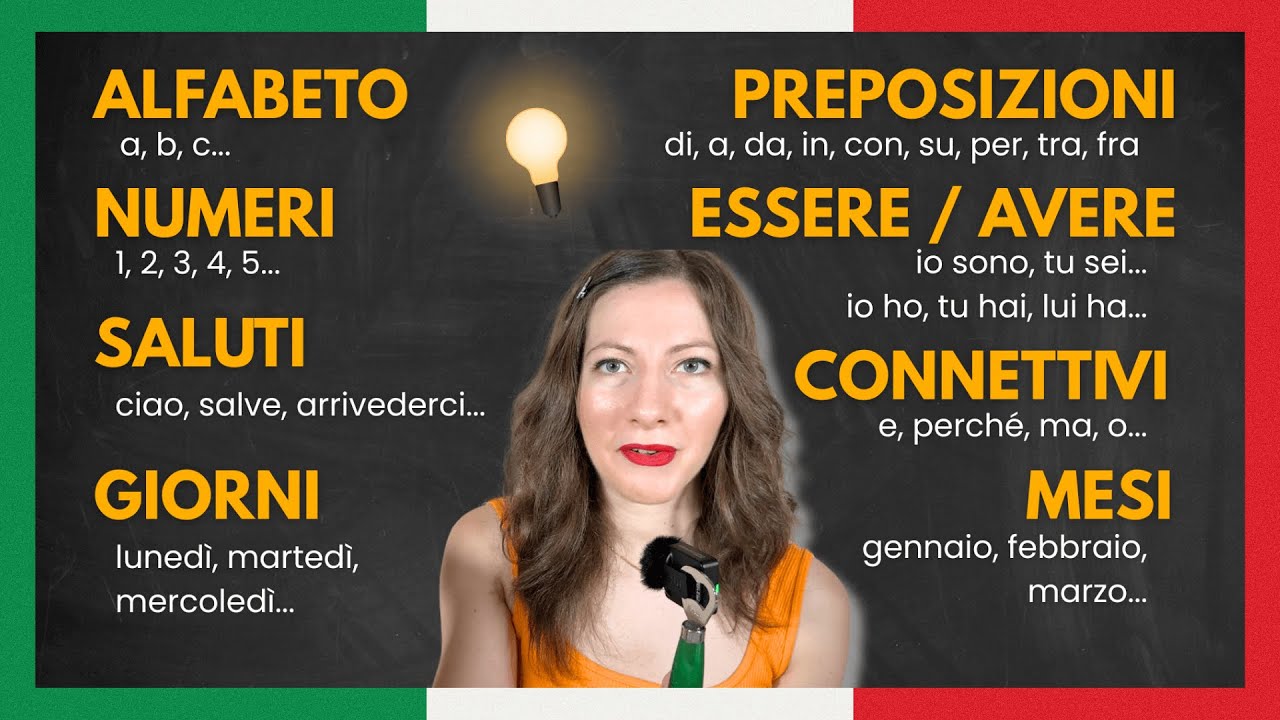
Everything You Need to Know to Start Speaking Italian
The Italian Alphabet
Italian has 21 letters in the standard alphabet. This characteristic makes learning Italian pronunciation simpler and more regular.
| Complete Italian Alphabet |
| A – B – C – D – E – F – G – H – I – L – M – N – O – P – Q – R – S – T – U – V – Z |
Pronunciation of the Most Difficult Letters
| Letter | Pronunciation Rule | Examples |
|---|---|---|
| C | + E/I = soft sound [ch] + A/O/U = hard sound [k] | ciao [hello], cinema [cinema] casa [house], come [how/like], cuore [heart] |
| G | + E/I = soft sound [g] + A/O/U = hard sound [gh] | gelato [ice cream], giro [turn] gatto [cat], gol [goal], gusto [taste] |
| H | Always silent – NEVER pronounced | hotel [hotel], ho [I have], hai [you have] |
Important: The letters J, K, W, X, Y are foreign letters that Italian uses only for words of foreign origin like “jeans“, “weekend“, “taxi“, “extra“, “yoga“.
Numbers in Italian
Numbers are fundamental for communicating in any language. In Italian they follow precise rules that, once understood, make everything simpler.
Numbers from 0 to 20
| Number | Italian | Number | Italian |
|---|---|---|---|
| 0 | zero | 11 | undici |
| 1 | uno | 12 | dodici |
| 2 | due | 13 | tredici |
| 3 | tre | 14 | quattordici |
| 4 | quattro | 15 | quindici |
| 5 | cinque | 16 | sedici |
| 6 | sei | 17 | diciassette |
| 7 | sette | 18 | diciotto |
| 8 | otto | 19 | diciannove |
| 9 | nove | 20 | venti |
| 10 | dieci |
Tens and Large Numbers
| Ten | Italian | Large Number | Italian |
|---|---|---|---|
| 30 | trenta | 100 | cento |
| 40 | quaranta | 1.000 | mille |
| 50 | cinquanta | 1.000.000 | un milione |
| 60 | sessanta | 2.000.000 | due milioni |
| 70 | settanta | 1.000.000.000 | un miliardo |
| 80 | ottanta | 2.000.000.000 | due miliardi |
| 90 | novanta |
Trick for compound numbers: To form numbers like 21, 35, 47, you join the ten to the single number. The ten loses its last letter if the single number starts with a vowel (ventuno [twenty-one], trentotto [thirty-eight]). Compound numbers with 3 always take an accent (ventitré [twenty-three], cinquantatré [fifty-three]).
Days of the Week
The days of the week in Italian have fascinating origins and follow specific rules for the use of articles and prepositions.
| Day | Origin | Characteristics |
|---|---|---|
| lunedì [Monday] | Day of the Moon | Starts the work week |
| martedì [Tuesday] | Day of Mars | Planet of war |
| mercoledì [Wednesday] | Day of Mercury | Planet of commerce |
| giovedì [Thursday] | Day of Jupiter | Main planet |
| venerdì [Friday] | Day of Venus | Planet of love |
| sabato [Saturday] | From Latin “sabbatum” | Weekend |
| domenica [Sunday] | Day of the Lord | Day of rest |
Important rules: Days of the week in Italian never start with a capital letter (except at the beginning of a sentence). Il fine settimana [the weekend] is masculine in Italian!
Prepositions with Days
| Form | Use | Example |
|---|---|---|
| “Il lunedì” | Every Monday (habitually) | “Il lunedì vado in palestra” [On Mondays I go to the gym] |
| “Lunedì” | This specific Monday | “Lunedì ho un appuntamento” [Monday I have an appointment] |
| “Di lunedì” | On Mondays as a habit | “Di lunedì sono sempre stanco” [On Mondays I’m always tired] |
Months of the Year
Months in Italian derive from the Roman calendar and have specific characteristics regarding the use of prepositions.
| Month | Season | Month | Season |
|---|---|---|---|
| gennaio [January] | Winter | luglio [July] | Summer |
| febbraio [February] | Winter | agosto [August] | Summer |
| marzo [March] | Spring | settembre [September] | Autumn |
| aprile [April] | Spring | ottobre [October] | Autumn |
| maggio [May] | Spring | novembre [November] | Autumn |
| giugno [June] | Summer | dicembre [December] | Winter |
Important: Months in Italian always start with a lowercase letter (except at the beginning of a sentence). The preposition used with months is always “A”: a ottobre [in October], a settembre [in September], a luglio [in July].
Personal Pronouns
Personal pronouns are essential for building sentences in Italian. Unlike other languages, in Italian they can often be omitted because the verb already indicates who performs the action.
| Person | Singular | Plural | When to use |
|---|---|---|---|
| First | io [I] | noi [we] | Who is speaking |
| Second | tu [you] | voi [you pl.] | Who you’re speaking to (informal) |
| Second formal | Lei (capital) [You] | Loro [You pl.] | Respect and courtesy |
| Third | lui/lei [he/she] | loro [they] | Who you’re speaking about |
When to use pronouns: Normally in Italian they are omitted (“Sono italiano” [I am Italian] instead of “Io sono italiano“), but they are used for emphasis (“Vado IO!” [I’M going!]) or for contrast (“IO sono italiano, TU sei tedesco” [I am Italian, YOU are German]).
The Verbs Essere and Avere
Essere and avere are the most important verbs in Italian. They are used both on their own and as auxiliary verbs to form compound tenses.
Present Tense Conjugation
| Pronoun | ESSERE | AVERE | Usage examples |
|---|---|---|---|
| io | sono [am] | ho [have] | Sono italiana [I am Italian] / Ho fame [I am hungry] |
| tu | sei [are] | hai [have] | Sei bravo [You are good] / Hai 20 anni [You are 20 years old] |
| lui/lei/Lei | è [is] | ha [has] | È dottore [He/She is a doctor] / Ha una macchina [He/She has a car] |
| noi | siamo [are] | abbiamo [have] | Siamo a casa [We are at home] / Abbiamo fretta [We are in a hurry] |
| voi | siete [are] | avete [have] | Siete simpatici [You are nice] / Avete ragione [You are right] |
| loro | sono [are] | hanno [have] | Sono francesi [They are French] / Hanno sete [They are thirsty] |
Main Uses of the Verb ESSERE
| Use | Explanation | Examples |
|---|---|---|
| Identity | Who we are | “Io sono Marco” [I am Marco], “Lei è Maria” [She is Maria] |
| Nationality | Where we come from | “Sono italiano” [I am Italian], “È francese” [He/She is French] |
| Profession | What job we do | “Sono dottore” [I am a doctor], “È insegnante” [He/She is a teacher] |
| Characteristics | What something/someone is like | “Il gatto è nero” [The cat is black], “Sei intelligente” [You are intelligent] |
| Time | What time it is | “Sono le tre” [It’s three o’clock], “È mezzogiorno” [It’s noon] |
| Location | Where something is located | “Maria è a casa” [Maria is at home], “Siamo in Italia” [We are in Italy] |
Main Uses of the Verb AVERE
| Use | Explanation | Examples |
|---|---|---|
| Possession | Owning something | “Ho una macchina” [I have a car], “Hai un cane” [You have a dog] |
| Age | How old we are | “Ho 25 anni” [I am 25 years old] (NOT “sono 25 anni“!) |
| Physical sensations | How we feel | “Ho fame” [I am hungry], “Hai sete” [You are thirsty], “Abbiamo freddo” [We are cold] |
| Body parts | Describing physical appearance | “Ho gli occhi blu” [I have blue eyes], “Hai i capelli lunghi” [You have long hair] |
| Emotions | States of mind | “Ho paura” [I am afraid], “Hai fretta” [You are in a hurry], “Abbiamo voglia” [We feel like] |
Stop reading Italian.
Start speaking it.
Online lessons in groups of 4, organised by level and goals, with qualified teachers. Pick the day and time that suit you from the available slots.
Max 4 students:
there’s a seat for you
Main Conjunctions
Conjunctions are words that connect sentences, words or concepts. They are fundamental for building fluid and articulated discourse in Italian.
| Conjunction | Function | Practical examples |
|---|---|---|
| E [and] | Addition, union | “Marco e Lucia sono amici” [Marco and Lucia are friends], “Pane e burro” [Bread and butter] |
| O [or] | Alternative, choice | “Caffè o tè?” [Coffee or tea?], “Oggi o domani” [Today or tomorrow] |
| MA [but] | Contrast, opposition | “È simpatico ma timido” [He is nice but shy], “Studia ma non impara” [He studies but doesn’t learn] |
| PERCHÉ [because] | Cause, reason | “Studio perché voglio imparare” [I study because I want to learn], “Piango perché sono triste” [I cry because I am sad] |
| SE [if] | Condition, hypothesis | “Se piove, prendo l’ombrello” [If it rains, I take the umbrella], “Se studi, impari” [If you study, you learn] |
| QUINDI [so/therefore] | Consequence, result | “Ho fame, quindi mangio” [I am hungry, so I eat], “È tardi, quindi vado” [It’s late, so I go] |
| QUANDO [when] | Time | “Quando arrivi?” [When do you arrive?], “Ti chiamo quando sono libero” [I’ll call you when I’m free] |
| MENTRE [while] | Simultaneity | “Studio mentre ascolto musica” [I study while listening to music], “Cucino mentre parli” [I cook while you talk] |
Simple Prepositions
Prepositions are short but essential words that connect elements of the sentence. Remember the rhyme: “Di A Da In Con Su Per Tra Fra” – repeat it to memorize them!
| Preposition | Main Use | Practical examples | Other uses |
|---|---|---|---|
| DI [of/from] | Possession, origin | “Il libro di Marco” [Marco’s book], “Sono di Roma” [I am from Rome] | Material, topic |
| A [to/at] | Direction, place | “Vado a casa” [I go home], “Sono a Milano” [I am in Milan] | Time, age |
| DA [from/by] | Provenance, agent | “Vengo da scuola” [I come from school], “Fatto da me” [Made by me] | Duration, purpose |
| IN [in] | Closed place, means | “In casa” [At home], “In macchina” [By car] | Time, manner |
| CON [with] | Company, instrument | “Con gli amici” [With friends], “Scrivo con la penna” [I write with a pen] | Manner, means |
| SU [on] | Above, position | “Il libro è sul tavolo” [The book is on the table] | Topic, about |
| PER [for] | Purpose, duration | “Studio per imparare” [I study to learn], “Per due ore” [For two hours] | Cause, means |
| TRA/FRA [between/in] | Future time, position | “Tra 10 minuti” [In 10 minutes], “Fra me e te” [Between you and me] | Choice, relationship |
Important curiosity: TRA and FRA are identical in meaning! Choose the one that sounds better: “tra fratelli” [among brothers] (better than “fra fratelli“), “fra tre giorni” [in three days] (better than “tra tre giorni“).
Greetings and Courtesy Expressions
Knowing how to greet correctly is fundamental for integrating into Italian culture. There are different greetings for formal and informal situations, and for different times of the day.
Greetings for Every Occasion
| Type of Greeting | When Arriving | When Leaving | Context |
|---|---|---|---|
| Informal | Ciao! [Hi/Bye] | Ciao! [Bye] | Friends, family, peers |
| Neutral | Salve! [Hello] | Salve! [Goodbye] | Neither formal nor informal |
| Formal morning | Buongiorno [Good morning] | Buona giornata [Have a good day] | Until about 4:00 PM |
| Formal evening | Buonasera [Good evening] | Buona serata [Have a good evening] | After 4:00 PM |
| Only late evening | – | Buonanotte [Good night] | Only when going to sleep! |
| Formal general | – | Arrivederci [Goodbye] | Always appropriate |
Essential Courtesy Expressions
| Expression | When to use | Appropriate response |
|---|---|---|
| Grazie [Thank you] | To thank someone | “Prego” / “Di niente” [You’re welcome] |
| Prego [Please/You’re welcome] | Response to “grazie”, to invite | – |
| Scusi (formal) [Excuse me] | To apologize, get attention | “Non si preoccupi” [Don’t worry] |
| Scusa (informal) [Sorry] | With friends, family | “Non fa niente” [It doesn’t matter] |
| Mi dispiace [I’m sorry] | To express regret | “Non importa” [It doesn’t matter] |
| Permesso? [May I?] | To pass, enter | “Prego” [Please] |
| Come sta? (formal) [How are you?] | Ask how someone is | “Bene, grazie, e Lei?” [Fine, thank you, and you?] |
| Come stai? (informal) [How are you?] | With friends, family | “Bene, grazie, e tu?” [Fine, thank you, and you?] |
Useful Phrases for Beginners
Here are some essential phrases that every beginner should know to start communicating in Italian right away.
| Situation | Phrase in Italian | When to use it |
|---|---|---|
| Introducing yourself | “Mi chiamo… [My name is…] / Sono… [I am…]” | First meeting with someone |
| Asking for a name | “Come si chiama? [What’s your name?] / Come ti chiami? [What’s your name?]” | To know someone’s name |
| Not understanding | “Non capisco [I don’t understand] / Non ho capito [I didn’t understand]” | When you don’t comprehend |
| Asking for help | “Può aiutarmi? [Can you help me?] / Mi può aiutare? [Can you help me?]” | When you need assistance |
| Repetition | “Può ripetere, per favore? [Can you repeat, please?]” | To have something repeated |
| Speaking more slowly | “Può parlare più lentamente? [Can you speak more slowly?]” | When someone speaks too fast |
| Asking where | “Dove si trova…? [Where is…?] / Dov’è…? [Where is…?]” | To ask for directions |
| How much does it cost | “Quanto costa? [How much does it cost?] / Quanto viene? [How much is it?]” | To ask the price |
Frequently Asked Questions (FAQ)
Why can the subject pronoun be omitted in Italian?
Because the verb ending (the final part) changes for each person and already clearly indicates who performs the action. For example: “parlo” [I speak] can only be said by “io” [I], “parli” [you speak] only by “tu” [you], etc.
When do you use capital “Lei”?
“Lei” with a capital letter is the formal pronoun for addressing someone with respect whom you don’t know well, older people, in formal or professional contexts.
Why do you say “Ho 25 anni” and not “Sono 25 anni”?
In Italian age is considered something you “have”, not something you “are”. It’s a particular characteristic of Italian that must be memorized.
How do I remember when to use “essere” or “avere”?
A general rule: ESSERE for permanent states, identity, characteristics; AVERE for possession, age, physical sensations. With practice it will become automatic!
Your Journey in Italian Starts Here
Excellent LearnAmici! Now you have the solid foundations to start your adventure with Italian. Remember: Italian is a beautiful but also logical language. Every rule has a reason, and even when there are exceptions… well, exceptions make everything more interesting!
These fundamental elements – alphabet, numbers, days, months, pronouns, verbs essere and avere, conjunctions and prepositions – are the building blocks with which you will construct all your future linguistic skills. Practice a little every day, don’t be afraid to make mistakes, and above all… have fun learning this wonderful language!
In the next video we’ll see regular verbs and start building more complex sentences. The Italian adventure continues!
If you want to learn other useful vocabulary, read this article about useful terms for traveling on means of transport!
Do you want to take Italian lessons with our qualified native teachers? Purchase your Italiano Intensivo package!
Want the lesson PDF with exercises and solutions?
Join the LearnAmo AcademyCaricamento quiz in corso…
Podcast: Play in new window | Download (Duration: 24:33 — 56.2MB)
Iscriviti: Apple Podcasts | Spotify | Android | iHeartRadio | Podcast Index | TuneIn | Deezer | RSS | Altri...