


Indefinite adjectives indicate an imprecise quantity or a generic quality of people, animals, or things. Unlike numeral adjectives that express precise quantities (one, two, three…), indefinite adjectives express approximate, indeterminate, or generic quantities.
Their correct understanding and use is essential for communicating naturally and fluently in Italian, especially when you don’t know or don’t want to specify an exact quantity.
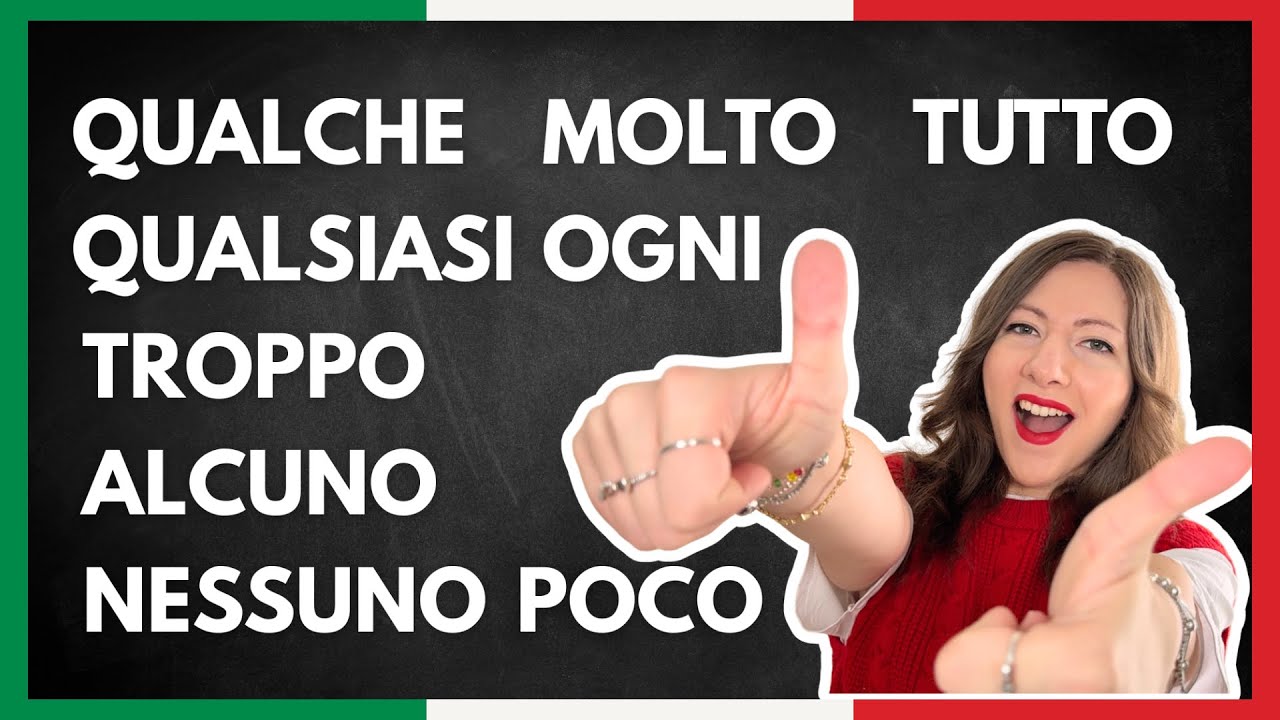
Indefinite Adjectives in Italian (qualche, tutto, molto, qualsiasi…)
What Indefinite Adjectives Are
Indefinite adjectives are words that accompany the noun and determine its quantity or quality in a vague and imprecise way. They don’t provide specific information about the exact number or nature of the element they refer to, but offer a general indication. These adjectives are particularly useful when you don’t know the exact number of something, when you want to generalize, or when precision is not necessary.
The main characteristic of indefinite adjectives is that they always precede the noun and agree with it in gender (masculine or feminine) and number (singular or plural). This agreement is fundamental for constructing grammatically correct sentences in Italian.
Classification of Indefinite Adjectives
Indefinite adjectives can be divided into different categories based on the type of information they convey. This classification helps to better understand their meaning and appropriate use.
Adjectives Indicating Indefinite Quantity
This category includes adjectives that express a generic quantity without specifying a precise number. They are among the most used in everyday Italian language and allow you to communicate naturally when numerical exactness is not relevant or is not known.
Molto/a/i/e indicates a large quantity and agrees in gender and number with the noun it refers to. Example: Ho molto lavoro oggi [I have a lot of work today] (singular masculine), Ci sono molte persone in piazza [There are many people in the square] (plural feminine).
Poco/a/chi/che expresses a scarce or limited quantity. Example: Ho poco tempo [I have little time] (singular masculine), Ci sono poche sedie libere [There are few free chairs] (plural feminine).
Troppo/a/i/e indicates an excessive quantity, more than necessary or desired. Example: C’è troppo rumore [There is too much noise] (singular masculine), Hai comprato troppa frutta [You bought too much fruit] (singular feminine).
Vario/a/i/e – Parecchio/a/i/e expresses a considerable quantity, quite large but not excessive. It is less common in modern spoken Italian but still present in formal writing. Example: Ho parecchi dubbi [I have quite a few doubts] (plural masculine).
Tanto/a/i/e indicates a large quantity, similar to “molto” but often used in comparative or exclamatory contexts. Example: Non ho tanta pazienza [I don’t have so much patience] (singular feminine), Ci sono tanti problemi [There are so many problems] (plural masculine).
Tutto/a/i/e expresses the totality, the entirety of something. It always requires the definite article after it. Example: Tutta la classe è presente [The whole class is present] (singular feminine), Tutti gli studenti studiano [All the students study] (plural masculine).
Adjectives Indicating Indefinite Quality
These adjectives don’t express quantity but rather a generic or indeterminate quality of the element they refer to. They are fundamental for expressing uncertainty, genericity, or alternatives.
Qualche is invariable (never changes form) and is always used with singular nouns, even if the meaning is plural. It indicates a small indefinite quantity. Example: Ho comprato qualche libro [I bought some books] (means “alcuni libri” – some books).
Alcuno/a/i/e has two opposite meanings: in the singular (alcuno, alcuna) it has a negative value and means “nessuno” [none], while in the plural (alcuni, alcune) it indicates a limited but unspecified quantity. Example: Non ho alcun dubbio [I have no doubt] (nessun dubbio – no doubt), Alcune persone sono arrivate [Some people arrived] (a limited number of people).
Certo/a/i/e indicates something unspecified but existing. It suggests that the element exists but is not precisely identified. Example: Certe persone non capiscono [Certain people don’t understand] (some people in particular, but not specified).
Altro/a/i/e indicates a person or thing different from the one already mentioned or considered. It expresses alternative or addition. Example: Vorrei un altro caffè [I would like another coffee] (an extra or different coffee), Hai altre domande? [Do you have other questions?] (additional questions).
Adjectives Indicating Totality or Absence
This category includes adjectives that express absolute extremes: total presence or complete absence of something. They are particularly important for expressing negations or categorical affirmations.
Ogni is invariable and is always used in the singular. It indicates totality considered element by element, one by one. It has a distributive value. Example: Ogni studente deve studiare [Every student must study] (all students, considered individually).
Nessuno/a expresses total absence, complete lack. It is always used in the singular and has a negative value. Example: Non c’è nessun problema [There is no problem] (zero problems), Non ho nessuna idea [I have no idea] (zero ideas).
Qualsiasi/qualunque are invariable and indicate one or more elements taken indifferently from a group, without distinction or preference. They express indifference in choice. Example: Puoi scegliere qualsiasi libro [You can choose any book] (it doesn’t matter which), Qualunque risposta va bene [Any answer is fine] (all answers are acceptable).
Table of Variable Indefinite Adjectives
To facilitate understanding of the variable forms of indefinite adjectives, here is a complete table showing how these adjectives change based on the gender and number of the noun they accompany. This table is a valuable tool for memorizing the different forms and using them correctly.
| Adjective | Masculine Singular | Feminine Singular | Masculine Plural | Feminine Plural |
|---|---|---|---|---|
| Molto | molto | molta | molti | molte |
| Poco | poco | poca | pochi | poche |
| Troppo | troppo | troppa | troppi | troppe |
| Tanto | tanto | tanta | tanti | tante |
| Tutto | tutto | tutta | tutti | tutte |
| Alcuno | alcuno | alcuna | alcuni | alcune |
| Altro | altro | altra | altri | altre |
| Certo | certo | certa | certi | certe |
| Nessuno | nessuno | nessuna | – | – |
| Parecchio | parecchio | parecchia | parecchi | parecchie |
Invariable Indefinite Adjectives
Some indefinite adjectives are invariable, meaning they always maintain the same form regardless of the gender or number of the noun they accompany. This characteristic makes them simpler to use, since it’s not necessary to remember different forms to make them agree with the noun.
Qualche always remains the same and is accompanied exclusively by singular nouns. Examples: qualche amico [some friend], qualche amica [some (female) friend], but never “qualche amici”.
Ogni never changes and is used only in the singular. Examples: ogni giorno [every day], ogni settimana [every week].
Qualsiasi and qualunque maintain the same form with all nouns. Examples: qualsiasi cosa [any thing], qualunque problema [any problem], qualsiasi libri [any books].
Peculiarities of “Tutto” and the Use of the Article
The indefinite adjective “tutto” presents an important peculiarity that distinguishes it from other indefinite adjectives: it always requires the use of the definite article (il, lo, la, i, gli, le) between the adjective itself and the noun. This rule is fundamental and admits no exceptions in standard Italian.
The correct structure is: tutto/a/i/e + definite article + noun. This construction indicates that one is referring to the complete and defined totality of something specific. Let’s look at some clarifying examples:
- Tutta la città [The whole city] (the entire city, considered as a whole)
- Tutto il giorno [All day] (the entire day, from morning to evening)
- Tutti gli studenti [All the students] (the totality of students, none excluded)
- Tutte le case [All the houses] (every house, without exceptions)
Omitting the article after “tutto” is considered a grammatical error. You cannot say “tutto giorno” or “tutte case”, but always tutto il giorno and tutte le case.
Differences Between Similar Indefinite Adjectives
Some indefinite adjectives can create confusion because they have similar meanings or seem interchangeable. Understanding the subtle differences between these adjectives is fundamental for using them correctly and with precision.
Qualche vs Alcuni/Alcune
Both indicate a small indefinite quantity, but they present important structural differences:
Qualche is invariable and is always used with the noun in the singular, even if the meaning is plural. Example: Ho comprato qualche mela [I bought some apples] (means “alcune mele” – some apples, but “mela” is singular).
Alcuni/alcune agrees in gender with the noun and is always used in the plural. Example: Ho comprato alcune mele [I bought some apples] (both the adjective and the noun are plural).
The meaning is substantially identical, so the choice often depends on stylistic preferences or the fluidity of the sentence. “Qualche” tends to be perceived as slightly more colloquial.
Ogni vs Tutto/i/e
Both express totality but with a different perspective:
Ogni considers elements individually, one by one, in a distributive way. It is used in the singular. Example: Ogni studente ha un libro [Every student has a book] (each single student has their book).
Tutti considers elements as a single group, collectively. It is used in the plural with the article. Example: Tutti gli studenti hanno i libri [All the students have books] (the entire group possesses books).
Qualsiasi vs Qualunque
These two adjectives are practically synonymous and can be used interchangeably in most contexts. Both express indifference in choice and indicate that any option is fine.
Example: Puoi scegliere qualsiasi/qualunque colore [You can choose any color] (there is no preference, all colors are equally acceptable).
In some regional or stylistic contexts, one may be preferred over the other, but from a grammatical point of view they are equivalent.
The Position of Indefinite Adjectives in the Sentence
Indefinite adjectives follow rather rigid position rules in Italian sentence structure. Understanding where to place them is essential for constructing grammatically correct and natural sentences.
The general rule is that indefinite adjectives always precede the noun they refer to. They cannot be positioned after the noun like some qualifying adjectives. This is an important difference compared to other languages.
Basic structure: Indefinite adjective + (article if necessary) + noun
Correct examples: Molti libri [Many books], Poche persone [Few people], Qualche problema [Some problem], Tutta la verità [The whole truth].
When an article is present (as in the case of “tutto”), the order is: Indefinite adjective + article + noun. Examples: Tutta la classe [The whole class], Tutti gli amici [All the friends].
Stop reading Italian.
Start speaking it.
Online lessons in groups of 4, organised by level and goals, with qualified teachers. Pick the day and time that suit you from the available slots.
Max 4 students:
there’s a seat for you
Elided Forms: Nessun, Alcun and Qualcun
Some indefinite adjectives present elided forms (abbreviated) that are used in specific situations for reasons of euphony (pleasant sound). These forms are mandatory in certain contexts and represent an important aspect of correct Italian grammar.
Nessuno becomes “nessun” before masculine singular nouns that begin with a consonant (except impure s, z, gn, ps, x). Examples: nessun amico [no friend], nessun problema [no problem], but nessuno studente [no student] (with impure s).
Alcuno becomes “alcun” under the same conditions as “nessuno” when used in the singular with negative value. Examples: senza alcun dubbio [without any doubt], non ho alcun interesse [I have no interest].
These elided forms follow the same rules as the indefinite article “un/uno”. This analogy can help remember when to use the elided form: if before a noun you would use “un”, then you will use “nessun” or “alcun”; if you would use “uno”, then you will use “nessuno” or “alcuno”.
Indefinite Adjectives in Negative Sentences
The use of indefinite adjectives in negative sentences presents some peculiarities that can be complicated for those studying Italian as a foreign language. The construction of negation in Italian requires particular attention when using certain indefinite adjectives.
Nessuno/a always requires the negative particle “non” before the verb. The double negation in Italian does not cancel itself out but reinforces the negative meaning. Example: Non c’è nessun problema [There is no problem] (literally “not there is no problem”, the double negation is correct and necessary).
Alcuno/a in the singular has a negative value and follows the same rule as “nessuno”. Example: Non ho alcuna intenzione di uscire [I have no intention of going out] (non ho nessuna intenzione – I have no intention).
With “qualche” or “alcuni/e”, negation is constructed normally: Non ho comprato qualche libro [I didn’t buy some books] would be incorrect; instead you say Non ho comprato nessun libro [I didn’t buy any books] or Non ho comprato alcun libro [I didn’t buy any books].
Formal and Informal Contexts of Use
Indefinite adjectives are not all used with the same frequency in different linguistic registers. Some are more common in everyday speech, others belong to a more formal or literary register. Knowing these nuances allows you to communicate more appropriately to the context.
Informal/colloquial register: In everyday language, simple forms like molto [much/many], poco [little/few], qualche [some], ogni [every], tutto [all] are preferred. Examples: Ho molti amici [I have many friends], Vengo ogni giorno [I come every day].
Formal/written register: In formal contexts, official documents, or literary texts, less common forms like parecchio [quite a lot], alcuno [some] (in the plural), taluno [some], diverso [several] are also used. Examples: Parecchi cittadini hanno espresso preoccupazione [Quite a few citizens have expressed concern], Alcuni rappresentanti hanno votato contro [Some representatives voted against].
“Qualsiasi” and “qualunque” are neutral and suitable for all contexts, while forms like “certo/a/i/e” in the sense of “some” sound more literary: Certi individui non comprendono [Certain individuals don’t understand] has a more formal tone than Alcune persone non capiscono [Some people don’t understand].
Summary Table: Main Characteristics
To facilitate study and memorization, here is a complete summary table that synthesizes the main characteristics of the most common indefinite adjectives, including information on variability, singular or plural use, and important notes for each.
| Adjective | Variable/Invariable | Singular/Plural | Important Notes |
|---|---|---|---|
| Molto | Variable | Both | Expresses large quantity |
| Poco | Variable | Both | Expresses scarce quantity |
| Troppo | Variable | Both | Expresses excessive quantity |
| Tanto | Variable | Both | Similar to “molto”, often emphatic |
| Tutto | Variable | Both | Always requires the definite article |
| Qualche | Invariable | Singular only | Noun always singular, plural meaning |
| Alcuni/e | Variable | Plural only | Equivalent of “qualche” but plural |
| Ogni | Invariable | Singular only | Distributive value, considers element by element |
| Nessuno/a | Variable | Singular only | Negative value, requires “non” before verb |
| Alcuno/a/i/e | Variable | Both | Singular = nessuno; plural = alcuni |
| Qualsiasi | Invariable | Both | Expresses indifference in choice |
| Qualunque | Invariable | Both | Synonym of “qualsiasi” |
| Altro/a/i/e | Variable | Both | Indicates different or additional element |
| Certo/a/i/e | Variable | Both | Indicates something unspecified but existing |
| Parecchio/a/i/e | Variable | Both | More formal, indicates considerable quantity |
Combinations with Other Grammatical Elements
Indefinite adjectives can combine with other elements of the sentence, creating more complex structures. Understanding these combinations is important for constructing articulated and natural sentences.
With prepositions: Many indefinite adjectives can be preceded by articulated prepositions. Examples: di molti libri [of many books], con poche persone [with few people], per tutti gli studenti [for all the students], tra alcune persone [among some people]. The preposition is articulated with any article present.
With qualifying adjectives: It is possible to combine indefinite and qualifying adjectives. The typical order is: indefinite adjective + qualifying adjective + noun. Examples: molti bravi studenti [many good students], poche buone idee [few good ideas], tutti i nuovi libri [all the new books].
With possessives: Some indefinite adjectives can coexist with possessive adjectives, but the order and structure require attention. Examples: tutti i miei amici [all my friends] (tutti + article + possessive + noun), alcuni miei colleghi [some of my colleagues] (alcuni + possessive + noun, without article).
Common Errors to Avoid
Foreign students tend to make some recurring errors in the use of indefinite adjectives. Recognizing these errors and knowing how to avoid them is fundamental for improving one’s linguistic competence.
Error 1: Using “qualche” in the plural. ❌ Incorrect: qualche libri. ✅ Correct: qualche libro [some book] or alcuni libri [some books]. “Qualche” is invariable and always requires the noun in the singular.
Error 2: Omitting the article after “tutto”. ❌ Incorrect: tutta casa, tutti studenti. ✅ Correct: tutta la casa [the whole house], tutti gli studenti [all the students]. The definite article is mandatory.
Error 3: Using “ogni” in the plural. ❌ Incorrect: ogni libri. ✅ Correct: ogni libro [every book]. “Ogni” is invariable and is used only in the singular.
Error 4: Forgetting “non” with “nessuno”. ❌ Incorrect: C’è nessun problema. ✅ Correct: Non c’è nessun problema [There is no problem]. In Italian, double negation is mandatory and correct.
Error 5: Confusing singular and plural “alcuno”. ❌ Incorrect: Ho alcuno amici [I have some friends] (singular with plural meaning). ✅ Correct: Ho alcuni amici [I have some friends] (plural) or Non ho alcun amico [I have no friend] (singular negative).
Error 6: Placing the indefinite adjective after the noun. ❌ Incorrect: libri molti, persone poche. ✅ Correct: molti libri [many books], poche persone [few people]. Indefinite adjectives always precede the noun.
Frequently Asked Questions about Indefinite Adjectives
What is the difference between indefinite adjectives and indefinite pronouns?
Indefinite adjectives always accompany a noun and determine it quantitatively or qualitatively in an indefinite way (examples: molti libri [many books], qualche amico [some friend]). Indefinite pronouns instead replace a noun and stand alone in the sentence (examples: molti pensano [many think], qualcuno è arrivato [someone arrived]). Many words can function as both adjectives and pronouns depending on the context: Ho letto molti libri [I read many books] (adjective) vs Molti non capiscono [Many don’t understand] (pronoun).
Why is “qualche” used with singular nouns if the meaning is plural?
This is a historical peculiarity of the Italian language. “Qualche” derives from Latin and has maintained an invariable form that grammatically requires the singular, even if the meaning is clearly plural. When we say qualche libro [some book] we actually mean “alcuni libri” [some books], but the grammatical construction demands the singular. This apparent contradiction is simply a characteristic of Italian that must be accepted and memorized. To express the same concept with a noun in the plural, we use alcuni/alcune [some].
Can I use multiple indefinite adjectives together in the same sentence?
In general, it is inadvisable to use multiple indefinite adjectives that refer to the same noun, because it creates confusion and redundancy. It would be incorrect to say molti alcuni libri or pochi troppi studenti. However, it is possible to use different indefinite adjectives that refer to different nouns in the same sentence: Molti studenti hanno letto pochi libri [Many students read few books] (here “molti” refers to students, “pochi” to books). It is also possible to combine an indefinite adjective with other types of adjectives: tutti i nuovi libri [all the new books] (indefinite + qualifying).
How do I choose between “qualsiasi” and “qualunque”?
Actually there is no significant difference in meaning between “qualsiasi” and “qualunque”: they are practically perfect synonyms and can be used interchangeably in most contexts. Both express indifference in choice. The preference for one or the other often depends on regional habits, personal taste, or simply the sound in the specific sentence. Some speakers perceive “qualunque” as slightly more formal or literary, but this is a minimal nuance. When in doubt, you can safely use either one without making a mistake.
Do indefinite adjectives change with nouns that indicate people, animals, or things?
No, indefinite adjectives do not change based on the type of referent (person, animal, or thing). They only change based on the gender (masculine/feminine) and number (singular/plural) of the noun, regardless of what that noun represents. Therefore we will use “molti” for molti studenti [many students] (people), molti gatti [many cats] (animals), and molti libri [many books] (things), because in all cases the noun is masculine plural. The distinction between people/animals/things does not affect the form of the indefinite adjective.
When do I use “parecchio” instead of “molto”?
The meaning of “parecchio” is very similar to “molto”: both indicate a large quantity. The main difference lies in the linguistic register: “parecchio” is perceived as more formal, literary, or slightly antiquated compared to “molto”, which is neutral and universal. In everyday spoken Italian, “molto” is much more common. “Parecchio” is found more frequently in formal written contexts, newspaper articles, or bureaucratic language. For a foreign student, it is advisable to mainly use “molto”, which is always appropriate, and reserve “parecchio” for more formal situations when you want to give a more elevated tone to your Italian.
If you’re interested in deepening this topic, read this article on errors with Italian indefinite adjectives and pronouns!
Do you want to take Italian lessons with our qualified native teachers? Purchase your Italiano Intensivo package!
Want the lesson PDF with exercises and solutions?
Join the LearnAmo AcademyCaricamento quiz in corso…
Podcast: Play in new window | Download (Duration: 21:28 — 29.7MB)
Iscriviti: Apple Podcasts | Spotify | Android | iHeartRadio | Podcast Index | TuneIn | Deezer | RSS | Altri...