


Have you ever wondered why we say “imbiancare” and not simply “biancare“? Or why the verb “allargare” exists but not “largare“?
Parasynthetic verbs are a topic you probably never studied in school, but one you use every day without knowing it. You’ll learn how they’re formed, how to recognize them, and most importantly, why they’re so important for enriching your Italian and speaking more naturally and precisely.
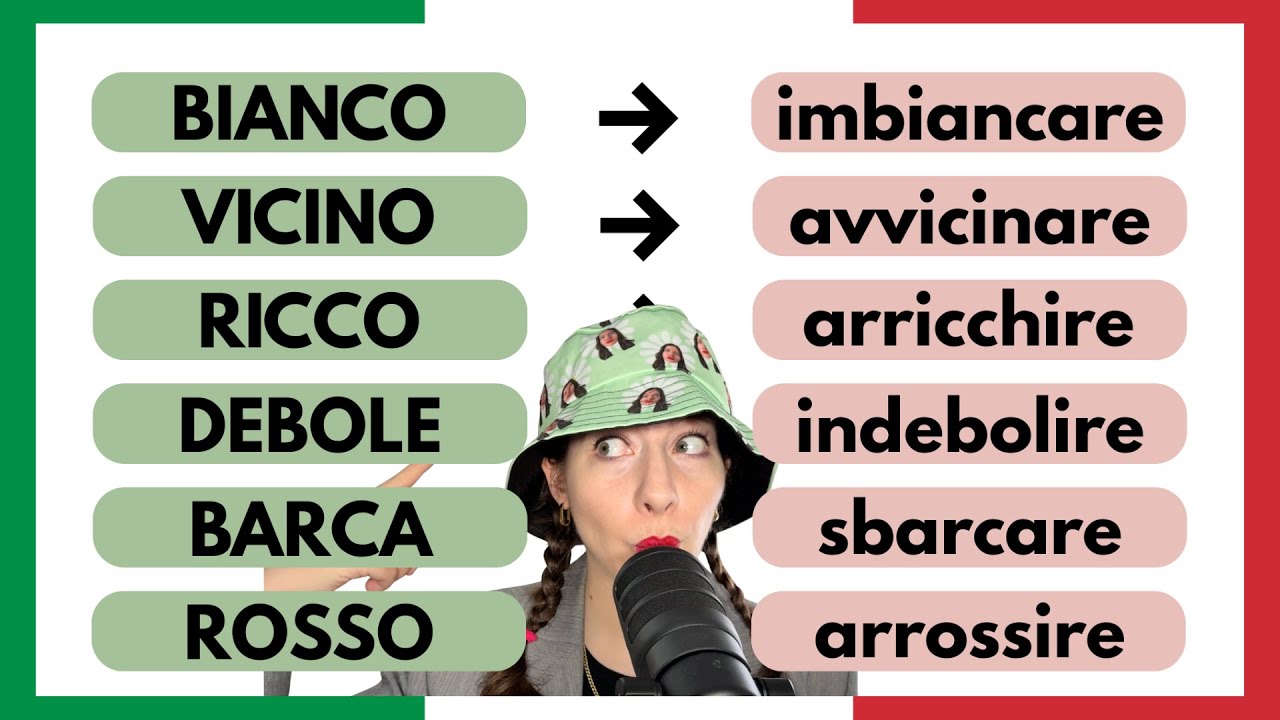
I VERBI PARASINTETICI: abbellire, irrobustire, arrossire…
What Is a Parasynthetic Verb?
Parasynthetic verbs are verbs that are formed by adding simultaneously a prefix at the beginning and a suffix at the end of a base word, which can be a noun or an adjective. The key word is precisely “simultaneously”: it means that neither the word with only the prefix nor the word with only the suffix exists in Italian. Both elements must be added together for the verb to make sense.
Let’s take a practical example with the verb “imbiancare” [to whiten/to turn white]:
- We start from the adjective “bianco” [white]
- We add the prefix “in-“ (which becomes “im-” before B) + the suffix “-are”
- We get: imbiancare
But attention! In Italian, neither “biancare” (only suffix) nor “imbianco” as a verb (only prefix) exist.
There must be both! That’s why it’s called “parasynthetic” – from Greek “para” (beside) and “synthesis” (composition): the elements are added together, beside each other!
How Are Parasynthetic Verbs Formed?
Think of parasynthetic verbs as a complete sandwich: you need the bread on top, the bread on the bottom, and the filling in the middle. Without one of these elements, you don’t have a complete sandwich! The formula is this:
PREFIX + BASE WORD (noun or adjective) + VERBAL SUFFIX (-are, -ire, -ificare)
The Most Common Prefixes
The prefixes most used in forming parasynthetic verbs are:
- a-: avvicinare [to bring closer], arrossare [to redden], abbellire [to beautify]
- in-/im-/il-/ir-: imbiancare [to whiten], indebolire [to weaken], illuminare [to illuminate], irrobustire [to strengthen] (this prefix changes form like a chameleon before different letters, but always remains the same!)
- s-: spaventare [to frighten], svenare [to bleed], sbiancare [to bleach]
- dis-: disgelare [to thaw]
- ri-: riempire [to fill] (although some linguists still debate whether it’s truly parasynthetic)
The Most Frequent Suffixes
The verbal suffixes that complete the formation of parasynthetic verbs are:
Types of Parasynthetic Verbs with Practical Examples
Parasynthetic verbs can be classified into different categories based on the type of change or action they indicate. Let’s see them in detail with numerous examples!
Verbs Indicating a Color Change
These verbs describe all possible and imaginable chromatic transformations. They are particularly useful for describing natural phenomena and physical changes:
- Imbiancare (in- + bianco + -are) = to become white or to make something white
- Example: “I miei capelli stanno iniziando a imbiancare.” [My hair is starting to turn white.]
- Example: “Domani devo imbiancare le pareti della cucina.” [Tomorrow I have to whitewash the kitchen walls.]
- Arrossare/Arrossire (a- + rosso + -are/-ire) = to become red
- Example: “Maria arrossisce sempre quando le faccio un complimento!” [Maria always blushes when I give her a compliment!]
- Ingiallire (in- + giallo + -ire) = to become yellow
- Example: “Le pagine di questo vecchio libro sono ingiallite con il tempo.” [The pages of this old book have yellowed with time.]
- Annerire (a-/in- + nero + -ire) = to become black
- Example: “Il fumo ha annerito il soffitto della cucina.” [The smoke has blackened the kitchen ceiling.]
- Inverdire (in- + verde + -ire) = to become green
- Example: “In primavera i prati inverdiscono rapidamente.” [In spring the meadows green rapidly.]
Verbs Indicating a Size Change
These verbs are very useful when something is too big, too small, too long, or too short. They allow you to express dimensional modifications with precision:
- Allargare (a- + largo + -are) = to make wider
- Example: “Devo allargare questi pantaloni, sono troppo stretti!” [I need to widen these pants, they’re too tight!]
- Accorciare (a- + corto + -are) = to make shorter
- Example: “Il sarto ha accorciato la gonna di due centimetri.” [The tailor shortened the skirt by two centimeters.]
- Allungare (a- + lungo + -are) = to make longer
- Example: “Puoi allungare il brodo con un po’ d’acqua?” [Can you thin out the broth with a little water?]
- Rimpicciolire (ri- + piccolo + -ire) = to make smaller
- Example: “Questa giacca si è rimpicciolita in lavatrice!” [This jacket shrank in the wash!]
- Ingrandire (in- + grande + -ire) = to make bigger
- Example: “Potresti ingrandire questa foto? Non si vede bene.” [Could you enlarge this photo? It’s not clear.]
Verbs Indicating a Quality or State Change
This category includes verbs for the most significant transformations concerning physical, mental, or economic characteristics:
- Indebolire (in- + debole + -ire) = to weaken
- Example: “L’influenza mi ha indebolito molto.” [The flu weakened me greatly.]
- Irrobustire (ir- + robusto + -ire) = to strengthen
- Example: “L’allenamento in palestra mi ha irrobustito.” [Training at the gym has strengthened me.]
- Abbellire (a- + bello + -ire) = to beautify
- Example: “Hanno abbellito la piazza con nuove fontane.” [They beautified the square with new fountains.]
- Impazzire (in- + pazzo + -ire) = to go crazy
- Example: “Sto impazzendo con tutti questi compiti da fare!” [I’m going crazy with all these tasks to do!]
- Example: “I tifosi sono impazziti quando la squadra ha segnato!” [The fans went crazy when the team scored!]
- Arricchire (a- + ricco + -ire) = to enrich
- Example: “Leggere libri arricchisce la mente.” [Reading books enriches the mind.]
- Example: “Si è arricchito vendendo immobili.” [He got rich selling real estate.]
- Impoverire (in- + povero + -ire) = to impoverish
- Example: “La crisi economica ha impoverito molte famiglie.” [The economic crisis impoverished many families.]
Verbs Indicating Movements or Specific Actions
These verbs describe dynamic actions that involve movements in space or changes of position:
- Avvicinare (a- + vicino + -are) = to bring closer
- Example: “Avvicina la sedia al tavolo, per favore.” [Bring the chair closer to the table, please.]
- Allontanare (a- + lontano + -are) = to move away
- Example: “Il cane ha allontanato il gatto dal giardino.” [The dog drove the cat away from the garden.]
- Atterrare (a- + terra + -are) = to land
- Example: “L’aereo atterrerà tra dieci minuti.” [The plane will land in ten minutes.]
- Affondare (a- + fondo + -are) = to sink
- Example: “Il Titanic affondò nell’Oceano Atlantico.” [The Titanic sank in the Atlantic Ocean.]
- Sbarcare (s- + barca + -are) = to disembark
- Example: “I turisti sono sbarcati sul molo.” [The tourists disembarked on the pier.]
Verbs Indicating Emotions or Psychological States
This category includes verbs that express intense emotional states and their manifestations:
- Spaventare (s- + pavento [paura] + -are) = to frighten
- Example: “Non spaventare il bambino con quelle storie!” [Don’t scare the child with those stories!]
- Rattristare (r- + triste + -are) = to sadden
- Example: “Questa notizia mi ha rattristato molto.” [This news saddened me greatly.]
- Inferocire (in- + feroce + -ire) = to enrage
- Example: “Il suo comportamento mi ha inferocito!” [His behavior enraged me!]
How to Recognize a Parasynthetic Verb
Here’s the infallible method for identifying a parasynthetic verb: mentally remove the prefix or suffix from the verb. If the remaining word doesn’t exist as a verb in Italian, you’ve found a parasynthetic verb! It’s like a linguistic detective game.
Practical example:
- Imbiancare → I remove the prefix and suffix → “biancare“
Does “biancare” exist? NO! → IT’S PARASYNTHETIC! - Rileggere → I remove the prefix → “leggere“
Does “leggere” exist? YES! → It’s NOT parasynthetic
See? It’s very simple! Just apply this practical rule and you’ll always know how to distinguish parasynthetic verbs from other verbs.
Stop reading Italian.
Start speaking it.
Online lessons in groups of 4, organised by level and goals, with qualified teachers. Pick the day and time that suit you from the available slots.
Max 4 students:
there’s a seat for you
Linguistic Curiosities About Parasynthetic Verbs
The Reflexive Form
Many parasynthetic verbs also have a reflexive form. For example, “arrossare” becomes “arrossarsi“, “avvicinare” becomes “avvicinarsi“. The difference is significant:
- Transitive form: “Ho arrossato le guance del bambino” [I reddened the child’s cheeks] (I made his cheeks turn red – so I → him)
- Reflexive form: “Mi sono arrossato per l’imbarazzo” [I blushed from embarrassment] (I myself became red – so I → I)
Parasynthetic Verbs Hidden in Everyday Language
Some parasynthetic verbs are so common that we don’t even realize they are! Think of “atterrare” – you hear it every time you take a plane in announcements: “Signore e signori, stiamo per atterrare…” [Ladies and gentlemen, we are about to land…] Yet no one has ever stopped to think: “But why don’t we say ‘terrare’?” Because it doesn’t exist! It’s a parasynthetic verb undercover!
Dialectal Variations
In some Italian dialects there exist parasynthetic verbs that don’t exist in standard Italian. It’s as if each region had its own secret linguistic superpowers! This linguistic richness demonstrates the creativity and vitality of the Italian language in all its regional variants.
The Double Meaning of “Imbiancare”
The verb “imbiancare” is particularly interesting because it has a double meaning:
- To paint walls white: “Domani devo imbiancare il salone.” [Tomorrow I have to whitewash the living room.]
- To become white (referring to hair): “I miei capelli stanno iniziando a imbiancare.” [My hair is starting to turn white.]
This demonstrates the versatility and semantic richness of parasynthetic verbs!
Common Mistakes to Avoid
Even advanced students make some typical errors when using parasynthetic verbs. Here are the most common ones and how to avoid them:
Error 1: Confusing Parasynthetic Verbs with Normal Prefixed Verbs
This is the most frequent error:
- Wrong: Thinking that “rivedere” is parasynthetic
- Correct: “Rivedere” is NOT parasynthetic because “vedere” already exists as a verb! It’s just a verb with an added prefix.
It’s like thinking that a pizza with extra ingredients is a completely new dish. No! It’s still pizza, just more loaded!
Error 2: Forgetting That BOTH Elements Are Needed
Students often try to simplify, but Italian requires both the prefix and the suffix:
- Wrong: “Io bianco le pareti“
- Correct: “Io imbianco le pareti” [I whitewash the walls]
Remember the sandwich? You can’t eat just the bread or just the filling! You must have everything together!
Error 3: Using the Wrong Prefix
Creativity is beautiful, but with verbs we must be precise:
- Wrong: “Disbiancare” (when meaning to become white)
- Correct: “Imbiancare“
There isn’t always perfect logic: you simply need to learn which prefix goes with which base word. It’s like remembering whether a word is masculine or feminine – sometimes you just have to know!
Error 4: Inventing Parasynthetic Verbs That Don’t Exist
Sometimes students are so creative that they invent beautiful verbs that… unfortunately don’t exist! For example, someone might say “inrosare” instead of “arrossire“. It sounds good, but it’s not correct!
The golden rule: if you’re not sure whether a parasynthetic verb exists, check the dictionary or ask a native Italian speaker!
Summary Table of the Most Common Parasynthetic Verbs
Here’s a complete table that summarizes the main parasynthetic verbs organized by category, with their formation and meaning:
| Parasynthetic Verb | Formation | Meaning | Example |
|---|---|---|---|
| Imbiancare | in- + bianco + -are | To become/make white | “I capelli imbiancano con l’età” [Hair turns white with age] |
| Arrossire | a- + rosso + -ire | To become red | “Maria arrossisce facilmente” [Maria blushes easily] |
| Ingiallire | in- + giallo + -ire | To become yellow | “Le pagine ingialliscono nel tempo” [Pages yellow over time] |
| Inverdire | in- + verde + -ire | To become green | “I prati inverdiscono in primavera” [Meadows green in spring] |
| Allargare | a- + largo + -are | To make wider | “Devo allargare questi pantaloni” [I need to widen these pants] |
| Accorciare | a- + corto + -are | To make shorter | “Accorcia la gonna di 3 cm” [Shorten the skirt by 3 cm] |
| Allungare | a- + lungo + -are | To make longer | “Allunga il brodo con acqua” [Thin out the broth with water] |
| Ingrandire | in- + grande + -ire | To make bigger | “Ingrandisci questa fotografia” [Enlarge this photograph] |
| Rimpicciolire | ri- + piccolo + -ire | To make smaller | “La maglia si è rimpicciolita” [The shirt shrank] |
| Indebolire | in- + debole + -ire | To weaken | “La malattia lo ha indebolito” [The illness weakened him] |
| Irrobustire | ir- + robusto + -ire | To strengthen | “Lo sport mi ha irrobustito” [Sports strengthened me] |
| Abbellire | a- + bello + -ire | To beautify | “Hanno abbellito la piazza” [They beautified the square] |
| Impazzire | in- + pazzo + -ire | To go crazy | “Sto impazzendo con questo lavoro” [I’m going crazy with this work] |
| Arricchire | a- + ricco + -ire | To enrich | “La lettura arricchisce la mente” [Reading enriches the mind] |
| Impoverire | in- + povero + -ire | To impoverish | “La crisi ha impoverito molti” [The crisis impoverished many] |
| Avvicinare | a- + vicino + -are | To bring closer | “Avvicina la sedia al tavolo” [Bring the chair closer to the table] |
| Allontanare | a- + lontano + -are | To move away | “Allontana quel cane pericoloso” [Move that dangerous dog away] |
| Atterrare | a- + terra + -are | To land | “L’aereo atterrerà alle 15:00” [The plane will land at 3:00 PM] |
| Affondare | a- + fondo + -are | To sink | “La nave è affondata in mare” [The ship sank at sea] |
| Sbarcare | s- + barca + -are | To disembark | “I passeggeri sono sbarcati” [The passengers disembarked] |
| Spaventare | s- + pavento + -are | To frighten | “Non spaventare i bambini” [Don’t frighten the children] |
| Rattristare | r- + triste + -are | To sadden | “La notizia mi ha rattristato” [The news saddened me] |
| Inferocire | in- + feroce + -ire | To enrage | “Il suo atteggiamento mi ha inferocito” [His attitude enraged me] |
Frequently Asked Questions About Parasynthetic Verbs
Are All Verbs with Prefixes Parasynthetic?
No, absolutely not! A verb is parasynthetic only if the base form of the verb doesn’t exist without the prefix AND without the suffix. For example, “rifare” is not parasynthetic because “fare” already exists as a verb. “Imbiancare” is parasynthetic because “biancare” doesn’t exist.
How Do I Know If a Parasynthetic Verb Really Exists?
The best way is to consult an Italian dictionary or ask a native speaker. Not all verbs that seem parasynthetic really exist in the Italian language. With time and practice, you’ll learn to recognize which combinations are correct.
Can I Create New Parasynthetic Verbs?
In theory yes, following the formation rules, but they won’t be accepted as correct if they’re not already recognized by standard Italian. The language evolves, but the invention of new verbs must go through collective use and official recognition.
Are Parasynthetic Verbs Transitive or Intransitive?
It depends on the verb! Some are transitive (they require a direct object), like “allargare qualcosa” [to widen something], others are intransitive, like “arrossire” (you don’t blush something, you just blush). Some can be used in both ways, especially in the reflexive form.
Why Are They Called “Parasynthetic”?
The term comes from ancient Greek: “para” means “beside” and “synthesis” means “composition”. The name indicates that the elements (prefix and suffix) are composed “together, beside” the base word, simultaneously.
Do Parasynthetic Verbs Exist in Other Languages Too?
Yes, there are similar phenomena in other Romance languages like Spanish (for example “embellecer” = abbellire [to beautify]) and French (for example “embellir“). Other language families also have verb formation mechanisms that require the simultaneous addition of multiple affixes.
How Important Is It to Know Parasynthetic Verbs for Speaking Italian?
It’s very important! Many parasynthetic verbs are used daily and don’t have simple alternatives. Knowing them allows you to express with precision changes of state, color, size, and emotions. Furthermore, it demonstrates a deep knowledge of Italian that goes beyond the basic level.
Want the lesson PDF with exercises and solutions?
Join the LearnAmo AcademyLoading quiz…
Podcast: Play in new window | Download ()
Iscriviti: Apple Podcasts | Spotify | Android | iHeartRadio | Podcast Index | TuneIn | Deezer | RSS | Altri...