


Have you ever had doubts about which preposition to use in Italian? “Vado A Roma or IN Roma?” “Parlo DI te or SU te?” Prepositions are small words that create big problems! But today we will solve all your doubts together with a complete test that covers all levels, from A1 to C2.
With this article, you will test your knowledge of Italian prepositions through progressive exercises that will allow you to discover exactly where you are and which aspects you still need to improve. At the end of this journey, you will know how to use prepositions like a true Italian!
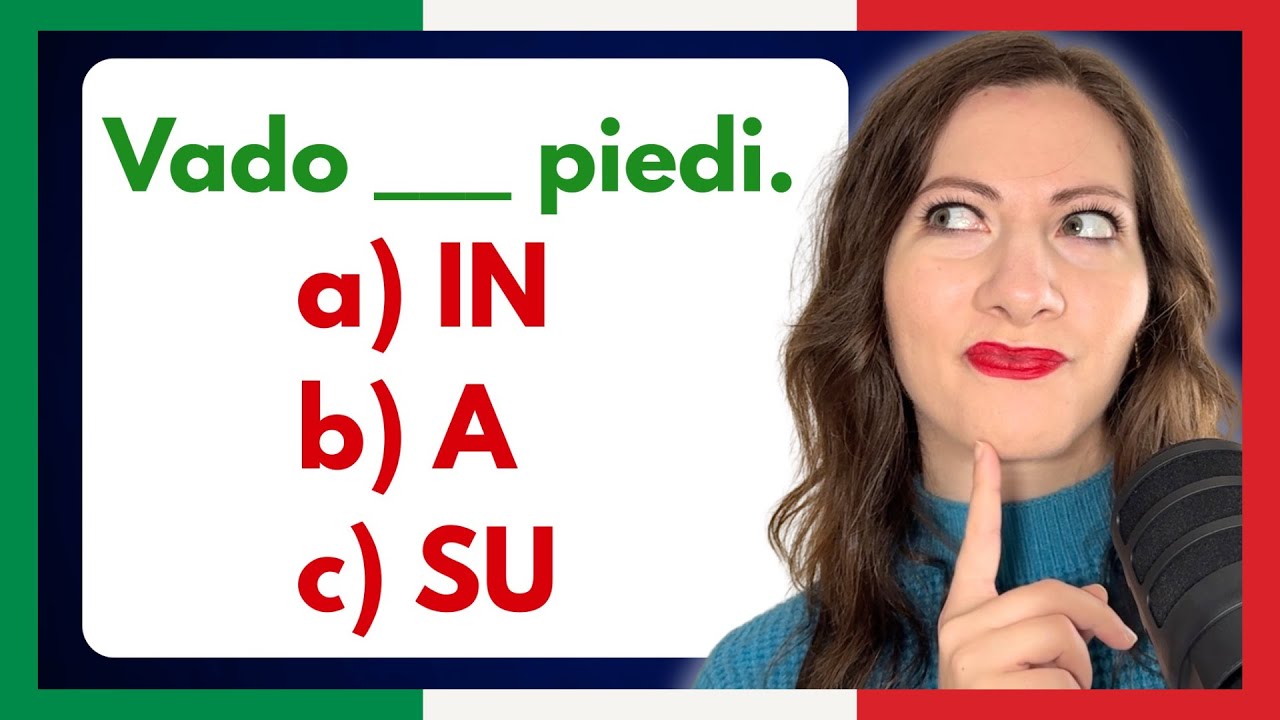
Italian Prepositions: Complete Test from A1 to C2
How This Test Works
The test is organized in progressive levels: we will start with simple sentences at level A1, then move on to level A2, B1, B2, C1 and finally C2. For each level, you will find 3 sentences to complete with the correct prepositions. Towards the end, there will be a special final exercise with 10 particularly difficult sentences that will test all your skills. Finally, you will have all the solutions with detailed explanations to understand each single use.
So, prepare paper and pen to write your answers and let’s begin this journey through Italian prepositions!
LEVEL A1 – The Basics of Prepositions
Let’s start with level A1, the one for absolute beginners. Here we will use the most common prepositions in very simple contexts. These are basic sentences that every Italian student must be able to complete. Ready?
1. Vado ___ scuola ogni giorno. [I go ___ school every day.]
2. Maria viene ___ Regno Unito. [Maria comes ___ the United Kingdom.]
3. Questo è il telefono ___ mio amico Paolo. [This is the phone ___ my friend Paolo.]
Level A1 Solutions
1. Vado a scuola ogni giorno.
2. Maria viene dal Regno Unito.
3. Questo è il telefono del mio amico Paolo.
LEVEL A2 – A Step Forward
At level A2, things become slightly more complicated. Here we will find articulated prepositions and some slightly more specific uses. Note how here we must think not only about the right preposition, but also whether it should be combined with the article. A nice challenge, right?
1. ___ Natale abbiamo pranzato tutti insieme. [___ Christmas we had lunch all together.]
2. Il treno parte ___ 8 ___ sera. [The train leaves ___ 8 ___ the evening.]
3. Abito ___ un appartamento ___ centro. [I live ___ an apartment ___ the center.]
Level A2 Solutions
1. A Natale abbiamo pranzato tutti insieme.
2. Il treno parte alle 8 di sera.
3. Abito in un appartamento in centro.
LEVEL B1 – It Gets Complicated
Now things get interesting! At level B1, you will need to know well the idiomatic uses and fixed expressions. At this level, you really need to think! Prepositions don’t always follow logic, so you need to study and practice a lot. Attention!
1. Ho mal ___ testa ___ due ore. [I have had a headache ___ two hours.]
2. ___ piccola, andavo sempre ___ miei nonni ___ campagna. [___ a little girl, I always went ___ my grandparents ___ the countryside.]
3. Durante l’esame non ho risposto ___ nessuna ___ domande. [During the exam I didn’t answer ___ any ___ the questions.]
Level B1 Solutions
1. Ho mal di testa da due ore.
2. Da piccola, andavo sempre dai miei nonni in campagna.
3. Durante l’esame non ho risposto a nessuna delle domande.
LEVEL B2 – For Serious Students
We have reached level B2. Here we are talking about students who already have a good command of the language. The sentences will be longer and more complex. You will see how in a single sentence there can be even 5-6 different prepositions! This is real spoken and written Italian.
1. La disoccupazione ___ nostro Paese è aumentata, soprattutto ___ i giovani ___ 18 ___ 30 anni. [Unemployment ___ our country has increased, especially ___ young people ___ 18 ___ 30 years old.]
2. Il treno ___ Milano passa ___ Bologna prima ___ arrivare ___ destinazione. [The train ___ Milan passes ___ Bologna before ___ arriving ___ its destination.]
3. Non sono riuscito ___ finire il progetto ___ tempo ___ causa di troppi impegni. [I didn’t manage ___ finish the project ___ time ___ because of too many commitments.]
Level B2 Solutions
1. La disoccupazione nel nostro Paese è aumentata, soprattutto tra i giovani dai 18 ai 30 anni.
2. Il treno per Milano passa da Bologna prima di arrivare a destinazione.
3. Non sono riuscito a finire il progetto in tempo a causa di troppi impegni.
LEVEL C1 – For Experts
Now we enter the territory of experts! Level C1 requires a deep knowledge of the nuances of the Italian language. Here prepositions can completely change the meaning of a sentence! You really need to know Italian at an advanced level: each preposition has a precise role and is not interchangeable.
1. ___ capire il significato ___ quella parola, ___ fine ho dovuto consultare il vocabolario ___ italiano. [___ understand the meaning ___ that word, ___ the end I had to consult the Italian dictionary.]
2. Si è rifiutato ___ partecipare ___ riunione perché le sue opinioni sono diverse ___ quelle ___ suoi colleghi. [He refused ___ participate ___ the meeting because his opinions are different ___ those ___ his colleagues.]
3. ___ base ___ nuove regole, gli studenti devono iscriversi ___ esami entro la fine ___ mese. [___ according ___ the new rules, students must register ___ exams by the end ___ the month.]
Level C1 Solutions
1. Per capire il significato di quella parola, alla fine ho dovuto consultare il vocabolario di italiano.
2. Si è rifiutato di partecipare alla riunione perché le sue opinioni sono diverse da quelle dei suoi colleghi.
3. In base alle nuove regole, gli studenti devono iscriversi agli esami entro la fine del mese.
LEVEL C2 – Only for the Brave!
Here we are at level C2, the level of educated native speakers. These sentences contain complex idiomatic expressions, formal registers and very sophisticated constructions. If you have reached this level, congratulations! You are a true champion of Italian prepositions!
1. Tu riesci sempre ___ mettere tutti ___ proprio agio. [You always manage ___ put everyone ___ ease.]
2. Lo scrittore ha lavorato ___ questo romanzo ___ molti anni, prendendo ispirazione ___ tradizione popolare ___ suo Paese. [The writer worked ___ this novel ___ many years, taking inspiration ___ the popular tradition ___ his country.]
3. L’imputato è stato assolto ___ accusa ___ corruzione ___ mancanza ___ prove sufficienti. [The defendant was acquitted ___ the charge ___ corruption ___ lack ___ sufficient evidence.]
Level C2 Solutions
1. Tu riesci sempre a mettere tutti a proprio agio.
2. Lo scrittore ha lavorato a questo romanzo per molti anni, prendendo ispirazione dalla tradizione popolare del suo Paese.
3. L’imputato è stato assolto dall’accusa di corruzione per mancanza di prove sufficienti.
Final Exercise – 10 Mixed Level Sentences
Now it’s time for the final exercise! I have prepared 10 mixed sentences that cover all levels. This is the moment to test everything you have learned. Complete the sentences before looking at the solutions!
1. Mio fratello studia medicina ___ università di Bologna ___ tre anni. [My brother studies medicine ___ the University of Bologna ___ three years.]
2. ___ messa ___ la chiusura ___ corsi, il rettore ha tenuto un discorso ___ importanza ___ studio. [___ mass ___ the closing ___ courses, the rector gave a speech ___ the importance ___ study.]
3. Non mi piace sentire parlare male ___ lei perché so che è una persona ___ grande cuore. [I don’t like hearing bad things ___ her because I know she is a person ___ a big heart.]
4. Questa è la borsa ___ mia sorella, quella ___ pelle nera che hai visto ___ negozio ___ cui siamo stati ieri. [This is the bag ___ my sister, the one ___ black leather that you saw ___ the shop ___ which we were yesterday.]
5. ___ andare ___ casa mia ___ casa sua ci vogliono circa 20 minuti ___ piedi. [___ go ___ my house ___ her house it takes about 20 minutes ___ foot.]
6. Sono più bravo ___ matematica ___ mio cugino, ma lui è più bravo ___ me ___ lingue straniere. [I am better ___ math ___ my cousin, but he is better ___ me ___ foreign languages.]
7. Ho comprato tutti i libri ___ il corso e ora sono completamente ___ verde, cioè senza soldi! [I bought all the books ___ the course and now I am completely broke, that is without money!]
8. ___ fine ___ capire il significato ___ quella parola, ho dovuto consultare il dizionario ___ italiano. [___ the end ___ understand the meaning ___ that word, I had to consult the Italian dictionary.]
9. La farmacia non è lontana ___ negozio ___ abbigliamento ___ cui siamo stati ___ settimana scorsa. [The pharmacy is not far ___ the clothing store ___ which we were ___ last week.]
10. Ti ricordi ___ Francesca? È quella ragazza alta ___ i capelli rossi che abitava vicino ___ casa nostra ___ Toscana. [Do you remember Francesca? She’s that tall girl ___ red hair who lived near ___ our house ___ Tuscany.]
Final Exercise Solutions with Detailed Explanations
Here are all the solutions with complete explanations to understand each single use of prepositions. Read the explanations carefully to improve your understanding!
Sentence 1: University Studies
Solution: Mio fratello studia medicina all’università di Bologna da tre anni.
Detailed explanation:
- “All'” because università [university] is feminine singular and requires the articulated preposition (a + l’ before a vowel). A is used to indicate the place where one studies or works.
- “Di” to indicate the city where the university is located, forming a complement of specification.
- “Da” to express the temporal duration that continues to the present (from when he started and still studies).
Sentence 2: Formal Event
Solution: Alla messa per la chiusura dei corsi, il rettore ha tenuto un discorso sull’importanza dello studio.
Detailed explanation:
- “Alla” to indicate the specific place or event where the action takes place.
- “Per” indicates the purpose or occasion of the mass (the reason why it was organized).
- “Dei” is the articulated preposition (di + i) that forms the complement of specification.
- “Sull'” because importanza [importance] begins with a vowel, so the apostrophized form of the articulated preposition (su + l’) is used.
- “Dello” because studio [study] begins with s + consonant, which requires the article lo and therefore the articulated preposition dello.
Sentence 3: Speaking About Someone
Solution: Non mi piace sentire parlare male di lei perché so che è una persona dal grande cuore.
Detailed explanation:
- “Di” after the verb “parlare” [to speak] introduces the topic or the person being spoken about. It’s a fixed construction: parlare di qualcuno/qualcosa [to speak of someone/something].
- “Dal” is an idiomatic expression that in this context means “with a”. Dal grande cuore = “with a big heart”. This is a typical Italian construction to describe intrinsic qualities.
Sentence 4: Description of an Object
Solution: Questa è la borsa di mia sorella, quella di/in pelle nera che hai visto nel negozio in cui siamo stati ieri.
Detailed explanation:
- First “di” indicates possession: the bag belongs to my sister.
- “Di” or “in” pelle [leather] indicate the material the bag is made of. Both prepositions are correct! Di pelle and in pelle are interchangeable when talking about materials.
- “Nel” is the articulated preposition (in + il) that indicates the specific place where you saw the bag.
- “In” introduces the relative clause with cui. When cui is preceded by a preposition, the article is not used.
Sentence 5: Distance and Time
Solution: Per andare da casa mia a casa sua ci vogliono circa 20 minuti a piedi.
Detailed explanation:
- “Per” introduces the purpose of the action: for what purpose? To go.
- “Da…a” indicate movement from one point to another. This pair of prepositions is fundamental for expressing routes and movements.
- “A piedi” [on foot] is a fixed expression that indicates the means of locomotion. Attention: you don’t say in piedi when talking about walking! In piedi means “standing up” (in an upright position), while a piedi means “on foot” (walking).
Sentence 6: Comparisons and Subjects
Solution: Sono più bravo in matematica di mio cugino, ma lui è più bravo di me nelle lingue straniere.
Detailed explanation:
- “In” is used to indicate the subject or discipline in which one is good. It’s the standard preposition for school or academic subjects.
- “Di” introduces the second term of comparison in the comparative. When comparing two people or things, di is used.
- “Nelle” (with article) for subjects (specific).
Sentence 7: Idiomatic Expressions
Solution: Ho comprato tutti i libri per il corso e ora sono completamente al verde, cioè senza soldi!
Detailed explanation:
- “Per” indicates the purpose: the books are necessary to follow the course.
- “Al verde” [broke] is a fixed idiomatic expression that means “without money”, “penniless”. This expression derives from the fact that in the past, candles, when about to finish, showed the green of the bottom. Attention: you cannot say in verde or di verde! The correct form is always and only al verde.
Sentence 8: Consulting the Dictionary
Solution: Alla fine per capire il significato di quella parola, ho dovuto consultare il dizionario di italiano.
Detailed explanation:
- “Alla fine” [in the end] is a fixed time expression that means “finally”, “after various attempts”. You cannot say in fine or a fine in this context.
- “Per” introduces the purpose: for what purpose did I consult the dictionary? To understand the meaning.
- “Di” introduces the complement of specification: the meaning of what? Of that word.
- “Di italiano” indicates the type of dictionary.
Sentence 9: Expressing Distance
Solution: La farmacia non è lontana dal negozio di abbigliamento in cui siamo stati la settimana scorsa.
Detailed explanation:
- “Dal” after the adjective “lontano/lontana” [far] is mandatory. In Italian we say lontano da qualcosa, not lontano a or lontano di. It’s a fixed construction.
- “Di” indicates the type of shop, forming a complement of specification. Negozio di abbigliamento = shop that sells clothing.
- “In” introduces the relative with “cui”. When cui is preceded by a preposition, it follows the preposition required by the verb: essere in un luogo [to be in a place] → in cui.
- “La” settimana scorsa [last week] is a time expression that does not require a preposition! You don’t say nella settimana scorsa or alla settimana scorsa, but simply la settimana scorsa.
Sentence 10: Remembering and Physical Characteristics
Solution: Ti ricordi di Francesca? È quella ragazza alta con i capelli rossi che abitava vicino a casa nostra in Toscana.
Detailed explanation:
- “Di” after the reflexive verb “ricordarsi” [to remember] is mandatory. Ricordarsi di qualcuno/qualcosa is the correct construction. Attention: the verb ricordare (without “si”) instead does NOT want the preposition: ricordo Francesca (without “di”).
- “Con” [with] to describe physical characteristics or attributes. When we describe someone, we use con to indicate distinctive features: con i capelli rossi [with red hair], con gli occhi azzurri [with blue eyes], con la barba [with a beard], etc.
- “A casa”
- “In” for Italian regions. In Italian, in is used without an article for regions: in Toscana, in Lombardia, in Sicilia, etc. You don’t say alla Toscana or nella Toscana (except in particular expressions).
Summary Table: Italian Prepositions by Context
To facilitate study and review, here is a complete table that summarizes the main uses of Italian prepositions organized by context of use. This table is a valuable tool to consult whenever you have doubts!
| Context | Preposition | Examples | Notes |
|---|---|---|---|
| Place (state in place) | in, a, da | Sono in Italia Vado a Roma Sono da Maria | “In” for nations and regions “A” for cities “Da” for someone’s house |
| Origin | da, di | Vengo dal Giappone Sono di Milano | “Da” with verbs of movement “Di” for origin/birth |
| Time (specific moment) | a, in, di | A Natale In estate Di sera | “A” for holidays “In” for seasons and months “Di” for parts of the day |
| Time (duration) | da, per, in | Studio da due anni Resto per un mese Finisco in un’ora | “Da” = from the start until now “Per” = future duration “In” = necessary time |
| Possession | di | Il libro di Maria La macchina del professore | Always “di” + possessor |
| Material | di, in | Una tavola di legno Una giacca in pelle | Both correct for materials |
| Means of transport | in, con | Vado in treno Viaggio con il treno delle 8 | “In” without article (generic) “Con” with article (specific) |
| Purpose | per, da | Libri per studiare Occhiali da sole | “Per” = general purpose “Da” = specific use |
| Topic | di, su | Parlare di politica Un libro su Dante | “Di” = general topic “Su” = specific topic/theme |
| Cause | per, di, da | Piangere per la gioia Morire di fame Tremare dal freddo | Depends on verb and type of cause |
| Manner | con, in, a | Parlare con calma Vestirsi in fretta Camminare a piedi | Often fixed expressions |
| Age | di, a | Un bambino di 5 anni A vent’anni ho viaggiato | “Di” = current age “A” = age when something happened |
Articulated Prepositions: Complete Scheme
Articulated prepositions are formed by combining some simple prepositions with definite articles. Here is the complete scheme you need to know:
| il | lo | l’ | la | i | gli | le | |
|---|---|---|---|---|---|---|---|
| DI | del | dello | dell’ | della | dei | degli | delle |
| A | al | allo | all’ | alla | ai | agli | alle |
| DA | dal | dallo | dall’ | dalla | dai | dagli | dalle |
| IN | nel | nello | nell’ | nella | nei | negli | nelle |
| SU | sul | sullo | sull’ | sulla | sui | sugli | sulle |
Important note: The prepositions CON and PER can theoretically form articulated prepositions (col, coi, pel, pei), but these forms are considered archaic and are no longer used in modern Italian. It is preferred to keep the preposition and article separate: con il, con la, per il, per la.
Idiomatic Expressions with Fixed Prepositions
Many Italian idiomatic expressions require specific prepositions that cannot be changed. Here are the most common ones you need to memorize:
Expressions with “A”
- A piedi = walking (on foot)
- A mano = made manually or delivered personally
- A memoria = memorized perfectly
- A poco a poco = gradually
- A proposito = regarding something / by the way
- A proprio agio = comfortable, relaxed
- A causa di = because of
- A forza di = by continuing to do something insistently
Expressions with “DI”
- Di buon’ora = very early in the morning
- Di corsa = quickly, running
- Di fretta = in a hurry, quickly
- Di solito = normally, usually
- Di sicuro = certainly
- Di nascosto = secretly
- Di proposito = intentionally
Expressions with “IN”
- In anticipo = before the established time
- In ritardo = after the established time
- In tempo = on time, at the right moment
- In bocca al lupo = good luck!
- In gamba = good, capable
- In base a = according to, based on
- In ogni caso = anyway
Expressions with “DA”
- Da solo = without help from others
- Da parte = separately
- Da capo = from the beginning
- Da morire = very much (e.g.: bello da morire = drop-dead gorgeous)
- Da grande = when I’m an adult
- Da piccolo = when I was a child
Special Expressions
- Al verde = without money (broke)
- Alla fine = finally, after various attempts
- Per caso = by chance
- Per fortuna = fortunately
- Con calma = calmly
- Senza dubbio = certainly
Verbs that Require Specific Prepositions
Many Italian verbs require specific prepositions to introduce their complements. This is one of the most difficult aspects for foreign students, because often there is no apparent logic. Here are the most common verbs organized by preposition:
Verbs + A
- Andare a = andare a casa, andare al cinema
- Cominciare a / Iniziare a = cominciare a studiare
- Continuare a = continuare a lavorare
- Riuscire a = riuscire a capire
- Imparare a = imparare a nuotare
- Insegnare a = insegnare a leggere
- Pensare a = pensare alle vacanze
- Partecipare a = partecipare alla riunione
- Credere a = credere a una storia
- Giocare a = giocare a calcio
- Assomigliare a = assomigliare a tuo padre
Verbs + DI
- Parlare di = parlare di politica
- Discutere di = discutere di lavoro
- Trattare di = il libro tratta di storia
- Decidere di = decidere di partire
- Finire di = finire di mangiare
- Smettere di = smettere di fumare
- Cercare di = cercare di capire
- Dimenticare di / Dimenticarsi di = dimenticare di chiamare
- Ricordarsi di = ricordarsi di un appuntamento
- Avere bisogno di = avere bisogno di aiuto
- Avere paura di = avere paura del buio
- Avere voglia di = avere voglia di gelato
- Accusare di = accusare di furto
- Ringraziare di = ringraziare dell’aiuto
Verbs + DA
- Venire da = venire dall’Italia
- Dipendere da = dipendere dalle circostanze
- Distinguersi da = distinguersi dagli altri
- Separarsi da = separarsi dal marito
- Allontanarsi da = allontanarsi da casa
- Essere diverso da = essere diverso dai fratelli
Verbs + IN
- Credere in = credere in Dio, credere in qualcuno (to have faith)
- Sperare in = sperare in un futuro migliore
- Consistere in = consistere in tre parti
- Trasformarsi in = trasformarsi in farfalla
- Imbattersi in = imbattersi in un problema
Verbs + SU
- Contare su = contare sull’aiuto di qualcuno
- Riflettere su = riflettere su una decisione
- Influire su = influire sul risultato
- Basarsi su = basarsi sui fatti
- Concentrarsi su = concentrarsi sullo studio
Verbs + CON
- Parlare con = parlare con un amico
- Lavorare con = lavorare con un collega
- Sposarsi con = sposarsi con qualcuno
- Confrontarsi con = confrontarsi con la realtà
- Essere d’accordo con = essere d’accordo con te
Verbs + PER
- Partire per = partire per le vacanze
- Lottare per = lottare per i propri diritti
- Ringraziare per = ringraziare per il regalo
- Scusarsi per = scusarsi per il ritardo
- Essere famoso per = essere famoso per la pizza
Common Mistakes to Avoid
Even advanced students make mistakes with prepositions. Here are the 10 most common mistakes and how to correct them:
1. Confusing “A” and “IN” with Cities and Countries
❌ Mistake: Vado IN Roma / Vivo A Italia
✅ Correct: Vado A Roma / Vivo IN Italia
Rule: A is used for cities and IN for nations and regions.
2. Making Mistakes with Temporal “DA”
❌ Mistake: Studio italiano PER due anni
✅ Correct: Studio italiano DA due anni
Rule: DA is used to express a duration that continues from the past to the present. PER is used for future or completed durations.
3. Confusing Prepositions with Means of Transportation
❌ Mistake: Vado IN piedi / Viaggio CON treno
✅ Correct: Vado A piedi / Viaggio IN treno
Rule: A piedi is a fixed expression. For means of transportation, IN is used without an article (in treno, in auto) or CON with the article when specifying which means (con il treno delle 8).
4. Mistakes with “Ricordare” and “Ricordarsi”
❌ Mistake: Ricordo DI te / Mi ricordo te
✅ Correct: Ricordo te (without preposition) / Mi ricordo DI te
Rule: Ricordare (without “si”) does NOT want a preposition. Ricordarsi (reflexive) always requires DI.
5. Making Mistakes with Parts of the Day
❌ Mistake: Studio IN mattina / Lavoro A notte
✅ Correct: Studio DI/LA mattina / Lavoro DI notte
Rule: For parts of the day DI or the definite article is used: di mattina/la mattina, di sera/la sera, di notte/la notte.
6. Confusing “Parlare DI” and “Parlare CON”
❌ Mistake: Parlo CON politica / Parlo DI Maria (when Maria is present)
✅ Correct: Parlo DI politica / Parlo CON Maria
Rule: Parlare DI = the topic of the conversation. Parlare CON = the person you’re talking with.
7. Mistakes with School Subjects
❌ Mistake: Sono bravo A matematica
✅ Correct: Sono bravo IN matematica
Rule: To indicate subjects in which one is good or studies, IN is always used.
8. Confusing “A casa” and “IN casa”
❌ Mistake: Vado IN casa / Sono A casa (when inside)
✅ Correct: Vado A casa / Sono IN casa (inside)
Rule: A casa = towards or at one’s home. In casa = inside the home.
9. Mistakes with “Sposarsi”
❌ Mistake: Mi sposo A Maria
✅ Correct: Mi sposo CON Maria / Sposo Maria (without preposition)
Rule: Sposarsi (reflexive) requires CON. Sposare (without reflexive) doesn’t want a preposition.
10. Forgetting Articulated Prepositions
❌ Mistake: Vado A IL cinema / Vengo DA IL lavoro
✅ Correct: Vado AL cinema / Vengo DAL lavoro
Rule: The prepositions DI, A, DA, IN, SU ALWAYS merge with the definite article forming articulated prepositions.
How to Evaluate Your Level
Now that you have completed all the exercises, it’s time to evaluate your level! Use this guide to understand where you are in your Italian learning journey:
| Score | Level | What It Means | What to Do Now |
|---|---|---|---|
| 0-5 correct | A1-A2 | You’re still at the basics. Don’t worry, it’s normal! | Focus on simple prepositions and the most common expressions. Review the basic rules and do many guided exercises. |
| 6-10 correct | B1 | You have a decent basic knowledge, but there are still gaps. | Study articulated prepositions and idiomatic expressions. Read texts in Italian to see prepositions in context. |
| 11-15 correct | B2 | You have a good command! Keep it up! | Perfect the details and learn verbs that require specific prepositions. Practice with more complex texts. |
| 16-20 correct | C1 | Great work! You’re at an advanced level. | Focus on nuances and more refined constructions. Read Italian literature and specialized articles. |
| 21-24 correct | C2 | Excellent! You have an almost perfect knowledge. | Maintain your level by reading and writing regularly in Italian. Focus on formal and literary registers. |
| 25-28 correct | Advanced C2 | Perfect! You use prepositions like a native speaker. | Congratulations! Keep practicing to maintain your level. You could teach Italian to others! |
Strategies to Improve with Prepositions
Regardless of your current level, here are some effective strategies to improve your use of Italian prepositions:
1. Learn Prepositions in Context
Don’t try to memorize isolated prepositions. Instead, learn complete sentences and fixed expressions. For example, instead of memorizing only “a”, memorize vado a scuola [I go to school], sono bravo a giocare [I’m good at playing], a poco a poco [little by little].
2. Create Thematic Flashcards
Organize prepositions by themes or situations: prepositions of place, time, with verbs, in idiomatic expressions. This will help you recall them more easily when you need them.
3. Read a Lot in Italian
Extensive reading is one of the best ways to assimilate the natural use of prepositions. Read articles, novels, blogs in Italian and pay attention to the prepositions used. Over time, it will become automatic.
4. Practice with Targeted Exercises
Do regular exercises on prepositions, like the ones you found in this article. Repetition and constant practice are fundamental to consolidate knowledge.
5. Speak and Write in Italian
Active use of the language is essential. When you speak or write in Italian, pay attention to the prepositions you use. If possible, ask for feedback from a native speaker or teacher.
6. Don’t Translate from Your Mother Tongue
One of the most common mistakes is trying to literally translate prepositions from your mother tongue. Italian prepositions often don’t correspond directly to those in other languages. Try to think directly in Italian.
7. Keep a Prepositions Notebook
Every time you learn a new expression or a new verb with its preposition, write it down in a dedicated notebook with example sentences. Reread your notes regularly.
8. Use Apps and Online Resources
Take advantage of the numerous digital resources available: apps for language learning, websites with interactive exercises, podcasts in Italian. The variety of tools makes learning more fun and effective.
Italian Prepositions: A Journey, Not a Destination
Congratulations on completing this complete test on Italian prepositions! You have taken an important step in your Italian language learning journey.
Remember that prepositions are one of the most difficult aspects of Italian even for advanced students, and even native speakers sometimes have doubts. Don’t be discouraged if you made some mistakes: it’s absolutely normal and part of the learning process.
The key to mastering Italian prepositions is constant practice and exposure to the language. The more you read, listen, speak and write in Italian, the more natural and automatic prepositions will become.
Keep studying, don’t give up, and above all have fun on your journey through the beautiful Italian language. Prepositions are just one of many pieces that will allow you to communicate with confidence and precision!
Happy studying and see you next time!
If you’re interested in deepening your knowledge of Italian grammar, read this article on the use of definite articles!
Do you want to take Italian lessons with our qualified native teachers? Purchase your Italiano Intensivo package!
Stop reading Italian.
Start speaking it.
Online lessons in groups of 4, organised by level and goals, with qualified teachers. Pick the day and time that suit you from the available slots.
Max 4 students:
there’s a seat for you
Podcast: Play in new window | Download ()
Iscriviti: Apple Podcasts | Spotify | Android | iHeartRadio | Podcast Index | TuneIn | Deezer | RSS | Altri...