


Have you ever wondered why, when you speak Italian, even if you use perfect grammar, Italians look at you a little puzzled? The problem might be that you are translating literally from your own language… or that you are not using the idiomatic expressions that native speakers use every day. With this guide, you will learn 30 Italian expressions that you can use in real conversations to sound more natural and fluent.
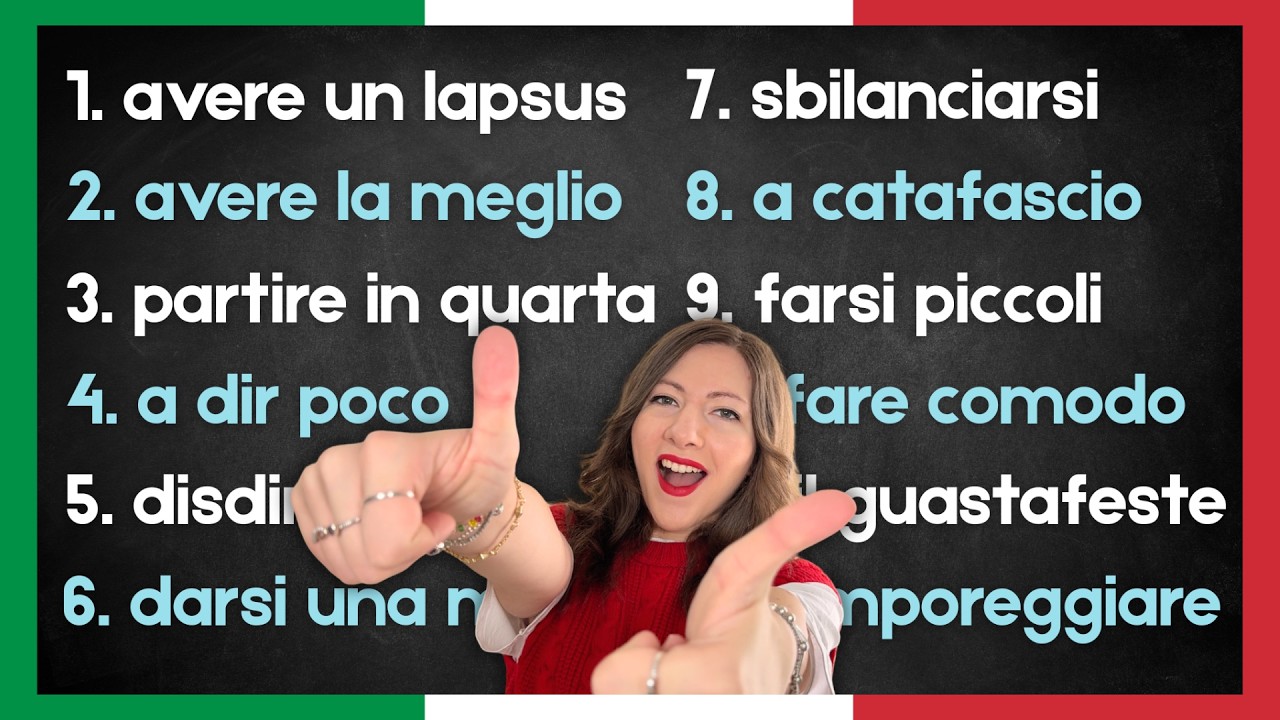
30 Italian Idioms to Speak Like a Native
Part 1: Everyday Life Idioms
1. Rimangiarsi le Parole / Ingoiare il Rospo [To Eat One’s Words / To Swallow the Toad]
“Rimangiarsi le parole“ means having to take back something you said, admitting you were wrong. It’s a very common expression when someone has to backtrack on a previous statement.
Example: “Lucia ha dovuto rimangiarsi le parole quando si è resa conto di aver criticato duramente il capo proprio davanti a lui, senza accorgersi che era lì!” [Lucia had to eat her words when she realized she had harshly criticized the boss right in front of him, without noticing he was there!]
“Ingoiare il rospo“ is similar, but it means accepting something unpleasant without being able to protest. It’s used when you’re forced to accept an unfair or unpleasant situation.
Example: “Ho dovuto ingoiare il rospo e accettare quella promozione ingiusta del mio collega, anche se non la meritava.” [I had to swallow the toad and accept my colleague’s unfair promotion, even though he didn’t deserve it.]
2. Fare Scalpore [To Cause a Stir]
When something fa scalpore, it means that everyone is talking about it, it creates sensation and attracts general attention. It’s a useful expression to describe news, events, or situations that become topics of public discussion.
Example: “Il nuovo film di quel regista ha fatto molto scalpore al Festival di Venezia – critiche entusiaste e polemiche ovunque!” [That director’s new film caused quite a stir at the Venice Festival – enthusiastic reviews and controversy everywhere!]
3. Andare sul Sicuro [To Play It Safe]
This expression means not taking risks, taking precautions to avoid problems or unpleasant situations.
Example: “Ho portato l’ombrello anche se non sembra che pioverà, così vado sul sicuro.” [I brought the umbrella even though it doesn’t look like it will rain, so I’m playing it safe.]
Italians always play it safe, especially with food. If they invite 10 people for dinner, they cook for 20!
4. Per Quanto Ne So / A Quanto Pare [As Far As I Know / Apparently]
These expressions are used when you’re not 100% sure but still want to say something. They’re the Italian way of communicating information without sounding arrogant.
Examples:
- “Per quanto ne so, il negozio è chiuso oggi.” [As far as I know, the shop is closed today.]
- “A quanto pare, domani ci sarà il sole.” [Apparently, it will be sunny tomorrow.]
These phrases allow you to express caution and show that you’re aware of not having absolute certainty on the topic.
5. Andare in Fumo / Andare a Monte [To Go Up in Smoke / To Fall Through]
It’s used when all your work, your efforts, your dreams vanish like smoke. It indicates that something has been completely nullified or cancelled.
Example: “Tutti i suoi progetti sono andati in fumo quando l’azienda ha chiuso improvvisamente.” [All his plans went up in smoke when the company suddenly closed.]
“Andare a monte“ means the same thing and is equally common.
6. Passare alla Storia [To Go Down in History]
When something is so important or so incredible that it will be remembered forever. It’s used in both serious and joking contexts among friends.
Examples:
- “Quel gol di Totti passerà alla storia del calcio italiano.” [That goal by Totti will go down in Italian football history.] (serious context)
- “La tua caduta in piazza davanti a tutti ieri sera passerà alla storia del nostro gruppo!” [Your fall in the square in front of everyone last night will go down in our group’s history!] (joking context)
7. Avere un Successo Strepitoso / Essere un Trionfo / Fare il Botto [To Have Huge Success / To Be a Triumph / To Make a Bang]
These expressions are used when something has huge success. They’re useful for describing events, shows, products, or initiatives that have received great acclaim.
Example: “Il concerto è stato un trionfo, il pubblico urlava ancora dopo tre bis!” [The concert was a triumph, the audience was still screaming after three encores!]
“Fare il botto“ literally means to explode and is particularly expressive.
8. Ad Ogni Morte di Papa [Once in a Blue Moon]
It’s used to indicate something that happens very rarely, almost never. It has an interesting historical origin.
Example: “Vado in palestra ad ogni morte di papa“ [I go to the gym once in a blue moon] means that I go very little, almost never.
Why the death of a pope? Because popes, historically, remained in office for many years, so their death was a rare event.
9. Questa Batte Tutte / Questa È il Massimo [This One Takes the Cake / This Is the Limit]
When someone does something so absurd that it surpasses everything else. It’s useful for expressing disbelief.
Example: “Marco ne ha fatte tante di sciocchezze, ma presentarsi al matrimonio in costume da supereroe, questa batte tutte!” [Marco has done many foolish things, but showing up at the wedding in a superhero costume, this one takes the cake!]
10. Approfittarsi di / Sfruttare [To Take Advantage of / To Exploit]
It means to benefit from a situation or someone. This expression can be negative or neutral, depending on the context. The meaning changes completely based on the situation
Negative use: “Si approfitta sempre della generosità del capo arrivando tardi ogni giorno.” [He always takes advantage of the boss’s generosity by arriving late every day.]
Neutral use: “Ho approfittato del bel tempo per fare una passeggiata in centro.” [I took advantage of the nice weather to take a walk downtown.]
In the second case, it only means “I seized the opportunity”. Context is everything.
Part 2: Idioms About Social Relations and Work
11. Annullare / Cancellare / Disdire [To Cancel / To Call Off]
These verbs mean to nullify a scheduled commitment or event, to declare that something will no longer take place. They are fundamental in Italian everyday life
Example: “Abbiamo dovuto disdire il festival all’aperto quando abbiamo visto le previsioni del tempo.” [We had to cancel the outdoor festival when we saw the weather forecast.]
You can annullare meetings, cancellare events, disdire reservations. In Italy, “disdire” is a word you’ll hear often.
12. I Nodi Vengono al Pettine [The Chickens Come Home to Roost]
It means that hidden problems sooner or later emerge and become visible. It’s that moment when everything comes to the surface and you can no longer ignore the problem.
Example: “I nodi sono venuti al pettine quando lei si è presentata alla festa di famiglia completamente ubriaca.” [The chickens came home to roost when she showed up at the family party completely drunk.]
The origin of the expression: Knots in hair become visible when you comb it, just like hidden problems eventually come out.
13. Puntare Dritto a / Fare a Razzo per [To Head Straight For / To Make a Beeline For]
To go directly toward something without distractions. This expression describes a decisive and determined movement toward a goal.
Example: “Appena è entrato alla festa, ha puntato dritto al tavolo del buffet senza nemmeno salutare!” [As soon as he entered the party, he made a beeline for the buffet table without even saying hello!]
14. Avere un Vuoto di Memoria / Non Ricordare Proprio [To Have a Memory Blank / To Not Remember at All]
It means to temporarily forget something, to be unable to recall information in that specific moment. That moment when your brain decides not to cooperate. It often happens at the most inopportune times, like during an exam or when you run into someone on the street.
Example: “Mi dispiace, ho un vuoto di memoria totale, come si chiama tua sorella?” [I’m sorry, I’m having a total memory blank, what’s your sister’s name?]
15. A Dir Poco / Per Non Dir di Peggio [To Say the Least / Not to Say Worse]
The Italian way of being diplomatic while making it clear that the situation is serious. These expressions indicate that reality is even worse than what you’re saying.
Examples:
- “A dir poco, quella cena non è stata un successo” [To say the least, that dinner wasn’t a success] means it was a total disaster.
- “Il capo era arrabbiato, a dir poco!” [The boss was angry, to say the least!] means he was furious.
16. Avere la Meglio / Avere il Coltello dalla Parte del Manico [To Have the Upper Hand / To Hold All the Cards]
Being in an advantageous position. These expressions describe someone who has control of the situation or decision-making power.
Example: “Silvia ha il coltello dalla parte del manico in questa trattativa perché ha le informazioni che tutti vogliono.” [Silvia holds all the cards in this negotiation because she has the information everyone wants.]
The origin of the expression: Whoever holds the knife by the handle has control of the weapon and therefore of the situation.
17. Mettere i Bastoni tra le Ruote [To Put a Spoke in Someone’s Wheels]
This expression means to hinder someone, to create problems intentionally. The image is clear: sticks in the wheels of a cart stop it.
Example: “I concorrenti hanno cercato di metterci i bastoni tra le ruote, ma siamo riusciti comunque a vincere il contratto.” [The competitors tried to put a spoke in our wheels, but we still managed to win the contract.]
18. Lavarsene le Mani [To Wash One’s Hands of Something]
This expression has a biblical origin (Pontius Pilate) and means not wanting to be involved anymore in a situation, renouncing all responsibility.
Example: “Dopo mesi di discussioni inutili, il manager se ne è lavato le mani e ha lasciato la decisione al consiglio.” [After months of useless discussions, the manager washed his hands of it and left the decision to the board.]
19. Rigare Dritto / Comportarsi Bene [To Toe the Line / To Behave Well]
This is the favorite expression of all parents and coaches. It means to behave well and not cause trouble.
Example: “Riga dritto con i tuoi genitori, altrimenti niente uscite il sabato notte!” [Toe the line with your parents, otherwise no going out on Saturday night!]
20. Darsi una Mossa / Svegliarsi / Muoversi [To Get a Move On / To Wake Up / To Get Moving]
It means to hurry up, to act quickly, to stop wasting time. It’s the expression of impatient coaches and parents in the morning when children won’t get out of bed. It expresses urgency and the need to do something quickly.
Examples:
- “Dai, svegliati! Siamo già in ritardo!” [Come on, wake up! We’re already late!]
- “Datevi una mossa, è il secondo tempo e stiamo perdendo!” [Get a move on, it’s the second half and we’re losing!]
Part 3: Unique and Colorful Idioms
21. Esporsi / Sbilanciarsi / Mettersi in Gioco [To Put Oneself on the Line / To Stick One’s Neck Out]
When you put yourself in a vulnerable position, usually for a good cause. It requires courage and involves a certain personal risk.
Example: “Si è esposto quando ha chiesto alla ragazza di sposarlo durante il concerto davanti a 50.000 persone – rischio altissimo ma per fortuna ha detto sì!” [He put himself on the line when he asked the girl to marry him during the concert in front of 50,000 people – huge risk but luckily she said yes!]
22. Andare a Rotoli / Andare in Malora / Andare a Catafascio [To Go Downhill / To Go to Ruin / To Go to Pieces]
When something drastically worsens. These are very commonly used expressions to describe situations that go badly.
Example: “Questa serie TV è andata in malora dopo la terza stagione!” [This TV series went downhill after the third season!]
“Andare a catafascio“ is even stronger, perfect for situations completely out of control.
23. Passare Sotto i Ferri / Essere sulla Graticola [To Be Put Through the Wringer / To Be on the Hot Seat]
To undergo harsh and continuous criticism. These are very vivid expressions that evoke images of constant pressure.
Example: “Le celebrità devono passare sotto i ferri della critica ogni giorno.” [Celebrities have to go through the wringer of criticism every day.]
“Essere sulla graticola“ is useful when someone asks you a thousand uncomfortable questions, as if you were meat on the grill being turned over and over continuously.
24. Stare in Disparte / Tenere un Profilo Basso / Farsi Piccoli [To Stay on the Sidelines / To Keep a Low Profile / To Make Oneself Small]
When you want to avoid attention for a while. These expressions describe the desire to go unnoticed.
Example: “Stiamo tenendo un profilo basso finché i vicini non dimenticano la nostra festa rumorosa di sabato.” [We’re keeping a low profile until the neighbors forget our noisy party on Saturday.]
“Farsi piccoli piccoli“ is even more expressive – you practically want to disappear.
25. Seppellire l’Ascia di Guerra / Fare Pace [To Bury the Hatchet / To Make Peace]
To end a fight and become friends again. It’s an expression that derives from the Native American tradition and indicates reconciliation after a conflict.
Example: “Mario e Giuseppe hanno seppellito l’ascia di guerra davanti a una pizza e due birre.” [Mario and Giuseppe buried the hatchet over a pizza and two beers.]
In Italy, problems are often solved at the table!
26. Fare le Cose in Grande / Darci Dentro / Non Badare a Spese [To Do Things in a Big Way / To Go All Out / To Spare No Expense]
When you do something without holding back. Italians are famous for doing things in a big way, especially weddings and parties.
Example: “Il team ci ha dato dentro con la scenografia: sembra di essere davvero a Roma!” [The team went all out with the set design: it feels like we’re really in Rome!]
27. Tornare Utile / Fare Comodo / Capitare a Fagiolo [To Come in Handy / To Be Convenient / To Come at the Perfect Moment]
When something turns out to be useful at the right moment. These expressions describe the luck of having what you need exactly when you need it.
Example: “Quel dizionario di modi di dire mi è tornato utilissimo!” [That dictionary of idioms came in very handy for me!]
“Capitare a fagiolo“ is more colloquial and means “to arrive at the perfect moment“.
28. Prendere Tempo / Guadagnare Tempo [To Buy Time / To Gain Time]
It means to strategically delay something to have more time available.
Example: “Non aveva finito il progetto, quindi ha cercato di prendere tempo dicendo che doveva andare dal dottore.” [He hadn’t finished the project, so he tried to buy time by saying he had to go to the doctor.]
29. Esserci per Qualcuno / Stare Vicino a Qualcuno [To Be There for Someone / To Stand by Someone]
When you promise unconditional support. For Italians, friendship is sacred. It’s an almost family bond that is taken very seriously.
Example: “Sei il mio migliore amico, ci sarò sempre per te, qualunque cosa succeda.” [You’re my best friend, I’ll always be there for you, whatever happens.]
30. Rovinare l’Atmosfera / Guastare la Festa / Buttare Acqua sul Fuoco [To Ruin the Atmosphere / To Spoil the Party / To Throw Cold Water on Something]
When someone ruins the moment for everyone. These expressions describe someone who dampens the enthusiasm or joy of others.
Example: “Il suo atteggiamento negativo ha rovinato l’atmosfera alla festa.” [His negative attitude ruined the atmosphere at the party.]
And then there’s “il guastafeste” [the party pooper] – that person who always ruins everything with their negativity.
Stop reading Italian.
Start speaking it.
Online lessons in groups of 4, organised by level and goals, with qualified teachers. Pick the day and time that suit you from the available slots.
Max 4 students:
there’s a seat for you
Summary Table of the 30 Idioms
| No. | Idiom | Meaning | Category |
|---|---|---|---|
| 1 | Rimangiarsi le parole | To take back something you said | Everyday life |
| 2 | Ingoiare il rospo | To accept something unpleasant | Everyday life |
| 3 | Fare scalpore | To cause a sensation, make everyone talk | Everyday life |
| 4 | Andare sul sicuro | To play it safe, take precautions | Everyday life |
| 5 | Per quanto ne so | As far as I know (with uncertainty) | Everyday life |
| 6 | Andare in fumo | To vanish, be nullified | Everyday life |
| 7 | Passare alla storia | To go down in history | Everyday life |
| 8 | Fare il botto | To have huge success | Everyday life |
| 9 | Ad ogni morte di papa | Very rarely | Everyday life |
| 10 | Questa batte tutte | This one takes the cake | Everyday life |
| 11 | Approfittarsi di | To take advantage of / seize the opportunity | Everyday life |
| 12 | Disdire | To cancel | Relations/Work |
| 13 | I nodi vengono al pettine | Hidden problems eventually emerge | Relations/Work |
| 14 | Puntare dritto a | To head straight for | Relations/Work |
| 15 | Avere un vuoto di memoria | To have a memory blank | Relations/Work |
| 16 | A dir poco | To say the least | Relations/Work |
| 17 | Avere il coltello dalla parte del manico | To hold all the cards | Relations/Work |
| 18 | Mettere i bastoni tra le ruote | To put a spoke in someone’s wheels | Relations/Work |
| 19 | Lavarsene le mani | To wash one’s hands of something | Relations/Work |
| 20 | Rigare dritto | To toe the line | Relations/Work |
| 21 | Darsi una mossa | To get a move on | Relations/Work |
| 22 | Esporsi / Sbilanciarsi | To put oneself on the line | Unique |
| 23 | Andare a rotoli | To go downhill | Unique |
| 24 | Essere sulla graticola | To be grilled / under pressure | Unique |
| 25 | Tenere un profilo basso | To keep a low profile | Unique |
| 26 | Seppellire l’ascia di guerra | To bury the hatchet | Unique |
| 27 | Fare le cose in grande | To do things in a big way | Unique |
| 28 | Capitare a fagiolo | To come at the perfect moment | Unique |
| 29 | Prendere tempo | To buy time | Unique |
| 30 | Esserci per qualcuno | To be there for someone | Unique |
Frequently Asked Questions
What’s the Difference Between “Andare in Fumo” and “Andare a Monte”?
Both expressions mean that something has been nullified or cancelled. The difference is mainly stylistic: “andare in fumo” evokes the image of something vanishing like smoke, while “andare a monte” derives from card game language (when a hand of cards is cancelled). You can use them interchangeably in most contexts.
Can I Use These Idioms in Formal Contexts?
Some idioms are also suitable for formal contexts (such as “per quanto ne so“, “a dir poco“, “andare sul sicuro“), while others are more colloquial (such as “fare il botto“, “ad ogni morte di papa“, “capitare a fagiolo“). In general, in work or formal environments, it’s better to use less colorful expressions.
How Can I Better Memorize These Idioms?
The best way to memorize idioms is to use them actively. Try to include one or two in your daily conversations in Italian. You can also create flashcards with the expression on one side and the meaning on the other, or watch Italian movies and TV series paying attention to when they’re used.
Are These Idioms Used Throughout Italy or Only in Some Regions?
The 30 idioms presented in this guide are standard expressions of the Italian language, understood and used throughout the national territory. Of course, each Italian region also has its own local and dialectal idioms, but the ones you’ve learned here will be understood wherever you go in Italy.
Where Do Many of These Italian Idioms Come From?
Italian idioms have diverse origins: some derive from the Bible (such as “lavarsene le mani“), others from the agricultural and rural world (such as “i nodi vengono al pettine“), still others from history (such as “ad ogni morte di papa“) or from adapted foreign cultures (such as “seppellire l’ascia di guerra” from Native Americans). This variety of origins makes the Italian language particularly rich.
If you enjoyed this article, dive into the one about chic and sophisticated Italian expressions to discover the most elegant and refined side of our language.
Access Italian websites and content from anywhere in the world with total security with NordVPN! Use the coupon code LEARNAMO to get a special discount!
Want the lesson PDF with exercises and solutions?
Join the LearnAmo AcademyLoading quiz…
Podcast: Play in new window | Download (Duration: 38:55 — 35.6MB)
Iscriviti: Apple Podcasts | Spotify | Android | iHeartRadio | Podcast Index | TuneIn | Deezer | RSS | Altri...