


What is the difference between ESSERE and STARE? These two verbs may seem similar, but they have very different functions and meanings. In this complete guide, you will learn to distinguish them and use them correctly, with plenty of practical examples, idiomatic expressions, and the most common mistakes to avoid.
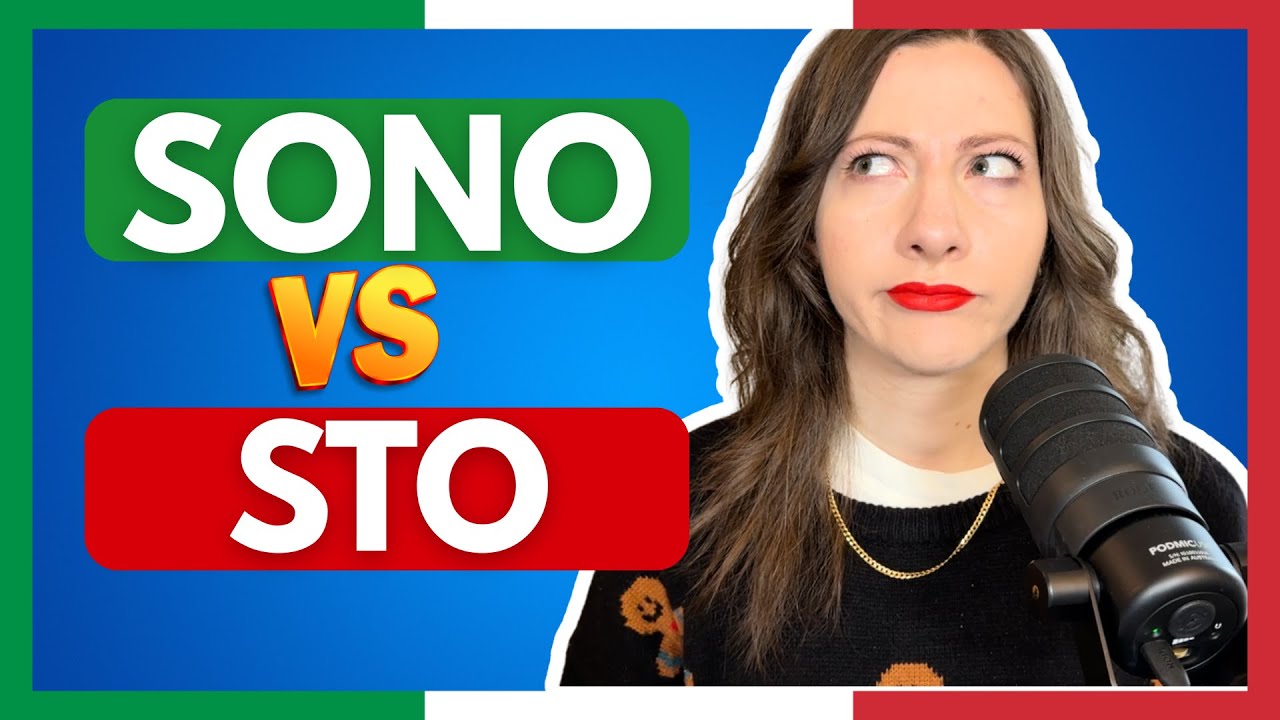
ESSERE vs STARE: When to Use Them?
When to Use the Verb ESSERE
The verb ESSERE is much more frequent in Italian than STARE. You use it in many different situations and it represents the main verb to describe states, conditions, and characteristics.
1. Existence
When you want to communicate that something or someone exists in a particular place, you use ESSERE in the forms c’è (for singular) and ci sono (for plural).
| Example | Explanation |
|---|---|
| C’è un problema con il computer. [There is a problem with the computer.] | There is a problem (singular) |
| Ci sono molti turisti in piazza. [There are many tourists in the square.] | There are many tourists (plural) |
| Non c’è nessuno in casa. [There is nobody at home.] | There is no one |
2. Possession
When you want to indicate that something belongs to someone, you use ESSERE.
| Example | Explanation |
|---|---|
| Questa borsa è mia. [This bag is mine.] | The bag belongs to me |
| Quei libri sono di Marco. [Those books are Marco’s.] | The books belong to Marco |
| Di chi è questo ombrello? [Whose umbrella is this?] | Question about possession |
3. Origin and Nationality
When you want to express where a person comes from or what their nationality is, you use ESSERE followed by a nationality adjective or by the preposition “di” + place.
| Example | Structure |
|---|---|
| Laura è italiana. [Laura is Italian.] | ESSERE + nationality adjective |
| I miei nonni sono messicani. [My grandparents are Mexican.] | ESSERE + nationality adjective |
| Sono di Roma, e tu? [I’m from Rome, and you?] | ESSERE + di + city/place |
4. Profession
When you want to indicate someone’s job or occupation, you use ESSERE followed directly by the profession. Note: in Italian, you don’t use an article before the profession!
| Correct | Incorrect |
|---|---|
| Mio padre è architetto. [My father is an architect.] | Mio padre è un architetto. |
| Siamo studenti universitari. [We are university students.] | Siamo degli studenti universitari. |
| Da grande voglio essere veterinaria. [When I grow up, I want to be a veterinarian.] | Da grande voglio essere una veterinaria. |
5. Description of Qualities
When you want to describe the characteristics of a person, an object, a place, or anything else (physical appearance, personality, taste, temperature…), you use ESSERE.
| Example | Type of Description |
|---|---|
| Marco è simpaticissimo. [Marco is very nice.] | Personality |
| Questa pizza è deliziosa! [This pizza is delicious!] | Taste |
| Il film è noioso. [The movie is boring.] | Quality |
| L’acqua è fredda. [The water is cold.] | Temperature |
| La tua casa è enorme! [Your house is huge!] | Size |
6. Emotions and Moods
When you want to express how you feel emotionally or describe someone’s mood, you use ESSERE. This is a fundamental point that often confuses Spanish-speaking students!
| Example | Emotion/Mood |
|---|---|
| Sono felice di vederti! [I’m happy to see you!] | Happiness |
| Perché sei così nervoso oggi? [Why are you so nervous today?] | Nervousness |
| Siamo preoccupati per l’esame. [We are worried about the exam.] | Worry |
| Era triste perché il suo gatto era malato. [She was sad because her cat was sick.] | Sadness |
7. State of Places and Objects
When you want to describe the condition of a place or an object (open/closed, on/off, full/empty…), you use ESSERE.
- Example: La porta è aperta o chiusa? [Is the door open or closed?]
- Example: Il supermercato è chiuso la domenica. [The supermarket is closed on Sundays.]
- Example: La strada è buia, accendi i fari! [The road is dark, turn on the headlights!]
- Example: Il ristorante era pieno, non c’era neanche un tavolo libero. [The restaurant was full, there wasn’t even a free table.]
8. Position
Here is a crucial point! When you want to indicate where something or someone is located, in standard Italian you use ESSERE.
| Example | Context |
|---|---|
| Dove sei? — Sono in ufficio. [Where are you? — I’m at the office.] | Position of a person |
| Roma è nel Lazio. [Rome is in Lazio.] | Geographical position |
| Le chiavi sono sul tavolo. [The keys are on the table.] | Position of an object |
| Il bagno è in fondo al corridoio. [The bathroom is at the end of the hallway.] | Directions |
| Scusa, sai dov’è la fermata dell’autobus? [Excuse me, do you know where the bus stop is?] | Request for information |
When to Use the Verb STARE
The verb STARE has more specific and limited uses compared to ESSERE. It is essential to know them to avoid common mistakes.
1. Health and General Condition
When you want to ask or answer about someone’s health or general condition, you use STARE. This is probably one of the first things you learn in Italian!
| Question | Answer |
|---|---|
| Come stai? [How are you?] | Sto bene, grazie! [I’m fine, thank you!] |
| Come sta tua madre? [How is your mother?] | Sta meglio, grazie. [She’s better, thank you.] |
| Come state? [How are you (plural)?] | Non sto molto bene oggi, ho mal di testa. [I’m not feeling very well today, I have a headache.] |
2. Physical Body Position
When you want to describe the physical position that a person’s body is assuming (sitting, standing, lying down…), you can use STARE.
- Example: Sto seduta da tre ore, ho mal di schiena! [I’ve been sitting for three hours, my back hurts!]
- Example: Il dottore mi ha detto di stare sdraiato. [The doctor told me to stay lying down.]
- Example: Preferisco stare in piedi, grazie. [I prefer to stand, thank you.]
The Nuance Between “Sono Seduto” and “Sto Seduto”
You can say both sono seduto and sto seduto, but with an important small difference:
| Form | Meaning | Example |
|---|---|---|
| Sono seduto | You simply describe your position, a condition | Sono seduto sulla panchina. [I’m sitting on the bench.] |
| Sto seduto | It’s an active choice, a voluntary action | Sto seduto perché mi fanno male le gambe. [I’m staying seated because my legs hurt.] |
Imagine this scene: you’re on the bus, you see an elderly lady, and you offer her your seat. She replies: “No, grazie, sto in piedi perché scendo tra poco.” [No, thank you, I’ll stand because I’m getting off soon.] In this case, she is choosing to remain standing, she’s not simply describing her position.
3. Staying in a Place
When you want to express that someone remains or spends time in a particular place, you use STARE as a synonym for RIMANERE or RESTARE (to stay/remain).
| Example | Meaning |
|---|---|
| Stasera sto a casa, sono stanca. [Tonight I’m staying home, I’m tired.] | = I’m staying home |
| Quest’estate stiamo in montagna per due settimane. [This summer we’re staying in the mountains for two weeks.] | = we’re staying in the mountains |
| Quanto tempo state in Italia? [How long are you staying in Italy?] | = how long are you remaining |
The Fundamental Difference Between “Sono a Casa” and “Sto a Casa”
If a friend calls you and says:
| Sentence | Meaning |
|---|---|
| “Sono a casa di mia sorella.” [I’m at my sister’s house.] | She simply is there at that moment (position) |
| “Sto a casa di mia sorella.” [I’m staying at my sister’s house.] | She is spending time there, maybe staying for the weekend |
4. Behavior (Imperative)
When you want to tell someone how to behave or invite them to adopt a certain attitude, you use STARE, especially in the imperative form.
| Example | Context |
|---|---|
| Stai zitto! [Be quiet!] | Order to be silent (a bit rude!) |
| State attenti quando attraversate! [Be careful when you cross!] | Invitation to be cautious |
| Sta’ calmo, risolviamo tutto. [Stay calm, we’ll solve everything.] | Invitation to stay calm |
| Bambini, state buoni! [Children, behave yourselves!] | Request to behave well |
5. Fit and Suitability
When you want to express that a garment, a color, or an accessory suits someone or looks good on them, you use STARE.
| Example | Meaning |
|---|---|
| Quel colore ti sta benissimo! [That color looks great on you!] | The color suits you very well |
| Questi pantaloni mi stanno stretti. [These pants are too tight on me.] | The pants don’t fit properly |
| Come mi sta questo cappello? [How does this hat look on me?] | Question about fit |
| Quella giacca non ti sta bene, provane un’altra. [That jacket doesn’t look good on you, try another one.] | The jacket doesn’t suit |
6. Capacity and Fitting
A use that many students don’t know! When you want to indicate that there is enough space to contain something or someone, you use STARE.
| Example | Context |
|---|---|
| In questa macchina ci stanno cinque persone. [Five people fit in this car.] | Capacity of a vehicle |
| Tutti questi vestiti non ci stanno nella valigia! [All these clothes won’t fit in the suitcase!] | Insufficient space |
| Nel frigorifero non ci sta più nulla, è strapieno! [Nothing else fits in the fridge, it’s completely full!] | Exhausted capacity |
| Quante persone ci stanno in questo ascensore? [How many people fit in this elevator?] | Question about capacity |
7. The Two Fundamental Grammatical Structures with STARE
The verb STARE is fundamental in two grammatical constructions that are very commonly used in Italian.
STARE + GERUND (Present Progressive)
You use this structure when you want to indicate an action in progress, something that is happening right now. It also works in the past!
| Tense | Example |
|---|---|
| Present | Cosa stai facendo? — Sto cucinando. [What are you doing? — I’m cooking.] |
| Present | Non posso parlare, sto guidando. [I can’t talk, I’m driving.] |
| Present | Shhh! Il bambino sta dormendo. [Shhh! The baby is sleeping.] |
| Past (imperfect) | Cosa stavi facendo quando ti ho chiamato? — Stavo dormendo! [What were you doing when I called you? — I was sleeping!] |
STARE PER + INFINITIVE (Imminent Future)
You use this structure when you want to indicate an action that will happen very soon.
| Example | Meaning |
|---|---|
| Il treno sta per partire, corri! [The train is about to leave, run!] | The train will leave very soon |
| Sto per addormentarmi, sono esausto. [I’m about to fall asleep, I’m exhausted.] | I’ll fall asleep any moment now |
| Sta per piovere, prendi l’ombrello! [It’s about to rain, take the umbrella!] | It will rain soon |
ESSERE or STARE with the Same Adjective?
There are some adjectives that you can use with both ESSERE and STARE, but the meaning changes. Let’s look at the most common cases and the nuances of meaning.
Tranquillo (Calm)
| Form | Meaning |
|---|---|
| Marco è tranquillo. [Marco is calm.] | Marco is a calm person by nature, it’s a permanent quality |
| Stai tranquillo! [Calm down! / Don’t worry!] | Calm down! Don’t worry! It’s an invitation to behave in a certain way |
Attento (Careful/Attentive)
| Form | Meaning |
|---|---|
| Lucia è molto attenta. [Lucia is very attentive.] | Lucia is an attentive person in general, it’s her characteristic |
| Sta’ attento! [Be careful!] | Pay attention now! You’re about to do something dangerous! |
Zitto (Quiet/Silent)
| Form | Meaning |
|---|---|
| Perché sei così zitto oggi? [Why are you so quiet today?] | Why aren’t you talking? You’re silent (description) |
| Stai zitto! [Be quiet! / Shut up!] | Stop talking! Be silent! (order about behavior) |
Fermo (Still/Stopped)
| Form | Meaning |
|---|---|
| La macchina è ferma. [The car is stopped.] | The car isn’t moving, I’m describing its state |
| Stai fermo! [Stay still! / Don’t move!] | Don’t move! (order) |
Pronto (Ready)
This case is particularly interesting!
| Form | Meaning | Contextualized Example |
|---|---|---|
| Sono pronto. [I’m ready.] | I’ve finished getting ready, I’m describing my current condition | “Sei pronto?” — “Sì, sono pronto, possiamo andare.” [“Are you ready?” — “Yes, I’m ready, we can go.”] |
| Stai pronto! [Get ready! / Be ready!] | Get ready! Something is about to happen! It’s a warning | “Stai pronto che arrivo!” [Get ready, I’m coming!] (playing hide and seek) |
Stop reading Italian.
Start speaking it.
Online lessons in groups of 4, organised by level and goals, with qualified teachers. Pick the day and time that suit you from the available slots.
Max 4 students:
there’s a seat for you
ESSERE and STARE in the Past
How do these verbs work in the past? Here’s something interesting: in the passato prossimo, ESSERE and STARE share the same past participle: “stato”! This can create confusion, but the differences in meaning remain.
ESSERE in the Past
You use ESSERE in the past to describe conditions, states, and emotions in the past.
| Example | Verb Tense | Use |
|---|---|---|
| Ieri ero molto stanco. [Yesterday I was very tired.] | Imperfect | Description of a state |
| La festa è stata bellissima! [The party was wonderful!] | Passato prossimo | Judgment on an event |
| Quando ero piccola, ero molto timida. [When I was little, I was very shy.] | Imperfect | Characteristic in the past |
STARE in the Past
You use STARE in the past to indicate health, staying in a place, or behavior in the past.
| Example | Meaning |
|---|---|
| Come sei stato alla festa? [How was it at the party for you?] | How did you find it? Did you enjoy yourself? |
| Ieri sono stato a casa tutto il giorno. [Yesterday I stayed home all day.] | I remained at home (staying) |
| Siamo stati in Grecia per due settimane. [We stayed in Greece for two weeks.] | We spent two weeks in Greece |
Pay Attention to the Difference!
| Sentence | Meaning |
|---|---|
| Ieri ero a casa. [Yesterday I was at home.] | I simply describe where I was (position) |
| Ieri sono stato a casa tutto il giorno. [Yesterday I stayed home all day.] | I emphasize that I remained, I spent time there |
| Com’era il concerto? [How was the concert?] | I ask for a description/opinion about the concert |
| Come sei stato al concerto? [How was it for you at the concert?] | I ask how you felt, how you personally found it |
Ambiguous Cases: “È Bene” vs “Sta Bene” and Others
There are some expressions where both verbs are possible, but with different nuances that are important to know.
Come Sei? vs Come Stai?
| Question | Meaning | Example Answer |
|---|---|---|
| Come sei? [What are you like?] | I ask for a description (physical appearance, personality) | “Sono alto, moro, abbastanza simpatico…” [“I’m tall, dark-haired, quite friendly…”] |
| Come stai? [How are you?] | I ask about health or general condition | “Sto bene, grazie! E tu?” [“I’m fine, thank you! And you?”] |
È Bene / Va Bene vs Sta Bene
| Expression | Meaning | Example |
|---|---|---|
| È bene così. / Va bene così. [It’s good this way. / It’s fine this way.] | It’s a good thing, it’s right, it’s correct | “Hai deciso di studiare medicina? È bene così, sarai un ottimo dottore!” [“You decided to study medicine? That’s good, you’ll be a great doctor!”] |
| Sta bene così. [That’s enough. / It’s fine like this.] | It’s sufficient, it’s fine as is, nothing more is needed | “Vuoi altro caffè?” — “No grazie, sto bene così.” [“Do you want more coffee?” — “No thanks, I’m fine like this.”] |
Ci Sta Tutto vs È Tutto Qui
| Expression | Meaning |
|---|---|
| È tutto qui. [This is all there is.] | This is everything, there’s nothing else (description) |
| Ci sta tutto qui. [Everything fits here.] | All of this fits here, there’s enough space (capacity) |
The Most Common Mistakes Made by Foreign Students
This section is essential for recognizing and avoiding the typical mistakes that Italian learners make based on their native language.
Mistakes by Spanish and Portuguese Speaking Students
In Spanish and Portuguese, estar/estou is used for position and for temporary states, so many students get confused.
Mistake 1: Temporary Moods
| Incorrect | Correct | Explanation |
|---|---|---|
| “Sto felice“ (from “Estoy feliz”) | “Sono felice“ [I’m happy] | In Italian you always use ESSERE for emotions |
| “Sto triste“ | “Sono triste“ [I’m sad] | Even for temporary states! |
| “Sto stanco“ | “Sono stanco“ [I’m tired] | Never STARE for emotional/physical conditions |
In Spanish, there’s a distinction between “Soy feliz” (permanent characteristic) and “Estoy feliz” (temporary state). In Italian, however, you always use ESSERE, both for permanent characteristics and for temporary states: Sono una persona felice [I’m a happy person] (characteristic) and Oggi sono felice perché è il mio compleanno! [Today I’m happy because it’s my birthday!] (temporary state).
Mistake 2: The Position of Objects
| Incorrect | Correct |
|---|---|
| “Le chiavi stanno sul tavolo“ | “Le chiavi sono sul tavolo“ [The keys are on the table] |
| “Il libro sta sulla scrivania“ | “Il libro è sulla scrivania“ [The book is on the desk] |
To indicate where an object is located, in standard Italian you always use ESSERE.
Mistakes by English Speaking Students
Native English speakers sometimes confuse the structure “I am being…” and incorrectly translate it with STARE.
| Incorrect | Correct | Origin of the mistake |
|---|---|---|
| “Sto serio“ | “Sono serio“ / “Parlo sul serio“ [I’m serious / I mean it] | “I am being serious” |
| “Stai stupido!” | “Non fare lo stupido!” / “Stai facendo lo stupido!“ [Don’t be stupid! / You’re being stupid!] | “You are being stupid!” |
Important rule: “I am being + adjective” in Italian is often translated with “fare + article + adjective” or with ESSERE!
Mistakes by German Speaking Students
German students may have difficulty with the STARE + gerund structure, because in German there is no direct equivalent of the present progressive. In German, you simply say “Ich koche” (I cook), without distinction.
| Italian | Meaning | German |
|---|---|---|
| Cucino ogni giorno. [I cook every day.] | Habitual action | Ich koche jeden Tag. |
| Sto cucinando. [I’m cooking.] | Action in progress right now | Ich koche (gerade). |
Mistakes by French Speaking Students
In French, être covers both ESSERE and STARE in most cases. The advice for French students is: use ESSERE as the general rule (like être in French), and learn the specific cases where STARE is used!
Idiomatic Expressions with ESSERE and STARE
Idiomatic expressions are the secret to speaking like a real Italian! Here are the most common and useful ones.
Expressions with ESSERE
| Expression | Meaning | Example |
|---|---|---|
| Essere al verde | To be broke (have no money) | Non posso uscire stasera, sono al verde! [I can’t go out tonight, I’m broke!] |
| Essere in gamba | To be smart, capable, sharp | Tua figlia è davvero in gamba, ha superato tutti gli esami! [Your daughter is really smart, she passed all her exams!] |
| Essere tra le nuvole | To be distracted, daydreaming | Ehi, mi ascolti? Sei sempre tra le nuvole! [Hey, are you listening to me? You’re always daydreaming!] |
| Essere al settimo cielo | To be over the moon (very happy) | Quando ha saputo di aver vinto, era al settimo cielo! [When he found out he won, he was over the moon!] |
| Essere in un mare di guai | To be in deep trouble | Se il capo scopre quello che hai fatto, sarai in un mare di guai! [If the boss finds out what you did, you’ll be in deep trouble!] |
| Essere un pesce fuor d’acqua | To feel out of place | Alla festa di laurea di mio cugino ero un pesce fuor d’acqua, non conoscevo nessuno. [At my cousin’s graduation party, I felt like a fish out of water, I didn’t know anyone.] |
| Essere una buona forchetta | To be a big eater (to enjoy food) | Mio nonno è una buona forchetta, finisce sempre tutto! [My grandfather is a big eater, he always finishes everything!] |
Expressions with STARE
| Expression | Meaning | Example |
|---|---|---|
| Stare fresco | To be in for a surprise (ironic, meaning you won’t get what you want) | Se pensi che ti presterò altri soldi, stai fresco! [If you think I’ll lend you more money, think again!] |
| Stare sulle spine | To be on pins and needles (anxious) | Sto sulle spine, aspetto i risultati dell’esame! [I’m on pins and needles, waiting for the exam results!] |
| Stare con le mani in mano | To sit around doing nothing | Non puoi stare con le mani in mano tutto il giorno, aiutami! [You can’t sit around doing nothing all day, help me!] |
| Starci | To be in (to agree to something) | Andiamo al cinema stasera? — Sì, ci sto! [Shall we go to the movies tonight? — Yes, I’m in!] |
| Stare alle calcagna di qualcuno | To be on someone’s heels (to follow closely) | Il mio capo mi sta sempre alle calcagna, non mi lascia respirare! [My boss is always on my heels, he doesn’t give me any breathing room!] |
| Stare sullo stomaco | To not be able to stand someone | Quel collega mi sta proprio sullo stomaco, è così antipatico! [I really can’t stand that colleague, he’s so unpleasant!] |
| Non stare nella pelle | To be beside oneself with excitement | Non sto nella pelle! Domani parto per il Giappone! [I’m beside myself with excitement! Tomorrow I’m leaving for Japan!] |
Summary Chart: ESSERE vs STARE
| ESSERE | STARE |
|---|---|
| Existence (c’è, ci sono) | Health (Come stai?) |
| Possession | Physical body position (active choice) |
| Origin and nationality | Staying in a place (= to remain) |
| Profession | Behavior (imperative) |
| Description of qualities | Fit/suitability |
| Emotions and moods | Capacity/fitting |
| State of places/objects | STARE + gerund (action in progress) |
| Position (where something is) | STARE PER + infinitive (imminent future) |
Frequently Asked Questions
Can I Say “Sto Felice” in Italian?
No. In Italian, you always say “Sono felice”, both to express a permanent characteristic and a temporary state. This is different from Spanish, where there’s a distinction between “Soy feliz” and “Estoy feliz”. In Italian, all emotions and moods require the verb ESSERE: sono triste [I’m sad], sono arrabbiato [I’m angry], sono stanco [I’m tired], sono contento [I’m happy].
What Is the Difference Between “Dove Sei?” and “Dove Stai?”
In most cases, they are interchangeable in everyday speech. However, there’s a nuance: “Dove sei?” [Where are you?] is the more neutral and universal form, while “Dove stai?” can also mean “Where are you staying? Where are you lodging?” (it indicates staying somewhere). For example, if a friend comes to visit you on vacation and you ask “Dove stai?”, it clearly means “Which hotel are you staying at?”.
Why Do You Say “Come Stai?” but “Sono Stanco”?
Because “Come stai?” refers specifically to a person’s health and general condition (a specific use of STARE), while “stanco” describes a physical/emotional state, which requires ESSERE. They are two different grammatical functions: STARE to ask about health, ESSERE to describe conditions.
When Do I Use “STARE + Gerund”?
Use STARE + gerund when you want to indicate an action that is happening right now: “Sto mangiando” [I’m eating] (now), “Sto lavorando” [I’m working] (at this moment). Don’t use it for habitual actions: “Mangio sempre alle 13” [I always eat at 1 PM] (simple present, not *Sto sempre mangiando alle 13).
What Does “Ci Sto!” Mean?
“Ci sto!” is a very common idiomatic expression that means “I agree!” or “I’m in!”. It’s used to accept a proposal: “Andiamo al cinema?” — “Sì, ci sto!” [“Shall we go to the movies?” — “Yes, I’m in!”]. It’s a colloquial and informal expression very commonly used among friends.
How Do You Say “The Dress Looks Good on You” in Italian?
You say “Il vestito ti sta bene” using the verb STARE. In Italian, when you talk about how a garment, a color, or an accessory suits someone, you always use STARE: “Quel colore ti sta benissimo!” [That color looks great on you!], “Questi pantaloni mi stanno stretti” [These pants are too tight on me].
Why Do ESSERE and STARE Have the Same Past Participle?
It’s a peculiarity of the Italian language! Both verbs use the past participle “stato”: “sono stato” can mean both “I was” (ESSERE) and “I stayed” (STARE). Context always clarifies the meaning: “La festa è stata bella” [The party was nice] (ESSERE – judgment) vs “Sono stato a casa” [I stayed at home] (STARE – staying).
What Is the Most Important Rule to Remember?
The golden rule is: ESSERE is the main verb in Italian, the one you’ll use in most situations (descriptions, emotions, positions, professions…). STARE, on the other hand, has more specific and limited uses: health, behavior, staying somewhere, fit/suitability, and the two structures with gerund and “per + infinitive.” When in doubt, ask yourself: “Am I describing something?” → probably ESSERE. “Am I talking about health, behavior, or staying somewhere?” → probably STARE.
Now that you know the difference between ESSERE and STARE, take the next step: discover Italian pronominal verbs and test your skills!
Do pronominal verbs trip you up and fill you with doubts? Turn confusion into confidence with our exclusive course: “Da «Non ce la faccio più» a «Ora me la cavo»: i verbi pronominali in 30 giorni.” With fun, bite-size lessons and targeted practice, you’ll learn to use them naturally in just one month.
Want the lesson PDF with exercises and solutions?
Join the LearnAmo AcademyLoading quiz…
Podcast: Play in new window | Download (Duration: 28:08 — 38.9MB)
Iscriviti: Apple Podcasts | Spotify | Android | iHeartRadio | Podcast Index | TuneIn | Deezer | RSS | Altri...