


Words like «per favore» [please], «mi dispiace» [I’m sorry], «sto bene» [I’m fine], «sono stanco» [I’m tired], «sono triste» [I’m sad] and «mi annoio» [I’m bored] are among the most used in Italian — but always using them only in their basic form can make your Italian sound repetitive and unnatural. In this article you will find 30 alternatives to enrich your vocabulary and speak in a more varied, precise and authentic way.
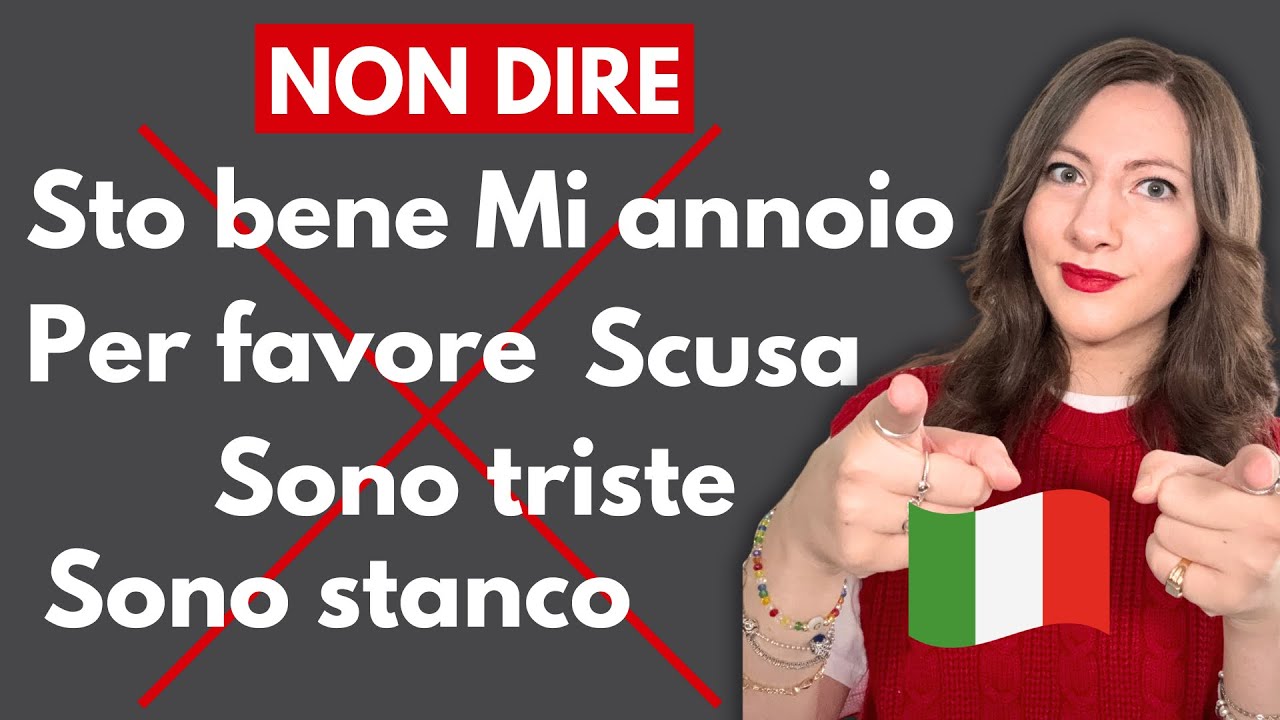
Alternatives to 6 Common Italian Expressions
1. Alternatives for «Per Favore» [Please]
When you want to make a request in a more polite, formal or nuanced way, these expressions are much richer than the simple «per favore» [please].
Le Dispiacerebbe / Ti Dispiacerebbe…? [Would you mind…?]
A polite and indirect formula for making a request. Using the conditional instead of the imperative makes the question much less direct and more respectful — it leaves the other person free to choose without feeling obliged. «Le dispiacerebbe» is used in the formal register, with people you don’t know well, with superiors or in professional contexts; «ti dispiacerebbe» in the informal register, with friends and family.
- «Ti dispiacerebbe passarmi il sale?» [Would you mind passing me the salt?]
- «Le dispiacerebbe chiudere la porta? C’è corrente.» [Would you mind closing the door? There’s a draught.]
Le/Ti Sarei Grato/a Se Potesse/Potessi… [I would be grateful if you could…]
A formal and very courteous expression that conveys anticipatory gratitude — you thank the person before they have agreed, which is a sign of respect and humility. It is particularly effective in written contexts such as emails or professional messages, but also works well in speech when you want to give a specially respectful tone to the request. The gender agreement (grato/grata) must be adapted to your own grammatical gender.
- «Ti sarei grata se potessi lasciarmi dormire qui stanotte.» [I would be grateful if you could let me sleep here tonight.]
- «Le sarei grato se potesse mandarmi i documenti entro domani.» [I would be grateful if you could send me the documents by tomorrow.]
Sarebbe in Grado di / Saresti in Grado di…? [Would you be able to…?]
Used when you want to know whether someone has the ability, the knowledge or the practical availability to do something. Unlike the simple «puoi…?» [can you…?], this formula is more thoughtful and also considers the other person’s real possibilities, not just their willingness. It is less pressuring and leaves more room for a negative answer without awkwardness.
- «Saresti in grado di venirmi a prendere alla stazione stasera?» [Would you be able to come and pick me up at the station tonight?]
- «Sarebbe in grado di gestire il progetto da solo per una settimana?» [Would you be able to manage the project alone for a week?]
Non È che per Caso Potrebbe/Potresti…? [I don’t suppose you could…? / Any chance you could…?]
A very colloquial and indirect formula, typical of everyday Italian speech. It softens the request by making it almost casual, as if you were not necessarily expecting a positive answer. This makes it less awkward to ask and less pressuring to receive — it is an elegant way of asking for something without seeming insistent or needy. It is used almost exclusively in the informal register.
- «Non è che per caso potresti prestarmi la bicicletta per questo pomeriggio?» [Any chance you could lend me the bicycle this afternoon?]
- «Non è che per caso potreste darmi un passaggio fino in centro?» [I don’t suppose you could give me a lift to the city centre?]
Mi Chiedo Se Potrebbe/Potresti… [I wonder if you could…]
A reflective and very polite formula, typical of semi-formal contexts. By presenting the request as a personal thought rather than a direct question, it leaves the other person the maximum freedom to respond without creating pressure. It is especially suitable in the workplace when you want to propose something delicately without imposing it.
- «Mi chiedo se potresti rinviare la riunione di qualche giorno.» [I wonder if you could postpone the meeting by a few days.]
- «Mi chiedo se potrebbe dedicarmi cinque minuti del suo tempo.» [I wonder if you could spare me five minutes of your time.]
2. Alternatives for «Mi Dispiace / Scusa» [I’m Sorry / Excuse Me]
Depending on the seriousness of the situation and the linguistic register, there are much more expressive and precise ways of apologising. Some of these expressions communicate not only regret, but also awareness of the mistake and the willingness to take responsibility.
È Stata una Mia Mancanza / Disattenzione [It was an oversight / a lapse of attention on my part]
Used when you acknowledge having made a mistake not out of bad intention, but through negligence or inattention. The word «mancanza» [failing] suggests that a duty or responsibility has not been fulfilled; «disattenzione» [lapse of attention] instead indicates that something important was simply overlooked. Both variants are more precise and nuanced than the generic «mi dispiace» and convey a greater awareness of the mistake.
- «È stata una mia mancanza averti avvertito così tardi — me ne scuso.» [It was an oversight on my part to warn you so late — I apologise for it.]
- «È stata una mia disattenzione: avrei dovuto controllare i dati prima di mandarti il file.» [It was a lapse of attention on my part: I should have checked the data before sending you the file.]
Ti Devo delle Scuse [I owe you an apology]
A direct and mature formula that explicitly acknowledges the debt of an apology to the other person. Unlike the simple «scusa» [sorry], which can seem automatic or insincere, this expression communicates that you are fully aware of having done something that warrants a formal apology and that you are ready to make it. It can be used both in speech and in writing, in formal and informal contexts.
- «Ti devo delle scuse per il mio comportamento di ieri sera — non avrei dovuto risponderti così.» [I owe you an apology for my behaviour last night — I shouldn’t have answered you like that.]
- «So che ti devo delle scuse da un po’ — ho aspettato troppo a dirtelo.» [I know I’ve owed you an apology for a while — I waited too long to tell you.]
Mi Assumo la Piena Responsabilità delle Mie Azioni [I take full responsibility for my actions]
A formal and serious expression that leaves no room for ambiguity or attempts to minimise the mistake. It indicates full awareness of what has been done and the willingness not to look for justifications. It is used mainly in professional contexts — after a serious work mistake, in official communications or in situations where the consequences of the mistake are significant and require a clear and unequivocal assumption of responsibility.
- «Mi assumo la piena responsabilità delle mie azioni e sono pronto ad affrontarne le conseguenze.» [I take full responsibility for my actions and am ready to face the consequences.]
- «Non voglio fare scaricabarile: mi assumo la piena responsabilità di questo errore.» [I don’t want to pass the buck: I take full responsibility for this mistake.]
Sono Mortificato/a [I am mortified]
Expresses deep shame and sincere regret for something one has done. It goes beyond simple repentance: it indicates that you feel humiliated by your behaviour and profoundly disturbed by it. It is a very heartfelt and authentic expression that immediately conveys the intensity of the regret. It works well both in speech and in writing, and in both formal and informal contexts.
- «Sono mortificata: non avrei mai voluto che la situazione degenerasse così.» [I am mortified: I never wanted the situation to deteriorate like this.]
- «Sono mortificato per quello che è successo — ti chiedo di credermi.» [I am mortified by what happened — I ask you to believe me.]
Spero che Tu Possa Trovare nel Tuo Cuore la Forza di Perdonarmi [I hope you can find it in your heart to forgive me]
A very emphatic and theatrical formula that takes the request for forgiveness to an almost melodramatic level. The tone is deliberately exaggerated, which makes it effective in two opposite contexts: among friends to deflate a light situation with irony, or in truly serious moments to underline how guilty one feels. The effect depends entirely on the context and the tone of voice with which it is said.
- «Ho finito il tuo gelato… spero che tu possa trovare nel tuo cuore la forza di perdonarmi.» [I ate your ice cream… I hope you can find it in your heart to forgive me.]
- «So che ti ho deluso tantissimo. Spero che tu possa trovare nel tuo cuore la forza di perdonarmi.» [I know I’ve let you down terribly. I hope you can find it in your heart to forgive me.]
3. Alternatives for «Sto Bene / Così Così» [I’m Fine / So-So]
Always replying with «sto bene» [I’m fine] is generic and not very expressive. These alternatives allow you to communicate more precisely how you actually feel — from maximum enthusiasm to the most philosophical resignation.
Non Potrei Stare Meglio [I couldn’t be better]
Used when you feel wonderful, at the very top of your form — physically and mentally. The negative structure of the conditional emphasises that there is no better state than the current one: it is the maximum possible, and you know it. It is an enthusiastic and positive response that conveys energy and satisfaction. It works well in everyday speech as well as in more formal contexts.
- «Come stai dopo le vacanze?» «Non potrei stare meglio, grazie! Mi sono riposata moltissimo.» [How are you after the holidays? “I couldn’t be better, thank you! I’ve rested a great deal.”]
- «Non potrei stare meglio: ho appena saputo che ho ottenuto il lavoro.» [I couldn’t be better: I’ve just found out I got the job.]
Sono in Gran Forma! [I’m in great shape!]
Used when you feel healthy, full of energy and ready to face the day. It has a more physical nuance than «non potrei stare meglio» — it indicates above all physical wellbeing, vitality and good overall condition. It is a lively and positive expression, very common in informal speech, often accompanied by an enthusiastic tone.
- «Come ti senti dopo l’operazione?» «Sono in gran forma! Mi hanno detto che sono guarito benissimo.» [How are you feeling after the operation? “I’m in great shape! They told me I’ve recovered very well.”]
- «Ho dormito dieci ore — sono in gran forma stamattina.» [I slept ten hours — I’m in great shape this morning.]
Non C’è Male / Niente Male [Not bad / Not bad at all]
A fairly neutral response equivalent to “pretty well” without enthusiasm or complaints. It is one of the most typical responses from the average Italian: no exaggerating on the positive side, but no complaining either. It has a slightly understated connotation, typical of everyday Italian communication — you’re fine, but you don’t shout it from the rooftops.
- «Come va?» «Non c’è male, grazie. E tu?» [How’s it going? “Not bad, thanks. And you?”]
- «Com’è andata la settimana?» «Niente male — qualche problema, ma niente di grave.» [How did the week go? “Not bad at all — a few problems, but nothing serious.”]
Sono Stato Peggio / Ne Ho Passate di Peggiori [I’ve been worse / I’ve been through worse]
Used when you’re not at your best, but you acknowledge with a certain philosophical attitude that things could be worse. It has a resigned but not negative tone — it is a way of putting your own condition in perspective without openly complaining. It is often used with irony or a smile, and conveys a certain maturity in dealing with difficult moments.
- «Come stai dopo quella brutta influenza?» «Sono stato peggio — piano piano sto recuperando.» [How are you after that nasty flu? “I’ve been worse — I’m slowly recovering.”]
- «È stato un mese difficile, ma ne ho passate di peggiori. Ce la farò.» [It’s been a difficult month, but I’ve been through worse. I’ll manage.]
Potrei Stare Meglio [I could be better]
Used when you’re not feeling very well, without going into detail. It is an elegant and discreet way of communicating discomfort without dramatising or opening a long conversation about your state of mind. It leaves the other person the choice of whether to probe further or not — whoever wants to understand will ask more, whoever doesn’t want to get involved can let it pass.
- «Come stai?» «Potrei stare meglio, a dirti la verità.» [How are you? “I could be better, to tell you the truth.”]
- «Potrei stare meglio — è stata una settimana pesante e ho bisogno di staccare.» [I could be better — it’s been a heavy week and I need to switch off.]
Me la Cavo [I’m managing / I’m getting by]
Indicates that you’re getting by, managing — neither well nor badly. It comes from the pronominal verb cavarsela, meaning to cope with a situation. As a response to «come stai?» [how are you?], it is the Italian version of the French «ça va»: it expresses neither enthusiasm nor discomfort — just a placid everyday existence. It is very common in everyday speech and conveys a sense of modesty and pragmatism.
- «Come te la passi?» «Me la cavo, grazie — niente di speciale.» [How are you getting on? “I’m managing, thanks — nothing special.”]
- «Riesci a stare dietro a tutto il lavoro?» «Me la cavo, anche se ogni tanto è dura.» [Are you managing to keep up with all the work? “I’m managing, even though it’s tough sometimes.”]
4. Alternatives for «Sono Triste» [I’m Sad]
Sadness has many shades — from a slight melancholy to a deep desolation. These expressions allow you to communicate them precisely, choosing the one most appropriate to the intensity of what you feel.
Sono a Pezzi [I’m in pieces / I’m shattered]
Indicates great sadness or disappointment — you feel emotionally destroyed, like something whole that has broken into pieces. It is used after particularly painful events: a romantic break-up, a loss, a deep disappointment. It is a very strong and visual expression that immediately communicates the intensity of the pain without the need for further explanation.
- «Da quando si è lasciata con Marco è a pezzi — non riesce nemmeno a mangiare.» [Since she broke up with Marco she’s been in pieces — she can’t even eat.]
- «Sono a pezzi: non me lo aspettavo proprio, mi ha preso completamente di sorpresa.» [I’m in pieces: I really didn’t expect it, it caught me completely off guard.]
Sono Assolutamente Devastato/a / Distrutto/a [I am absolutely devastated / destroyed]
Used when you are profoundly affected by a serious or unexpected event, to the point of feeling overwhelmed. The adverb «assolutamente» amplifies the intensity of the feeling and leaves no doubt about the magnitude of the pain. Compared to «sono a pezzi», it has a slightly more formal nuance and also lends itself well to written communication, such as in a message or a letter.
- «Sono assolutamente devastata dalla notizia — non riesco ancora a crederci.» [I am absolutely devastated by the news — I still can’t believe it.]
- «Dopo quella sconfitta era distrutto — ci aveva messo tutto se stesso.» [After that defeat he was destroyed — he had put everything he had into it.]
Mi Sento Davvero Giù / Depresso/a [I feel really low / depressed]
Used when you feel downcast and your mood is low, without necessarily having a precise cause. «Giù» [down] is a very colloquial term that visually describes a descending mood. «Depresso/a» is stronger and indicates a more persistent and deep condition — it should be used with awareness, because in certain contexts it can be interpreted in a clinical sense.
- «Ultimamente mi sento davvero giù — non so bene perché, ma non riesco a tirarmi su di morale.» [Lately I’ve been feeling really low — I don’t quite know why, but I can’t seem to lift my spirits.]
- «È un periodo difficile: mi sento un po’ depresso e faccio fatica a trovare motivazione.» [It’s a difficult period: I feel a bit depressed and I’m struggling to find motivation.]
Ho il Morale a Terra [My morale is at rock bottom]
Used when you feel poorly motivated, without mental energy and without the desire to do anything. The image of morale “at rock bottom” evokes something heavy that has fallen low and struggles to get back up. It is a very common expression in everyday speech and describes a prolonged state of mind, often without a specific triggering cause — a tiredness of the soul rather than of the body.
- «Dopo quel colloquio andato male ho il morale a terra — non so se ci riproverò.» [After that interview that went badly my morale is at rock bottom — I don’t know if I’ll try again.]
- «Ho il morale a terra da settimane: forse ho bisogno di una pausa.» [My morale has been at rock bottom for weeks: perhaps I need a break.]
Sono un Po’ Giù di Corda [I’m a bit down / a bit flat]
Used to describe a mild and diffuse sadness, a feeling of melancholy that doesn’t necessarily have a precise cause. The image of the “cord” evokes something loosened that has lost tension and can’t manage to stay taut. It is more nuanced than «sono a pezzi» or «ho il morale a terra» — suitable for communicating a low-mood moment without dramatising.
- «Oggi sono un po’ giù di corda — forse è solo stanchezza accumulata.» [Today I’m a bit flat — perhaps it’s just accumulated tiredness.]
- «Non preoccuparti, sono un po’ giù di corda ma passerà — capita a tutti ogni tanto.» [Don’t worry, I’m a bit down but it’ll pass — it happens to everyone from time to time.]
5. Alternatives for «Sono Stanco/a» [I’m Tired]
Tiredness too has different gradations — from simple weariness to total exhaustion. These expressions allow you to communicate it in a more precise and colourful way, choosing the one most appropriate to the intensity of what you are experiencing.
Sono Esausto/a [I’m exhausted]
Used when you are at the limit of tiredness — energy reserves are completely depleted, both physically and mentally. It is stronger and more definitive than the simple «sono stanco» [I’m tired] and leaves no doubt about the intensity of what you feel. It has a neutral register and works well in both informal speech and more formal contexts.
- «Dopo tre turni di notte consecutivi sono esausta — ho bisogno di dormire almeno dodici ore.» [After three consecutive night shifts I’m exhausted — I need to sleep at least twelve hours.]
- «Sono esausto mentalmente: questo progetto mi ha prosciugato ogni energia.» [I’m mentally exhausted: this project has drained me of every bit of energy.]
Ho le Pile Scariche [My batteries are flat]
A colloquial and very vivid expression: you’ve run out of energy like a flat battery that can no longer power anything. It is a modern and immediate metaphor, very common especially among young people. It communicates tiredness in a light and visual way, without the heavy tone of expressions like «sono stremato» — it is perfect for situations of ordinary but intense tiredness.
- «Ho le pile scariche — questa settimana è stata un massacro.» [My batteries are flat — this week has been brutal.]
- «Non ce la faccio a uscire stasera, scusa: ho le pile completamente scariche.» [I can’t go out tonight, sorry: my batteries are completely flat.]
Sono Stremato/a [I’m worn out / exhausted to the limit]
Indicates a deep and draining tiredness, often caused by a prolonged effort over time — physical, mental or emotional. It has a more literary and formal tone than «sono esausto» and suggests that not only have you reached your limit, but the process that led to this state has been long and consuming. It is often used to describe periods of great sustained effort.
- «Dopo tre mesi di preparazione per gli esami sono stremata — ho dato tutto quello che avevo.» [After three months of exam preparation I’m worn out — I’ve given everything I had.]
- «I soccorritori erano stremati dopo quarantotto ore di operazioni ininterrotte.» [The rescue workers were worn out after forty-eight hours of uninterrupted operations.]
Mi Sento uno Straccio [I feel like a wrung-out rag]
Used when you feel worn down and battered by too many things to do — exhausted and shattered, like a used and wrinkled rag after a lot of work. It is a very colourful and colloquial expression, typical of informal speech. It communicates not just physical tiredness, but also the feeling of having been worn down by circumstances without having had time to recover.
- «Tre bambini piccoli, lavoro e casa: mi sento uno straccio dalla mattina alla sera.» [Three small children, work and home: I feel like a wrung-out rag from morning to night.]
- «Dopo quella settimana di trasferte mi sentivo uno straccio — non riuscivo nemmeno a parlare.» [After that week of work trips I felt like a wrung-out rag — I couldn’t even speak.]
Sono Completamente Svuotato/a [I’m completely empty / drained]
Used when you are drained of all energy, both physical and mental. The image of “emptiness” suggests that nothing remains inside — neither strength, nor enthusiasm, nor emotional resources. It is especially suited to describing tiredness after periods of great stress or prolonged effort, and has a more emotional nuance than «sono esausto» — you’re not just tired, you’re also emotionally empty.
- «Dopo mesi di assistenza al mio familiare malato sono completamente svuotata — non ho più niente da dare.» [After months of caring for my sick family member I’m completely drained — I have nothing left to give.]
- «Sono completamente svuotato: è come se qualcuno avesse aperto un rubinetto e avesse fatto scolare via tutto.» [I’m completely drained: it’s as if someone had opened a tap and let everything drain away.]
Non Ce la Faccio più [I can’t take it anymore / I’ve had enough]
Indicates the limit of one’s strength — physical or emotional. You have reached the breaking point, beyond which you can no longer go on. It can express deep tiredness, but also frustration, emotional overwhelm or the feeling of not being able to bear a situation any longer. It is a very direct and sincere expression that immediately communicates the intensity of what you feel.
- «Non ce la faccio più con questi ritmi: devo prendermi una pausa, altrimenti crollo.» [I can’t take this pace anymore: I need to take a break, otherwise I’ll collapse.]
- «Ho provato a resistere, ma non ce la faccio più — ho bisogno di aiuto.» [I’ve tried to hold on, but I can’t take it anymore — I need help.]
6. Alternatives for «Mi Annoio» [I’m Bored]
Boredom in Italian can be expressed in many ways — from the colloquial register to youth slang. Some of these expressions are very vivid and characteristic of everyday speech, and communicate not just boredom but also the intensity and quality of the experience.
Mi Sto Rompendo (le Scatole / le Palle) [I’m getting really fed up / I’m losing my patience]
A very colloquial expression indicating deep boredom and growing intolerance. The version with «le scatole» [the boxes] is informal but acceptable in everyday speech between people who know each other well; the one with «le palle» is vulgar and should be used carefully depending on the context. Both communicate that the situation has become unbearable and that patience is about to run out — it’s not just boredom, it’s active irritation.
- «Sono tre ore che aspetto e mi sto rompendo le scatole: qualcuno mi dica qualcosa.» [I’ve been waiting for three hours and I’m getting really fed up: someone tell me something.]
- «Mi sto rompendo le scatole di fare sempre le stesse cose — ho bisogno di cambiare aria.» [I’m getting really fed up of always doing the same things — I need a change of scenery.]
Mi Sto Scocciando [I’m getting annoyed / I’m losing patience]
Indicates that patience is wearing thin due to boredom or a situation that is dragging on without interest. It is less strong than «mi sto rompendo le scatole» — it suggests a growing but still contained irritation, more of a nuisance than true intolerance. It is typical of central and southern Italian speech and is very common in everyday conversation.
- «Mi sto scocciando di aspettare — sono qui da mezz’ora.» [I’m getting annoyed with waiting — I’ve been here for half an hour.]
- «Mi sto scocciando di questa situazione: si potrebbe risolvere in cinque minuti se ci fosse un po’ di buona volontà.» [I’m losing patience with this situation: it could be resolved in five minutes if there were a bit of goodwill.]
Il Tempo Non Passa Mai [Time never passes]
Used when you find yourself in a boring situation and time seems to pass very slowly, almost as if it had stopped. It doesn’t just describe boredom in an abstract sense, but the subjective perception of time not moving forward — typical of situations like an endless meeting, an agonising wait or an empty afternoon with nothing to do. It is a very common and universally recognisable observation.
- «Guardo l’orologio ogni cinque minuti: il tempo non passa mai quando non hai niente da fare.» [I look at the clock every five minutes: time never passes when you have nothing to do.]
- «In quella sala d’attesa il tempo non passava mai — sembravano ore anche solo cinque minuti.» [In that waiting room time never passed — even five minutes seemed like hours.]
Che Sbatti! [What a drag! / What a pain!]
A youth slang expression indicating boredom, fatigue or a heavy and unstimulating situation. «Sbatti» derives from the verb sbattere and in informal slang indicates something tiring and pointless. It is used both to describe boredom properly and to complain about something unnecessarily demanding or repetitive. It is very widespread among young people, especially in large cities.
- «Dover ricompilare tutta la domanda da capo per un errore banale… che sbatti!» [Having to fill in the whole application again because of a silly mistake… what a drag!]
- «Che sbatti stare qui fermi senza fare niente — usciamo almeno a prendere un caffè.» [What a pain sitting here doing nothing — let’s at least go out for a coffee.]
Non Vedo l’Ora che Succeda Qualcosa [I’m waiting for something to happen]
Indicates a wait and a lack of stimulation — you’re bored waiting for something interesting to happen. Unlike the previous expressions, it doesn’t express irritation or active intolerance, but rather a passive and resigned boredom: you would like something to change, but you don’t quite know what or how. It conveys a feeling of emptiness and of time that isn’t filled with anything meaningful.
- «È domenica pomeriggio e non vedo l’ora che succeda qualcosa — questa casa è silenziosa da far paura.» [It’s Sunday afternoon and I’m waiting for something to happen — this house is eerily quiet.]
- «Sono a casa da tre settimane senza lavoro: non vedo l’ora che succeda qualcosa — qualsiasi cosa.» [I’ve been at home for three weeks without work: I’m waiting for something to happen — anything.]
Mi Sto Girando i Pollici [I’m twiddling my thumbs]
A colourful expression that describes absolute inactivity — there’s nothing to do and time won’t pass. The image of thumbs turning around each other is visually immediate and universal: you are sitting still, without a purpose or a stimulus. It is perfect for describing those moments when there is literally nothing to do and boredom becomes almost physical, tangible.
- «Il capo è via e non ci ha lasciato niente da fare: ci stiamo girando i pollici da stamattina.» [The boss is away and left us nothing to do: we’ve been twiddling our thumbs all morning.]
- «Mi sto girando i pollici da due ore — qualcuno ha qualcosa di interessante da propormi?» [I’ve been twiddling my thumbs for two hours — does anyone have something interesting to suggest?]
Frequently Asked Questions (FAQ)
What Is the Difference Between «Sono Esausto» and «Sono Stremato»?
Both indicate intense tiredness, but «esausto» [exhausted] is more neutral and generic — it is used for both physical and mental tiredness. «Stremato» [worn out to the limit] instead suggests a prolonged and draining effort, often physical, that has pushed you to the limit of your strength.
Are These Expressions Only Used in Speech or Also in Writing?
It depends on the expression. Some — such as «mi assumo la piena responsabilità» [I take full responsibility] or «le sarei grato se» [I would be grateful if] — also work well in formal writing. Others — such as «che sbatti», «ho le pile scariche» or «mi sto rompendo le scatole» — belong to colloquial speech and would be out of place in a formal text.
What Does «Me la Cavo» Exactly Mean?
«Me la cavo» comes from the pronominal verb cavarsela, meaning to cope with a situation. As a response to «come stai?» [how are you?], it indicates that you’re getting by without great enthusiasm or great problems — a bit like the French «ça va».
What Is the Difference Between «Sono a Pezzi» and «Ho il Morale a Terra»?
«Sono a pezzi» [I’m in pieces] indicates an intense sadness or disappointment — you feel emotionally destroyed, often because of a specific event. «Ho il morale a terra» [my morale is at rock bottom] describes instead a low and prolonged state of mind, often without a precise cause — a lack of motivation and mental energy.
How Is «Ti Devo delle Scuse» Used in Conversation?
It is used when you acknowledge being in the wrong and want to apologise in a direct and explicit way. It is more formal and heartfelt than the simple «scusa» [sorry] — it implies awareness of the mistake and the willingness to make amends. It can be used both in speech and in writing, in both formal and informal contexts.
An authentic Italian speaker is recognised by the variety of words they use — continue the journey with the article on 30 Italian expressions.
Do pronominal verbs trip you up and fill you with doubts? Turn confusion into confidence with our exclusive course:“Da «Non ce la faccio più» a «Ora me la cavo»: i verbi pronominali in 30 giorni.” With fun, bite-size lessons and targeted practice, you’ll learn to use them naturally in just one month.
Loading quiz…
Podcast: Play in new window | Download (Duration: 25:19 — 35.1MB)
Iscriviti: Apple Podcasts | Spotify | Android | iHeartRadio | Podcast Index | TuneIn | Deezer | RSS | Altri...