


How long ci vuole to learn Italian? But wait — ci vuole or ci metto? And what does «mi ci metto» mean? These four expressions — ci vuole, ci metto, mi ci vuole and mi ci metto — look almost the same but have very different meanings. In this article we analyse them one by one, with practical examples and clear explanations.
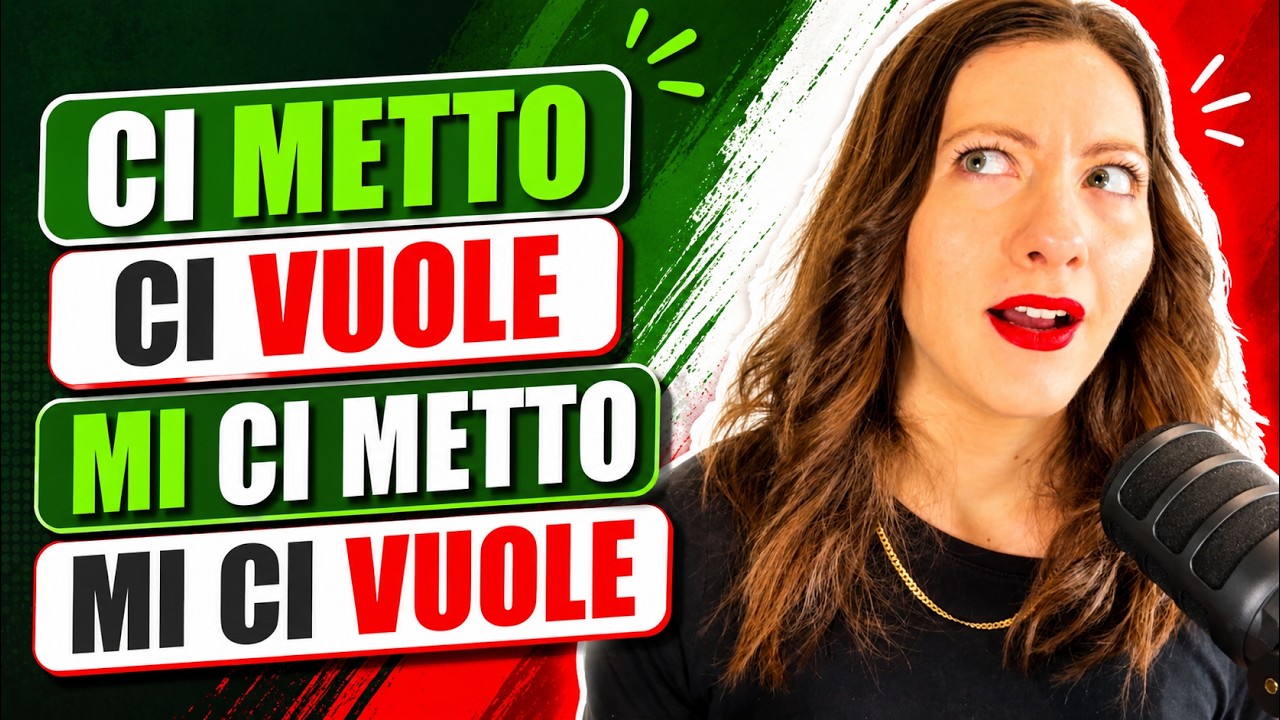
CI VUOLE / MI CI VUOLE / CI METTO / MI CI METTO: Differences, Rules and Uses
1. CI VUOLE / CI VOGLIONO [it takes / it takes (plural)]
Volerci [to take / to be needed] indicates the time — or the quantity of something — needed in a general sense, valid for everyone, without specifying who. The key idea is impersonality: you are not talking about a specific person, but about an objective condition.
The conjugation is very simple, because volerci [to take] only exists in two forms, which agree with the quantity that follows:
- CI VUOLE when the quantity that follows is singular: «Ci vuole un’ora per fare il pane fatto in casa.» [It takes an hour to make homemade bread.] / «Ci vuole molta pazienza per studiare il congiuntivo italiano!» [It takes a lot of patience to study the Italian subjunctive!]
- CI VOGLIONO when the quantity that follows is plural: «Ci vogliono due anni per diventare davvero fluenti.» [It takes two years to become truly fluent.] / «Ci vogliono almeno tre caffè per sopravvivere al lunedì mattina.» [It takes at least three coffees to survive Monday morning.]
Volerci in Compound Tenses
In compound tenses, volerci requires the auxiliary ESSERE [to be] — and the past participle agrees with the quantity:
- «Ci è voluto un anno per finire quel progetto.» [It took a year to finish that project.] (un anno: masculine singular → voluto)
- «Ci sono voluti mesi per convincere mia sorella.» [It took months to convince my sister.] (mesi: masculine plural → voluti)
- «Ci è voluta una settimana per riparare la macchina.» [It took a week to repair the car.] (una settimana: feminine singular → voluta)
- «Ci sono volute ore e ore di studio.» [It took hours and hours of study.] (ore: feminine plural → volute)
2. CI METTO [it takes me / I take]
Metterci [to take (time)] indicates the time needed by a specific person to do something. Unlike volerci [to take], which is impersonal, metterci [to take] always refers to a specific subject — and that is why it is conjugated in all persons.
For example: «Io ci metto 45 minuti per andare al lavoro in bici.» [It takes me 45 minutes to get to work by bicycle.] Not everyone — me. Whoever goes by metro ci mette [it takes them] 20 minutes; whoever lives near the office ci mette [it takes them] 5 minutes on foot. Each person has their own timings.
Conjugation: io ci metto / tu ci metti / lui o lei ci mette / noi ci mettiamo / voi ci mettete / loro ci mettono. [I take / you take / he or she takes / we take / you (pl.) take / they take]
- «Mia nonna ci mette due ore per cucinare la pasta al forno. Vale la pena aspettare!» [My grandmother takes two hours to cook pasta al forno. It’s worth waiting!]
- «Ragazzi, quanto ci mettete per imparare 10 parole nuove al giorno?» [Guys, how long does it take you to learn 10 new words a day?]
- «Ieri abbiamo preso il treno sbagliato e ci abbiamo messo quattro ore invece di due!» [Yesterday we got on the wrong train and it took us four hours instead of two!]
Metterci in Compound Tenses
In compound tenses, metterci uses the auxiliary AVERE [to have] — exactly the opposite of volerci [to take].
Passato prossimo [present perfect]: io ci ho messo / tu ci hai messo / lui o lei ci ha messo / noi ci abbiamo messo / voi ci avete messo / loro ci hanno messo. [I took / you took / he or she took / we took / you (pl.) took / they took]
Stop reading Italian.
Start speaking it.
Online lessons in groups of 4, organised by level and goals, with qualified teachers. Pick the day and time that suit you from the available slots.
Max 4 students:
there’s a seat for you
3. MI CI VUOLE [it takes me / I need]
Volerci [to take] is normally used impersonally, for everyone. But if you want to use it referring to a specific person, you add an indirect pronoun [pronome indiretto] before «ci»:
- mi ci vuole (for me) [it takes me]
- ti ci vuole (for you) [it takes you]
- gli ci vuole / le ci vuole (for him / for her) [it takes him / her]
- a noi ci vuole (for us) [it takes us] — this form is preferred to avoid the repetition «ci ci vuole»
- vi ci vuole (for you pl.) [it takes you]
- gli ci vuole (for them) [it takes them]
Compare these two sentences:
- «Ci vuole un’ora per imparare questa poesia.» [It takes an hour to learn this poem.] — Impersonal: for everyone, in general.
- «Mi ci vuole un’ora per imparare questa poesia.» [It takes me an hour to learn this poem.] — For me personally, according to my way of studying and my memory.
Further examples:
- «A mio fratello gli ci vogliono tre ore per prepararsi la mattina. È assurdo!» [It takes my brother three hours to get ready in the morning. It’s absurd!]
- «Professoressa, le ci vuole molto tempo per correggere i compiti?» [Professor, does it take you a lot of time to mark the homework?]
- «A noi ci vuole sempre un’ora per accordarci. Ma perché?!» [It always takes us an hour to reach an agreement. Why?!]
Mi Ci Vuole in Compound Tenses
Here too the past participle agrees with the quantity:
- «Mi ci è voluta una settimana intera per capire il congiuntivo.» [It took me a whole week to understand the subjunctive.] (una settimana: feminine singular → voluta)
- «Gli ci sono voluti anni per trovare il coraggio di andarsene.» [It took him years to find the courage to leave.]
4. MI CI METTO [I get down to it / I set about it] — The Different One of the Family
Note: mi ci metto does not indicate the time needed to do something. It is an expression completely different from the other three. The verb here is mettersi [to put oneself / to set about] — reflexive — and the meaning changes depending on the context.
Meaning 1 — To Place Oneself in a Physical Location
When talking about a physical place, «ci» refers precisely to that place: «mi ci metto» literally means “I put myself there”.
- «C’è ancora posto sul divano? Ah sì, benissimo — mi ci metto anch’io!» [Is there still room on the sofa? Oh yes, great — I’ll sit there too!] (= I put myself there, on the sofa)
- «La macchina è parcheggiata là? Ok, mi ci metto dietro.» [Is the car parked there? Ok, I’ll go behind it.] (= I put myself there behind it)
Meaning 2 — To Set About Something, To Get Started
When talking about dedicating yourself to something, «mi ci metto» is an idiomatic expression meaning “I start, I get down to it” — the «ci» has no precise reference, but reinforces the idea of commitment and personal involvement.
- «Domani mi ci metto seriamente a studiare il vocabolario.» [Tomorrow I’ll seriously get down to studying the vocabulary.] (= I start with determination)
- «Questa settimana non ho ancora fatto i compiti… ma domani mi ci metto!» [This week I still haven’t done my homework… but tomorrow I’ll get on it!] (= I set about doing it)
- «Se mi ci metto io, finiamo prima.» [If I get on it, we’ll finish sooner.] (= if I commit myself, if I work on it)
In practice, this expression is used almost always in the first, second and third person singular: mi ci metto, ti ci metti, ci si mette. The plural forms exist but are very rare in everyday speech.
Summary: the Four Expressions Compared
Here are the four expressions compared in the same context — preparing for an Italian exam:
| Expression | Example | Meaning |
|---|---|---|
| CI VUOLE [it takes] | «Ci vuole un mese per prepararsi bene.» [It takes a month to prepare well.] | Time needed in general, for everyone. |
| CI METTO [it takes me] | «Io ci metto due mesi, perché lavoro anche.» [It takes me two months, because I also work.] | Time needed specifically for me. |
| MI CI VUOLE [it takes me] | «Mi ci vogliono due mesi per prepararmi.» [It takes me two months to prepare.] | Like ci metto, but built with volerci + indirect pronoun. |
| MI CI METTO [I get down to it] | «Da domani mi ci metto!» [From tomorrow I’ll get on it!] | Does not indicate a time: means “I start, I commit myself”. |
Frequently Asked Questions
What Is the Main Difference Between «Ci Vuole» and «Ci Metto»?
«Ci vuole» is impersonal — it indicates the time needed in general, for everyone, without referring to any specific person. «Ci metto» is personal — it indicates the time a specific person takes. That is why volerci only exists in singular and plural forms, while metterci is conjugated in all persons.
Are «Ci Metto» and «Mi Ci Vuole» Interchangeable?
Yes, in many contexts the two forms are interchangeable: «Ci metto due ore» [It takes me two hours] and «Mi ci vogliono due ore» [It takes me two hours] express the same concept — the time needed for me personally. The difference is structural: metterci uses the verb mettere conjugated in the person; volerci with an indirect pronoun maintains the impersonal structure while adding the pronoun to specify the person who has the need.
Why Do You Say «A Noi Ci Vuole» and Not «Ci Ci Vuole»?
Because the repetition of «ci ci» is redundant and awkward in Italian. For the first person plural the form «a noi ci vuole» is therefore preferred, as it avoids the collision of the two «ci» and flows more naturally in speech.
Which Auxiliary Is Used with Volerci and Metterci in the Past?
The two verbs use opposite auxiliaries: volerci requires ESSERE [to be] («ci è voluta un’ora» [it took an hour]), while metterci requires AVERE [to have] («ci ho messo un’ora» [it took me an hour]). This is one of the most important differences to remember, because using the wrong auxiliary changes the grammatical correctness of the sentence.
Can «Mi Ci Metto» Only Be Used in the Singular?
Not exclusively, but in everyday speech it is used almost always in the first, second and third person singular: mi ci metto, ti ci metti, ci si mette. The plural forms exist grammatically but are very rare and sound unnatural in ordinary speech.
Think you’ve got Italian particles figured out? The real challenge is in the article dedicated to ci vs ne.
Want the lesson PDF with exercises and solutions?
Join the LearnAmo AcademyLoading quiz…
Podcast: Play in new window | Download (Duration: 22:39 — 20.7MB)
Iscriviti: Apple Podcasts | Spotify | Android | iHeartRadio | Podcast Index | TuneIn | Deezer | RSS | Altri...