


Have you ever heard an Italian word and thought: “Wait a moment, hadn’t I already heard this with another meaning?”. There are five little words in Italian — small and apparently innocent — that foreigners hear everywhere in movies, songs, on the street, at the bar. But that almost nobody manages to use in the right way. They are proprio, ancora, appena, allora and già. The problem? Each one has not one, not two, but many different meanings. And they often get confused with each other. In this guide you’ll see all their meanings with practical examples, and you’ll finally learn to distinguish them once and for all.
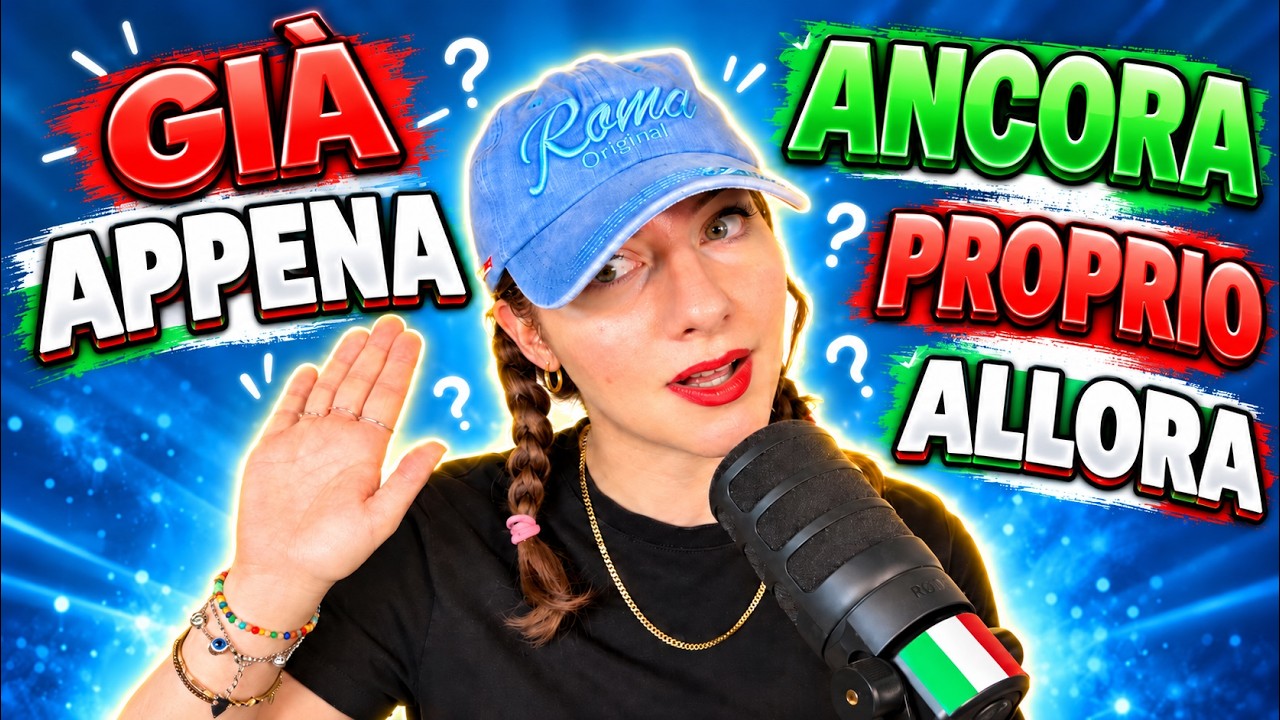
Proprio, Ancora, Appena, Allora, Già: Uses and Meanings
These are five of the most frequent and deceptive words in spoken Italian. They seem simple, but they hide a series of meanings that completely change the sense of a sentence. After reading this guide, you’ll know exactly what an Italian means when they say “Ma dai, è proprio così!” [Come on, it’s really like that!] or “Non ci credo, l’hai già finito?” [I can’t believe it, you’ve already finished it?]. These are the words that make you go from someone who “speaks Italian well” to someone who “almost sounds Italian”: the difference is all in the details.
Proprio: 5 Different Meanings in a Single Word
Let’s start with proprio, a truly versatile word. It has five main uses, which are worth learning all together because they are very different from each other. For a deeper look at the word, you can check out the guide on the use of proprio.
Use 1 — Intensifier (Really, Truly)
When you want to emphasize something, you use proprio to give more strength to the sentence.
- “Questo gelato è proprio buono!” [This ice cream is really good!] (= it’s truly, really good)
- “Sono proprio stanca oggi.” [I’m really tired today.] (= I’m very tired)
Use 2 — Exactly, Precisely
Here proprio indicates a perfect, precise match.
- “Ti chiami Marco?” “Sì, proprio così!” [Is your name Marco? Yes, exactly!] (= exactly so)
- “Abito proprio davanti alla stazione.” [I live right in front of the station.] (= exactly in front)
Use 3 — Possessive Adjective (il Proprio)
In this case proprio means “of oneself”, and refers to the subject of the sentence. It’s very used in general or impersonal sentences.
- “Ognuno pensa ai propri problemi.” [Everyone thinks about their own problems.] (= about the problems of oneself)
- “Bisogna difendere le proprie idee.” [One must defend one’s own ideas.]
Useful curiosity: in Italian, when the subject is generic (like “ognuno”, “ciascuno”, “si”), proprio is preferred over suo. You say “Ognuno ha i propri gusti” [Everyone has their own tastes], not “i suoi gusti”. To learn more, you can check out the guide on possessive adjectives.
Use 4 — Characteristic of, Typical of
Here proprio describes something that belongs to or is typical of someone or something.
- “La curiosità è propria dei bambini.” [Curiosity is characteristic of children.] (= it’s typical, characteristic of children)
- “Ogni lingua ha suoni propri.” [Every language has its own sounds.] (= its own, characteristic)
Grammatical deepening: from this use come three expressions that are very frequent in the study of Italian. The senso proprio [literal sense] of a word is the literal one (“Mi fa male la gamba“ [My leg hurts], the body part); the senso figurato [figurative sense] is the metaphorical one (“Marco è una persona in gamba“ [Marco is a capable person], that is, in gamba). And the nome proprio [proper noun] is the one written with a capital letter: Maria, Roma, Italia.
Use 5 — At All (in Negative Sentences)
When you put it after a negation, it reinforces the “no”.
- “Non ho proprio voglia di uscire.” [I don’t feel like going out at all.] (= I don’t feel like it at all)
- “Non capisco proprio cosa vuoi dire.” [I don’t understand at all what you mean.] (= I don’t understand at all)
Ancora: Three Adverbial Uses plus a Hidden Trick
Watch out for ancora, because it hides an interesting trick. As an adverb it has three main meanings (the tonic accent falls on the second syllable: an-có-ra).
Use 1 — Continuity (Still, Up to Now)
Indicates that an action or a situation is continuing in time.
- “Sono le 3 di notte e sei ancora sveglio?” [It’s 3 AM and you’re still awake?] (= you continue to be awake)
- “Vivo ancora con i miei genitori.” [I still live with my parents.] (= I continue to live there)
Its opposite is “non ancora” [not yet], an expression absolutely worth remembering.
- “Hai finito?” “Non ancora.” [Have you finished? Not yet.] (= I haven’t finished yet, but I will)
- “Il treno non è ancora arrivato.” [The train hasn’t arrived yet.]
Use 2 — Repetition (Again, One More Time)
- “Ho sbagliato ancora!” [I made a mistake again!] (= again)
- “Puoi ripeterlo ancora una volta?” [Can you repeat it one more time?]
Use 3 — Quantity More (More, in Addition)
- “Vuoi ancora un po’ di caffè?” [Do you want a little more coffee?] (= more coffee)
- “Ne voglio ancora!” [I want more!] (= I want more of it)
Watch out for an important nuance: ancora + comparative means “even more”, and serves to reinforce a comparison.
- “Pensavo fosse difficile, ma è ancora più difficile!” [I thought it was difficult, but it’s even more difficult!] (= even more difficult)
- “Oggi fa ancora più caldo di ieri.” [Today it’s even hotter than yesterday.]
The Accent Trick: Ancóra vs Àncora
Here’s a detail that almost no foreigner knows. If you move the accent to the first syllable and say àncora (àn-co-ra), the word changes completely: it becomes a noun and indicates the ship’s anchor, that heavy, iron one that’s thrown into the sea to stop the boat.
- “Ho ancóra fame.” [I’m still hungry.] (adverb, I’m still hungry)
- “Il marinaio getta l’àncora.” [The sailor throws the anchor.] (noun, the iron object)
Same spelling, different accent, completely different meaning. Italians understand it from the context, but it’s one of the most fun peculiarities of the language. To learn more, you can check out the guide on the accent in Italian.
Appena: Just Now, Only, Non Appena
Let’s move to appena, a word with three very useful uses. For a complete deepening, you can check out the guide on the meanings of appena.
Use 1 — Just Now, a Short Time Ago
Indicates that an action happened a very short time ago. It’s used a lot with the passato prossimo.
- “Sono appena arrivato.” [I’ve just arrived.] (= I arrived a few moments ago)
- “Ho appena finito di mangiare.” [I’ve just finished eating.]
Use 2 — Only, Barely
Here appena indicates a minimum, almost insufficient quantity.
- “Ho appena 5 euro nel portafoglio.” [I only have 5 euros in my wallet.] (= only 5 euros, few)
- “C’è così poca luce che riesco appena a leggere.” [There’s so little light that I can barely read.] (= barely, with difficulty)
Use 3 — Non Appena (Temporal Conjunction)
Introduces an action that happens immediately after another.
- “Appena arrivi a casa, chiamami!” [As soon as you get home, call me!] (= at the exact moment you arrive)
- “Ti scrivo appena ho finito il lavoro.” [I’ll write to you as soon as I finish the work.]
Deepening: this use is powerful for talking about the future. In Italian, after appena, you can use the future in both parts of the sentence: “Appena avrò tempo, ti aiuterò.” [As soon as I have time, I’ll help you.]. But in everyday speech Italians often use the present: “Appena ho tempo, ti aiuto.” [As soon as I have time, I help you.]. Both correct. To learn more, you can check out the guide on temporal conjunctions.
Fun fact: if you double up — “appena appena” — the effect is “very little, the bare minimum”: “Ce l’ho fatta appena appena!” [I just barely made it!] (= by a hair).
Allora: The Most “Italian” Word of All
Here comes allora, perhaps the most “Italian” word of all, the one you hear at the beginning of half the sentences. It has five uses. For a complete deepening, you can check out the guide on the meanings of allora.
Use 1 — At That Moment in the Past
It refers to a specific past time.
- “Allora non esistevano gli smartphone.” [Back then smartphones didn’t exist.] (= in that period of the past)
- “Nel 2010 vivevo a Milano; allora ero molto giovane.” [In 2010 I lived in Milan; back then I was very young.]
Use 2 — So, Then (Consequence)
Introduces a logical consequence.
- “Ho finito i compiti.” “Allora possiamo uscire!” [I’ve finished my homework. Then we can go out!] (= in that case)
- “Non ti piace? E allora perché l’hai comprato?” [You don’t like it? So why did you buy it?]
Use 3 — Filler Word of Speech
This is the most typical use and the one loved by Italians. It serves to introduce a speech, to take time, to attract attention.
- “Allora, ragazzi, cosa facciamo stasera?” [So, guys, what are we doing tonight?]
- “Allora… vediamo un po’…” [So… let’s see…]
To learn more about filler words in Italian (that is, words like cioè, praticamente, diciamo), you can check out the dedicated guide.
Use 4 — Allora? (The Question that Prompts an Answer)
When you use it as a question, you’re impatiently asking for news or a decision.
- “Allora? Cosa hai deciso di fare?” [So? What did you decide to do?]
- “Ho parlato con il capo.” “E allora? Cosa ti ha detto?” [I talked to the boss. So? What did he tell you?]
Use 5 — Adjective of That Time (“l’Allora…”)
A more formal use, typical of newspapers and history.
- “L’allora presidente firmò il documento.” [The then-president signed the document.] (= the president at that time)
Stop reading Italian.
Start speaking it.
Online lessons in groups of 4, organised by level and goals, with qualified teachers. Pick the day and time that suit you from the available slots.
Max 4 students:
there’s a seat for you
Già: from “Already” to “By Now” to Agreement
And here we are at the last of the five words: già. This one also has five interesting uses.
Use 1 — At an Earlier Moment, Sooner than Expected
Indicates that something happened before now, or before what was expected.
- “Ho già mangiato, grazie.” [I’ve already eaten, thanks.] (= I ate earlier, I’m not hungry anymore)
- “Hai già finito? Che velocità!” [You’ve already finished? What speed!] (= so soon, before what was expected)
Use 2 — By Now (Ormai)
Indicates that a moment has arrived, often faster than expected.
- “È già sera.” [It’s already evening.] (= by now it’s evening)
- “Siamo già a dicembre!” [We’re already in December!] (= how quickly the year has passed)
Use 3 — Confirmation, Agreement (Exactly, Yeah)
In spoken language, già on its own means “yes, it’s true”, often with a slightly melancholic or resigned tone.
- “Fa freddo oggi.” “Già…” [It’s cold today. Yeah…] (= yeah, it’s really true)
- “La vita è complicata.” “Eh già.” [Life is complicated. Yeah.]
This use is very typical of speech and transmits an emotion. Often it means “yes, unfortunately” or “yes, you’re right, but we can’t do anything about it”. It’s one of those nuances that make Italian so rich.
Use 4 — Previously, Formerly (Formal)
Used to indicate a previous name or status. You often find it on signs, documents, addresses.
- “Via Garibaldi, già Via del Corso.” [Via Garibaldi, formerly Via del Corso.] (= previously called Via del Corso)
- “Il signor Rossi, già direttore dell’azienda.” [Mr. Rossi, former director of the company.] (= ex-director)
Use 5 — “Già che ci Sei / Siamo”
A very useful colloquial expression: it means “taking advantage of the fact that you’re / we’re doing something”.
- “Già che ci sei, compra anche il pane!” [While you’re at it, buy the bread too!]
- “Già che ci siamo, puliamo tutta la casa.” [While we’re at it, let’s clean the whole house.]
How to Distinguish These 5 Words from Each Other
Now we get to the heart of the problem. Why do these words get confused? Because some of them seem to say the same thing, but actually don’t. Let’s see the most common confusions.
The Passato Prossimo Trio: Già vs Appena vs (Non) Ancora
This is the most useful part of the entire guide. Imagine someone asks you “Hai mangiato?” [Have you eaten?]. See how everything changes depending on the word you choose.
- “Ho già mangiato.” [I’ve already eaten.] → completed action, perhaps sooner than expected.
- “Ho appena mangiato.” [I’ve just eaten.] → completed action, but a very short time ago.
- “Non ho ancora mangiato.” [I haven’t eaten yet.] → not completed action, which still has to happen.
Three words, three different snapshots of the same moment. The use of the passato prossimo makes them more similar in appearance, but the meaning changes a lot.
Ancora vs Già: Opposites of Each Other
To the question “Hai finito di studiare?” [Have you finished studying?]:
- “Già fatto!” [Already done!] → you’ve finished, it’s completed.
- “Ancora no” / “Non ancora“ [Not yet] → you haven’t finished, the action still has to happen.
So già indicates a completed action, non ancora a non-completed action. In this context they are practically opposites. But watch out: ancora also has the sense of continuity (“Sto ancora studiando” [I’m still studying] = I continue to study). To learn more, you can check out the guide on già vs ancora.
Appena vs Già
They seem similar but they’re not:
- “Sono appena arrivato.” [I’ve just arrived.] → I arrived a very short time ago (what counts is how little time has passed).
- “Sono già arrivato.” [I’ve already arrived.] → I’ve arrived, perhaps sooner than expected (what counts is the fact that it’s completed or anticipated).
Practical example: if a friend calls you and you say “Sono appena uscito di casa” [I’ve just left the house], it means you left just now. If you say “Sono già uscito” [I’ve already left], it means you’re out by now (maybe he thought you were still at home).
Appena vs Ancora (“Just” vs “Still”)
Two time words that foreigners often swap:
- “Sono appena arrivato.” [I’ve just arrived.] → recent action, just concluded.
- “Sono ancora qui.” [I’m still here.] → situation that continues.
Appena looks at an action that just concluded; ancora at a situation that goes on in time.
Allora vs Proprio (as Filler Words)
Both can open or animate a sentence in speech, but with different functions:
- “Allora, cominciamo!” [So, let’s start!] → introduces, kicks off, attracts attention.
- “È proprio vero!” [It’s really true!] → reinforces, confirms with emphasis.
In short: allora opens and organizes the speech; proprio intensifies.
Proprio vs Appena (in the Sense of Quantity)
Remember that appena can mean “only, barely”. Don’t confuse it with proprio (= exactly):
- “Ho appena 5 euro.” [I only have 5 euros.] → I have only 5 euros (few, minimum quantity).
- “Costa proprio 5 euro.” [It costs exactly 5 euros.] → it costs exactly 5 euros (no more, no less).
The difference is subtle but important: appena stresses that it’s little, proprio stresses the precision of the amount.
Summary Table of the Main Meanings
Here’s a summary of the main meanings of the five words:
| Word | Main meanings |
|---|---|
| Proprio | Really / exactly / of oneself (possessive) / typical of / at all (in negations) |
| Ancora | Continuity (still) / repetition (again) / quantity more / ship’s anchor (noun) |
| Appena | Just now / only, barely / non appena (temporal conjunction) |
| Allora | Back then / so, then / filler word of speech / question “allora?” / adjective “l’allora…” |
| Già | Already / by now / confirmation “eh già” / previously / già che ci sei |
Frequently Asked Questions
What Is the Difference between “Già” and “Appena”?
The difference is subtle but important. “Già” means that an action has been completed, perhaps sooner than expected: “Ho già mangiato” [I’ve already eaten] (I ate earlier, I’m not hungry anymore). “Appena”, on the other hand, means the action was completed a very short time ago: “Ho appena mangiato” [I’ve just eaten] (I ate a few minutes ago). Both are used with the passato prossimo, but già puts the emphasis on the fact that it’s completed, while appena puts the emphasis on the short time elapsed. In English they are respectively already and just.
How Do You Say “Not Yet” in Italian?
You say “non ancora”. It’s one of the most useful expressions to memorize, because it indicates that an action hasn’t happened yet, but will. To the question “Hai finito?” [Have you finished?], the answer “Non ancora“ means “I haven’t finished yet, but I will”. It can also be used alone as a short answer: “Hai visto il film?” “Non ancora“ [Have you seen the movie? Not yet]. It’s the opposite of già: if “Ho già finito” [I’ve already finished] indicates a completed action, “Non ho ancora finito” [I haven’t finished yet] indicates a non-completed action.
Why Are “Àncora” and “Ancóra” Written the Same but Have Different Meanings?
Because they are two homographs, that is, words written the same way but with different origin, pronunciation and meaning. Ancóra (with the tonic accent on the second syllable) is an adverb that means “still, again, more”: “Ho ancóra fame” [I’m still hungry]. Àncora (with the tonic accent on the first syllable) is instead a noun indicating the heavy iron object that’s thrown into the sea to stop the boat: “Il marinaio getta l’àncora“ [The sailor throws the anchor]. In writing the two words have no distinguishing marks (apart from the tonic accent that isn’t written), so context is essential to understand which of the two it is.
Why Is “Allora” So Loved by Italians?
Because it’s the classic filler word of the Italian language, that is, that little word used to introduce a speech, take time before speaking or attract the attention of the listener. “Allora, ragazzi…” [So, guys…] is the typical way many speeches begin in Italian, from school explanations to recipes in the kitchen. As a filler, allora doesn’t have a precise meaning: it’s like a small pause that helps the speaker organize their thoughts and the listener understand that something important is coming. It also has other uses (temporal, logical consequence, question), but it’s its opening function that makes it so widespread in everyday speech.
What Does “Eh Già” Mean in Spoken Italian?
“Eh già” is a typical expression of spoken Italian that means “yes, it’s true”, but with a particular nuance: it often conveys resignation, melancholy or acceptance. If someone says “Il tempo passa in fretta” [Time flies] and you answer “Eh già…”, you’re saying “yes, unfortunately it’s true” or “yes, you’re right, but we can’t do anything about it”. It’s different from a simple “yes”: it carries an emotion. If instead someone says “Dobbiamo pulire tutta la casa” [We have to clean the whole house] and you answer “Eh già…”, you express resignation at the idea. It’s one of those small nuances that native speakers use continuously and that, learned well, make Italian much more natural.
Want the lesson PDF with exercises and solutions?
Join the LearnAmo AcademyLoading quiz…
Podcast: Play in new window | Download (18.4MB)
Iscriviti: Apple Podcasts | Spotify | Android | iHeartRadio | Podcast Index | TuneIn | Deezer | RSS | Altri...