


Have you ever wondered how to express agreement or disagreement in Italian? That is, how to say that what someone just said is true for you as well (or not)?
This article will guide you through the key expressions to respond correctly to affirmative and negative statements, while giving some practical examples to clear up any doubts.
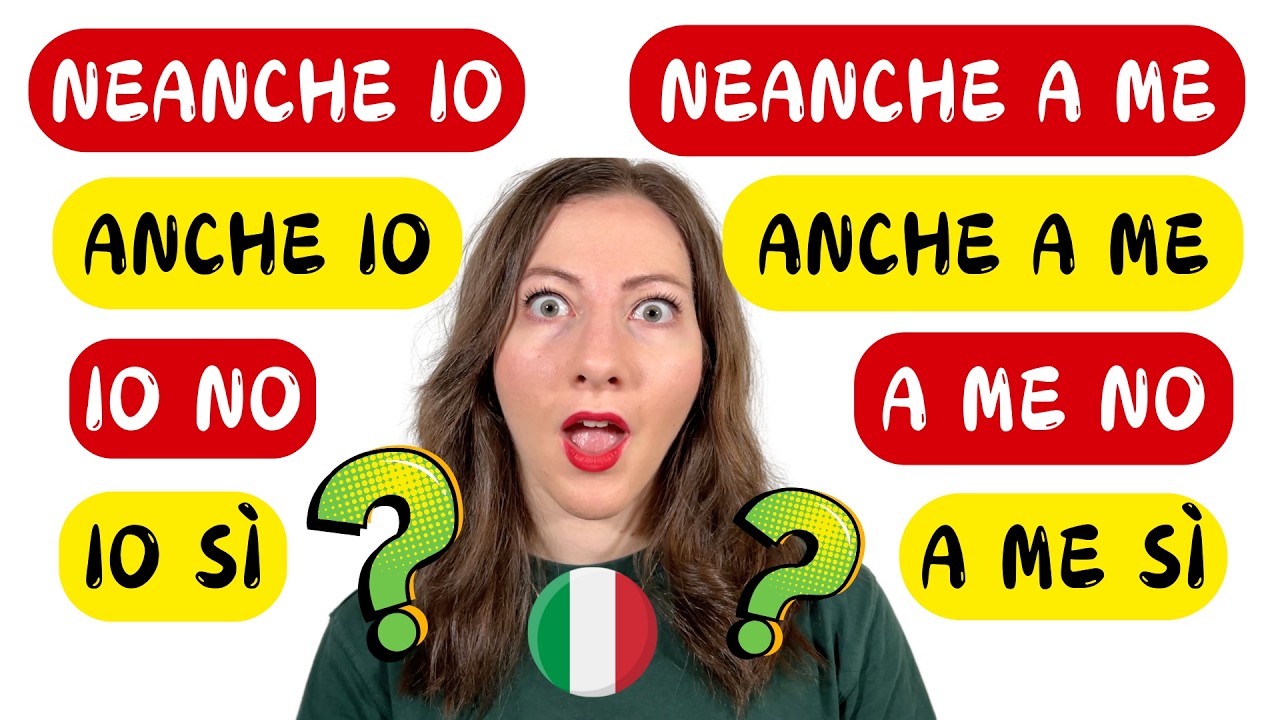
Anche io, Anche a me, Neanche io, Neanche a me and similar expressions
1. Agreement with Affirmative Statements
There are two main expressions to agree with an affirmative statement:
- Anche io
- Anche a me
When should you use “Anche io”?
Use Anche io when the grammatical subject matches the person performing the action.
Example:
- Mangio la pasta ogni giorno.
- Response: Anche io.
- Noi ci alleniamo in palestra ogni giorno.
- Response: Anche io.
If you don’t share the same experience, you can respond with Io no.
Example:
- Mangio la pasta ogni giorno.
- Reponse: Io no.
- Noi ci alleniamo in palestra ogni giorno.
- Response: Io no.
When should you use “Anche a me”?
Use Anche a me when the grammatical subject differs from the speaker, and the verb requires the preposition “a” (e.g., with the verb piacere).
Example:
- Mi piace la pizza.
- Response: Anche a me.
- Ci mancano gli anni della nostra infanzia.
- Response: Anche a me.
Instead, if you want to express disagreement, say A me no.
Example:
- Mi piace la pizza.
- Response: A me no.
- Ci mancano gli anni della nostra infanzia.
- Response: A me no.
Stop reading Italian.
Start speaking it.
Online lessons in groups of 4, organised by level and goals, with qualified teachers. Pick the day and time that suit you from the available slots.
Max 4 students:
there’s a seat for you
2. Agreement with Negative Statements
To agree with negative statements, use:
- Neanche io
- Neanche a me
Note: You can replace “Neanche” with synonyms like Nemmeno or Neppure.
When should you use “Neanche io”?
Use Neanche io when the grammatical subject matches the speaker.
Example:
- Non mangio la pasta tutti i giorni.
- Response: Neanche io.
If you want to express a positive position instead, say Io sì.
Example:
- Non mangio la pasta tutti i giorni.
- Response: Io sì.
When should you use “Neanche a me”?
Use Neanche a me with verbs that require the preposition “a”, where the grammatical subject differs from the speaker.
Example:
- Non mi piace la pizza.
- Reponse: Neanche a me.
To express the opposite, say A me sì.
Example:
- Non mi piace la pizza.
- Response: A me sì.
3. Responding to Polite Expressions
How can you respond correctly to phrases like “Buona giornata!” o “Buona serata!”? Avoid the common mistake of saying “Anche tu!“ Instead, use these options:
- Repeat the same phrase:
- Buona giornata!
Response: Buona giornata!
- Buona giornata!
- Use “Anche a te”:
- Buona giornata!
Response: Anche a te!
- Buona giornata!
- Choose “Altrettanto”:
- Buona serata!
Response: Altrettanto!
- Buona serata!
Practical Excercises
Try responding to the following statements using the correct phrases, based on what’s true for you:
- Amo il gelato al pistacchio.
- Non dormo mai a pancia in giù.
- Mi diverte molto ballare.
- Non sono mai stata a Dubai.
- Parlo bene due lingue straniere.
- Non mi piacciono i peperoni
- Non mi mancano i compiti che ricevevo a casa
- Mi alleno ogni giorno
- Mi piacciono i tulipani
- Ascolto tantissima musica
Write your responses in the comments!
Now that you know all the rules for expressing agreement and disagreement in Italian, you can respond naturally and accurately. Practice these expressions to improve your fluency!
Access Italian websites and content from anywhere in the world with total security with NordVPN! Use the coupon code LEARNAMO to get a special discount!
Are you also making these Mistakes with Italian Pronouns? Check out this article to find out and learn how to avoid them.
See you next time!
Want the lesson PDF with exercises and solutions?
Join the LearnAmo AcademyCaricamento quiz in corso…
Podcast: Play in new window | Download (Duration: 16:03 — 22.3MB)
Iscriviti: Apple Podcasts | Spotify | Android | iHeartRadio | Podcast Index | TuneIn | Deezer | RSS | Altri...