


Italian has many rules. But in this lesson, we’ll take a look at the “optional rules,” which are those cases where there are two options to say the same thing, so choosing one over the other is just a matter of style! However, the meaning remains the same.
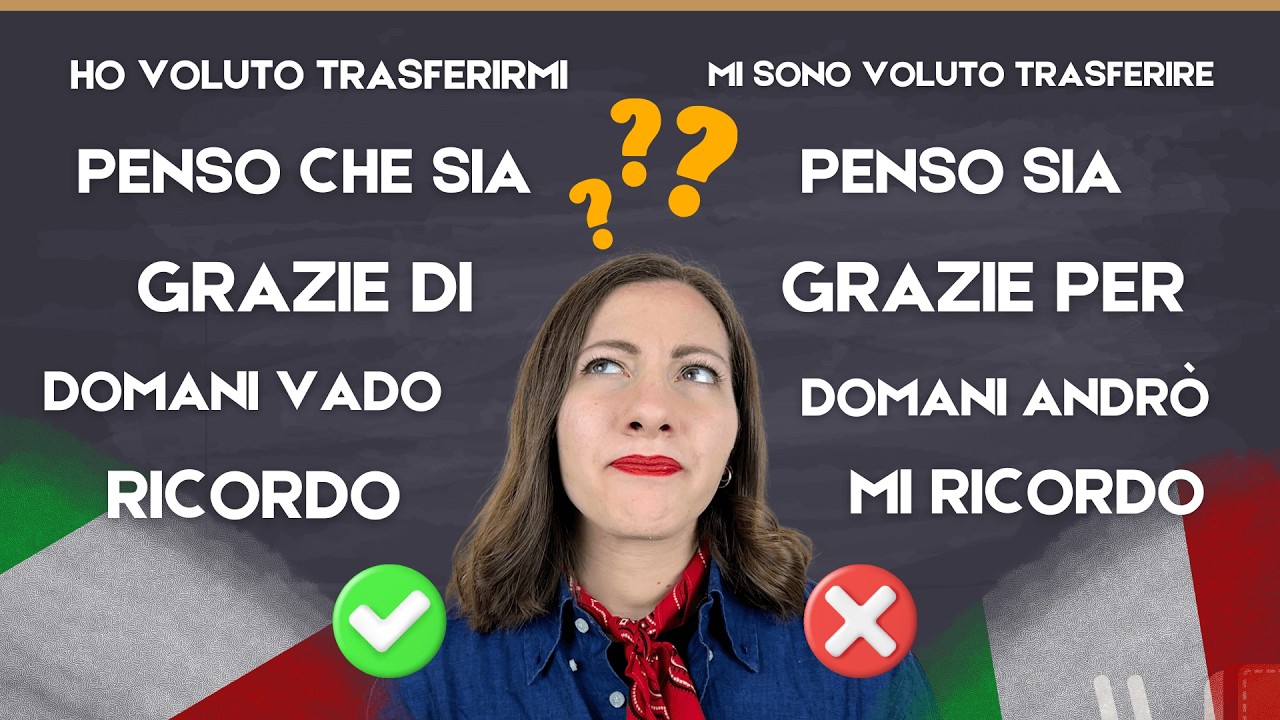
Flexible Rules of Italian Grammar
Understanding these nuances not only enriches our mastery of the language but also allows us to communicate in a more varied and personal way.
1 – Ricordarsi vs Ricordare
The verbs “ricordarsi” and “ricordare” can be used interchangeably, but there are some small differences in usage in certain cases. Let’s clarify.
The verb “ricordare” has two meanings:
1 – “to have in memory”
With this meaning, it can be used:
– followed by a direct object, thing or person
Ricordo la tua data di nascita / Ricordava il fidanzato della sorella
– followed by an entire phrase, introduced by DI + infinitive, when the subgect is the same, or CHE + conjugated verb, when the subject is different
Ricordo di essere andata a letto presto ieri sera / Ricordava che Lorenzo lo aveva aiutato
With this meaning, “ricordarsi” works in the same way, except in one case:
– when “ricordarsi” is followed by a direct object, thing or person, it can be used alone t can be used alone (just like “ricordare”) or it can also be followed by the preposition DI (which is not possible with “ricordare”).
Ricordo la tua data di nascita = Mi ricordo la tua data di nascita = Mi ricordo della tua data di nascita
Ricordava il fidanzato della sorella = Si ricordava il fidanzato della sorella = Si ricordava del fidanzato della sorella
– when “ricordarsi” is followed by a phrase, it behaves just like “ricordare”.
Mi ricordo di essere andata a letto presto ieri sera
Si ricordava che Lorenzo lo aveva aiutato
So is choosing one over the other a matter of style? In general, yes.
Accademia della Crusca:
The reflexive form “increases the degree of the subject’s participation in the action or feeling expressed by the verb. The tendency to use the pronominal variant is justified precisely by this greater component of affection”.
Therefore, it’s better to use the reflexive form when talking about things or people closer to us, with whom we have a direct bond.
For example:
Ricordo che Napoleone è morto il 5 maggio 1821.
Ricordo i colori della bandiera francese.
but
Mi ricordo che ci siamo divertiti un sacco alla festa di Marta.
Mi ricordo bene il sorriso che ha fatto quando ha visto il regalo!
I repeat: it’s a tendency, not a strict rule.
However, “ricordare” also has a second meaning:
2 – “to remind others”
RICORDARE + direct object (noun or phrase introduced by DI + infinitive / CHE + conjugated verb) + indirect object (A + persona)
Let’s look at some examples:
Il professore ricorda agli studenti la data dell’esame.
Questo profumo mi (= a me) ricorda i pranzi a casa di nonna.
Ti (= a te) ricordo che devi andare a prendere Sofia all’aeroporto.
Ricorda a Sofia di fare attenzione!
In this case, the reflexive form cannot be used.
2 – Dimenticarsi vs Dimenticare / Scordarsi vs Scordare
For these pairs of verbs, the same reasoning applies as for ricordarsi and ricordare.
So let’s just look at a few examples:
Mi sono dimenticata di rispondere alla sua email.
Hanno scordato il titolo di quella canzone.
Non scordatevi che dovete dare da mangiare al gatto mentre noi siamo via.
Hai già dimenticato quello che devi dire durante la riunione?
Stop reading Italian.
Start speaking it.
Online lessons in groups of 4, organised by level and goals, with qualified teachers. Pick the day and time that suit you from the available slots.
Max 4 students:
there’s a seat for you
3 – Futuro vs Presente per parlare al futuro
Often, to talk about the future in Italian, the present tense is used. It is understood that one is talking about a future action thanks to the context or temporal indicators often present before or after the verb (domani, la prossima settimana, tra due mesi).
For example:
Domani vado al cinema. = Domani andrò al cinema.
Si sposano il mese prossimo. = Si sposeranno il mese prossimo.
WARNING!
Speaking in the present expresses a greater degree of certainty: one is sure that the announced action will actually happen because it has already been planned. Indeed, it is always accompanied by a precise temporal reference.
So we will say:
La settimana prossima comincio un corso di cucina. (I have already paid the registration, it will definitely happen)
BUT
Quando comincerò un corso di cucina, ti preparerò un buon pranzo. (When? Who knows!)
4 – Grazie DI vs Grazie PER
Often, using GRAZIE DI or GRAZIE PER is the same thing. But even here, there are small differences in usage in some cases. Let’s clarify!
GRAZIE DI and GRAZIE PER are interchangeable when used with nouns or verbs.
Grazie del consiglio = Grazie per il consiglio
Grazie di avermi consigliato questo libro = Grazie per avermi consigliato questo libro
As you can see, both are generally used with the past infinitive.
When used with “tutto”:
DI + TUTTO (alone, as a finished sentence)
Grazie di tutto!
PER + TUTTO (if the sentence continues)
Grazie per tutto quello che fai per me!
5 – Penso che sia vs Penso sia
Many students read or hear phrases like “Penso sia giusto” and ask me: “Is it a mistake? Is the CHE missing in this sentence!”.
Actually, both forms are correct.
Accademia della Crusca:
In dependent clauses, CHE can also be omitted, but only if the verb that follows is in the subjunctive, conditional or, more rarely, future indicative.
It is often done when there are other CHEs in the sentence, to avoid repetitions, but it is not the only case.
For example:
Credo (che) dovresti raccontare tutto ai tuoi genitori.
Ti ripeto che pensavamo (che) vi foste persi.
Spero (che) si divertiranno in vacanza.
6 – Avreste voluto trasferirvi vs Vi sareste voluti trasferire
These two sentences communicate the same meaning but are constructed differently, even though they have the same elements (the modal verb volere + the reflexive verb trasferirsi). The problem arises from the presence of the reflexive pronoun (vi, in this case).
When there is a modal verb + an infinitive and a pronoun needs to be added, the pronoun can be placed either before the modal or after the infinitive, maintaining the same identical meaning.
For example:
Ti devo parlare = Devo parlarti
L’ho potuto fare = Ho potuto farlo
Vi abbiamo voluto salutare = Abbiamo voluto salutarvi
The situation gets a bit more complicated, however, when dealing with a REFLEXIVE verb.
If the verb in the infinitive is reflexive, the auxiliary “essere” is used if the pronoun comes before the modal; the auxiliary “avere” is used if the pronoun comes after the infinitive.
That’s why the sentences:
Avreste voluto trasferirvi = Vi sareste voluti trasferire
Ho potuto svegliarmi = Mi sono potuta svegliare
And now learn also… All The Ways to Say “LAZY” in Italian!
Want the lesson PDF with exercises and solutions?
Join the LearnAmo AcademyCaricamento quiz in corso…
Podcast: Play in new window | Download (Duration: 16:54 — 23.6MB)
Iscriviti: Apple Podcasts | Spotify | Android | iHeartRadio | Podcast Index | TuneIn | Deezer | RSS | Altri...