


When you use combined pronouns in Italian, do you feel like you’re solving an impossible puzzle? Do you find yourself thinking: “La mi dice? Mi la dice? Glielo? Glilo?” Combined pronouns are one of the topics that challenge almost every Italian student, but after this guide you’ll learn to avoid the 5 most common mistakes and your Italian will sound much more natural and fluent.
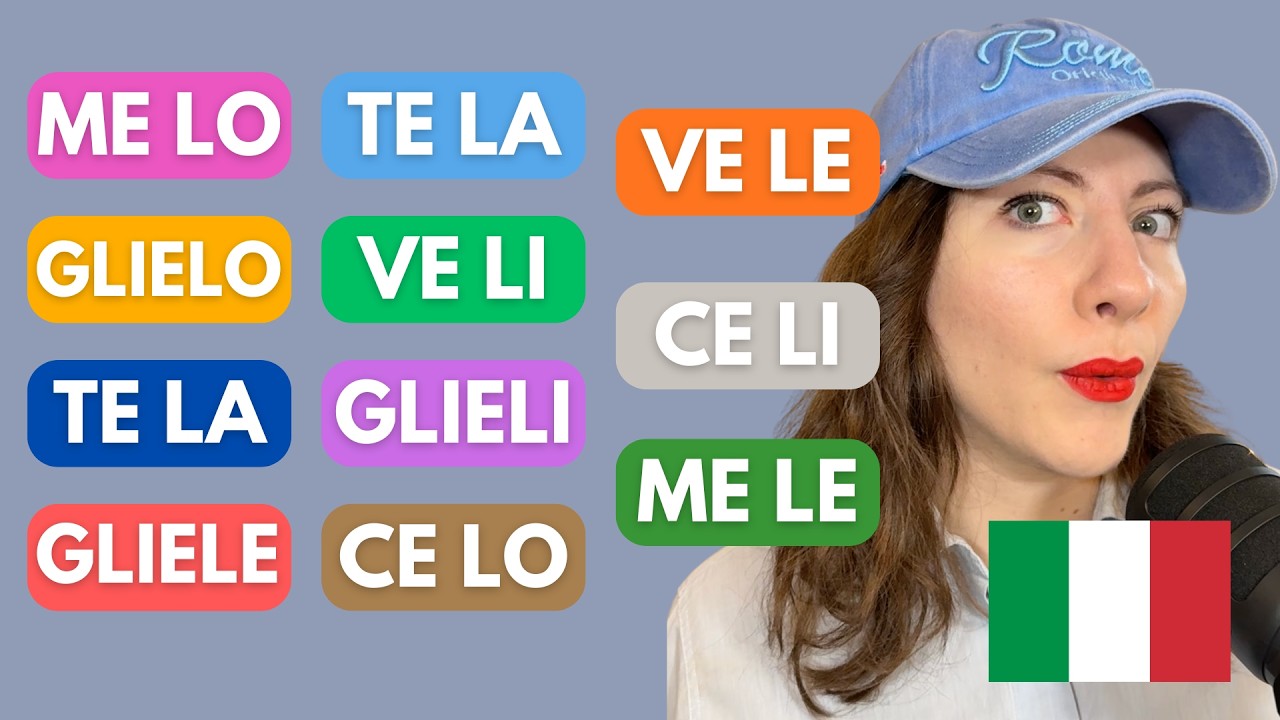
Combined Pronouns: Everything You Need to Know
Mistake #1 — Wrong Order: the Indirect Pronoun ALWAYS Comes First
Let’s start with perhaps the most frequent mistake of all. When two pronouns are used together — one direct and one indirect — the order is not free. There is a precise rule you must always keep in mind:
First the indirect pronoun, then the direct pronoun.
Easy to remember this way: INdirect = INitial.
So, if you want to say “[She] says [this] to me”, you first need to figure out which pronouns to use: questo/quello [this/that] becomes lo [it] (direct pronoun) and a me [to me] stays me (indirect pronoun). Following the order — indirect first, then direct — the result is:
- LA MI dice → WRONG word order
- ME LO dice [she says it to me — CORRECT] → CORRECT
But why me lo and not mi la? Because when pronouns combine, they don’t stay the same: they change form! And that’s exactly the second mistake we’ll look at.
Mistake #2 — Writing Pronouns Separately: gli/le + lo/la/li/le Become One Single Word
When the indirect pronoun is mi, ti, ci, vi, the combination follows a fairly regular pattern: the final vowel of the pronoun changes, adapting to the direct pronoun that follows.
| Indirect | + lo [it, m.] | + la [it, f.] | + li [them, m.] | + le [them, f.] | + ne [of it/them] |
|---|---|---|---|---|---|
| mi [to me] | me lo [it to me] | me la [it to me] | me li [them to me] | me le [them to me] | me ne [of it to me] |
| ti [to you] | te lo [it to you] | te la [it to you] | te li [them to you] | te le [them to you] | te ne [of it to you] |
| ci [to us] | ce lo [it to us] | ce la [it to us] | ce li [them to us] | ce le [them to us] | ce ne [of it to us] |
| vi [to you all] | ve lo [it to you all] | ve la [it to you all] | ve li [them to you all] | ve le [them to you all] | ve ne [of it to you all] |
Fairly logical, right? The final -i becomes -e and a harmonious combination is created. But now comes the part that drives everyone crazy: the pronouns gli and le of the third person singular.
When gli or le combine with lo, la, li, le, ne, they are NOT written separately. They merge completely into a single word that always begins with GLIE-:
| Indirect | + lo [it, m.] | + la [it, f.] | + li [them, m.] | + le [them, f.] | + ne [of it/them] |
|---|---|---|---|---|---|
| gli / le [to him / to her] | glielo [it to him/her] | gliela [it to him/her] | glieli [them to him/her] | gliele [them to him/her] | gliene [of it to him/her] |
Examples:
- Le lo diamo → WRONG form
- Glielo diamo → CORRECT (= Lo diamo a lui / Lo diamo a lei) [We give it to him / We give it to her]
- Gli la mando → WRONG form
- Gliela mando → CORRECT (= La mando a lui / La mando a lei) [I send it to him / I send it to her]
Pay attention to a very important detail: glielo, gliela etc. work both for the masculine (a lui [to him]) and for the feminine (a lei [to her]) — the form is identical in both cases!
So “Glielo dico” [I say it to him/her] can mean both “Lo dico a lui” [I say it to him] and “Lo dico a lei” [I say it to her]. The context of the conversation will help you understand who is being referred to.
Mistake #3 — The Plural: gli or loro?
For the third person plural — that is, a loro [to them] — do you use gli or loro? The answer is: both forms are correct! But there is an important difference in position within the sentence.
GLI goes before the verb and combines normally with direct pronouns, forming a single word:
Glielo do. (= Lo do a loro) [I give it to them]
LORO goes after the verb, and in this case the two pronouns remain separate — they do not merge:
Lo do loro. [I give it to them]
So both of these sentences are perfectly correct:
Glielo do. [I give it to them]
Lo do loro. [I give it to them]
In everyday spoken and informal language, gli is by far more common — Italians use it almost always, for everyone. Loro in this function is more formal, more literary; you’ll often find it in written texts or very elegant contexts. So if you want to speak like a real Italian, go ahead and use gli for everything, without hesitation!
Mistake #4 — Special Cases: Imperative, Infinitive and Gerund
So far we’ve seen combined pronouns with “regular” verbs — that is, conjugated verbs. In these cases the pronouns go before the verb. But there are three verb forms where the rules change completely: the imperative, the infinitive and the gerund.
With these three forms, pronouns do NOT go before the verb: they attach after it, forming one single word.
Imperative
The imperative is the form you use to give orders or make direct requests.
- Lo portami! → WRONG form
- Portamelo! [Bring it to me!] → CORRECT
Note! With the short imperative forms — fa’, da’, di’, sta’, va’ [do!, give!, say!, stay!, go!] — the initial consonant of the first pronoun that attaches doubles, whatever it may be. It is a phonetic rule of Italian to maintain the rhythm of the word. Here are some examples:
- Fa’ [do!] + me + lo → Fammelo! [Do it for me!]
- Da’ [give!] + me + lo → Dammelo! [Give it to me!]
- Di’ [say!] + me + lo → Dimmelo! [Tell it to me!]
- Dà’ [give!] + gli + la → Dagliela! [Give it to him/her!]
Note: the initial consonant of the pronoun always doubles — with me the m doubles (fammelo, dammelo, dimmelo), with gli the g doubles, even though in this case the doubling is not visible in writing but is heard in pronunciation: it is said dag-gliela, with a strengthened g.
Infinitive
With the infinitive, the pronouns attach to the end of the verb, after dropping the final -e:
- Voglio dire questo a te [I want to say this to you] → Voglio dirtelo. [I want to tell it to you.]
- È importante dare questo a lui subito [It is important to give this to him right away] → È importante darglielo subito. [It is important to give it to him right away.]
The -e of the infinitive drops and the pronouns take its place.
Gerund
Same logic with the gerund: the pronouns attach directly after, with no space:
- Stavo dicendo questo a lui proprio adesso [I was saying this to him just now] → Stavo dicendoglielo proprio adesso. [I was saying it to him just now.]
- Stavo parlando di questo a lui con calma [I was talking about this to him calmly] → Stavo parlandogliene con calma. [I was talking to him about it calmly.]
The gerund with combined pronouns may look long and complicated, but the rule is always the same: pronouns attached after.
Mistake #5 — The Infinitive with Modal Verbs: Two Options, Both Correct!
Last mistake, but absolutely not to be underestimated. When you use a modal verb (potere, dovere, volere [can, must, want]) + infinitive, you have two options for positioning the combined pronouns — and not all students know this, so they often choose a wrong position by elimination!
Look at this example: how do you say “Can you give it to me?” in Italian?
Option A — The pronouns go before the modal verb:
Me lo puoi dare? [Can you give it to me?]
Option B — The pronouns attach to the infinitive (dropping the final -e):
Puoi darmelo? [Can you give it to me?]
Both sentences are correct and absolutely natural! It is simply a matter of style and personal preference.
Puoi me lo dare? [incorrect word order] → WRONG! You cannot “split” the modal verb and the infinitive by putting the pronouns in between. Either they go before everything (me lo puoi dare) or they attach to the infinitive (puoi darmelo). In the middle — no.
Here is a clear summary:
| Wrong | Option 1 | Option 2 |
|---|---|---|
| Puoi me lo dare? [incorrect word order] | Me lo puoi dare? [Can you give it to me?] | Puoi darmelo? [Can you give it to me?] |
| Devo glielo dire? [incorrect word order] | Glielo devo dire? [Do I have to tell it to him/her?] | Devo dirglielo? [Do I have to tell it to him/her?] |
| Vuoi me lo mandare? [incorrect word order] | Me lo vuoi mandare? [Do you want to send it to me?] | Vuoi mandarmelo? [Do you want to send it to me?] |
Summary of the 5 Mistakes to Avoid
| # | Mistake | Rule to Remember |
|---|---|---|
| 1 | Wrong pronoun order | The indirect pronoun always goes first, before the direct one |
| 2 | Writing gli/le + pronoun separately | gli/le + lo/la/li/le/ne become one single word with GLIE- |
| 3 | Confusion between gli and loro in the plural | Gli goes before the verb; loro goes after the verb |
| 4 | Pronouns before the imperative, infinitive, gerund | With these forms pronouns attach after the verb |
| 5 | Pronouns “in between” the modal + infinitive | Either before the modal, or attached to the infinitive: never in between |
Frequently Asked Questions
What Is the Difference Between a Direct Pronoun and an Indirect Pronoun?
A direct pronoun (lo, la, li, le [it/them]) replaces the direct object — it answers the question “what?” or “who?”. An indirect pronoun (mi, ti, gli, le, ci, vi [to me, to you, to him, to her, to us, to you all]) replaces the indirect object — it answers the question “to whom?”. In combined pronouns, the indirect one always comes first.
Does “Glielo” Work for Both Him and Her?
Yes! In modern Italian, glielo, gliela, glieli, gliele, gliene work both for the masculine (a lui [to him]) and for the feminine (a lei [to her]). The gli has “absorbed” the le in everyday language. The context of the conversation will make it clear who is being referred to.
Are Combined Pronouns Also Used with Reflexive Verbs?
Yes, combined pronouns can be used with reflexive verbs too. The reflexive pronoun takes the place of the indirect pronoun and follows the same transformation rules: mi → me, ti → te, si → se, etc. Example: “Me lo metto” [I put it on] (= Metto [questo] su di me [I put (this) on myself]).
Are Combined Pronouns Also Used in Compound Tenses?
Yes, and in compound tenses (such as the passato prossimo [present perfect]) combined pronouns go before the auxiliary verb: “Me lo hai detto” [You said it to me] → “Me l’hai detto” [You told it to me] (with elision of the direct pronoun lo before the vowel). Note: the past participle agrees with the direct pronoun when it precedes the verb.
Understanding combined pronouns is a big step, to go even deeper, read the article dedicated to our guide to Italian pronouns.
Do pronominal verbs trip you up and fill you with doubts? Turn confusion into confidence with our exclusive course:“Da «Non ce la faccio più» a «Ora me la cavo»: i verbi pronominali in 30 giorni.” With fun, bite-size lessons and targeted practice, you’ll learn to use them naturally in just one month.
Want the lesson PDF with exercises and solutions?
Join the LearnAmo AcademyLoading quiz…
Podcast: Play in new window | Download (Duration: 32:15 — 29.5MB)
Iscriviti: Apple Podcasts | Spotify | Android | iHeartRadio | Podcast Index | TuneIn | Deezer | RSS | Altri...