


Have you ever thought about how boring it would be to always repeat the same names? “Marco ha visto Maria. Marco ha salutato Maria” [Marco saw Maria. Marco greeted Maria]
That’s why pronouns exist: essential linguistic tools that make speech fluid and natural. In this guide, you’ll learn to use all types of Italian pronouns with practical examples and clear rules!
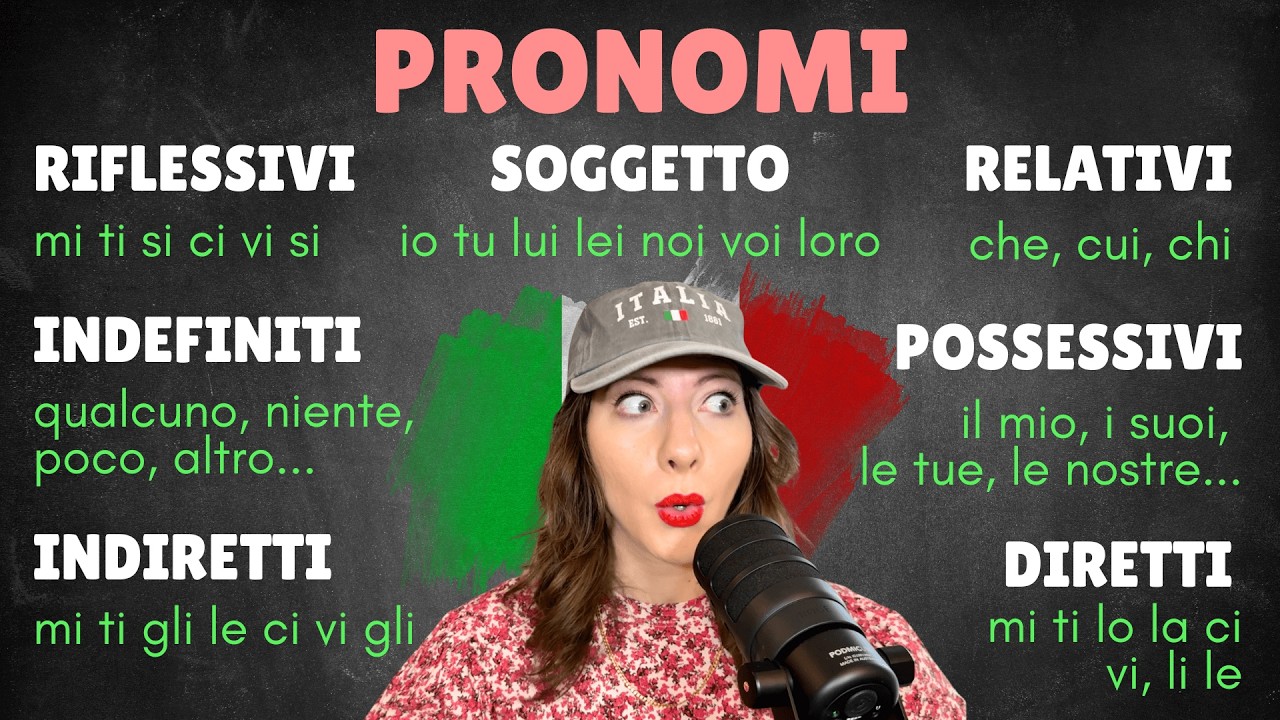
ITALIAN PRONOUNS: The Complete Guide
1. Personal Subject Pronouns
Personal subject pronouns replace the name of the person or thing performing the action. They are fundamental for identifying who is doing something and for giving structure to our sentences. In Italian, these pronouns are divided into singular and plural, and each has a specific function in communication.
Singular Form
- Io – first person singular (I’m talking about myself). This pronoun indicates the one who is speaking, the center of communication. Examples: Io mangio la pizza [I eat pizza], Io studio italiano [I study Italian], Io lavoro a Milano [I work in Milan].
- Tu – second person singular (I’m talking to you). It indicates the person you’re speaking directly to, the immediate interlocutor. Examples: Tu studi italiano [You study Italian], Tu parli bene [You speak well], Tu sei simpatico [You are nice].
- Lui/Lei/Egli/Ella/Esso/Essa – third person singular (I’m talking about someone else). These pronouns indicate a person or thing being talked about, but who is not present in the direct conversation. Lui is used for masculine, Lei for feminine. Examples: Lui lavora a Roma [He works in Rome], Lei studia medicina [She studies medicine], Esso funziona bene [It works well] (for objects).
Plural Form
- Noi – first person plural. It indicates a group of people that includes the speaker. It’s the pronoun of collectivity and inclusion. Examples: Noi andiamo al cinema [We go to the cinema], Noi parliamo italiano [We speak Italian], Noi abitiamo in Italia [We live in Italy].
- Voi – second person plural. It indicates a group of people being directly addressed. Examples: Voi studiate molto [You study a lot], Voi siete italiani [You are Italian], Voi capite tutto [You understand everything].
- Loro/Essi/Esse – third person plural. It indicates a group of people or things being talked about. Loro is the most common and modern form. Examples: Loro lavorano insieme [They work together], Loro sono amici [They are friends], Loro vivono a Firenze [They live in Florence].
Important Curiosities
In Italian, we often don’t use subject pronouns because the verb already tells us who is performing the action! This is a unique characteristic of Italian compared to other languages. For example, we can say “Mangio la pizza” [I eat pizza] instead of “Io mangio la pizza” [I eat pizza].
The verb ending (-o) clearly indicates that the subject is “io” (I). We use the subject pronoun only when we want to give emphasis or avoid confusion.
Examples of emphasis: “Io pago il conto!” [I pay the bill!] (I emphasize that I’m the one paying), “Tu devi studiare!” [You must study!] (I emphasize that it’s your responsibility).
ATTENTION! The forms “Egli, ella, essi, esse” are formal and literary forms that belong mainly to formal and literary written language. In everyday spoken language we always use “lui, lei, loro”.
If you want to sound like a 19th-century poetry book, go ahead and use “egli”… but your Italian friends will look at you strangely! These forms are still found in official documents, classic literary texts and very formal contexts, but are considered archaic in modern conversation.
2. Personal Complement Pronouns
These pronouns replace complements in sentences: direct object, indirect object and other types of complements. Here the situation becomes more complex and articulated, but don’t worry! With a bit of practice and attention, everything will become natural. Complement pronouns are essential for avoiding repetitions and making speech more flowing and elegant.
A) Direct Pronouns (Direct Object)
Direct pronouns answer the question “who?” or “what?” and replace the direct object. They are used when the verb’s action passes directly onto the object, without needing prepositions.
Weak forms (used before the conjugated verb):
- mi – me (first person singular): Marco mi vede [Marco sees me] = Marco vede me
- ti – you (second person singular): Ti chiamo domani [I’ll call you tomorrow] = Chiamo te domani
- lo – him/it (masculine singular) or “it”: Lo compro [I buy it] = Compro lui/quello/ciò
- la – her/it (feminine singular): La vedo [I see her] = Vedo lei/quella
- La – You (formal): La ringrazio, signora [I thank You, madam] = Ringrazio Lei
- ci – us (first person plural): Ci invitano [They invite us] = Invitano noi
- vi – you (second person plural): Vi aspetto [I wait for you] = Aspetto voi
- li – them (masculine plural): Li conosco [I know them] = Conosco loro (males or mixed group)
- le – them (feminine plural): Le compro [I buy them] = Compro loro (feminine things or women)
Practical examples with complete sentences:
- Vedi Marco? Sì, lo vedo. [Do you see Marco? Yes, I see him.] (lo = Marco) – Instead of repeating “Sì, vedo Marco” [Yes, I see Marco]
- Conosci Maria? Sì, la conosco. [Do you know Maria? Yes, I know her.] (la = Maria) – Instead of “Sì, conosco Maria” [Yes, I know Maria]
- Mangi la pasta? Sì, la mangio. [Do you eat pasta? Yes, I eat it.] (la = pasta) – The pronoun replaces the entire object
- Leggete i libri? Sì, li leggiamo. [Do you read the books? Yes, we read them.] (li = the books) – Masculine plural
- Compri le scarpe? Sì, le compro. [Do you buy the shoes? Yes, I buy them.] (le = the shoes) – Feminine plural
Trick to remember: “Lo” and “la” become “l’“ before a vowel for reasons of euphony (pleasant sound): L’amo [I love him/her] (amo lui/lei), L’ho visto [I saw him/her] (ho visto lui/lei/esso), L’ascolto [I listen to him/her] (ascolto lui/lei). This makes pronunciation more fluid and natural.
Direct Pronouns with the Past
Attention! When you use direct pronouns with the passato prossimo (and other compound tenses), the past participle must agree with the pronoun in gender and number. But there’s an important rule to remember:
With 3rd person singular (lo, la, l’) and plural (li, le) → agreement is MANDATORY:
- Hai visto Marco? Sì, l’ho visto. [Have you seen Marco? Yes, I saw him.] (visto = masculine singular)
- Hai visto Maria? Sì, l’ho vista. [Have you seen Maria? Yes, I saw her.] (vista = feminine singular)
- Hai mangiato le mele? Sì, le ho mangiate. [Have you eaten the apples? Yes, I ate them.] (mangiate = feminine plural)
- Hai letto i libri? Sì, li ho letti. [Have you read the books? Yes, I read them.] (letti = masculine plural)
With 1st and 2nd person singular and plural (mi, ti, ci, vi) → agreement is OPTIONAL (but always correct if done):
- Marco mi ha chiamato/chiamata. [Marco called me.] (both correct!)
- Maria ci ha visto/visti/viste. [Maria saw us.] (all forms are correct!)
- Ti ho cercato/cercata stamattina. [I looked for you this morning.] (both correct!)
Curiosity with Modal Verbs (dovere, potere, volere)
When you use direct pronouns with modal verbs in the passato prossimo, an interesting thing happens: it’s the pronoun that decides whether the past participle agrees or not!
If the pronoun is BEFORE the modal verb:
- Ci hanno voluti vedere. [They wanted to see us.] (voluti agrees with “ci” = us)
- Li ho dovuti chiamare. [I had to call them.] (dovuti agrees with “li” = them masculine)
- L’ho potuta incontrare. [I was able to meet her.] (potuta agrees with “l'” = her)
If the pronoun is AFTER (attached to the infinitive):
- Hanno voluto vederci. [They wanted to see us.] (NO agreement: hanno voluto)
- Ho dovuto chiamarli. [I had to call them.] (NO agreement: ho dovuto)
B) Indirect Pronouns (Indirect Object)
Indirect pronouns answer the question “to whom?” and replace the indirect object. They are used when the verb’s action is directed indirectly towards someone, typically with verbs that require the preposition “a”.
Weak forms:
- mi – to me: Mi telefoni? [Will you call me?] = Telefoni a me?
- ti – to you: Ti scrivo [I write to you] = Scrivo a te
- gli – to him: Gli parlo [I talk to him] = Parlo a lui
- le – to her: Le regalo fiori [I give her flowers] = Regalo fiori a lei
- Le – to You (formal): Le chiedo scusa [I apologize to You] = Chiedo scusa a Lei
- ci – to us: Ci scrivono [They write to us] = Scrivono a noi
- vi – to you: Vi spiego [I explain to you] = Spiego a voi
- gli/loro – to them: Gli telefono / Telefono loro [I call them] = Telefono a loro
Detailed examples:
- Telefoni a Marco? Sì, gli telefono. [Are you calling Marco? Yes, I’m calling him.] (gli = to Marco) – The verb “telefonare” always requires “a”
- Scrivi a Maria? Sì, le scrivo. [Are you writing to Maria? Yes, I’m writing to her.] (le = to Maria) – The verb “scrivere a qualcuno” [to write to someone]
- Parli ai tuoi genitori? Sì, gli parlo [Are you talking to your parents? Yes, I’m talking to them] (or: parlo loro). – Third person plural
- Dai un regalo a me? Sì, ti do un regalo. [Are you giving me a gift? Yes, I’m giving you a gift.] – First person singular indirect
Important note:
“Loro” can be used instead of “gli” for third person plural, but it presents a fundamental difference in position: it goes AFTER the verb instead of before. So we say: “Parlo loro” [I talk to them] instead of “Gli parlo” [I talk to them].
However, in modern and colloquial language, the form “gli” is winning this battle and is now the most used, although “loro” remains correct and is still used in more formal or literary contexts.
Common verbs that use indirect pronouns: telefonare, scrivere, parlare, chiedere, rispondere, regalare, dare, mandare, inviare, spedire, raccontare, spiegare, insegnare, prestare, mostrare.
C) Complement Pronouns – Strong Form (After All Prepositions)
Besides the weak forms, there are also strong forms (tonic) of complement pronouns. These are used AFTER prepositions and when you want to give emphasis.
Strong forms:
- me – me
- te – you
- lui/lei/Lei – him/her
- noi – us
- voi – you
- loro – them
- sé – himself/herself (reflexive form)
When are they used?
1. AFTER ALL PREPOSITIONS (a, di, da, con, per, su, tra, fra, senza…):
- Vengo con te. [I’m coming with you.] (NOT: vengo con ti)
- Parlo di lui. [I talk about him.] (NOT: parlo di lo)
- Questo regalo è per voi. [This gift is for you.] (NOT: questo regalo è per vi)
- Abito vicino a loro. [I live near them.] (NOT: abito vicino a gli)
- Senza di te, mi annoio. [Without you, I get bored.]
- Pensano sempre a me. [They always think about me.]
2. TO GIVE EMPHASIS:
- Amo te! [I love YOU!] (stronger than “Ti amo“)
- Ha chiamato me, non te! [He called ME, not YOU!]
- Cercano proprio voi! [They’re looking for YOU specifically!]
3. AFTER COMPARISONS (di, come, quanto):
- Sei più alto di me. [You’re taller than me.]
- Marco è intelligente come te. [Marco is as intelligent as you.]
- Lavora quanto noi. [He works as much as us.]
REFLEXIVE FORM “SÉ”:
The form “sé” (with or without accent, both correct: “sé” or “se”) is used for third person when the action falls back on the subject itself:
- Pensa sempre a sé (stesso). [He always thinks about himself.]
- Parla da sé. [He talks to himself.]
- Conta solo su sé (stesso). [He only counts on himself.]
COMPLETE EXAMPLES:
- Questo libro è per te, non per lui. [This book is for you, not for him.]
- Viene da noi stasera? [Is he coming to our place tonight?]
- Abito lontano da loro. [I live far from them.]
- Escono sempre con voi? [Do they always go out with you?]
- Pensa solo a sé. [He only thinks about himself.]
D) Combined Pronouns
When we combine an indirect pronoun with a direct one, the form changes in a particular way and the two pronouns merge together. This is one of the most interesting and complex characteristics of Italian, but once you understand the mechanism, it becomes automatic.
Combination scheme:
- mi + lo/la/li/le = me lo/la/li/le (separate)
- ti + lo/la/li/le = te lo/la/li/le (separate)
- gli/le + lo/la/li/le = glielo/gliela/glieli/gliele (all attached!)
- ci + lo/la/li/le = ce lo/la/li/le (separate)
- vi + lo/la/li/le = ve lo/la/li/le (separate)
- gli (loro) + lo/la/li/le = glielo/gliela/glieli/gliele (all attached!)
Golden rule: The indirect pronouns mi, ti, ci, vi change the final “i” to “e” when they combine with direct ones. The pronoun gli/le becomes “glie-“ and attaches completely to the direct pronoun.
Practical examples with complete explanation:
- Dai il libro a Marco? Sì, glielo do. [Are you giving the book to Marco? Yes, I’m giving it to him.] (glie-lo = to him-the book) — “Gli” (to him) + “lo” (the book) = “glielo”
- Presti la penna a Maria? Sì, gliela presto. [Are you lending the pen to Maria? Yes, I’m lending it to her.] (glie-la = to her-the pen) — “Le” (to her) + “la” (the pen) = “gliela”
- Mi mostri le foto? Sì, te le mostro. [Will you show me the photos? Yes, I’ll show them to you.] (te-le = to you-the photos) — “Ti” becomes “te” + “le” (the photos)
- Ci porti i documenti? Sì, ve li porto. [Will you bring us the documents? Yes, I’ll bring them to you.] (ve-li = to you-the documents) — “Vi” becomes “ve” + “li”
- Regali il telefono a Luigi? Sì, glielo regalo. [Are you giving the phone to Luigi? Yes, I’m giving it to him.] — Even with proper names the rule is identical
- Mandi le email ai clienti? Sì, gliele mando. [Are you sending the emails to the clients? Yes, I’m sending them to them.] — Plural: “to them” + “the emails” = “gliele”
3. Possessive Pronouns
Possessive pronouns indicate who something belongs to, but without repeating the name of the possessed object. They serve to express possession concisely and elegantly, avoiding unnecessary repetitions. The fundamental difference with possessive adjectives is that the latter accompany the noun (“il mio libro” [my book]), while pronouns replace it (“il mio” [mine]).
Complete forms with article:
- il mio/la mia/i miei/le mie – mine (first person singular)
- il tuo/la tua/i tuoi/le tue – yours (second person singular)
- il suo/la sua/i suoi/le sue – his/hers (third person singular)
- il nostro/la nostra/i nostri/le nostre – ours (first person plural)
- il vostro/la vostra/i vostri/le vostre – yours (second person plural)
- il loro/la loro/i loro/le loro – theirs (third person plural – invariable!)
Practical examples with context:
- Questa è la mia macchina, quella è la tua. [This is my car, that is yours.] (la tua = your car) – Avoid repeating “car”
- Questo libro è mio, quello è il suo. [This book is mine, that is his.] (il suo = his book) – Third person possession
- I nostri problemi sono diversi dai vostri. [Our problems are different from yours.] (vostri = your problems) – Comparison between possessors
- Le mie idee sono migliori delle sue. [My ideas are better than his/hers.] (sue = his/her ideas) – Feminine plural
- Questo telefono è il mio, non il loro. [This phone is mine, not theirs.] – Clear distinction between possessors
ATTENTION! The possessive pronoun always takes the definite article (il, la, i, le) and must agree in gender and number with the possessed object, NOT with the possessor.
Special note on “loro”: The possessive “loro” is invariable, meaning it never changes form: il loro libro [their book], la loro casa [their house], i loro amici [their friends], le loro idee [their ideas] – “loro” always stays the same!
4. Reflexive Pronouns
Reflexive pronouns are special pronouns that indicate that the verb’s action falls back on the subject itself that performs it. In practice, the subject does the action to itself! Imagine looking at yourself in the mirror: everything you do is “reflected” on yourself, just like in a mirror. That’s why they’re called “reflexive“!
The fundamental difference between a normal verb and a reflexive verb is this:
- Normal verb: the subject performs an action on someone or something else → “Lavo la macchina” [I wash the car] (I wash something external to me)
- Reflexive verb: the subject performs an action on itself → “Mi lavo” [I wash myself] (I wash myself)
Think of reflexive pronouns as arrows that come back towards whoever performs the action. When I say “Mi pettino” [I comb myself], the action of combing starts from me and comes back to myself. It’s as if the complete sentence were “Io pettino me stesso” [I comb myself], but in Italian we simply say “Mi pettino” using the reflexive pronoun “mi”.
Forms:
- mi – myself (io)
- ti – yourself (tu)
- si – himself/herself (lui/lei/Lei)
- ci – ourselves (noi)
- vi – yourselves (voi)
- si – themselves (loro)
How are they used?
Reflexive pronouns are used with reflexive verbs, that is, those verbs in which the subject performs an action on itself. These verbs in the infinitive always end in -si (lavarsi, vestirsi, pettinarsi) and when we conjugate them, the reflexive pronoun changes according to the person:
Examples with reflexive verbs:
- (Io) Mi lavo. [I wash myself.] (= I wash myself)
- (Tu) Ti vesti. [You dress yourself.] (= you dress yourself)
- (Lui) Si pettina. [He combs himself.] (= he combs himself)
- (Noi) Ci prepariamo. [We prepare ourselves.] (= we prepare ourselves)
- (Voi) Vi svegliate. [You wake up.] (= you wake yourselves)
- (Loro) Si siedono. [They sit down.] (= they sit themselves)
MOST COMMON REFLEXIVE VERBS:
- lavarsi – Mi lavo le mani. [I wash my hands.]
- vestirsi – Ti vesti sempre elegante! [You always dress elegantly!]
- svegliarsi – Ci svegliamo presto. [We wake up early.]
- alzarsi – Vi alzate tardi? [Do you get up late?]
- chiamarsi – Mi chiamo Marco. [My name is Marco.] (literally: I call myself Marco)
- divertirsi – Ci divertiamo molto insieme! [We have a lot of fun together!]
- prepararsi – Si preparano per la festa. [They prepare themselves for the party.]
- sentirsi – Mi sento bene oggi. [I feel good today.]
Attention to Reciprocal Forms!
Reflexive pronouns are also used to express a reciprocal action (that is, when two or more people do something to each other). In this case, the action doesn’t just return to one person, but is exchanged between multiple people:
- Marco e Maria si amano. [Marco and Maria love each other.] (= they love each other)
- Ci scriviamo spesso. [We write to each other often.] (= we write to one another)
- Vi conoscete? [Do you know each other?] (= do you know one another)
- Si telefonano ogni giorno. [They call each other every day.] (= they call one another)
Position of Reflexive Pronouns
They follow the same rules as other weak pronouns:
Before the conjugated verb:
- Mi alzo alle 7. [I get up at 7.]
- Ti prepari per uscire? [Are you getting ready to go out?]
Attached to the infinitive, gerund and imperative:
- Voglio alzarmi presto. [I want to get up early.] (or: Mi voglio alzare)
- Alzandosi, ha visto l’ora. [Getting up, he saw the time.]
- Svegliati! [Wake up!] (imperative)
With Passato Prossimo
Reflexive verbs ALWAYS use the auxiliary “essere” and the past participle agrees with the subject:
- (Io) Mi sono lavato/lavata. [I washed myself.]
- (Tu) Ti sei vestito/vestita. [You dressed yourself.]
- (Lui) Si è alzato. [He got up.] / (Lei) Si è alzata. [She got up.]
- (Noi) Ci siamo divertiti/divertite. [We had fun.]
- (Voi) Vi siete preparati/preparate. [You prepared yourselves.]
- (Loro) Si sono svegliati/svegliate. [They woke up.]
Attention! Some verbs change meaning if they are reflexive or not!
- Chiamare = to call someone → Chiamo Marco. [I call Marco.]
- Chiamarsi = to be named → Mi chiamo Luigi. [My name is Luigi.]
- Sentire = to perceive with the senses → Sento la musica. [I hear the music.]
- Sentirsi = to feel a sensation → Mi sento felice. [I feel happy.]
- Vedere = to watch → Vedo un film. [I watch a movie.]
- Vedersi = to meet each other → Ci vediamo domani! [See you tomorrow!]
TRICK TO REMEMBER:
If you can say “myself” after the verb, then it’s reflexive! “Io lavo me stesso” [I wash myself] = Mi lavo. “Io amo me stesso” [I love myself] = Mi amo.
5. Demonstrative Pronouns
Demonstrative pronouns indicate the position of something or someone in space or time, creating a sort of linguistic “pointing.” They serve to distinguish between near and far elements, both physically and conceptually, and are essential for clear and precise communication.
Main forms:
- questo/questa/questi/queste – near the speaker (physical or temporal proximity)
- quello/quella/quelli/quelle – far from the speaker (physical or temporal distance)
- ciò – “this thing” (neuter, used only in singular, very common)
Practical examples with spatial and temporal context:
- Mi piace questa camicia, ma preferisco quella. [I like this shirt, but I prefer that one.] (quella = that far shirt) – Spatial comparison
- Questi sono i miei amici, quelli sono i tuoi. [These are my friends, those are yours.] (quelli = those there, far away) – Distinction between groups
- Ciò che dici è interessante. [What you say is interesting.] (ciò = the thing that, the topic) – Very common neuter form
- Questi pantaloni sono comodi, ma quelli sono più eleganti. [These pants are comfortable, but those are more elegant.] – Qualitative comparison with distance
- Ciò mi sorprende molto. [This surprises me a lot.] – Generic reference to a situation
- Questa è la mia opinione, quella è la tua. [This is my opinion, that is yours.] – Abstract distinction of concepts
Important cultural curiosity: Italians often use demonstratives accompanied by gestures! When we say “questo” we point to or touch something near us, when we say “quello” we point far away, often extending our arm completely.
Nonverbal communication is fundamental in Italian. Remember: in Italy, speaking without using your hands is almost impossible! Gestures are an integral part of the language, they give meaning and emphasis to words.
Other uses of “ciò”: This neuter form is very versatile and is used in common expressions like: Ciò detto… [That said…] (having said this), Nonostante ciò… [Despite this…] (despite this), A causa di ciò… [Because of this…] (because of this).
6. Indefinite Pronouns
Indefinite pronouns indicate people or things in a generic and imprecise way, without specifying exactly who or what you’re talking about. They are fundamental linguistic tools for expressing indeterminate quantities, vague identities or generic references, and are used constantly in everyday conversation.
The most common and their use:
- Qualcuno – an unspecified or unknown person. Examples: Qualcuno ha bussato alla porta [Someone knocked on the door], C’è qualcuno in casa? [Is there someone at home?], Qualcuno sa la risposta? [Does someone know the answer?]
- Qualcosa – an unspecified or indefinite thing. Examples: Voglio mangiare qualcosa [I want to eat something], C’è qualcosa che non va? [Is there something wrong?], Ho dimenticato qualcosa [I forgot something]
- Nessuno – no person, total absence. Examples: Non ho visto nessuno [I didn’t see anyone], Nessuno è arrivato [No one arrived], Non c’è nessuno qui [There’s no one here]
- Niente/nulla – nothing, complete void. Examples: Non ho capito niente [I didn’t understand anything], Non c’è nulla da fare [There’s nothing to do], Non ho mangiato niente [I didn’t eat anything]
- Tutto – everything, totality. Examples: Ho capito tutto [I understood everything], Tutto è pronto [Everything is ready], Ho mangiato tutto [I ate everything]
- Tutti/tutte – all people. Examples: Tutti sono arrivati [Everyone arrived], Tutte le ragazze sono uscite [All the girls went out], Tutti vogliono venire [Everyone wants to come]
- Ciascuno – each person considered individually. Examples: Ciascuno ha le sue opinioni [Each one has their opinions], Ciascuno deve fare la sua parte [Each one must do their part]
- Alcuni/alcune – a certain number of people or things. Examples: Alcuni studenti sono assenti [Some students are absent], Alcune persone non capiscono [Some people don’t understand]
- Molti/molte – many people or things. Examples: Molti pensano così [Many think so], Molte sono d’accordo [Many agree]
- Pochi/poche – few people or things. Examples: Pochi sanno la verità [Few know the truth], Poche hanno risposto [Few answered]
- Altri/altre – other people or things. Examples: Altri arriveranno dopo [Others will arrive later], Altre persone studiano, altre lavorano [Some people study, others work]
Examples in complete sentences with context:
- Hai visto qualcuno in giardino? [Did you see someone in the garden?] – Question about an indefinite person
- Non ho visto nessuno ieri sera. [I didn’t see anyone last night.] – Negation with double negation
- Tutti sono arrivati in orario stamattina. [Everyone arrived on time this morning.] – Totality of people
- Vuoi mangiare qualcosa prima di uscire? [Do you want to eat something before going out?] – Generic food offer
- Alcuni studiano medicina, altri lavorano in banca. [Some study medicine, others work in a bank.] – Contrast between groups
- Molti parlano, ma pochi agiscono davvero. [Many talk, but few really act.] – Quantitative contrast
ATTENTION TO DOUBLE NEGATION! “Nessuno” and “niente” require double negation in Italian, which is a mandatory grammatical feature: “Non ho visto nessuno” [I didn’t see anyone] (literally: “I didn’t see no one” = I didn’t see any person).
In English you would say “I haven’t seen anyone” with a single negation, but in Italian double negation is not an error, it’s mandatory! In fact, without it the sentence would be incorrect.
Practical rule: With “nessuno” and “niente” you must always use “non” before the verb: Non so niente [I don’t know anything], Non vedo nessuno [I don’t see anyone], Non voglio nulla [I don’t want anything], Non c’è nessuno [There’s no one].
7. Relative Pronouns
Relative pronouns are fundamental linguistic tools that connect two sentences and refer to someone or something mentioned previously in the main clause. They serve to create complex and elaborate sentences, avoiding the repetition of subjects and objects, and making speech more fluid and sophisticated.
Main forms and their functions:
- Che – the most used relative pronoun! It can be the subject or object of the relative clause. It’s extremely versatile and works in most contexts. It never changes form and can refer to people, animals or things.
Examples: L’uomo che vedi è mio padre [The man that you see is my father] (che = subject: the man sees), Il libro che leggo è interessante [The book that I read is interesting] (che = object: I read the book)
- Cui – used exclusively after prepositions (a cui, di cui, con cui, per cui, in cui, su cui, da cui…). It can never stand alone without a preposition.
Examples: La persona di cui ti ho parlato è qui [The person about whom I spoke to you is here] (di + cui = to speak about someone), La città in cui vivo è bella [The city in which I live is beautiful] (in + cui = to live in a place), Il motivo per cui sono qui… [The reason why I’m here…] (per + cui = reason)
- Il quale/la quale/i quali/le quali – more formal and literary form of “che”. Used mainly in formal contexts, in written language or when you want to avoid ambiguity. It agrees in gender and number with the antecedent.
Example: Il ragazzo con il quale lavoro è simpatico [The boy with whom I work is nice] (il quale = formal form, you can also say “con cui”)
- Chi – means “the person who” and is used only for people. It has a generic and indefinite value, often with the value of a proverb or general statement.
Examples: Chi studia, impara [Who studies, learns] (chi = the person who), Chi dorme non piglia pesci [The early bird catches the worm] (proverb), Chi troppo vuole nulla stringe [He who wants too much gets nothing]
Complete examples with detailed explanations:
- L’uomo che vedi è mio padre. [The man that you see is my father.] – “Che” is subject of the relative: the man sees
- Il libro che leggo è interessante. [The book that I read is interesting.] – “Che” is object: I read the book
- La persona di cui ti ho parlato è arrivata. [The person about whom I spoke to you has arrived.] – “Di cui” because “to speak about someone”
- La città in cui vivo è bellissima. [The city in which I live is very beautiful.] – “In cui” because “to live in a place”
- Chi studia passa gli esami. [Who studies passes exams.] – General statement about all people
- Il ragazzo con il quale lavoro è molto professionale. [The boy with whom I work is very professional.] – Formal form instead of “con cui”
- La ragione per cui sono qui è importante. [The reason why I’m here is important.] – “Per cui” indicates cause or reason
Practical trick: Always use “che“ when in doubt! It’s the most versatile, universal relative pronoun and works in most cases. “Cui“ is used only and always after prepositions: it can never stand alone.
If there’s a preposition (a, di, con, per, in, su, da), use “cui”; otherwise use “che”.
How to choose the right pronoun:
- No preposition? → Use “che”
- Is there a preposition? → Use “cui”
- Formal context? → You can use “il quale/la quale”
- Talking about people in general? → Use “chi”
8. Interrogative Pronouns
Interrogative pronouns are used to ask direct questions and serve to request specific information about people, things, qualities or quantities. They are essential tools for any conversation and allow you to obtain necessary information clearly and precisely.
Main forms with detailed use:
- Chi? – which person? Refers exclusively to people, never to things or animals.
Examples: Chi è quella persona? [Who is that person?], Chi viene alla festa? [Who’s coming to the party?], Chi ha chiamato? [Who called?], Con chi parli? [Who are you talking with?]
- Che? / che cosa? / cosa? – what thing? Refers to things, actions, concepts. All three forms are correct and interchangeable.
Examples: Che vuoi? [What do you want?], Che cosa fai? [What are you doing?], Cosa mangi? [What are you eating?], Che succede? [What’s happening?]
- Quale/quali? – which among more options? Implies a choice between alternatives. Agrees in number (singular or plural) but not in gender.
Examples: Quale preferisci? [Which one do you prefer?], Quali vuoi? [Which ones do you want?]
- Quanto/quanta/quanti/quante? – what quantity? Asks for information about number, quantity, measure. Agrees in gender and number with what it refers to.
Examples: Quanti ne hai? [How many do you have?], Quanto costa? [How much does it cost?]
Complete examples in realistic contexts:
- Chi è quella persona con la giacca rossa? [Who is that person with the red jacket?] – Identity of a specific person
- Che vuoi mangiare stasera? [What do you want to eat tonight?] – Food choice
- Cosa stai facendo adesso? [What are you doing now?] – Present action
- Quale film preferisci tra questi due? [Which movie do you prefer between these two?] – Choice between options
Important cultural note: In Italian it’s extremely common to use “cosa“ instead of “che cosa” in everyday spoken language.
“Che fai?“ is more informal and colloquial than “Che cosa fai?”, but both forms are absolutely correct! The form “***cosa?***” alone is probably the most used in informal conversation between friends and family.
Levels of formality:
- Very informal: “Cosa fai?”
- Neutral: “Che fai?”
- Formal: “Che cosa fa?” [What are you doing?] (with Lei)
Stop reading Italian.
Start speaking it.
Online lessons in groups of 4, organised by level and goals, with qualified teachers. Pick the day and time that suit you from the available slots.
Max 4 students:
there’s a seat for you
9. Exclamatory Pronouns
Exclamatory pronouns have the same form as interrogative pronouns, but are used in exclamations to express surprise, wonder, indignation or other strong emotions.
Main forms:
- che! – what thing!
- quanto/quanta/quanti/quante! – what quantity!
- chi! – which person! (less common)
How to recognize them?
It’s simple: observe the punctuation! If there’s an exclamation mark, they’re exclamatory. If there’s a question mark, they’re interrogative.
Examples:
- Che bella giornata! [What a beautiful day!] (exclamation of joy)
- Che disastro! [What a disaster!] (exclamation of disappointment)
- Che sorpresa vederti qui! [What a surprise to see you here!]
- Quanta gente c’è! [How many people there are!] (exclamation of amazement)
- Quanti libri hai letto! [How many books you’ve read!] (exclamation of admiration)
- Quanto sei cresciuto! [How much you’ve grown!]
- Come sei bello! [How beautiful you are!] (also “come” can be exclamatory)
- Chi si rivede! [Look who’s here!] (exclamation when you see someone after a long time)
Difference between Interrogative and Exclamatory
- Che vuoi? [What do you want?] (question = interrogative)
- Che vuoi! [What do you want!] (exclamation = exclamatory, expresses annoyance or disbelief)
- Quanti ne hai? [How many do you have?] (question = interrogative)
- Quanti ne hai! [You have so many!] (exclamation = exclamatory, expresses surprise about age)
Curiosity: Italians are very expressive and use numerous exclamations in everyday communication. The frequent use of exclamatory pronouns is a distinctive characteristic of spoken Italian.
10. Pronominal Particles: CI and NE
The pronominal particles CI and NE are fundamental elements of the Italian language that present considerable complexity of use. These particles, characterized by their multifunctionality, replace different complements and are indispensable for fluid and natural communication in Italian. Understanding their multiple uses will allow you to express yourself with greater precision and mastery of the language.
The Particle “CI”
“Ci” has FIVE different uses! Let’s see them one by one:
1. REFLEXIVE PRONOUN (ourselves)
- Ci laviamo ogni mattina. [We wash ourselves every morning.] (= we wash ourselves)
- Ci prepariamo per uscire. [We prepare ourselves to go out.] (= we prepare ourselves)
2. DIRECT PRONOUN (us)
- Marco ci ha visti ieri. [Marco saw us yesterday.] (= he saw us)
- Maria ci chiama spesso. [Maria calls us often.] (= she calls us)
3. INDIRECT PRONOUN (to us)
- Luca ci telefona domani. [Luca will call us tomorrow.] (= he’ll call to us)
- Il professore ci spiega la lezione. [The professor explains the lesson to us.] (= he explains to us)
4. “IN/AT THIS PLACE” (adverb of place)
This is the most particular use! “Ci” can replace a place complement introduced by “a“, “in“, “su“, etc.
- Vai al cinema? Sì, ci vado. [Are you going to the cinema? Yes, I’m going there.] (ci = al cinema)
- Abiti a Roma? Sì, ci abito. [Do you live in Rome? Yes, I live there.] (ci = a Roma)
- Sei stato in Italia? Sì, ci sono stato molte volte. [Have you been to Italy? Yes, I’ve been there many times.] (ci = in Italia)
- Vai in spiaggia? Sì, ci vado ogni estate. [Are you going to the beach? Yes, I go there every summer.] (ci = sulla spiaggia)
5. “TO THIS THING” (with verbs)
“Ci” can replace a complement introduced by “a” that refers to a thing (NOT to a person):
- Pensi all‘esame? Sì, ci penso sempre. [Are you thinking about the exam? Yes, I always think about it.] (ci = all’esame)
- Credi ai fantasmi? No, non ci credo. [Do you believe in ghosts? No, I don’t believe in them.] (ci = ai fantasmi)
- Tieni alla tua famiglia? Sì, ci tengo molto. [Do you care about your family? Yes, I care about it a lot.] (ci = alla mia famiglia)
- Partecipi alla festa? Sì, ci partecipo. [Are you participating in the party? Yes, I’m participating in it.] (ci = alla festa)
COMMON VERBS THAT USE “CI”:
- pensare a qualcosa [to think about something] → pensarci
- credere a qualcosa [to believe in something] → crederci
- tenere a qualcosa [to care about something] → tenerci
- riuscire a fare qualcosa [to succeed in doing something] → riuscirci
- contare su qualcosa [to count on something] → contarci
FIXED EXPRESSIONS WITH “CI”:
- Ci vuole/vogliono = it’s necessary
- Quanto tempo ci vuole? [How much time does it take?] (= how much time is necessary?)
- Ci vogliono tre ore. [It takes three hours.] (= three hours are necessary)
- Ci sono/c’è = there are/there is (in a place)
- Ci sono molte persone. [There are many people.]
- C’è un problema? [Is there a problem?]
- Vederci = to see well/poorly (with eyes)
- Non ci vedo bene senza occhiali. [I can’t see well without glasses.]
- Sentirci = to hear well/poorly (with ears)
- Non ci sento! Parla più forte! [I can’t hear! Speak louder!]
The Particle “NE”
“Ne” also has many uses! It’s a versatile particle that makes Italian more elegant and fluid.
1. “OF THIS/THAT” (partitive – indicates quantity)
This is the most common use! “Ne” replaces a part of something, a quantity:
- Vuoi del caffè? Sì, ne voglio. [Do you want some coffee? Yes, I want some.] (ne = di caffè, without specifying how much)
- Hai delle mele? Sì, ne ho tre. [Do you have apples? Yes, I have three.] (ne = di mele)
- Compri dei libri? Sì, ne compro due. [Are you buying books? Yes, I’m buying two.] (ne = di libri)
- Quanti fratelli hai? Ne ho due. [How many brothers do you have? I have two.] (ne = di fratelli)
- Quanta pasta mangi? Ne mangio molta. [How much pasta do you eat? I eat a lot.] (ne = di pasta)
ATTENTION! With partitive “Ne”, you must always specify the quantity (un po’, molto, poco, due, tre, etc.) or use an indefinite pronoun (alcuni, molti, pochi…):
- Ne voglio un po’. [I want some.]
- Ne ho molti. [I have many.]
- Ne compro tre. [I’m buying three.]
- Ne voglio. [I want.] (incomplete! You want how much?)
2. “FROM THIS PLACE” (adverb of place – movement from a place)
“Ne” can replace a place complement with “da“, but this use is more common with pronominal verbs:
- Andarsene (to go away from a place) → Me ne vado ora. / Te ne vai già? [I’m leaving now. / Are you leaving already?]
- Uscirne (to get out of a situation) → È una situazione difficile, ma ne usciremo. [It’s a difficult situation, but we’ll get out of it.]
3. “OF THIS/THAT” (complement of topic)
“Ne” replaces a complement introduced by “di” that indicates the topic:
- Parli del problema? Sì, ne parlo con te. [Are you talking about the problem? Yes, I’m talking about it with you.] (ne = del problema)
- Discutete della politica? No, non ne discutiamo. [Are you discussing politics? No, we don’t discuss it.] (ne = della politica)
- Ti preoccupi degli esami? Sì, me ne preoccupo. [Are you worried about the exams? Yes, I’m worried about them.] (ne = degli esami)
COMMON VERBS THAT USE “NE”:
- parlare di qualcosa [to talk about something] → parlarne
- discutere di qualcosa [to discuss something] → discuterne
- essere orgoglioso di qualcosa [to be proud of something] → esserne orgoglioso
- avere bisogno di qualcosa [to need something] → averne bisogno
- avere voglia di qualcosa [to feel like something] → averne voglia
- essere contento di qualcosa [to be happy about something] → esserne contento
- rendersi conto di qualcosa [to realize something] → rendersene conto
4. WITH REFLEXIVE VERBS (PRONOMINAL VERBS)
Some verbs use “Ne” in fixed expressions:
- Andarsene = to go away
- Me ne vado. [I’m leaving.] (= I’m going away)
- Se ne sono andati. [They left.] (= they went away)
- Fregarsene = not to care (colloquial)
- Me ne frego! [I don’t care!] (= I don’t care about it!)
- Accorgersene = to realize
- Non me ne sono accorto. [I didn’t realize it.] (= I didn’t realize it)
- Pentirsi = to regret
- Me ne pento. [I regret it.] (= I regret this)
Position of “CI” and “NE”
Like other weak pronouns, “Ci” and “Ne” go:
Before the conjugated verb:
- Ci vado domani. [I’m going there tomorrow.]
- Ne voglio due. [I want two of them.]
After and attached to the infinitive, gerund and imperative:
- Voglio andarci. [I want to go there.]
- Comprane tre! [Buy three of them!]
- Parlandone, ho capito meglio. [Talking about it, I understood better.]
With Combined Pronouns
When “Ci” or “Ne” combine with other pronouns, “Ci” becomes “CE“:
- me + ne = me ne
- Me ne vado. [I’m leaving.] (= I’m going away)
- Me ne dai due? [Will you give me two of them?] (= will you give me two of these?)
- te + ne = te ne
- Te ne vai già? [Are you leaving already?] (= are you going away already?)
- ci + ne = ce ne
- Ce ne sono molti. [There are many of them.] (= of these there are many)
- Mi dai del pane? Sì, te ne do un po’. [Will you give me some bread? Yes, I’ll give you some.] (= I’ll give you some bread)
ATTENTION WITH “CI” + “LO/LA/LI/LE”:
“Ci” becomes “ce” also when it combines with direct pronouns:
- Metti i libri sul tavolo? Sì, ce li metto. [Are you putting the books on the table? Yes, I’m putting them there.] (ce = ci = sul tavolo; li = i libri)
- Porti Maria al cinema? Sì, ce la porto. [Are you taking Maria to the cinema? Yes, I’m taking her there.] (ce = ci = al cinema; la = Maria)
TRICKS TO REMEMBER:
- CI = “there, in that place” → Ci vado = I’m going there
- NE = “from there, of that” → Ne vengo = I’m coming from there / Ne voglio = I want some of that
11. Position of Pronouns in the Sentence
The position of pronouns in the Italian sentence follows precise rules that are fundamental to know in order to speak correctly. The position changes depending on the type of verb and the verbal form used, and getting the position wrong can make the sentence incomprehensible or grammatically incorrect.
General Rule: Before the Conjugated Verb
Weak pronouns (weak forms) go BEFORE the conjugated verb in all finite moods (indicative, subjunctive, conditional):
- Lo vedo ogni giorno. [I see him every day.] (lo = him, direct object before the verb)
- Ti chiamo domani sera. [I’ll call you tomorrow evening.] (ti = you, object before the verb)
- Gli parlo spesso al telefono. [I often talk to him on the phone.] (gli = to him, indirect complement)
- Mi piace molto la pizza. [I like pizza a lot.] (mi = to me)
- Ci vediamo stasera in centro. [We’ll see each other tonight downtown.] (ci = us)
EXCEPTIONS: When Pronouns Go After
With infinitive, gerund and affirmative imperative, pronouns go AFTER the verb and attached to it, forming a single word:
A) With the infinitive:
Pronouns attach to the end of the infinitive, which loses the final “e“:
- Voglio vederlo. [I want to see him.] (vedere + lo = vederlo) – Instead of “lo voglio vedere”, both forms are correct!
- Devo parlargli. [I must talk to him.] (parlare + gli = parlargli) – Instead of “gli devo parlare”, both correct!
- Posso chiamarti più tardi? [Can I call you later?] (chiamare + ti = chiamarti)
- Preferisco farlo da solo. [I prefer to do it alone.] (fare + lo = farlo)
IMPORTANT: With modal verbs (dovere, potere, volere) + infinitive, you can put the pronoun before the modal verb OR after the infinitive: “Lo voglio vedere” = “Voglio vederlo” (both correct and interchangeable!).
B) With the gerund:
Pronouns always attach to the end of the gerund:
- Parlandogli, ho capito la situazione. [Talking to him, I understood the situation.] (parlando + gli = parlandogli)
- Vedendola, ho sorriso immediatamente. [Seeing her, I smiled immediately.] (vedendo + la = vedendola)
- Scrivendoti questa lettera, mi sono emozionato. [Writing this letter to you, I got emotional.] (scrivendo + ti = scrivendoti)
C) With the affirmative imperative (positive commands):
Pronouns attach to the end of the imperative:
- Chiamalo! [Call him!] (tu – imperative of chiamare + lo)
- Scrivetegli! [Write to him!] (voi – imperative of scrivere + gli)
- Comprala! [Buy it!] (tu – imperative of comprare + la)
- Dimmi la verità! [Tell me the truth!] (tu – imperative of dire + mi)
- Fagli un favore! [Do him a favor!] (tu – imperative of fare + gli)
ATTENTION with the informal imperative (tu): With monosyllabic verbs (va’, fa’, di’, da’, sta’), the pronoun doubles the initial consonant: Vacci! [Go there!] (va + ci), Fallo! [Do it!] (fa + lo), Dille! [Tell her!] (di + le), Dammi! [Give me!] (da + mi).
D) With the negative imperative:
With negative commands, there are two options:
- Non lo chiamare! = Non chiamarlo!
- Non gli scrivete! = Non scrivetegli!
- Non la comprare! = Non comprarla!
Summary Position Scheme
| Verbal Form | Pronoun Position | Example |
|---|---|---|
| Conjugated verb (indicative, subjunctive, conditional) | BEFORE the verb (separate) | Lo vedo, Ti chiamo, Gli parlo |
| Infinitive | AFTER the verb (attached) | Vederlo, Chiamarti, Parlargli |
| Gerund | AFTER the verb (attached) | Vedendolo, Chiamandoti, Parlandogli |
| Affirmative imperative | AFTER the verb (attached) | Chiamalo! Scrivetegli! Comprala! |
| Negative imperative | BEFORE the verb (separate) | Non lo chiamare! Non gli scrivete! |
| Modal verbs + infinitive | Before the modal OR after the infinitive | Lo voglio vedere = Voglio vederlo |
Key Points to Remember
- Subject pronouns: In Italian they are often omitted because the verb already indicates who performs the action
- Direct pronouns: Answer “who?” or “what?” and go before the conjugated verb
- Agreement with passato prossimo: With 3rd person direct pronouns (lo, la, li, le) the agreement of the past participle is mandatory
- Indirect pronouns: Answer “to whom?” and indicate the recipient of the action
- Combined pronouns: When joined, they change form (mi→me, ti→te, ci→ce, vi→ve, gli/le→glie-)
- Strong forms: Are ALWAYS used after prepositions (con te, per lui, da noi) and to give emphasis
- Reflexive pronouns: Indicate that the action falls back on the subject itself (mi lavo = I wash myself)
- With infinitive, gerund and affirmative imperative: Pronouns go after and attached
- Particles CI and NE: Have multiple uses (place, quantity, topic) and are essential for speaking Italian naturally
- “CI” becomes “CE”: When it combines with other pronouns (ce lo, ce ne, ce li)
- With partitive “NE”: You must always specify the quantity (ne voglio due, ne ho molti)
- Relative pronouns: “Che” for most cases, “cui” always after prepositions
- Double negation: With “nessuno” and “niente” it’s mandatory in Italian
- Exclamatory pronouns: Have the same form as interrogatives but use the exclamation mark (Che bello! Quanto sei cresciuto!)
We’ve concluded this complete and in-depth guide on Italian pronouns! There are many, they’re complex and may seem complicated at first, especially combined pronouns and position rules, but with constant practice they’ll become automatic and natural.
Pronouns are one of the most characteristic and important aspects of the Italian language. Mastering them means taking a huge step forward towards fluency and expressive naturalness. Don’t get discouraged if they seem difficult at first: even Italian children take years to use them perfectly!
To better understand the difference between the particles Ci and Ne read more in the dedicated article
Do pronominal verbs trip you up and fill you with doubts? Turn confusion into confidence with our exclusive course: “Da «Non ce la faccio più» a «Ora me la cavo»: i verbi pronominali in 30 giorni.” With fun, bite-size lessons and targeted practice, you’ll learn to use them naturally in just one month.
Want the lesson PDF with exercises and solutions?
Join the LearnAmo AcademyLoading quiz…
Podcast: Play in new window | Download (Duration: 55:44 — 127.6MB)
Iscriviti: Apple Podcasts | Spotify | Android | iHeartRadio | Podcast Index | TuneIn | Deezer | RSS | Altri...