


How well do you really know Italian grammar? With this quiz you will be able to test your real level on some of the most insidious points of the language — collective nouns, pronouns, subjunctive, conditional and much more. 10 questions, one correct answer for each: find out how many you know.
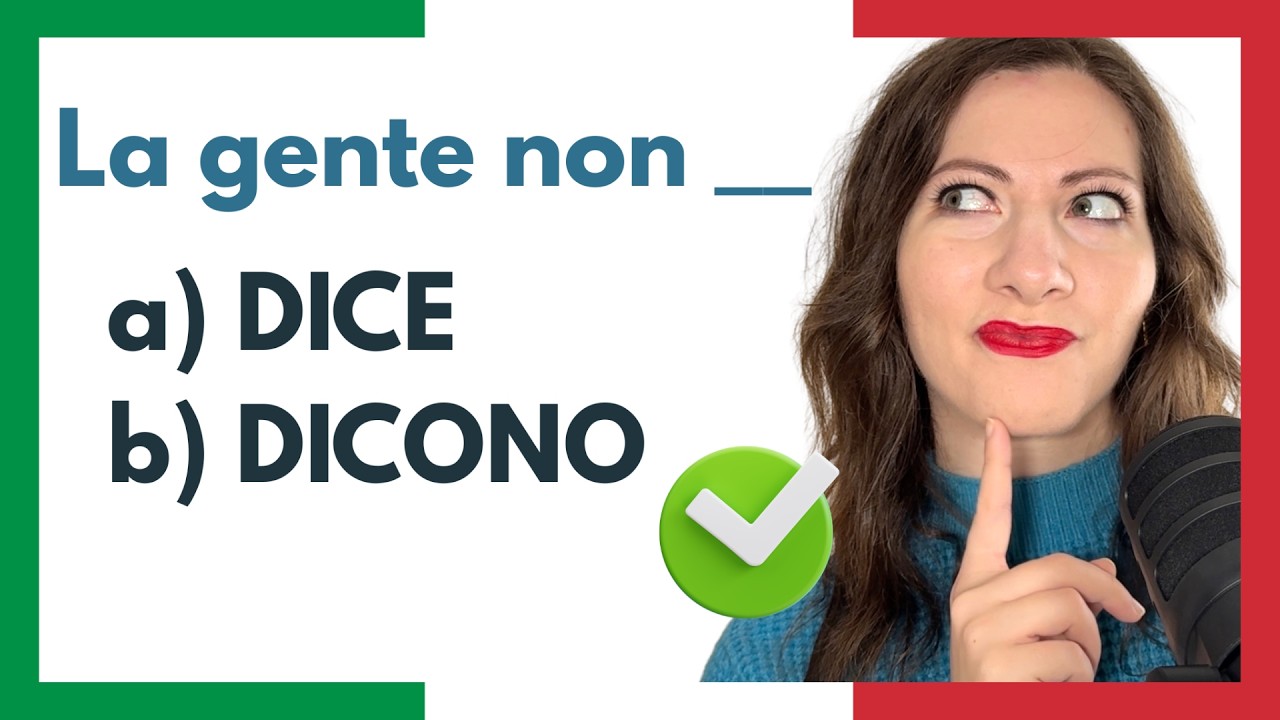
How Well Do You Know Italian Grammar? 10 Rules You Must Get Right
The Quiz Rules
Before you start, keep these simple guidelines in mind.
- Do not use dictionaries or translators — rely only on your own knowledge.
- Answer each question in your head, before reading the solution.
- Be honest with yourself: the result will be all the more useful the more sincere you are.
For each correct answer you earn one point. At the end you will find out what your score means.
The 10 Quiz Questions
Question 1 — Grammar: Collective Nouns
Choose the correct form to complete the sentence:
«La gente… entusiasta del concerto.» [The people were… enthusiastic about the concert.]
A) sono B) è
[…]
Correct Answer: B) è
«La gente» in Italian is a collective noun: it refers to several people, but grammatically it is always singular. The verb must always be in the third person singular: «la gente dice» [people say], «la gente fa» [people do], «la gente è» [people are]. The same applies to similar words such as «il gruppo» [the group] and «la classe» [the class].
If you prefer the plural, you can replace it with «le persone» [the people]: «le persone sono entusiaste del concerto» [the people were enthusiastic about the concert].
Question 2 — Grammar: The Future in the Past
Choose the correct form to complete the sentence:
«Mi aveva promesso che… a trovarmi.» [He/She had promised me that… to see me.]
A) verrebbe B) sarebbe venuto
[…]
Correct Answer: B) sarebbe venuto
This is what is known as the future in the past: it describes an action that was future relative to a past moment, but which has already passed relative to the moment of speaking. In Italian this is expressed with the past conditional — unlike English, Spanish and French, where different solutions are used.
Question 3 — Grammar: The Pronouns «Li» and «Gli»
Choose the correct form to complete the sentence:
«Ho visto Marco e Luca e… ho dato il libro.» [I saw Marco and Luca and… gave them the book.]
A) li B) gli
[…]
Correct Answer: B) gli
The verb «dare» [to give] requires a direct object (the thing given) and an indirect object (the recipient). Marco and Luca are the recipients, so you need the indirect third person plural pronoun: «a loro» [to them] → «gli». «Li» is instead the direct pronoun — it is used when replacing the direct object: «vedo Marco e Luca → li vedo» [I see Marco and Luca → I see them].
| Pronoun | Type | Example |
|---|---|---|
| li [them] | direct (3rd person plural masculine) | «Vedo Marco e Luca → li vedo» [I see Marco and Luca → I see them] |
| gli [to them] | indirect (3rd person plural) | «Do il libro a Marco e Luca → gli do il libro» [I give the book to Marco and Luca → I give them the book] |
Question 4 — Grammar: The Conditional After «Se»
Choose the correct form to complete the sentence:
«Sinceramente non so se io… sembra rischioso.» [Honestly I don’t know if I… it seems risky.]
A) l’avrei fatto B) l’avessi fatto
[…]
Correct Answer: A) l’avrei fatto
The general rule says that the conditional is not used after «se» — but there is an important exception. When «se» introduces an indirect question, that is, a sentence expressing a doubt or a question indirectly, the conditional is correct. These sentences depend on verbs such as «chiedersi» [to wonder], «non sapere» [not to know], «domandarsi» [to ask oneself]:
- «Mi domando se le cose potrebbero cambiare.» [I wonder if things could change.]
- «Non so se mi piacerebbe vivere all’estero.» [I don’t know if I would like to live abroad.]
- «Non so se avrei fatto quello che tu hai fatto.» [I don’t know if I would have done what you did.]
In these cases the conditional underlines that what is expressed is subject to a condition, even if implicit.
Question 5 — Grammar: Pronominal Verbs
Choose the correct form to complete the sentence:
«Quando gli hanno detto che non era stato selezionato,… tantissimo.» [When they told him he had not been selected,… a great deal.]
A) se l’è presa B) se l’è preso
[…]
Correct Answer: A) se l’è presa
The verb used is prendersela [to take it personally] — a pronominal verb meaning to get angry or to take offence. In the passato prossimo the auxiliary «essere» is used and the past participle agrees with the pronoun «la» — not with the subject. The result is always «presa», regardless of the gender or number of the subject:
- «Io me la sono presa.» [I took it personally.]
- «Marco se l’è presa.» [Marco took it personally.]
- «Noi ce la siamo presa.» [We took it personally.]
- «Voi ve la siete presa.» [You (pl.) took it personally.]
Question 6 — Grammar: The Relative Pronoun «Cui»
Choose the correct form to complete the sentence:
«È un quartiere… strade sono piene di negozi di souvenir.» [It is a neighbourhood… streets are full of souvenir shops.]
A) che le B) le cui C) del cui D) le
[…]
Correct Answer: B) le cui
The relative pronoun «cui» preceded by a definite article indicates possession. The article must agree in gender and number with the thing possessed — not with the possessor:
- «Marta, il cui cane è un barboncino» [Marta, whose dog is a poodle] → «il» agrees with «cane» (masculine singular)
- «Mio cugino, la cui moglie l’ha tradito» [My cousin, whose wife betrayed him] → «la» agrees with «moglie» (feminine singular)
- «Un quartiere le cui strade sono piene di negozi» [A neighbourhood whose streets are full of shops] → «le» agrees with «strade» (feminine plural)
Question 7 — Grammar: The Impersonal «Si» with Reflexive Verbs
Choose the correct form to complete the sentence:
«La domenica… sempre tardi.» [On Sundays… always late.]
A) si si sveglia B) ci si sveglia C) se si sveglia D) ci si svegliano
[…]
Correct Answer: B) ci si sveglia
The impersonal si is formed with «si» + verb in the third person singular. With reflexive verbs, however, the verb form already contains its own «si». The repetition «si si» is not permitted, so the first impersonal «si» becomes «ci»: «ci si sveglia» [one wakes up], «ci si alza» [one gets up], «ci si vergogna» [one is ashamed].
Question 8 — Grammar: «Volerci» and Agreement
Choose the correct form to complete the sentence:
«Per finire il progetto… 3 mesi.» [To finish the project… 3 months.]
A) ci è voluto B) ci sono voluti C) ci hanno voluto
[…]
Correct Answer: B) ci sono voluti
Volerci [to take / to be needed] means “to be necessary”, always requires the auxiliary «essere» and agrees in gender and number with the thing needed:
- «Ci sono voluti 3 mesi» [It took 3 months] → «mesi» is masculine plural → «voluti»
- «Ci è voluta un’ora» [It took an hour] → «un’ora» is feminine singular → «voluta»
- «Ci sono volute 3 ore» [It took 3 hours] → «le ore» is feminine plural → «volute»
Question 9 — Grammar: The Pronoun «Chi»
Choose the correct form to complete the sentence:
«Chi… un accento straniero spesso viene considerato affascinante.» [Whoever… a foreign accent is often considered fascinating.]
A) hanno B) ha
[…]
Correct Answer: B) ha
Although «chi» means “all the people who”, as a pronoun it is grammatically singular and always requires the verb in the third person singular. This is clearly seen in Italian proverbs: «chi dorme non piglia pesci» [he who sleeps does not catch fish], «chi va con lo zoppo impara a zoppicare» [he who walks with the lame learns to limp]. If you prefer the plural, you can use «quelli che» [those who] or «coloro che» [those who].
Question 10 — Grammar: The Independent Subjunctive
Choose the correct form to complete the sentence:
«Che codardo!… almeno il coraggio di dirmelo in faccia!» [What a coward!… at least the courage to tell me to my face!]
A) avesse B) avrebbe
[…]
Correct Answer: A) avesse
Normally the subjunctive depends on another main verb. However, there are cases where it can appear alone: this is called the independent subjunctive. In this specific case it has an exclamatory-desiderative value — it expresses a frustrated wish, something the speaker would like but which is not happening: «Se solo avesse il coraggio di dirmelo in faccia!» [If only he had the courage to tell me to my face!]
Quiz Results
Count your points and discover your level.
| Score | Level | Description |
|---|---|---|
| 0–3 points | A2 — Elementary | You are still building the foundations. Focus on fundamental grammatical points such as pronouns and the main verb tenses. |
| 4–6 points | B1/B2 — Intermediate | Good knowledge of basic structures. Some subtler rules still escape you — but you are close. |
| 7–9 points | C1 — Advanced | Your Italian is solid. You also know the exceptions and the more complex mechanisms of Italian grammar. |
| 10 points | C2 — Mastery | A perfect result. Your Italian grammar is at the level of an educated native speaker. Congratulations! |
Bear in mind that this is an indicative test, useful for getting a general idea of your level. For an official assessment you can refer to the CILS, CELI or PLIDA certifications.
Frequently Asked Questions (FAQ)
Can «La Gente» Ever Be Used with a Plural Verb?
No. In standard Italian «la gente» [people] always requires the verb in the third person singular. If you want to use the plural, you need to replace it with «le persone» [the people].
Is the Conditional After «Se» Always Incorrect?
Not always. It is incorrect in hypothetical sentences, where after «se» the subjunctive is used. It is correct however when «se» introduces an indirect question — as in «non so se l’avrei fatto» [I don’t know if I would have done it] or «mi domando se potrebbe cambiare» [I wonder if it could change].
How Do You Distinguish «Li» from «Gli»?
«Li» [them] is a direct pronoun: it is used with verbs such as «vedere» [to see] or «chiamare» [to call]. «Gli» [to them] is an indirect pronoun: it is used with verbs that require the preposition «a», such as «dare» [to give], «dire» [to say/tell], «scrivere» [to write].
Is «Essere» Always Used with «Volerci»?
Yes, «volerci» [to take/be needed] always requires the auxiliary «essere» in the past, and the participle agrees with the subject: «ci è voluta un’ora» [it took an hour], «ci sono voluti tre giorni» [it took three days], «ci sono volute due settimane» [it took two weeks].
What Is the Independent Subjunctive?
It is a use of the subjunctive in which the verb does not depend on any other main verb. It appears in some fixed structures of speech: desiderative value («avesse almeno il coraggio!» [if only he had the courage!]), concessive value («che venga pure» [let him come if he wishes]) and dubitative value («che sia già arrivato?» [could he have already arrived?]).
If any of the quiz questions gave you trouble, the article dedicated to the independent subjunctive will help you sort things out!
Do pronominal verbs trip you up and fill you with doubts? Turn confusion into confidence with our exclusive course:“Da «Non ce la faccio più» a «Ora me la cavo»: i verbi pronominali in 30 giorni.” With fun, bite-size lessons and targeted practice, you’ll learn to use them naturally in just one month.
Stop reading Italian.
Start speaking it.
Online lessons in groups of 4, organised by level and goals, with qualified teachers. Pick the day and time that suit you from the available slots.
Max 4 students:
there’s a seat for you
Loading quiz…
Podcast: Play in new window | Download (Duration: 37:33 — 51.9MB)
Iscriviti: Apple Podcasts | Spotify | Android | iHeartRadio | Podcast Index | TuneIn | Deezer | RSS | Altri...