

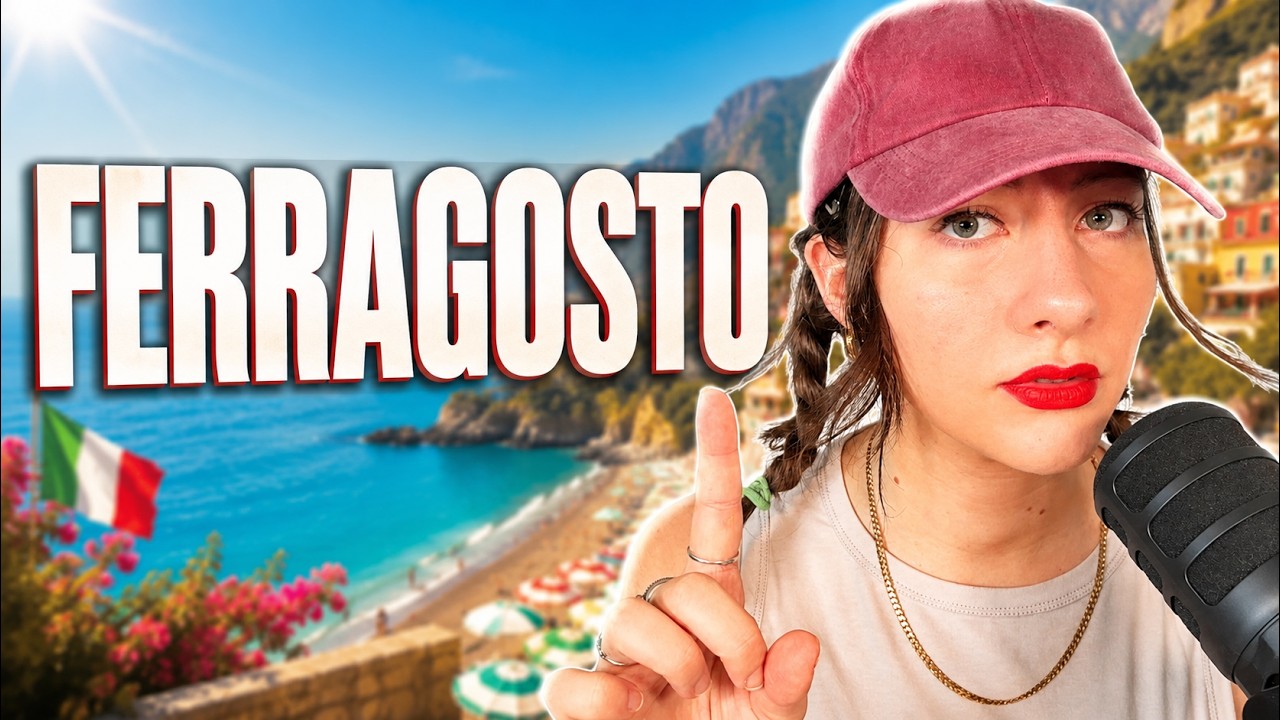
Have you ever wondered why, on August 15th, Italy seems to suddenly disappear? Cities empty out, shops pull down their shutters and on the beaches you can’t find a single centimeter of free sand. But what exactly is being celebrated on this day, and why is this festival called “Ferragosto”, a word that at first glance seems to combine “ferro” [iron] and the month of “agosto” [August]? Small spoiler: iron has nothing to do with it. In this guide you’ll discover the millenary history of Ferragosto, from the Romans to today, and you’ll also learn the summer expressions that Italians actually use.
What Is Celebrated on August 15th in Italy?
In this guide we’ll trace together the millenary history of Ferragosto, from its origins in imperial Rome to today’s crowded beaches. You’ll discover where this curious word comes from, understand why the festival shifted from August 1st to August 15th, and learn some expressions and words that Italians actually use in the summer. You’ll also discover that Ferragosto isn’t the only festival that Italians have inherited from the ancient Romans.
Where Does the Word “Ferragosto” Come From?
Let’s start from the beginning — actually, from very far away. The word “Ferragosto” comes from the Latin Feriae Augusti, which means “the rest of Augustus” or, if you prefer, “Augustus’s holidays”.
Small linguistic curiosity: the Latin word feriae indicated the days of rest, and it’s the same word from which modern Italian “ferie” derives, meaning the days of vacation from work. So the next time you say “sono in ferie” [I’m on vacation/on leave], keep in mind you’re using a word that’s more than two thousand years old.
Emperor Augustus and the Origins of the Festival
But who was this Augustus? He was the first Roman emperor, and it was precisely he who, in 18 BC, established this period of rest. After months of hard work in the fields, farmers finally had the right to stop, celebrate and catch their breath. After all, Italians have been taking their August break very seriously since forever.
Augustus was such an important figure that, a few years later, the month previously called sextilis was renamed augustus in his honor. Yes, you guessed it: that’s where the word “agosto” comes from. This emperor thus gave his name both to the festival and to the entire month.
At the beginning, however, Ferragosto wasn’t celebrated on the 15th, but on August 1st, and it didn’t last a single day: it was a long period of festivities, which merged with other Roman celebrations like the Consualia, the festivals dedicated to Consus, the god of the earth and fertility. People ate, drank and rested: a ritual that even today isn’t entirely foreign to us.
Why August 15th? The Double Soul of the Festival
But then why is Ferragosto today on August 15th and not on the 1st? The answer arrives many centuries later, with the Catholic Church. The Church moved the festival to August 15th to make it coincide with a very important religious celebration: the Assumption of Mary. According to Christian tradition, on this day the Virgin was “assumed”, meaning taken to heaven in body and soul.
That’s why Ferragosto has a double soul: on one side its pagan and Roman origins, on the other the Christian festival. Two different worlds that meet on the same day.
Why Does Everyone Go to the Sea on Ferragosto?
How is it that in every Italian’s mind “Ferragosto” immediately rhymes with “sea”, “mountain” and “trip”? This tradition is much more recent than one might think.
Let’s jump to the 1930s, more precisely to 1931. In that year, in Italy, the fascist regime inaugurated the so-called “Treni Popolari di Ferragosto” [Ferragosto Popular Trains]: tickets at extremely low prices that allowed even less wealthy families to take a trip and see, perhaps for the first time in their life, the sea or the mountains.
There were two possibilities:
- The one-day trip, within a radius of about 50-100 kilometers.
- The three-day trip, within about 100-200 kilometers.
However, there was a small detail: meals weren’t included in these trips. So what did the Italians do? They brought food from home. It’s precisely from here that one of the most beloved traditions of this day was born: the famous pranzo al sacco [packed lunch/picnic], the outdoor barbecue, the picnic with the family.
In Rome, these “DIY” tourists who brought food from home wrapped in a bundle were called “fagottari”: a nice word to pull out at the right moment. If today on Ferragosto you find yourself eating a sandwich sitting on a lawn or in front of the sea, keep in mind you’re continuing a tradition with almost a hundred years of history.
One place to learn Italian
Join the LearnAmo AcademyTraditions and Curiosities of Today’s Ferragosto
How is Ferragosto celebrated in Italy today? Here are some typical images:
- The barbecue is the great protagonist. Ferragosto is the only day of the year in which every Italian suddenly feels like a grill master — or at least tries to.
- The sea, with the extremely crowded beaches, the fireworks in the evening and, in many towns, the sagre, that is, popular festivals where you eat the typical dishes of the place.
- Cities completely empty out. On Ferragosto, finding an open bar in the center of Rome or Milan is like looking for a needle in a haystack.
There’s also an old, slightly joking saying: “Ferragosto, moglie mia non ti conosco” [Ferragosto, my wife I don’t know you]. It was an ironic way of saying that, in the confusion of the festival, one allowed oneself a pinch of freedom and fun. Today it’s used just to make a joke.
One more curiosity for tradition enthusiasts: the day after Ferragosto, August 16th, in Siena the famous Palio dell’Assunta is held, a spectacular horse race that has been going on for centuries.
Not Only Ferragosto: the Festivals Coming from Ancient Rome
We’ve seen that Ferragosto has its roots in Ancient Rome. But it’s not the only festival that Italians have inherited from the Romans. There are others, very well known, behind which a two-thousand-year-old piece of history is hidden. Let’s take a small journey through time.
Christmas and the Birth of the Sun
Let’s start with the most beloved festival of all: Christmas. The Romans, around the winter solstice, celebrated two very important festivities. The first were the Saturnali, in honor of the god Saturn, which were celebrated more or less from December 17th to 23rd: they were days of banquets, gifts and joy in which the roles were reversed, and even masters served their slaves at the table.
The second festival was the Dies Natalis Solis Invicti, that is, the “day of birth of the Unconquered Sun”, celebrated on December 25th. In that period, after the longest night of the year, the days began to lengthen again, and the Romans celebrated the “rebirth” of the Sun.
December 25th, making it coincide with these ancient festivals. Attention, however: even on this link historians debate. There is no definitive proof that Christmas was born “on top of” the festival of the Sun, and there are even those who think that December 25th derives from a religious calculation, that is, nine months after March 25th.
Linguistic curiosity: the word “Natale” [Christmas] comes from the Latin natalis, which means precisely “relating to birth”, “birthday”. So when you exchange gifts under the tree, you’re repeating a gesture that the Romans already made two thousand years ago.
New Year’s Day and the God with Two Faces
Let’s move forward a few days and arrive at Capodanno [New Year’s Day]. Why do we celebrate the beginning of the year precisely on January 1st? Here too the answer is Roman. It was the Romans who fixed the first day of the year on January 1st, and the one who made it official was Julius Caesar with his new calendar, in 46 BC.
And why precisely January? Because the month was dedicated to Giano [Janus], the god of beginnings, represented with two faces: one looking to the past and one looking to the future. A perfect symbol to start a new year.
The three linguistic curiosities of New Year’s Day:
- The word “gennaio” [January] comes precisely from Ianuarius, that is, from the name of the god Giano.
- Giano was the god of doors, and “door” in Latin is ianua: Giano is literally the god who opens the doors of the new year.
- The Romans exchanged good luck gifts, including figs called strenae: from there comes the word “strenna”, which is still used today for Christmas and New Year gifts.
Even the word “calendario” [calendar] comes from the Latin calendae, the first day of the Roman month.
Valentine’s Day and a Somewhat Uncertain Festival
Let’s move forward and arrive at February, with the lovers’ festival: Valentine’s Day. Here the story is fascinating but also a bit uncertain.
There’s a very popular version that links Valentine’s Day to an ancient Roman festival called Lupercalia, which was celebrated around February 15th: they were festivals of purification and fertility, quite lively, dedicated to the god Faunus. According to this version, the Church would have replaced the Lupercalia with the festival of Saint Valentine, on February 14th.
Many historians today are however skeptical about this direct link, and point out that the idea of Valentine’s Day as a “lovers’ festival” is actually much more recent, born in the Middle Ages. The truth is therefore less linear than what is told out there.
Linguistic curiosity: the name of the month “febbraio” [February] comes from the Latin februa, the strips of leather that Roman priests used precisely during those purification rites.
Carnival and the World Upside Down
Let’s close with a joyful and colorful festival: Carnival. In this case too we can go back to the Saturnali. Do you remember that, during those days, the roles were reversed and almost everything was allowed? That “world upside down”, with the masks, the pranks and the unrestrained joy, is the same spirit that we still find today in Italian Carnival: a Roman inheritance that, every winter, fills the country’s squares with confetti.
Summary Table of Festivals of Roman Origin
Here’s a recap of the main Italian festivals and their Roman origins:
| Modern festival | Roman origin | Linguistic curiosity |
|---|---|---|
| Ferragosto (August 15th) | Feriae Augusti, rest of Augustus | From “Feriae Augusti” → Ferragosto |
| Natale/Christmas (December 25th) | Saturnali and Unconquered Sun | From Latin “natalis” (relating to birth) |
| Capodanno/New Year (January 1st) | God Giano with two faces | Gennaio from “Ianuarius”; strenna from “strenae” |
| Valentine’s Day (February 14th) | Perhaps from the Lupercalia (debated) | Febbraio from “februa” |
| Carnival | Saturnali, “world upside down” | Spirit of freedom and masks |
Italian Summer Expressions to Know
Here are some expressions linked to summer and Ferragosto that will make you sound like a real Italian. To go deeper into the summer vocabulary, you can also check out the dedicated guide.
| Expression | Meaning |
|---|---|
| Fare il ponte | To take a few extra days of vacation to link a holiday to the weekend |
| Gita fuori porta | A short trip outside the city, in the surroundings |
| Pranzo al sacco | The lunch you bring from home, usually sandwiches, inside a bag or backpack |
| Scampagnata | A trip to the countryside or outdoors, in company |
| Chiuso per ferie | The sign you’ll find on many shops in August: it means the owner is on vacation |
| Sotto l’ombrellone | Literally “under the beach umbrella”, but it’s also a way to say “on vacation by the sea” |
| Il solleone | The intense and suffocating heat of August: the name comes from the fact that, in this period, the sun is in the constellation of Leo |
Frequently Asked Questions
What Exactly Is Celebrated on Ferragosto?
Ferragosto is a festival with a double soul. On one hand it celebrates the ancient Feriae Augusti, the “rest of Augustus” established in 18 BC by the first Roman emperor to give farmers a period of pause after the hard work in the fields. On the other hand, from a religious point of view, on August 15th the Assumption of Mary is celebrated, that is, the moment in which, according to Catholic tradition, the Virgin was taken to heaven in body and soul. Today the religious meaning is still alive in many communities, but for most Italians Ferragosto is above all synonymous with vacation, sea and barbecue with the family.
What to Reply When Someone Says “Buon Ferragosto”?
You can reply “Buon Ferragosto anche a te” [Happy Ferragosto to you too] or, in a more formal context, “Grazie, altrettanto” [Thanks, likewise]. It’s an informal and affectionate greeting exchanged among friends, colleagues and acquaintances before and during August 15th. If someone sends you a message on the evening of the 14th or the morning of the 15th, the most natural reply is precisely “Buon Ferragosto anche a te, grazie”. You can also add a small phrase like “passa una bella giornata” [have a nice day] or “goditi il mare” [enjoy the sea].
Why Is Everything Closed in August in Italy?
Because August is traditionally the month of summer holidays for most Italians. It’s not just August 15th: from mid-July to the end of August, and particularly in the two central weeks (between August 10th and 24th approximately), many shops, restaurants, bars, public offices and small businesses close for one or two weeks. The classic sign “Chiuso per ferie” [Closed for holidays] is one of the symbols of the Italian summer. Large chains and supermarkets stay open, but small neighborhood shops often don’t: so if you need something, better do it before or after Ferragosto.
What Does “Fare il Ponte” Mean?
“Fare il ponte” is a typically Italian expression that means taking an extra day of vacation to link a midweek holiday to the weekend. The classic example: if Ferragosto (August 15th) falls on a Thursday, many Italians also take Friday off to have four consecutive vacation days (Thursday, Friday, Saturday and Sunday). The “ponte” [bridge] is therefore the additional working day that is “crossed” to reach the weekend. Attention: here “ponte” has nothing to do with the one over the river — it’s a metaphor.
What’s the Difference Between “Ferie” and “Vacanze”?
They are two very similar words, but with an important nuance. “Ferie” indicates the days off from work, those that are entitled by contract to an employee: “Ho ancora dieci giorni di ferie da smaltire” [I still have ten days of leave to take]. “Vacanze”, on the other hand, is a more generic term and indicates any period of rest, often spent traveling or relaxing: “Andiamo in vacanza al mare” [We’re going on vacation to the sea]. A worker, therefore, goes on “ferie” from a contractual point of view to have “vacanze” from the point of view of everyday life. Students, on the other hand, don’t have “ferie”: they only have “vacanze” (summer, Christmas, Easter ones).
Do pronominal verbs trip you up and fill you with doubts? Turn confusion into confidence with our exclusive course: “Da «Non ce la faccio più» a «Ora me la cavo»: i verbi pronominali in 30 giorni.” With fun, bite-size lessons and targeted practice, you’ll learn to use them naturally in just one month.
Want the lesson PDF with exercises and solutions?
Join the LearnAmo AcademyLoading quiz…
Podcast: Play in new window | Download (Duration: 30:28 — 14.4MB)
Iscriviti: Apple Podcasts | Spotify | Android | iHeartRadio | Podcast Index | TuneIn | Deezer | RSS | Altri...
