


November 1st in Italy is a special day, with schools, offices and banks closed: the feast of All Saints is celebrated. The day after, instead, people work and go to school, although remembering the dead. And in between, between these two very ancient dates, in recent decades a relatively new festival has arrived in the country: Halloween. In this guide you’ll find all the traditions, the words and the curiosities to know about these three festivities that follow one another between the end of October and the beginning of November, from the Pantheon of Rome to chrysanthemums, from the Sicilian frutta martorana to the Calabrian “coccalu di muortu”, with two little grammar rules that confuse almost all foreign students.
What’s Celebrated in Late October and Early November in Italy?
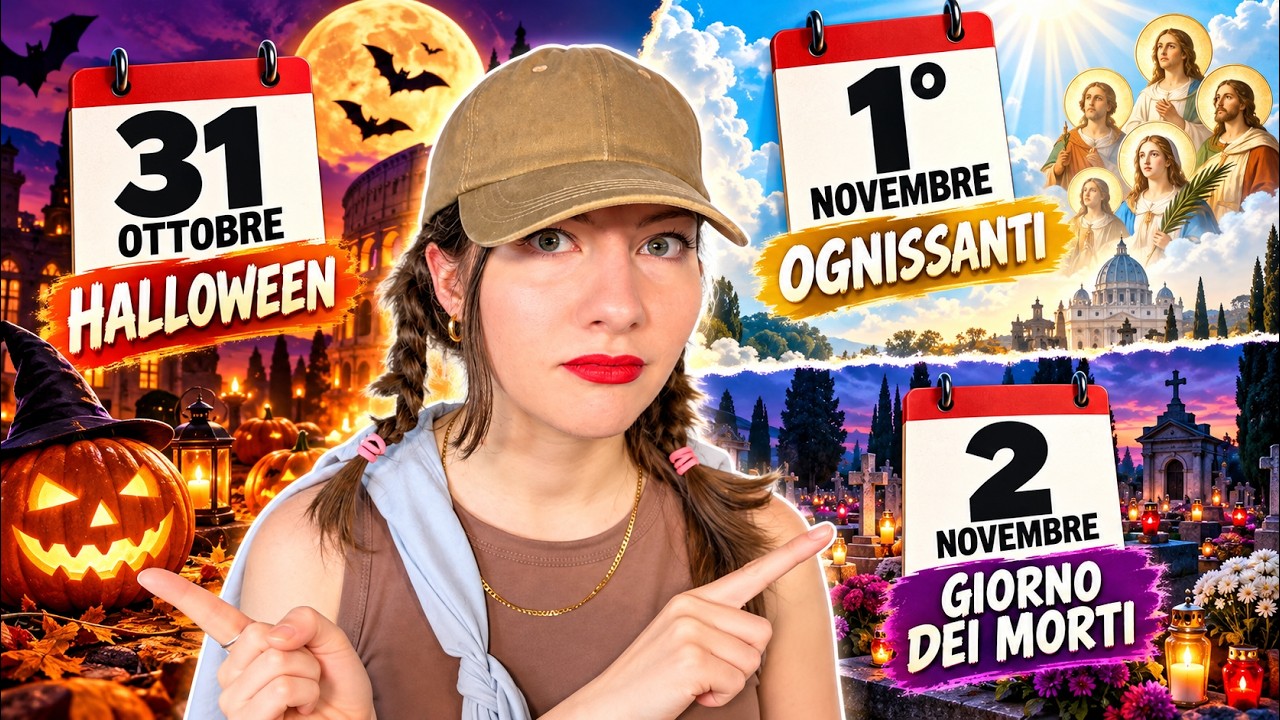
Within just three days, the Italian calendar concentrates three festivities that are very different from one another in origin, meaning and atmosphere. Halloween, on October 31st, is a festival imported from the Anglo-Saxon world, linked to dressing up and to children’s entertainment. Ognissanti [All Saints’ Day], on November 1st, is a Catholic religious feast celebrating all the saints. The giorno dei morti [Day of the Dead], on November 2nd, is dedicated to the memory of the deceased and is lived above all with family and at the cemetery. Understanding the three festivities separately — and discovering the many words that accompany them — helps grasp an important slice of Italian culture, in which religious tradition, regional habits and global influences coexist without too many conflicts.
November 1st: the Feast of Ognissanti
On November 1st the feast of Ognissanti is celebrated, also called “Tutti i Santi” [All the Saints] or, in everyday language, simply “i Santi” [the Saints]. The word is transparent from a linguistic point of view: ogni + santi [every + saints]. It’s the day on which the Catholic Church celebrates collectively all the saints, including those who don’t have a dedicated day in the calendar.
From the Pantheon of Rome to the Universal Tradition
Everything begins in Rome, in one of the most famous monuments in the world: the Pantheon. At the beginning of the 7th century, Pope Boniface IV transformed this ancient Roman temple, traditionally considered dedicated to “all the gods”, into a church dedicated to the Madonna and to all martyrs. The substitution of the pagan “all the gods” with the Christian “all the saints” marks one of the most representative symbolic transitions in European religious history.
At first, however, this feast was celebrated in May. In the 8th century, Pope Gregory III chose November 1st, and about a century later Pope Gregory IV extended this date to the whole Church. According to some scholars, the choice isn’t accidental: in that period, in Ireland, in Scotland and on the Isle of Man, the Celtic peoples celebrated Samhain, considered their New Year, a moment when it was believed that the border between the world of the living and that of the dead became particularly thin. The name will come up again later, when we’ll talk about the origins of Halloween.
How It’s Celebrated Today: Public Holiday and “Ponte”
Today November 1st is a public holiday throughout Italy: schools, offices and banks are closed. If November 1st falls on a Thursday or a Tuesday, many Italians take the opportunity to “fare il ponte” [literally: “make the bridge”], a very common everyday expression. Watch out: fare il ponte doesn’t mean building an actual bridge. It means taking a day off between the holiday and the weekend, in order to obtain a small four-day vacation period. In 2026, for example, Ognissanti falls on a Sunday, so no extra day off and no “ponte”.
L’Onomastico: Celebrating One’s Own Saint
In Italy, besides the birthday, many people celebrate the onomastico [name day], that is, the day of the saint who bears their name. Those called Giuseppe celebrate on March 19th; those called Lucia, on December 13th. And what about those who have a name not corresponding to any saint? In that case, by convention, the onomastico falls precisely on November 1st, the feast of all saints. Anyone, even with a name unusual to the Italian calendar, can therefore expect wishes on this date.
Quick Grammar: Dates and the Word “Santo”
Two little grammar rules are directly connected with these days and deserve a brief explanation, because they are among those that foreign students get wrong most often.
“Il Primo Novembre” But “Il Due Novembre”
In Italian, to indicate dates, cardinal numbers are used (due, tre, quattro… [two, three, four…]), not ordinals as in English. One says “il due novembre”, not “il secondo novembre”. There is, however, one important exception: the first day of the month. In this case the ordinal number is used: “il primo novembre”, which is written 1° novembre (with the degree symbol after the number). Another useful rule: in Italian the months are written with a lowercase letter — novembre, not Novembre.
San, Santo, Sant’, Santa: When to Use Each Form
The word santo changes form before the name of a saint, with a logic similar to that of the adjective bello or that of the definite article. The four main forms are:
- San: before masculine names beginning with a consonant. San Giuseppe, San Francesco, San Marco.
- Santo: before masculine names beginning with s + consonant. Santo Stefano, Santo Spirito.
- Sant’: before names beginning with a vowel, masculine and, often, feminine. Sant’Antonio, Sant’Ambrogio, Sant’Agata.
- Santa: before feminine names beginning with a consonant. Santa Lucia, Santa Chiara.
An important warning: these four forms are used only before the name of a specific saint. Before common nouns, or when the word appears alone, one simply uses santo or santa, in the full form: “il Santo Padre” [the Holy Father], “santo cielo!” [good heavens!], “mia nonna è una santa” [my grandmother is a saint].
Expressions and Proverbs with the Saints
Italians name the saints very often, even in completely secular contexts. Here are four expressions particularly useful for everyday conversation:
- Non sapere a che santo votarsi [not to know which saint to turn to]: not to know what to do anymore, not to find a solution. “Ho perso le chiavi, il telefono è scarico… non so più a che santo votarmi!” [I’ve lost my keys, my phone’s dead… I don’t know which saint to turn to anymore!]
- Avere qualche santo in paradiso [to have a saint in paradise]: to have an important person who helps, a recommendation from above. “Ha trovato lavoro in due giorni? Avrà qualche santo in paradiso…” [He found a job in two days? He must have a saint in paradise…]
- Passata la festa, gabbato lo santo [once the feast is over, the saint is tricked]: when a person obtains what they wanted, they forget the promises made. The verb gabbare means “to deceive”.
- Per Ognissanti, manicotto e guanti [for All Saints’, muff and gloves]: a proverb about the weather. In November the cold begins and the time comes to pull out scarves, hats and gloves.
Stop reading Italian.
Start speaking it.
Online lessons in groups of 4, organised by level and goals, with qualified teachers. Pick the day and time that suit you from the available slots.
Max 4 students:
there’s a seat for you
November 2nd: the Day of the Dead
On November 2nd the Commemorazione dei defunti [Commemoration of the Faithful Departed] is celebrated, which Italians simply call “il giorno dei morti” [the day of the dead] or “i Morti” [the Dead]. The difference from the previous day is precise: on November 1st the saints are celebrated, that is, the people who, according to the Church, are already in paradise; on November 2nd, instead, all the deceased are remembered, in particular relatives and loved ones who are no longer here.
From the Abbey of Cluny to the Whole Church
This commemoration was born in France, in the Abbey of Cluny, around the year 1000. It was Abbot Odilo who established that his monks had to pray for all the deceased on the day following All Saints’. The initiative was so successful that, in the following centuries, it extended to the whole Catholic Church.
Unlike Ognissanti, November 2nd in Italy isn’t a public holiday: people work and go to school normally. For this reason many families prefer to go to the cemetery already on November 1st, taking advantage of the day off.
The Words of the Day of the Dead
A small thematic vocabulary helps move with precision among the terms of this commemoration:
- il defunto / la defunta [the deceased, male / female]: the dead person, in a more formal and respectful form than “morto”.
- il cimitero [the cemetery]: the place where the dead are buried.
- la tomba e la lapide [the tomb and the headstone]: the tomb is the sepulchre as a whole; the lapide is the stone with the name and the dates.
- il lumino [the vigil candle]: the small candle that is lit on the tombs.
- il crisantemo [the chrysanthemum]: the typical flower of these days.
- la ricorrenza [the recurrence / anniversary]: a special day that recurs every year.
Watch Out for the Chrysanthemums!
On November 2nd Italian cemeteries fill with chrysanthemums, because they bloom precisely in autumn. The result is that in Italy the chrysanthemum has become the flower of the dead par excellence, with a cultural association so strong that it’s good to know it in advance. If an Italian invites someone to dinner at home, it’s appropriate to bring wine, sweets or roses, but never chrysanthemums: the cultural message would be totally out of place, and would almost certainly cause a moment of embarrassment.
A Journey through Regional Traditions
In Italy every region has its own traditions, and the day of the dead is no exception. Particular sweets, curious customs and popular beliefs differ even just a few hundred kilometres apart, as the guide on the interesting facts about Italian regions more generally recounts.
Sicily: the Children’s Feast and the Frutta Martorana
In Sicily the “Festa dei Morti” [Feast of the Dead] is lived above all as a feast for children. According to tradition, in the night between November 1st and 2nd the departed relatives return home and bring gifts and sweets to good children. On the morning of the 2nd, the children look for the gifts hidden around the house, in a custom that structurally recalls Christmas.
The typical Sicilian sweets of these days are remarkable. The frutta martorana consists of small almond-paste sweets shaped like fruit, crafted with surprising realism. There are also the “pupi di zucchero” [sugar dolls], colourful statuettes made entirely of sugar, and the “ossa di morto” [bones of the dead], hard bone-shaped biscuits, white on top and dark on the bottom. Despite the evocative name, these are highly appreciated sweets, an integral part of a gastronomic tradition that the guide on regional Italian dishes explores more broadly.
Lombardy, Veneto and Tuscany: Fave, Pan dei Morti and Pan co’ Santi
Moving towards the Centre-North, traditions change but remain strongly linked to food. In Lombardy and in Veneto, the “fave dei morti” [beans of the dead] are prepared, small almond biscuits shaped like a bean. In Milan, in particular, the “pan dei morti” [bread of the dead] is typical, a dark biscuit with cocoa, dried fruit and dried figs.
In Siena, in Tuscany, the “pan co’ santi” [bread with the saints] is prepared instead, a sweet bread with walnuts and raisins. The apostrophe in the name deserves a linguistic note: co’ is the Tuscan form of “con i” [with the], a small example of how Italian dialects still survive today in the names of dishes and traditions.
Sardinia: the Tradition of Is Animeddas
In Sardinia, children used to go — and in some villages still go — from house to house to ask for sweets, dried fruit and small gifts “per le anime” [for the souls]. This tradition takes the name of “Is Animeddas”, literally “le animucce, le piccole anime” [the little souls]. The similarity to another much better-known custom is remarkable, as we’ll see shortly. In many other regions, finally, there was the habit of leaving the table set during the night, with a bit of food, water and a lit vigil candle, to welcome the deceased who “returned home”.
Halloween in Italy: the Imported Festival
Finally, we arrive at the “scariest” festival of the year: Halloween, on October 31st. It’s the most recent of the three festivities, but also the one that most divides Italians, as the guide dedicated to Halloween in Italy explores in more detail.
From “All Hallows’ Eve” to Samhain: the Origins
The word Halloween comes from the English All Hallows’ Eve, that is, “the eve of All Saints”. In practice, Halloween coincides with the evening before Ognissanti. According to the most widespread theory, its roots lie precisely in the Celtic festival of Samhain, already mentioned when talking about Ognissanti. Subsequently, Irish emigrants brought these traditions to the United States and, from there — thanks above all to films and television series — Halloween spread throughout the world.
Why Many Italians Say “Alloween”
A small phonetic observation is useful to understand the pronunciation. In Italian, the letter H is never pronounced: it’s a silent letter. For this reason, many Italians, especially those who haven’t studied English, pronounce the word as “Alloween”, without the initial H. It isn’t linguistic laziness, but the automatic application of Italian pronunciation rules to a foreign word.
When Halloween Arrived in Italy
Halloween became popular in Italy only starting from the Nineties, and spread widely especially from the early 2000s. Today many children dress up as witches, ghosts and zombies, schools organise themed parties, young people go to discos and shops fill with pumpkins and fake cobwebs.
Italian children ring doorbells saying “dolcetto o scherzetto?” [trick or treat?], the standard translation of the English “trick or treat”. The formula is interesting from a grammatical point of view: both words are diminutives in -etto, that is, altered forms that make the noun smaller and more friendly. Dolce [sweet] becomes dolcetto, scherzo [prank] becomes scherzetto, in a mechanism that the guide on altered nouns describes in detail.
A Very Italian Debate: in Favour and Against
The reception of Halloween in Italy is anything but unanimous. For children and young people, it’s a fun festival linked to dressing up and consuming sweets. Another part of the population sees it instead as an “imported” and commercial festival, little consistent with Italian tradition. Some parishes also openly criticise it, and organise alternative parties dedicated to the saints, with children dressed as saints instead of monsters: these initiatives often have a creative name, such as “Holyween”. It’s, in summary, a festival that divides, a bit like the cappuccino after lunch: loved by some, observed with a certain distrust by others.
Italy Already Had Its Own Halloween
A little-known fact, even among many Italians, is that in various areas of the peninsula there were already traditions very similar to Halloween, centuries before Hollywood films made them familiar to everyone. The connection between these local customs and the Anglo-Saxon festival is so strong that one can openly speak of an ante litteram “Italian Halloween”.
The “Coccalu di Muortu” and the “Lumère”
In Abruzzo, in Molise and in Calabria there was the custom of hollowing out pumpkins, carving them in the shape of a skull and putting a lit candle inside. In Abruzzo these pumpkins take the name of “cocce de morte”, that is, “teste di morto” [heads of the dead]. In Serra San Bruno, in Calabria, children still go around the village today with their “coccalu di muortu” and ask for a small offering door to door. Also in the North, in Veneto and in Friuli, the tradition of the “lumère” was widespread: pumpkins hollowed out and lit by a candle, in every way similar to the modern jack-o’-lanterns.
Is Animeddas: the Sardinian “Trick or Treat”
As already mentioned when talking about regional traditions, in Sardinia the tradition of “Is Animeddas” provided (and in some villages still provides) that children went from house to house to ask for sweets and small gifts “per le anime” [for the souls]. The similarity to the formula of the American “trick or treat” is so evident that it suggests a common cultural root, linked to the autumn period and to the symbolic boundary between the living and the dead. The statement according to which Halloween “isn’t an Italian tradition” turns out therefore, in the end, to be somewhat hasty.
Frequently Asked Questions
Why Is November 1st a Public Holiday and November 2nd Isn’t?
Because only Ognissanti, that is, the feast of all saints on November 1st, is recognised by the Italian State as a national public holiday: schools, offices and banks remain closed. The day of the dead, on November 2nd, is instead a deeply felt religious commemoration, but not a public holiday from a civil point of view: people work and go to school normally. For this reason many families prefer to go to the cemetery on November 1st, taking advantage of the day off.
Do You Say “Il Primo Novembre” or “Il Secondo Novembre”?
Only the first day of the month is indicated with an ordinal number: one says “il primo novembre”, written 1° novembre. For all other days, instead, cardinal numbers are used: “il due novembre”, “il quindici agosto”, “il venticinque dicembre”. The form “il secondo novembre”, very common among foreign students because it translates literally from English, is considered incorrect.
Why Shouldn’t You Give Chrysanthemums to an Italian?
Because in Italy the chrysanthemum is the flower of the dead par excellence, a strong and deeply rooted cultural association that stems from the fact that these plants bloom precisely in autumn, coinciding with the day of the dead. Giving chrysanthemums to an Italian in a context other than the cemetery (a dinner, a birthday, a visit home) therefore turns out to be completely out of place, to the point that the gift would be perceived as inappropriate or even sinister.
What Is the “Onomastico”?
The onomastico is the day dedicated to the saint whose name a person bears. Those called Giuseppe celebrate on March 19th (San Giuseppe), those called Lucia on December 13th (Santa Lucia), and so on. Those who bear a name not linked to any saint of the calendar celebrate their onomastico on November 1st, the day of all saints. In Italy, the onomastico is still today a felt occasion, in particular by the older generations, and is celebrated with wishes, phone calls and, sometimes, a small gift.
Do Italians Really Celebrate Halloween?
It depends on whom one considers. Halloween is by now a very popular festival in Italy among children and young people, especially in the big cities, with costumes, parties at school, evenings in discos and the “dolcetto o scherzetto” formula rung at doorbells. A part of the population, however, considers it an imported and commercial festival, little in line with Italian traditions, and prefers to dedicate those days to the Catholic commemorations of Ognissanti and the day of the dead. A curious fact helps to nuance the judgment: many areas of Italy already had indigenous traditions very similar to Halloween — from the carved pumpkins of the Centre-South to the children’s begging in Sardinia — long before the Anglo-Saxon festival became popular in the country.
Want the lesson PDF with exercises and solutions?
Join the LearnAmo AcademyLoading quiz…
Podcast: Play in new window | Download (Duration: 19:48 — 27.4MB)
Iscriviti: Apple Podcasts | Spotify | Android | iHeartRadio | Podcast Index | TuneIn | Deezer | RSS | Altri...