


What are the 5 most common mistakes foreigners make with Italian pronouns? According to the Treccani encyclopaedic dictionary, pronouns are that variable part of speech that is used to replace another element in the sentence (usually the noun, but they can also replace a verb, an adjective or even an entire sentence). There are different categories of pronouns, depending on the meaning you want to convey, and so it is easy to make mistakes and get confused. Let’s figure it out!
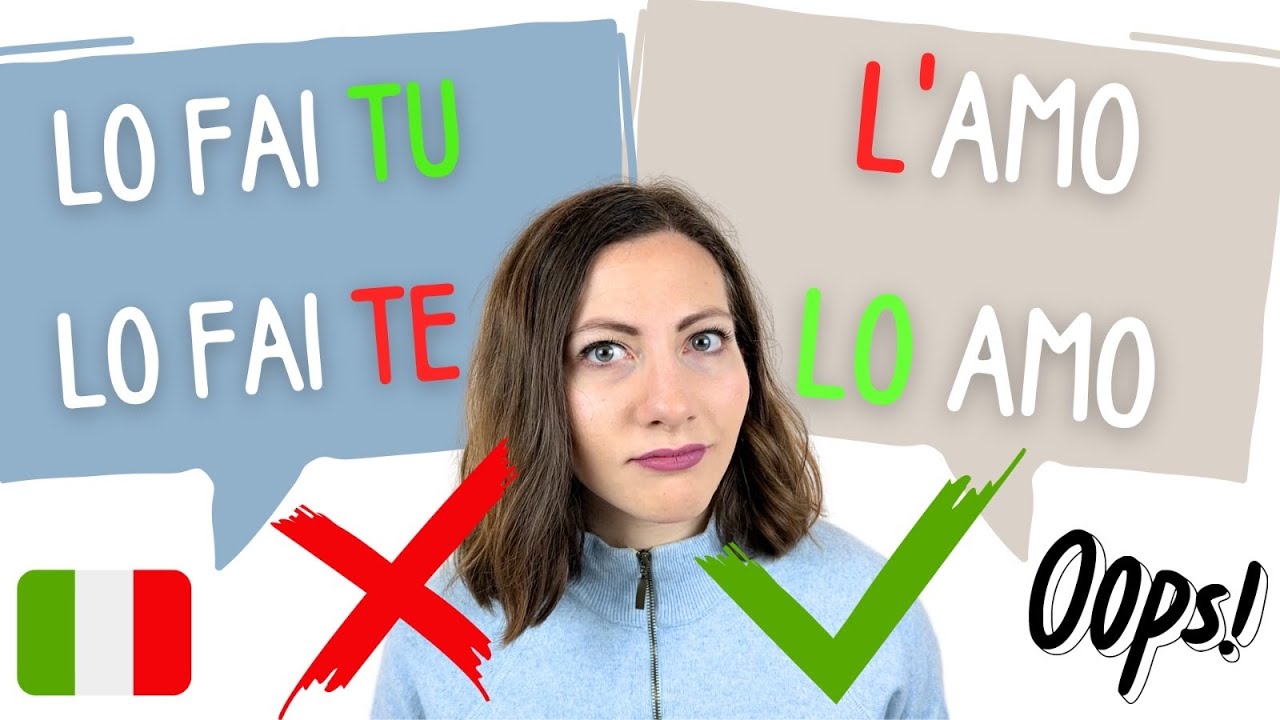
Italian Pronouns: avoid these 5 mistakes!
1 – Lo fai te or Lo fai tu?
You surely have heard both versions, despite the fact that the Italian language considers only one to be correct. Let’s first clarify the difference between tu and te in a simple way: “tu” is always used as subject, while “te” is a complement.
For example:
Tu vai a Londra. [tu performs the action, it is the subject]
Luca guarda te. [te is the direct object complement]
Vengo in vacanza con te. [te is a complement introduced by preposition]
“Lo fai te” – “Lo fai tu”, which is the correct one?
The verb is “fai” and it is conjugated in the 2 person singular. This means that the pronoun we need here is the subject, that is to say “tu.” So the correct sentence is “Lo fai tu“.
ATTENZIONE!
In some cases te is used instead of tu with subject function, but these are generally fixed expressions, such as:
Povero te!
Te compreso / Compreso te
In Italy, in the spoken language and especially in the north of Italy, “te” is used a lot instead of “tu” with a subject function, in sentences such as:
Dillo te
Vieni anche te?
Hai ragione te
Te vai
For now, these forms are considered grammatically incorrect, but in the future things might change. In your opinion, will “te” completely replace “tu”, just as happened to “lui, lei” and the original forms “egli, ella”?
2 – Ci hanno trovato or Ci hanno trovati?
We get this question from our students very frequentely… and indeed they have a point!
They ask: “I know I have to say l’ho vista if I’m talking about a woman, but, if I am talking about a woman again, should I say ti ho vista or ti ho visto, mi hai visto or mi hai vista?
The Treccani encyclopaedic dictionary explains the topic very well: in compound tenses with the auxiliary avere, with the complement object pronoun placed before the auxiliary, the rule demands to make the agreement for gender and number in the third person singular and plural, but leaves freedom of choice for both gender and number with first and second person singular and plural pronouns.
So, let’s make it clearer with some examples:
Ho trovato la rivista e l’ho comprata.
[The pronoun is in the third person singular, the rule demands agreement, so you can never say “Ho trovato la rivista e l’ho comprato”.]
Ho comprato i libri ma non li ho letti.
[The pronoun is in the third person plural, the rule demands agreement, so you can never say “Ho comprato i libri ma non li ho letto”.]
BUT
Sara, scusami ma non ti avevo visto.
Sara, scusami ma non ti avevo vista.
[The pronoun is in the second person singular, the rule allows you to choose freely about the agreement: therefore, both sentences are correct.]
Marco non ci ha ancora chiamato.
Marco non ci ha ancora chiamati.
[The pronoun is in the first person plural, the rule allows you to choose freely about the agreement: therefore, both sentences are correct.]
3 – Lo amo or L’amo? L’ama or La ama?
Grammatically both options would actually be correct.
In the past, the form with the apostrophe was certainly more common.
For example, Petrarca wrote:
Per quel che mi riguarda, io l’ammiro e l’amo, non lo disprezzo e credo di potere sicuramente affermare che se egli fosse vissuto fino a questo tempo, pochi avrebbe avuto più amici di me…
Nowadays, however, the habit is a little bit different.
When we use third person singular direct pronouns (lo and la) with verbs conjugated in simple tenses, we tend to avoid the apostrophe.
Therefore, the forms “lo amo” or “la ama” are preferable.
Now we explain you why.
If you use the form “l’amo” out of context, you would not know whether you love a man or a woman, or otherwise a male or female thing.
Io amo il caffè = io l’amo
Io amo la cioccolata = io l’amo
So using the full pronoun helps us in this regard (lo amo / la amo).
With third-person plural direct pronouns (li/le) the apostrophe is never used, so the problem does not occur.
With compound tenses, on the other hand, there is no such problem, because agreement is made with the past participle. Not for nothing, the apostrophe is still used in those forms.
Io ho amato il caffè = io l’ho amato
Io ho amato la cioccolata = io l’ho amata
4 – Mi fa divertire or Fa divertirmi?
In Italian, when you use the construction FARE + INFINITO, any pronouns should be placed before the verb fare, and not after the infinitive verb.
Then the correct sentence is: Mi fa divertire.
Other similar sentences would be:
Le fanno vedere a tutti.
Ti ha fatto sedere qui.
Gli farò dire la verità.
…and so on.
The position of the pronoun is convertible only if the first verb is a modal verb (dovere, potere, volere, sapere).
For example:
Voglio comprarlo = Lo voglio comprare
Non sanno farli = Non li sanno fare
The same rule that applies to FARE + INFINITO also applies to verbs that behave similarly to “fare”, that is to say, verbs that hold an infinitive verb immediately after (but are not modal), such as “lasciare” for example.
Lo lascio fare (and not “Lascio farlo”)
Le lascio cantare (and not “Lascio cantarle”)
5 – Mangio pizza, mangi pasta or Io mangio pizza, tu mangi pasta?
No doubt, when you started studying Italian you were told (or you realized on your own) that in Italian we tend not to use subject personal pronouns when speaking or writing, because the verb alone (with its endings) already makes it clear who the subject is.
So a “spontaneous” Italian sentence would be:
Parto per Parigi domani. (rather than “Io parto per Parigi domani”)
Facciamo una passeggiata. (rather than “Noi facciamo una passeggiata”)
But yet…
In some cases Italians tend to use personal subject pronouns. And often foreigners in these cases don’t use them, because they think they are complying with the rule, but their sentences would sound a little strange to a native speaker.
What are these cases?
1 – When the verbal form is the same for different people. I am referring for example to some forms of the present or imperfect subjunctive.
Credo che faccia una passeggiata. (Who? Io faccia? Tu faccia? Lui faccia? Lei faccia?)
It would be better to use the pronoun to avoid misunderstandings:
Credo che lei faccia una passeggiata.
2 – When expressing a comparison or contrast between two or more people or to emphasize the identity of the subject.
And this is the case in the opening sentence to mistake number 5.
We hear many foreigners say things like:
Mangio pizza, mangi pasta.
Sono andato in bagno, è andata a letto.
Abbiamo guardato un film horror ma volevo guardare un film romantico.
Lo hai rotto e lo ripari!
While they are not grammatically wrong, these sentences are not completely natural for a native speaker. It would be better to say:
Io mangio pizza, tu mangi pasta.
Io sono andato in bagno, lei è andata a letto.
Abbiamo guardato un film horror ma io volevo guardare un film romantico.
Tu lo hai rotto e tu lo ripari!
Just to emphasize who does one thing and who does something completely different.
We hope this article was useful! To learn more about Italian pronouns check out these videos on direct and indirect pronouns and personal pronouns! If you are curious to learn something new, don’t miss our article on the limits of the Italian language!
And don’t forget to read our fantastic book Parolacce… e come evitarle!
Want the lesson PDF with exercises and solutions?
Join the LearnAmo AcademyCaricamento quiz in corso…
Podcast: Play in new window | Download (Duration: 15:19 — 17.9MB)
Iscriviti: Apple Podcasts | Spotify | Android | iHeartRadio | Podcast Index | TuneIn | Deezer | RSS | Altri...