


One of the most common doubts among Italian learners is the use of “sovra-“ and “sopra-“. Should we say sovraccarico or sopraccarico? Soprabito or sovrabito?
If you have had this dilemma too, you are in the right place! Let’s find out the difference and the correct usage of these two forms.
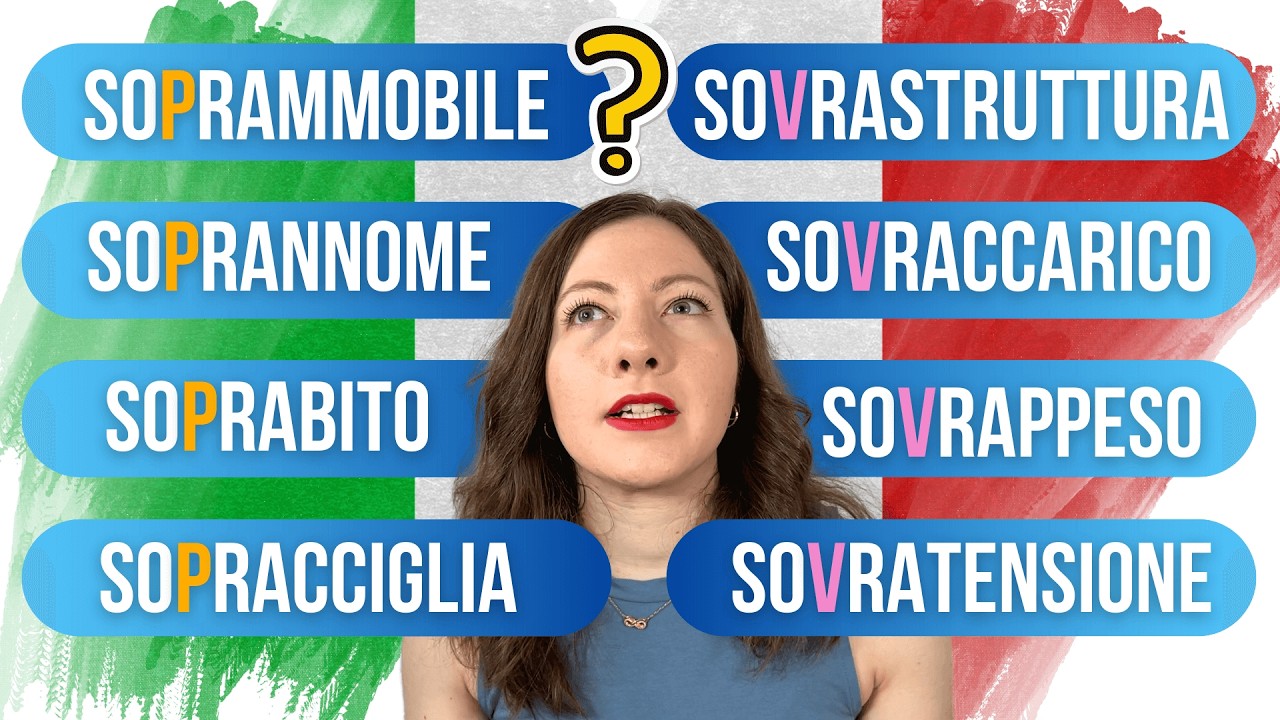
“Soprabito” or “Sovrabito”? Find Out Which Form Is Correct
The answer is simple: both are correct! However, although they have similar meanings, they are used in different contexts.
Let’s explore the main differences.
The Use of “Sovra-“
The prefix “sovra-“ is mainly used in formal, technical, or scientific contexts and carries a nuance of superiority or excess (indicating something that goes beyond a certain limit).
Examples of words with “sovra-“
- Sovraccarico: Excess load. (Sovraccarico: Excess load)
Example: “Il sistema è in sovraccarico a causa dell’elevato numero di utenti.”
(“The system is overloaded due to the high number of users.”) - Sovrappeso: Weight above normal. (Sovrappeso: Overweight)
Example: “Il medico ha diagnosticato un problema di sovrappeso in Luca.”
(“The doctor diagnosed an overweight problem in Luca.”) - Sovrastruttura: Additional or upper structure. (Sovrastruttura: Superstructure)
Example: “La sovrastruttura dell’edificio è stata rinforzata.”
(“The superstructure of the building has been reinforced.”)
In these cases, “sovra-” indicates something that exceeds a certain limit, both physically and figuratively.
The Use of “Sopra-“
Unlike “sovra-“, the prefix “sopra-“ is more common and colloquial, and it is used to indicate physical or spatial position.
Examples of words with “sopra-“
- Soprammobile: Decorative object placed on furniture. (Soprammobile: Ornament)
Example: “Quel soprammobile è un regalo di mia nonna.”
(“That ornament is a gift from my grandmother.”) - Sopravveste: Garment worn over other clothes. (Sopravveste: Overgarment)
Example: “La sopravveste medievale era spesso riccamente decorata.”
(“The medieval overgarment was often richly decorated.”) - Soprabito: Coat or jacket worn over other clothes. (Soprabito: Overcoat)
Example: “Oggi fa freddo, così ho deciso di uscire con il soprabito.”
(“It’s cold today, so I decided to go out with my overcoat.”) - Sopracciglia: Arched hair above the eyelashes. (Sopracciglia: Eyebrows)
Example: “Le mie sopracciglia sono folte.”
(“My eyebrows are thick.”) - Sopraindicato: Something mentioned above, e.g., in a document. (Sopraindicato: Above-mentioned)
Example: “Bisogna consegnare i documenti all’ufficio sopraindicato.”
(“The documents must be delivered to the above-mentioned office.”) - Soprannome: Name used “over” the real name. (Soprannome: Nickname)
Example: “Il soprannome di Marco è ‘pollice giallo’ perché è negato con il giardinaggio.”
(“Marco’s nickname is ‘yellow thumb’ because he’s terrible at gardening.”)
In these cases, “sopra-” simply indicates the position of one object in relation to another.
Differences and Guidelines for Use
| SOVRA- | SOPRA- |
|---|---|
| Formal, technical, scientific | Colloquial, everyday use |
| Indicates excess or superiority | Indicates physical position |
So, if you want to express a concept of superiority or excess, use “sovra-“. If, instead, you simply want to indicate the position of something relative to another object, use “sopra-“.
Pay Attention to Spelling Rules!
- Doubling of the consonant: When “sovra-” or “sopra-” are joined to a word that starts with a consonant, they often cause the initial consonant to double.
Examples: “sovraccarico”, “sopravvalutare”. (Examples: “overload”, “overestimate”.) - Exceptions: Some words, especially those of recent formation, do not follow this rule.
Example: “sovratensione”. (Example: “overvoltage”.) - Elimination of the vowel: When the prefix is joined to a word that starts with a vowel, the vowel is dropped.
Examples: “sovrabbondante”, “soprabito”. (Examples: “overabundant”, “overcoat”.)
Choosing between sovra- and sopra- depends on the context and the meaning you want to express. Now that you know the differences, you can use these words with confidence!
Buy our new book: “Parole Di Casa Mia: Un Viaggio Nei Colloquialismi Italiani“, and learn all the colloquial expressions to speak like a true native speaker!
Want to learn more? Watch our related video about these expression “Di più in più” (More and more)!
Have a great time studying, see you soon!
Want the lesson PDF with exercises and solutions?
Join the LearnAmo AcademyCaricamento quiz in corso…
Podcast: Play in new window | Download (Duration: 8:21 — 11.7MB)
Iscriviti: Apple Podcasts | Spotify | Android | iHeartRadio | Podcast Index | TuneIn | Deezer | RSS | Altri...