


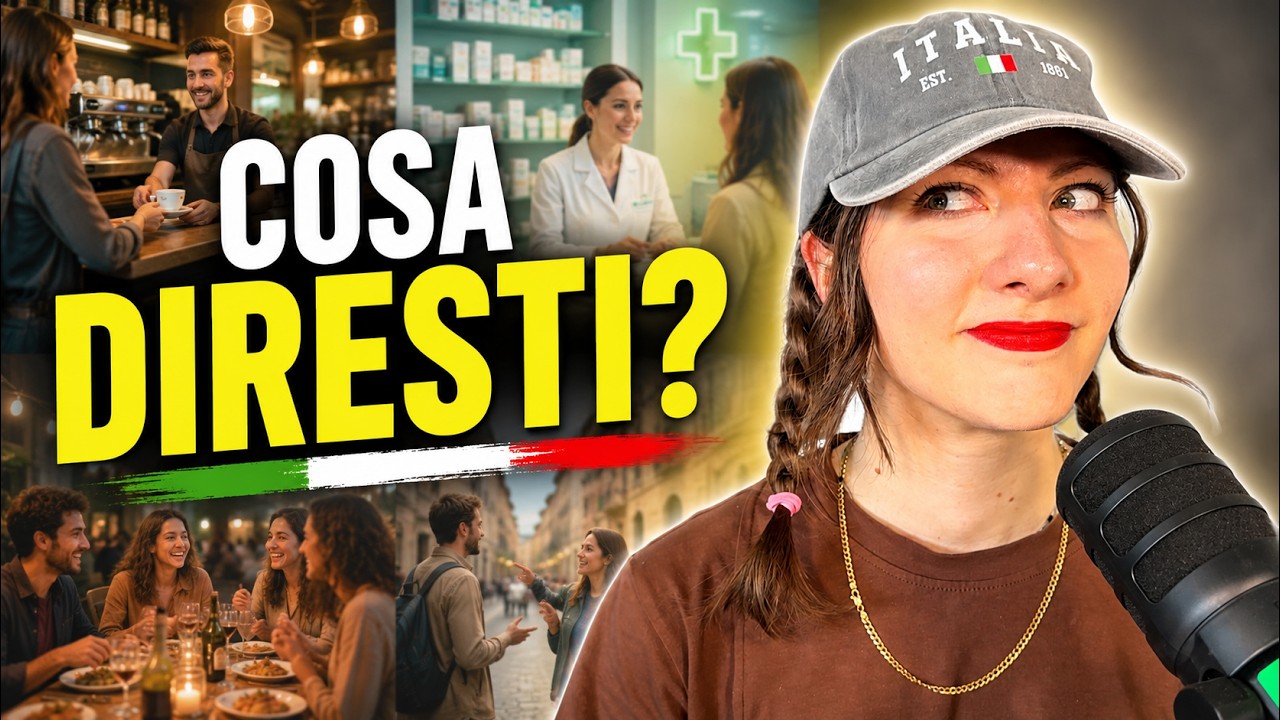
Imagine the scene: you’re finally in Italy. You walk into a bar full of people, you see everyone order in three seconds flat… and then it’s your turn. What do you say? And what if later you get a headache and walk into a pharmacy? And what if at dinner an Italian friend fills your plate for the third time and you’re stuffed to the brim? Would you know what to say — and above all how to manage gracefully — in all these situations?
Surviving in Italy: Useful Phrases in Context
In this guide we work on something more important than just vocabulary: your ability to communicate in real situations. You’ll learn to be polite and natural like a native speaker, to use the condizionale di cortesia (vorrei, potrei, avrei bisogno…) and to understand when to use Lei with a stranger and when to use tu with a friend. We’ll visit five places — bar, pharmacy, street, dinner with friends and hair salon — and for each place I’ll propose three situations: an easy one, an intermediate one and an advanced one. To dive deeper into the art of polite communication, you can check out the guide on the Italian conditional.
Place 1 — At the Bar
In Italy “il bar” is above all the place where in the morning you get coffee and a croissant. And remember: when an Italian says “un caffè”, they mean an espresso, the small and strong one! For the complete vocabulary of Italian coffee, there’s a dedicated guide on all types of Italian coffees.
Easy Situation — Ordering a Coffee
You’re at the counter. What do you say?
- “Un caffè, per favore.” [A coffee, please.]
- “Per me un caffè, grazie.” [A coffee for me, thanks.]
- “Mi fa un caffè?” [Can you make me a coffee?] — the most Italian of all, with the verb fare.
Notice that we don’t say “voglio un caffè”: voglio sounds brusque. Golden rule for the whole article: to be polite, use the condizionale. Vorrei instead of voglio, potrei instead of posso.
Intermediate Situation — Paying Before or After
You’ve had a coffee, but you don’t know if you pay first at the cash register or after at the counter.
- “Scusi, si paga prima alla cassa?” [Excuse me, do you pay first at the cash register?]
- “Pago alla cassa o direttamente al banco?” [Do I pay at the cash register or directly at the counter?]
- “Devo passare in cassa prima di ordinare?” [Do I have to go to the cash register before ordering?]
That “si paga” is the si impersonale: useful for speaking in general, without a precise subject.
Advanced Situation — The Order Is Wrong
You had ordered a cappuccino, but the barista brings you a regular coffee.
- “Scusi, credo ci sia un errore: avevo ordinato un cappuccino.” [Excuse me, I think there’s a mistake: I had ordered a cappuccino.]
- “Mi scusi, forse c’è stato un equivoco: io avevo chiesto un cappuccino.” [Excuse me, maybe there’s been a misunderstanding: I had asked for a cappuccino.]
- “Scusi, potrebbe rifarlo? Avevo ordinato un cappuccino, non un caffè.” [Excuse me, could you remake it? I had ordered a cappuccino, not a coffee.]
Even to complain we stay soft: “credo ci sia un errore” is much more elegant than “avete sbagliato”. Notice the use of the congiuntivo after “credo che…”.
Fun Fact about the Italian Bar
At the counter, standing up, you pay less; at the table, sitting down, you pay more — sometimes almost double! It’s a typically Italian custom that surprises many foreigners. So if you want to save money, grab a quick coffee at the counter like real Italians do!
Place 2 — At the Pharmacy
The pharmacy is recognizable by the green cross. And the pharmacist doesn’t only sell medicine: they can give you advice for small problems. For the specific vocabulary, check out the guide on the dialogue at the pharmacy.
Easy Situation — Headache
You have a bad headache and you want something to make it go away.
- “Mi dà qualcosa per il mal di testa?” [Can you give me something for a headache?]
- “Avete qualcosa per il mal di testa?” [Do you have something for a headache?]
- “Avrei bisogno di qualcosa per il mal di testa.” [I would need something for a headache.] — again the conditional (avrei bisogno, not ho bisogno).
Intermediate Situation — Do You Need a Prescription?
You need an antibiotic and you want to know if you need a prescription from the doctor.
- “Per questo antibiotico serve la ricetta?” [For this antibiotic do I need a prescription?]
- “Posso comprarlo senza ricetta?” [Can I buy it without a prescription?]
- “È un farmaco da banco o ci vuole la ricetta del medico?” [Is it an over-the-counter drug or do you need a prescription from the doctor?]
A “farmaco da banco” is a medicine you can buy freely, without a prescription.
Advanced Situation — Describing Symptoms
For three days you’ve had a sore throat and a bit of fever, and you ask the pharmacist for advice. To expand your health-related vocabulary, check out the guide on the vocabulary of illnesses in Italian.
- “Da tre giorni ho mal di gola e un po’ di febbre. Cosa mi consiglia?” [For three days I’ve had a sore throat and a bit of fever. What do you advise?]
- “Ho mal di gola e la febbre da qualche giorno: c’è qualcosa che posso prendere?” [I’ve had a sore throat and fever for a few days: is there something I can take?]
- “Avrei mal di gola e un po’ di febbre da tre giorni. Secondo lei cosa è meglio prendere?” [I would have a sore throat and a bit of fever for three days. In your opinion, what’s better to take?]
Notice “da tre giorni”: we use da + time to say how long a symptom has been lasting.
Fun Fact about Italian Pharmacies
At night and on holidays there’s always a “farmacia di turno” open for emergencies, indicated on the door of the other pharmacies. If you find yourself in difficulty outside of opening hours, just look for the sign that says “farmacia di turno” to know where to go!
Place 3 — Small Mishaps on the Street
We’re halfway there — it’s the case to say so! Let’s look at the mishaps that happen to everyone. To learn how to ask and give directions, there’s a dedicated guide.
Easy Situation — You’re Lost
You need to reach the station, but you’re lost.
- “Scusi, mi sono perso: come arrivo alla stazione?” [Excuse me, I’m lost: how do I get to the station?]
- “Scusi, mi sa dire dov’è la stazione?” [Excuse me, can you tell me where the station is?]
- “Scusi, sto cercando la stazione ma mi sono perso. Può indicarmi la strada?” [Excuse me, I’m looking for the station but I’m lost. Can you show me the way?]
Little note: perso is masculine; a woman would say persa (the participio passato agrees with who’s speaking).
Intermediate Situation — Asking for a Photo
You’re in front of the Fontana di Trevi and you want a photo.
- “Scusi, ci fa una foto con la Fontana di Trevi dietro?” [Excuse me, can you take a photo of us with the Fontana di Trevi behind?]
- “Scusi, ci scatta una foto davanti alla fontana?” [Excuse me, can you snap a photo of us in front of the fountain?] — scattare is the precise verb for “to take a photo”.
- “Scusi, le dispiacerebbe farci una foto qui alla fontana?” [Excuse me, would you mind taking a photo of us here at the fountain?] — the most elegant.
“Le dispiacerebbe…?” is one of the politest ways to ask for a favor. Write it down!
Advanced Situation — Your Wallet Has Been Stolen
You want to go file a report after having been the victim of a theft.
- “Mi hanno rubato il portafoglio: dov’è la stazione di polizia più vicina?” [They stole my wallet: where’s the nearest police station?]
- “Mi hanno preso il portafoglio, ho subito un furto. Vorrei sporgere denuncia.” [They took my wallet, I’ve been the victim of a theft. I’d like to file a report.]
- “Mi hanno rubato il portafoglio poco fa. Come faccio a sporgere denuncia?” [They stole my wallet a little while ago. How do I file a report?]
“Sporgere denuncia” is the exact expression for filing a formal report. And remember: in Italy there are both the Polizia and the Carabinieri, and you can turn to either.
Fun Fact about Polizia and Carabinieri
In Italy there are two main police forces: the Polizia di Stato (emergency number 113) and the Carabinieri (number 112). They have similar functions and you can turn to either of them indistinctly to file a report. The Carabinieri are also famous for being the protagonists of so many Italian jokes!
Stop reading Italian.
Start speaking it.
Online lessons in groups of 4, organised by level and goals, with qualified teachers. Pick the day and time that suit you from the available slots.
Max 4 students:
there’s a seat for you
Place 4 — At Dinner with Friends
A friend has invited you to dinner at their home. Watch out: here we switch from Lei to tu, because with friends you use the informal “you”! To discover other Italian colloquial expressions, check out the dedicated guide.
Easy Situation — What to Bring
In Italy you NEVER go to someone’s house empty-handed: you offer to bring the dessert.
- “Porto io il dolce?” [Shall I bring the dessert?]
- “Posso portare il dolce per tutti?” [Can I bring the dessert for everyone?]
- “Al dolce ci penso io: che gusto vi piace?” [I’ll take care of the dessert: what flavor do you like?]
“A mani vuote” = empty-handed. As an alternative to dessert, you can bring wine or flowers for the hostess.
Intermediate Situation — Giving Compliments
You finished eating and everything was excellent. To discover many alternatives, check out the guide on alternatives to “complimenti” in Italian.
- “Buonissimo, complimenti!” [Delicious, my compliments!]
- “Era tutto buonissimo!” [Everything was delicious!]
- “Buonissimo davvero, non ho mai mangiato così bene!” [Really delicious, I’ve never eaten so well!]
Even more colloquial: “Qui si mangia da Dio!” [You eat like a god here!] — da Dio means “really well”.
Advanced Situation — Refusing Seconds
The host wants to fill your plate for the third time, but you’re really full.
- “No grazie, sono pieno così.” [No thanks, I’m full as it is.]
- “Era tutto squisito, ma sono pieno: se mangio ancora scoppio!” [Everything was exquisite, but I’m full: if I eat more I’ll burst!]
- “Magari più tardi, adesso sono troppo pieno!” [Maybe later, now I’m too full!]
The secret is to combine a compliment with the refusal. “Fare il bis” means to take a second serving — and in Italy “no grazie” is often just the beginning of the negotiation: the host will insist again, it’s normal. Smile… and stand your ground!
Fun Fact about Italian Dinners
In Italian homes hospitality is measured by the amount of food offered! Italian mothers and grandmothers always insist on serving you again — it’s their way of showing affection. Don’t take offense: refusing with a smile and a compliment is the winning strategy!
Place 5 — At the Hair Salon
Last stop. Here we go back to Lei, because you’re talking to a person you don’t know. To expand the vocabulary, there’s a dedicated guide on the hair salon vocabulary in Italian.
Easy Situation — Just a “Spuntatina”
You don’t want to change your style, just shorten it a little.
- “Vorrei solo una spuntatina alle punte.” [I’d just like a little trim on the ends.]
- “Solo le punte, per favore.” [Just the ends, please.]
- “Mi accorci appena le punte, niente di drastico.” [Just trim the ends a bit, nothing drastic.]
“Una spuntatina” comes from spuntare, meaning to barely trim the ends: the magic word to not end up with ten centimeters less!
Intermediate Situation — Explaining the Cut
You want to shorten the sides but keep it longer on top.
- “Vorrei accorciare ai lati, ma lasciare un po’ più lungo sopra.” [I’d like to shorten the sides, but leave a bit longer on top.]
- “Corti ai lati e lunghi sopra: si può fare?” [Short on the sides and long on top: can you do it?]
- “Mi accorcia bene ai lati? Sopra invece vorrei tenerli più lunghi.” [Can you shorten the sides well? On top instead I’d like to keep it longer.]
The useful indications are “accorciare ai lati” and “lasciare lungo sopra”: with these the hairdresser understands right away.
Advanced Situation — Asking for Advice
Your hair is damaged and you don’t really know what to do.
- “Ho i capelli rovinati: cosa mi consiglia?” [My hair is damaged: what do you advise?]
- “I miei capelli sono messi male: come li sistemo?” [My hair is in bad shape: how do I fix it?]
- “Vorrei sistemare i capelli, ma non so come: mi affido a lei.” [I’d like to fix my hair, but I don’t know how: I trust you.]
“Mi affido a lei” means “I trust you, you decide”: perfect when you want to leave it to the expert.
Joke about the Hair Salon
Watch out for the word “spuntatina”, because everyone has their own idea of how much it is! So be precise… or bring a photo! It’s one of life’s great mysteries: how much is “una spuntatina”? Only your hairdresser truly knows!
Summary Table of the 5 Places
Here’s a table summarizing the 5 places with the keywords to remember for each one.
| Place | Keywords | Typical sentence |
|---|---|---|
| At the bar | caffè, espresso, cappuccino, banco, cassa | “Mi fa un caffè?” [Can you make me a coffee?] |
| At the pharmacy | mal di testa, ricetta, farmaco da banco, sintomi | “Avrei bisogno di qualcosa per il mal di testa.” [I would need something for a headache.] |
| On the street | perso, scattare, foto, sporgere denuncia, furto | “Scusi, mi sono perso: come arrivo alla stazione?” [Excuse me, I’m lost: how do I get to the station?] |
| At dinner | dolce, a mani vuote, buonissimo, il bis, pieno | “Era tutto squisito, ma sono pieno!” [Everything was exquisite, but I’m full!] |
| At the hair salon | spuntatina, punte, accorciare, ai lati, mi affido a lei | “Vorrei solo una spuntatina alle punte.” [I’d just like a little trim on the ends.] |
Frequently Asked Questions
How Do You Order a Coffee in Italy?
In Italy, when you say “un caffè”, you automatically mean an espresso: the small, strong one, served in a little cup. The most natural formula is “Un caffè, per favore” [A coffee, please] or “Mi fa un caffè?” [Can you make me a coffee?]. Never say “voglio un caffè”: it sounds brusque! Always use the condizionale di cortesia with “vorrei”. And remember: at the counter you pay less than at the table!
What Is a “Farmaco da Banco”?
A “farmaco da banco” is a medicine you can buy at the pharmacy without a doctor’s prescription: paracetamol, ibuprofen, cough syrups, sunburn creams, etc. It’s called “da banco” because the pharmacist can give it to you directly from the counter without asking for a prescription. For more serious medicines (like antibiotics), instead, you need a doctor’s prescription.
What’s the Difference Between Polizia and Carabinieri?
In Italy there are two main police forces to turn to for filing a report: the Polizia di Stato (under the Ministry of the Interior, emergency number 113) and the Carabinieri (under the Ministry of Defense, number 112). For the average citizen they are practically interchangeable: you can turn to one or the other without distinction. The Carabinieri are also famous for their dark uniform with the red stripe!
What Do You Bring to a Dinner with Friends in Italy?
In Italy you NEVER go to someone’s house “a mani vuote”! The classic options are: the dessert (perfect, because often whoever cooks doesn’t have time to prepare it), a bottle of wine (preferably a good one!) or some flowers for the hostess. If it’s an invitation from close friends, also a bottle of prosecco or sparkling wine for the toast works really well.
What Does “Una Spuntatina” Mean at the Hair Salon?
“Una spuntatina” comes from the verb spuntare, which means to just trim the ends of the hair. The diminutive (-ina) is used to indicate a very small cut, almost imperceptible. It’s the magic word to use when you don’t want to change your style but only refresh it. Watch out though: “spuntatina” is a slightly subjective word, so if you have a precise idea of how many centimeters to cut, say it clearly or bring a photo!
Want the lesson PDF with exercises and solutions?
Join the LearnAmo AcademyLoading quiz…
Podcast: Play in new window | Download (Duration: 32:26 — 15.2MB)
Iscriviti: Apple Podcasts | Spotify | Android | iHeartRadio | Podcast Index | TuneIn | Deezer | RSS | Altri...