


Have you ever wondered why in Italian there are two different words to say “he”? Why sometimes we read “egli” in classic books and other times we hear “lui” in everyday conversations? This article will explore in depth the difference between these two forms, their historical evolution and, above all, when to use one or the other in modern communication.
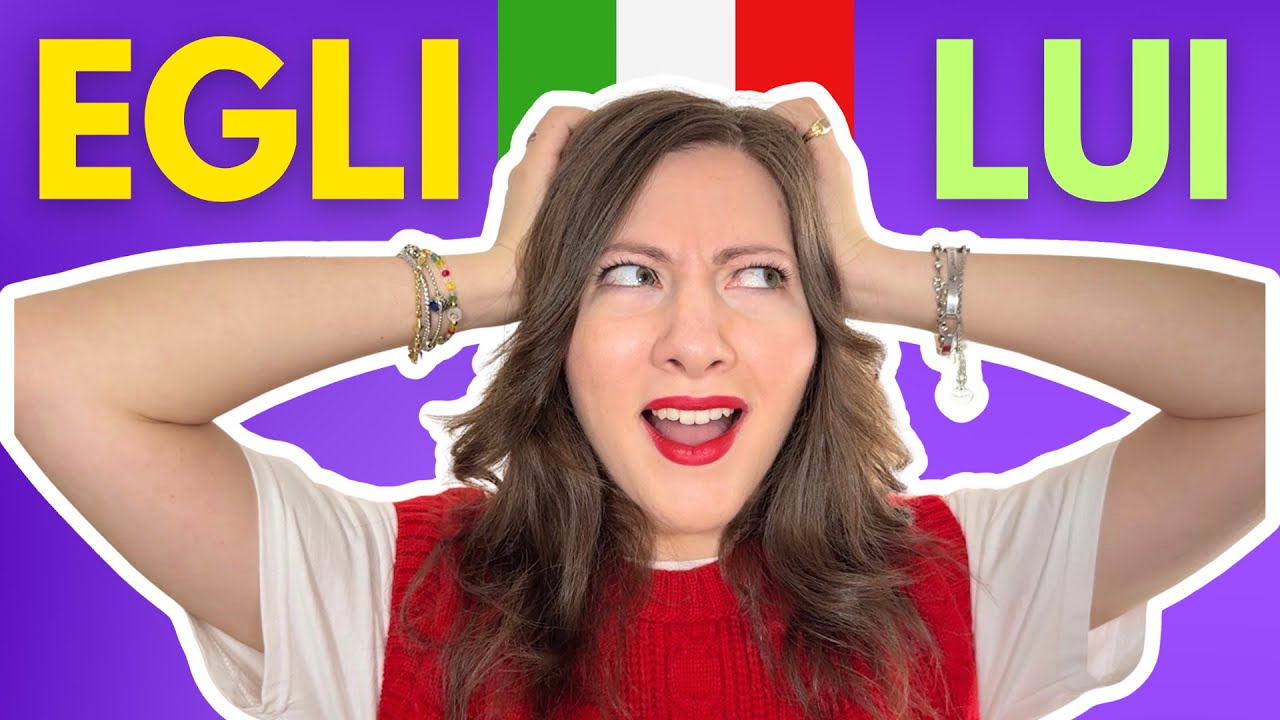
How and When to Use EGLI, History and Meaning
What Do “LUI” and “EGLI” Mean?
Both “lui” and “egli” are third person singular masculine personal pronouns. In practice, they both mean the same thing: they refer to a male person we are talking about. For example:
Examples:
Giuseppe è un bravo studente. Lui studia medicina. [Giuseppe is a good student. He studies medicine.]
Giuseppe è un bravo studente. Egli studia medicina. [Giuseppe is a good student. He studies medicine.]
As you can see, the meaning is identical! But then why do two different words exist to express the same concept? The answer has to do with grammatical function and with the evolution of the Italian language over the centuries.
The Fundamental Difference: SUBJECT Function
Here is the first crucial rule to understand: “egli” can be used ONLY as the subject of the sentence, while “lui” can be used both as subject and in other grammatical functions. This is the most important distinction between the two forms.
Let’s see some concrete examples to clarify better:
As Subject (who performs the action)
Examples:
Lui/Egli parla italiano molto bene. [He speaks Italian very well.] ✓
Lui/Egli è arrivato in ritardo. [He arrived late.] ✓
In these cases, both forms are grammatically correct because they function as the subject of the sentence.
As Direct Object
Examples:
Ho visto lui ieri sera. [I saw him last night.] ✓
Ho visto egli ieri sera. [I saw he last night.] ✗ (WRONG!)
After a Preposition
Examples:
Vado al cinema con lui. [I’m going to the cinema with him.] ✓
Vado al cinema con egli. [I’m going to the cinema with he.] ✗ (WRONG!)
After the Verb “To Be” to Identify Someone
Examples:
Sei tu? No, sono lui! [Is it you? No, it’s him!] ✓
Sei tu? No, sono egli! [Is it you? No, it’s he!] ✗ (WRONG!)
In Emphatic Constructions
Examples:
È lui che ha mangiato la torta! [It’s him who ate the cake!] ✓
È egli che ha mangiato la torta! [It’s he who ate the cake!] ✗ (WRONG!)
Therefore, it is essential to remember: “egli” is much more limited in use compared to “lui” and can appear exclusively in the subject position!
The History of “LUI” and “EGLI”: A Journey Through Time
To fully understand the use of these pronouns, it is essential to take a journey into the history of the Italian language. This historical journey will help to understand why these two forms exist and how they evolved over time.
The Latin Origins
EGLI is the older form. It derives from Latin “ille” (which meant “that”) and has been the standard form for centuries in written and formal Italian. In the Middle Ages and Renaissance, to write in correct Italian, it was necessary to use “egli”. The great masters of Italian literature such as Dante, Boccaccio and Ariosto used exclusively this form in their writings.
LUI, instead, has an interesting origin: it derives from Latin “illui”, which was a form of the dative (that is, “to that one”). Initially, “lui” was used only after prepositions, such as “con lui” [with him], “per lui” [for him], etc., or as a direct object (“Ho visto lui” [I saw him]). However, in spoken language, people began to use “lui” also as subject because it was simpler and more direct. And when spoken language changes, written language sooner or later follows.
Pietro Bembo and His “Rules”
A key figure in this story is Pietro Bembo, a sixteenth-century linguist who wrote a fundamental work called “Prose della volgar lingua” (published in 1525). Bembo wanted to establish what the rules of “good Italian” were and decided that the correct subject pronouns had to be “egli” and “ella”.
The most surprising aspect? Bembo even criticized some uses by Dante and Boccaccio (the greatest Italian writers!) when they used “lui” as subject, claiming that they did it “by distraction” or “by inadvertence”. It took some courage to state that Dante was wrong!
Bembo’s prescriptions were so influential that “egli” and “ella” remained the “official” form for centuries, even when common people no longer used them in everyday life. Even in recent years, in Italian elementary schools, verbs were taught like this:
Example:
io sono [I am]
tu sei [you are]
egli è [he is] (not “lui è”!)
noi siamo [we are]
voi siete [you are]
essi sono [they are] (not “loro sono”!)
Today, when teaching Italian to foreigners, “lui”, “lei” and “loro” are used immediately, because they are the forms that are actually used in contemporary communication!
“Egli” in Italian Literature
In the great classics of Italian literature, “egli”, “ella”, “essi” and “esse” are omnipresent. Here are some significant examples:
Ludovico Ariosto – Orlando Furioso (1516)
Examples:
“Egli partì pieno d’onore e gloria” [He left full of honor and glory]
“Ella piangeva la sorte sua infelice” [She wept her unhappy fate]
Ugo Foscolo – Ultime lettere di Jacopo Ortis (1802)
Examples:
“Ella non mi ama e io l’adoro” [She doesn’t love me and I adore her]
“Egli è troppo grande per questa terra” [He is too great for this earth]
Alessandro Manzoni – I Promessi Sposi (first edition, 1827)
Examples:
“Egli entrò nella stanza con passo misurato” [He entered the room with measured step]
“Ella rimase muta col capo chino” [She remained silent with her head bowed]
Alessandro Manzoni: The Revolutionary of Pronouns
Manzoni deserves a special discussion, because he was the first great writer to realize that “egli” and “ella” were becoming antiquated and artificial. He rewrote his masterpiece I Promessi Sposi many times precisely to modernize the language!
Observe these incredible numbers that demonstrate his linguistic evolution:
- 1827 edition: “egli” appears 862 times, “lui” as subject 0 times
- 1840 edition (13 years later): “egli” appears only 64 times, “lui” as subject appears 200 times!
But what happened to the other approximately 600 “egli”? Simple: Manzoni eliminated them, leaving the subject implicit (we’ll talk about this soon!). Manzoni was a true linguistic innovator who anticipated the times!
The Feminine and Plural Forms: “ELLA”, “ESSI”, “ESSE”
It is important to also know the other forms that existed in the traditional pronominal system:
ELLA
It is the feminine of “egli”. Today it has practically disappeared from spoken and written language, completely replaced by “lei”.
ESSO and ESSA
They were used primarily for inanimate things (objects, concepts, ideas), not for people. Today they have almost completely disappeared, replaced by “questo/a” [this], “quello/a” [that], or simply omitted.
Example:
Old example: “Il viaggio è stato lungo. Esso mi ha stancato molto.” [The journey was long. It tired me a lot.]
Modern Italian: “Il viaggio è stato lungo. Mi ha stancato molto.” [The journey was long. It tired me a lot.] (without pronoun) or “Questo mi ha stancato molto.” [This tired me a lot.]
ESSI and ESSE
They were the plurals of “egli/ella” and “esso/essa”. These too today are replaced by “loro” when talking about people, or are omitted when talking about things.
When to Use “EGLI” and When to Use “LUI”: Practical Rules
Here is the most important part for those who study or use Italian: when should you use one form or the other? Let’s see the practical rules with concrete examples.
Use “LUI” when:
1. Speaking in informal or everyday situations
Examples:
“Paolo voleva imparare a parlare italiano come un vero madrelingua. Lui ha quindi acquistato un corso intensivo.” [Paolo wanted to learn to speak Italian like a true native speaker. He therefore purchased an intensive course.]
“Dove vai?” “Vado da lui.” [Where are you going? I’m going to his place.]
2. Writing modern texts, emails, messages, newspaper articles
Example:
“Il sindaco ha dichiarato che lui non si dimetterà.” [The mayor declared that he will not resign.]
3. Wanting to emphasize the subject or create a contrast
Examples:
“Lui, a differenza di molti suoi colleghi, non cerca scorciatoie.” [He, unlike many of his colleagues, doesn’t look for shortcuts.]
“Mentre loro celebrano il successo, lui rimane umile.” [While they celebrate success, he remains humble.]
4. Having to use the pronoun after a preposition or in any position other than subject
Examples:
“Parlo con lui ogni giorno.” [I talk with him every day.]
“Questo regalo è per lui.” [This gift is for him.]
5. In emphatic constructions with the verb “to be”
Examples:
“È lui che ha vinto!” [It’s him who won!]
“Sono proprio loro i responsabili!” [They are indeed the responsible ones!]
Use “EGLI” when:
1. Writing very formal texts (official documents, legal acts, bureaucratic texts, scientific writings)
Examples:
“Egli dichiara di rinunciare ai propri diritti.” [He declares to renounce his rights.]
“Il professore ha pubblicato una nuova ricerca. Egli sostiene che…” [The professor published new research. He maintains that…]
2. Wanting to imitate an ancient literary style
Example:
“Egli camminava solo per le vie della città deserta.” [He walked alone through the streets of the deserted city.]
3. Making historical references or speaking about figures from the past in a formal manner
Example:
“Garibaldi sbarcò in Sicilia nel 1860. Egli guidò le sue truppe verso nord.” [Garibaldi landed in Sicily in 1860. He led his troops northward.]
Attention! “EGLI” Today is Almost Going Extinct
It is essential to understand that in contemporary Italian, “egli” is used less and less. Most Italians use almost exclusively “lui”, even when writing!
“Egli” sounds very formal, literary, and sometimes can even seem a bit strange or pompous if used in normal contexts. Imagine meeting a friend on the street and telling him: “Ho visto Matteo. Egli mi ha detto che domani viene alla festa.” [I saw Matteo. He told me that tomorrow he’s coming to the party.] Your friend would probably look at you strangely! It’s too formal for normal conversation.
The problem is that some Italians think that “lui”, “lei” and “loro” are a bit informal for formal writing. They feel uncomfortable using “lui” in an important text, but at the same time “egli” sounds too ancient! This creates a certain embarrassment: on one hand we have forms that seem old, on the other forms that seem too casual.
What is the solution? The most common answer is: omit the pronoun completely! And this brings us to the next fundamental point…
The “Null Subject” or “Zero Subject”: The Italian Solution
Here is one of the most interesting characteristics of Italian: we can completely omit the subject pronoun! Linguists call this phenomenon “null subject” or “zero subject”.
Italian, like Spanish and Portuguese, is a “pro-drop” language (from English pronoun-dropping). This means we can “drop” the pronoun. On the contrary, in languages like English, French or German, the subject is mandatory.
Comparison between languages:
- English: “He speaks Italian” → the subject “he” is mandatory
- French: “Il parle italien” → the subject “il” is mandatory
- Italian: “Parla italiano” [Speaks Italian] → no subject necessary!
How Does It Work?
In Italian the verb endings already tell us who the subject is:
- parlo [I speak] → io
- parli [you speak] → tu
- parla [he/she speaks] → lui/lei
- parliamo [we speak] → noi
- parlate [you speak] → voi
- parlano [they speak] → loro
Therefore there is no need to repeat the pronoun!
Concrete Example
Imagine reading this text about Leonardo da Vinci:
Example:
“Leonardo da Vinci nacque nel 1452 in Toscana. Ø Studiò pittura fin da giovane. Ø Dipinse capolavori come la Gioconda. Ø Progettò anche macchine volanti. Ø Morì in Francia nel 1519.” [Leonardo da Vinci was born in 1452 in Tuscany. Ø Studied painting from a young age. Ø Painted masterpieces like the Mona Lisa. Ø Also designed flying machines. Ø Died in France in 1519.]
Where we put the symbol Ø (zero), there is a null subject. We could put “egli” or “lui”, but it would be unnatural and redundant! The text works perfectly fine as is.
In practice, this is the most used solution in modern Italian: instead of choosing between “egli” (too formal) and “lui” (which to some seems too informal for writing), simply put nothing!
Stop reading Italian.
Start speaking it.
Online lessons in groups of 4, organised by level and goals, with qualified teachers. Pick the day and time that suit you from the available slots.
Max 4 students:
there’s a seat for you
When You CANNOT Omit the Pronoun
Naturally, there are specific cases in which it is necessary to express the subject pronoun. Let’s see which ones they are:
1. To Avoid Ambiguity
Example:
“Quando Francesco ha incontrato Roberto, era molto nervoso.” [When Francesco met Roberto, he was very nervous.]
Who was nervous? Francesco or Roberto? It’s not clear! In this case we should specify better using the pronoun or reformulating the sentence.
2. To Create a Contrast or Emphasis
In these cases, the pronoun is necessary to underline the difference:
Examples:
“Lui, a differenza dei suoi compagni, ha studiato tutta la notte.” [He, unlike his classmates, studied all night.]
“Mentre loro si divertivano, lui lavorava.” [While they were having fun, he was working.]
“Teresa ama la matematica, ma lui preferisce la letteratura.” [Teresa loves mathematics, but he prefers literature.]
“L’hanno fatto loro, non noi!” [They did it, not us!]
3. In Short Answers
Examples:
“Chi ha rotto il vaso?” “Lui!” [Who broke the vase? Him!]
“Chi viene al cinema?” “Lei viene, lui no.” [Who’s coming to the cinema? She’s coming, he’s not.]
How to Replace “ESSO/ESSA” When They Refer to Things
When the pronoun refers to an object, concept or idea (not to a person), today we almost never use “esso” or “essa”. What do we use instead?
Option 1: Omit the Pronoun (the most common)
Example:
“Ho comprato una nuova macchina. Ø È rossa.” [I bought a new car. Ø Is red.]
Option 2: Use “questo/a” or “quello/a”
Example:
“Ho comprato una nuova macchina. Questa è rossa!” [I bought a new car. This one is red!]
Option 3: Use “ciò” to Refer to an Entire Sentence or Concept
Example:
“Roberto ha criticato il progetto. Ciò ha sorpreso tutti.” [Roberto criticized the project. This surprised everyone.]
In this sentence, “ciò” refers to the fact that Roberto criticized the project (the entire previous sentence).
We could also say:
Examples:
“Roberto ha criticato il progetto. Questo ha sorpreso tutti.” [Roberto criticized the project. This surprised everyone.]
“Roberto ha criticato il progetto, il che ha sorpreso tutti.” [Roberto criticized the project, which surprised everyone.]
Summary Table: LUI vs EGLI
| Characteristic | LUI | EGLI |
|---|---|---|
| Grammatical function | Subject, object, after prepositions | Only subject |
| Linguistic register | Informal and modern formal | Very formal, literary, archaic |
| Use in spoken language | Always used | Never used |
| Use in modern writing | Common | Rare (only very formal texts) |
| Emphatic constructions | Yes (“È lui che…” [It’s him who…]) | No |
| After prepositions | Yes (“con lui” [with him]) | No |
| Current trend | Increasing | Decreasing/extinction |
Practical Examples of Transformation
Let’s see how the same sentence can be expressed in different ways depending on the linguistic register:
Example 1: Historical Context
Archaic/literary style: “Leonardo da Vinci nacque nel 1452 in Toscana. Egli studiò pittura fin da giovane.” [Leonardo da Vinci was born in 1452 in Tuscany. He studied painting from a young age.]
Modern informal style: “Leonardo da Vinci nacque nel 1452 in Toscana. Lui studiò pittura fin da giovane.” [Leonardo da Vinci was born in 1452 in Tuscany. He studied painting from a young age.]
Preferred modern style (with null subject): “Leonardo da Vinci nacque nel 1452 in Toscana. Studiò pittura fin da giovane.” [Leonardo da Vinci was born in 1452 in Tuscany. Studied painting from a young age.]
Example 2: Legal Document
Very formal style: “Il sottoscritto dichiara che egli accetta tutte le condizioni.” [The undersigned declares that he accepts all conditions.]
Preferred modern style: “Il sottoscritto dichiara di accettare tutte le condizioni.” [The undersigned declares to accept all conditions.] or “Il sottoscritto dichiara che accetta tutte le condizioni.” [The undersigned declares that he accepts all conditions.]
Example 3: Daily Conversation
Correct: “Paolo voleva migliorare il suo italiano. Lui ha quindi acquistato un corso intensivo.” [Paolo wanted to improve his Italian. He therefore purchased an intensive course.]
Unnatural/incorrect: “Paolo voleva migliorare il suo italiano. Egli ha quindi acquistato un corso intensivo.” [Paolo wanted to improve his Italian. He therefore purchased an intensive course.] (too formal for the context)
More natural (with null subject): “Paolo voleva migliorare il suo italiano. Ha quindi acquistato un corso intensivo.” [Paolo wanted to improve his Italian. Therefore purchased an intensive course.]
Frequently Asked Questions (FAQ)
1. Is it wrong to use “lui” in a formal text?
No, it’s not wrong! In contemporary Italian, “lui” is accepted even in formal texts. The best solution, however, is often to omit the pronoun when possible.
2. Do Italians still use “egli” when speaking?
No, never. “Egli” is never used in contemporary spoken language. It would sound artificial and pompous.
3. When do I absolutely have to use the pronoun “lui”?
The pronoun is mandatory after prepositions (“con lui” [with him], “per lui” [for him]), in emphatic constructions (“È lui che…” [It’s him who…]), in short answers (“Chi?” “Lui!” [Who? Him!]), and when it serves to create a contrast or avoid ambiguity.
4. How do “lei” and “loro” behave?
Exactly like “lui”! “Lei” has replaced “ella” and “loro” has replaced “essi/esse”. Today they are the standard forms for all linguistic registers.
5. When writing a thesis or academic article, which form should I use?
In modern academic Italian, the best solution is to omit the pronoun when possible. If necessary to express it, “lui” is perfectly acceptable. “Egli” can be used only if you want to maintain a deliberately archaic style or are citing ancient texts.
6. Why did Manzoni change so many “egli” to “lui” or eliminate them?
Manzoni wanted his novel to be written in a lively and natural Italian, similar to the cultured spoken language of his time. He realized that “egli” was too rigid and literary, so he replaced it with more natural forms.
7. If I read an Italian classic book, will I find “egli” or “lui”?
In Italian classics (Dante, Boccaccio, Ariosto, Foscolo, Leopardi) you will find almost exclusively “egli”, “ella”, “essi”, “esse”. Only starting from the late nineteenth century, and especially with Manzoni, “lui” begins to appear as subject.
8. What happens if I use “egli” in a normal conversation?
Italians will probably laugh or look at you strangely! It would sound as if you were speaking in a deliberately archaic or pompous way, like someone who says “thou” instead of “you” in English.
Final Summary Scheme
To consolidate everything we have learned, here is a complete summary scheme:
- “EGLI” = ancient form, derives from Latin “ille”, used ONLY as subject, very formal/literary, going extinct
- “LUI” = modern form, derives from Latin “illui”, used as subject, object and after prepositions, standard in contemporary Italian
- NULL SUBJECT = the most natural solution in modern Italian is often to completely omit the pronoun
- GOLDEN RULE: when in doubt, omit the pronoun or use “lui/lei/loro”. It will always be natural and correct!
- PIETRO BEMBO = sixteenth-century linguist who codified “egli” as standard form, influencing written language for centuries
- ALESSANDRO MANZONI = first great writer to modernize the use of pronouns, eliminating many “egli” in successive editions of I Promessi Sposi
- RELATED FORMS: “ella” → “lei”; “essi/esse” → “loro”; “esso/essa” → omitted or replaced by “questo/quello” [this/that]
The Continuous Evolution of Language
The story of “lui” and “egli” teaches us an important lesson about the living and changing nature of language. Languages are not fixed entities established by immutable rules, but living organisms that evolve with the use made by speakers.
What was considered “correct” in the sixteenth century (according to Pietro Bembo) can seem artificial and antiquated today. What Dante and Boccaccio wrote naturally was then “corrected” by grammarians, and finally the language returned toward more natural forms, as demonstrated by Manzoni’s revolution.
Today, the trend is clear: “lui”, “lei” and “loro” are the standard forms for all contexts, from informal conversation to academic writing. “Egli” survives only in very specific and increasingly rare contexts: particularly formal legal documents, texts that want to deliberately imitate an ancient style, or historical references.
The most beautiful and particular characteristic of Italian remains however the possibility of omitting the subject pronoun, exploiting the richness of verb endings. This characteristic makes Italian more fluid and elegant, allowing to avoid unnecessary repetitions and keeping the text flowing.
Always remember: language is a communication tool, and the best form is the one that communicates most clearly and effectively with your interlocutor or reader. Don’t be afraid to use “lui” even in formal contexts, and take advantage of the possibility to omit the pronoun when it’s clear from context who the subject is. Your Italian will sound more natural, modern and flowing!
If you’re interested in improving your use of pronouns, read this article on the 5 mistakes to avoid with formal address!
Do you want to take Italian lessons with our qualified native teachers? Purchase your Italiano Intensivo package!
Want the lesson PDF with exercises and solutions?
Join the LearnAmo AcademyCaricamento quiz in corso…
Podcast: Play in new window | Download (Duration: 28:48 — 39.9MB)
Iscriviti: Apple Podcasts | Spotify | Android | iHeartRadio | Podcast Index | TuneIn | Deezer | RSS | Altri...