


How many times have you written “buona fortuna!” [good luck] in a message and thought: is there something more natural? The answer is yes, and there are tons of them! Italians rarely use “buona fortuna” in daily life: it sounds almost translated from English, a bit stiff, dictionary-like. Those who speak the language every day have an entire palette of expressions at their disposal: warmer, livelier, more nuanced. In this guide you’ll find 23 alternatives organized by tone and context, with practical examples and grammar notes. By the end you’ll know exactly which wish to choose in every situation.
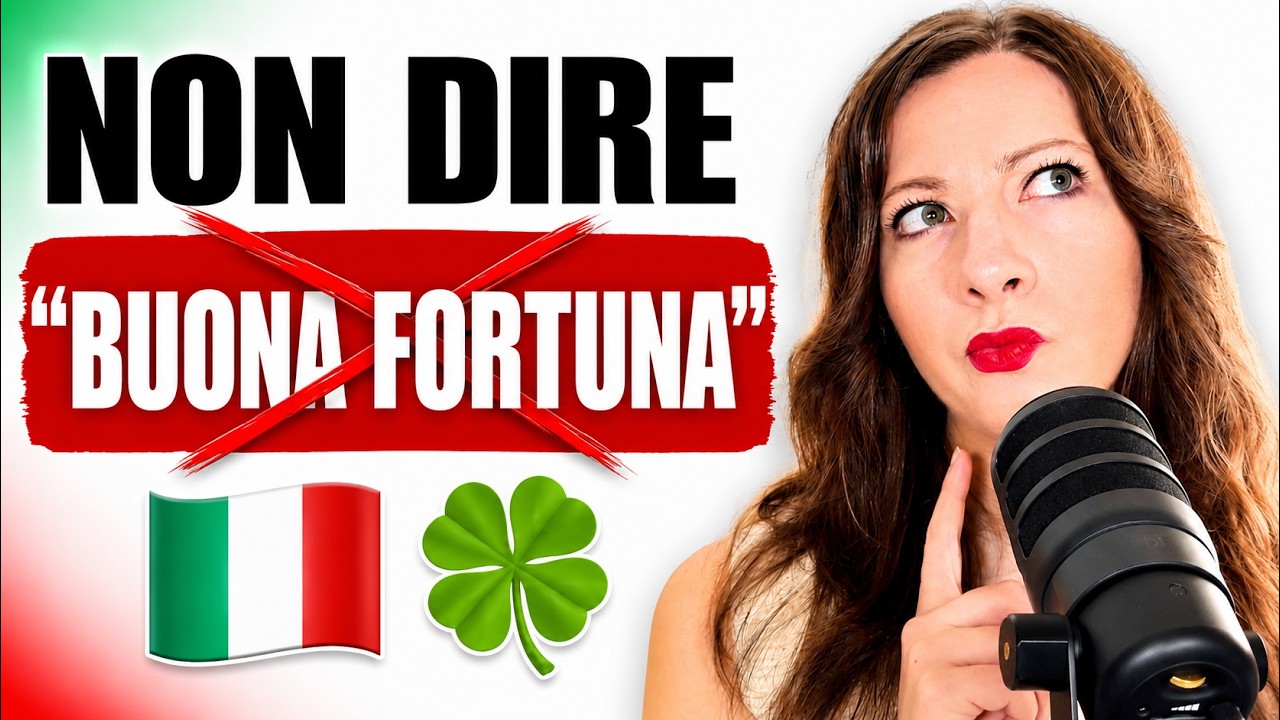
Stop Saying “Buona Fortuna” All the Time
The Italian alternatives to “buona fortuna” are divided into five categories, based on tone and situation: informal, neutral, motivational, poetic and affectionate. To deepen the topic of wishes, you can check out the guide on the differences between auguri, congratulazioni and complimenti.
Category 1 — Informal and Common
These expressions are used among friends, colleagues and family. They are the bread and butter of spoken Italian: warm, spontaneous, immediate.
1. In Bocca al Lupo!
The most famous and the most Italian of all! It’s used before exams, job interviews, auditions, sports competitions… every time someone is about to face an important challenge. But watch out: the correct response is not “Grazie” [Thank you], but “Crepi!” [May it die!] (from the verb crepare, meaning “to die”). Answering “grazie” is considered bad luck by the superstitious!
Example: “Domani ho l’esame di matematica. In bocca al lupo! — Crepi!” [Tomorrow I have the math exam. Break a leg! — Thanks (literally: “may it die”!)]
To learn more about the origin of this expression, you can check out the complete guide on the expression “in bocca al lupo”.
2. Spacca Tutto!
Youthful and energetic expression. Perfect before a performance, a challenge or an event where you need to give it your all. Literally it means “break everything”, but the sense is: “give your best, be unstoppable!”.
Example: “Domani hai il concerto? Spacca tutto!” [Tomorrow you have the concert? Nail it!]
3. Dacci Dentro!
It invites you to put in maximum effort. It has a tone of enthusiasm and grit, almost like a sports coach. It contains the particle ci (pronoun combined with the imperative) and you can use it both among friends and at work among young colleagues. To learn more, also check out the guide on the particella CI.
Example: “Manca solo l’ultimo esame prima della laurea. Dacci dentro!” [Only the last exam left before graduation. Go for it!]
4. Vai Tranquillo/a!
It conveys confidence and serenity. It’s like saying “don’t worry, you’ve got this”. Grammar note: the adjective tranquillo/a agrees with the gender of the person you’re talking to. To a man you’ll say “vai tranquillo!”, to a woman “vai tranquilla!”.
Example: “Ti sei preparata benissimo per il colloquio. Vai tranquilla!” [You prepared really well for the interview. Take it easy!]
5. Forza!
Short, direct, powerful. It’s used to encourage someone before something tough. A single “forza!”, said with the right look, is worth a thousand sentences.
Example: “È l’ultima salita. Forza!” [It’s the last climb. Come on!]
6. Tutto Liscio!
To wish that there are no hitches. Perfect for trips, moves, organizational events. The adjective liscio means “without problems”, “without obstacles”.
Example:
- “Parto per il viaggio domani mattina.” [I’m leaving on my trip tomorrow morning.]
- “Tutto liscio!” [Smooth sailing!]
Category 2 — More Neutral
These expressions work in almost all contexts: from a message to a friend to an email to a colleague, from informal conversation to a greeting card. They are the safe choice when you don’t know the person well or when the context is mixed.
7. Ti Auguro il Meglio
It’s used above all for big life changes: a new job, a move, an important turning point. It has a sincere and warm tone, but not too confidential. In the courtesy form (directed to “Lei”) it becomes: “Le auguro il meglio”.
Example: “Ho saputo che ti trasferisci all’estero: ti auguro il meglio!” [I heard you’re moving abroad: I wish you all the best!]
8. Tanti Auguri
Watch out: not only for birthdays! It can accompany any happy or turning-point moment: weddings, graduations, promotions, a new beginning, an important project. It’s a universal wildcard.
Example: “Ho saputo che ti sposi! Tanti auguri!” [I heard you’re getting married! Best wishes!]
9. Spero Vada Tutto Bene
You’re not just wishing for something, you’re saying that you care. Also suitable for writing. Grammar note: “vada” is the congiuntivo presente of the verb andare, mandatory after “spero che”.
Example: “So che oggi è una giornata importante per te: spero vada tutto bene.” [I know today is an important day for you: I hope everything goes well.]
10. Ti Faccio i Miei Auguri
Slightly more formal, suitable for written communications or semi-official contexts. In the courtesy form it becomes: “Le faccio i miei auguri”.
Example: “Per il tuo nuovo incarico ti faccio i miei auguri, sono certa che farai un ottimo lavoro.” [For your new position I extend my best wishes, I’m sure you’ll do an excellent job.]
11. Buona Continuazione!
It’s used when someone is already doing something (a job, a trip, a project) and you wish them to go on well. It’s a typically Italian expression that foreigners don’t use enough! You can also hear it at the restaurant, when the waiter walks away after serving.
Example: “Vedo che stai lavorando bene al progetto. Buona continuazione!” [I see you’re working well on the project. Keep it up!]
Stop reading Italian.
Start speaking it.
Online lessons in groups of 4, organised by level and goals, with qualified teachers. Pick the day and time that suit you from the available slots.
Max 4 students:
there’s a seat for you
Category 3 — Motivational
These expressions serve to convey confidence to those facing a challenge. They don’t just wish that things go well: they clearly say “I believe in you”.
12. Ce la Farai!
A full declaration of confidence in the other person. Grammar note: “farai” is the futuro semplice of the verb fare, used here to give the expression an almost prophetic value: “I’m sure you’ll succeed”.
Example: “So che sei stanca, ma manca poco: ce la farai!” [I know you’re tired, but you’re almost there: you’ll make it!]
13. Andrà alla Grande!
Perfect when you want to be enthusiastic together with the other person. It’s the classic optimistic wish: not just “it will go well”, but “it will go GREAT!”.
Example: “Domani apre il tuo negozio! Andrà alla grande!” [Tomorrow your shop opens! It’s going to be great!]
14. Hai Tutte le Carte in Regola
It means: “you have everything you need”. It’s used to tell someone that they are prepared, qualified, ready — for example before job interviews or important exams. It’s a metaphor taken from card games: those who have their cards in order have good chances of winning.
Example: “Non essere nervoso per il colloquio: hai tutte le carte in regola.” [Don’t be nervous about the interview: you have everything you need.]
15. Fidati di Te Stesso/a!
It’s not so much a wish as an affectionate piece of advice: “stop doubting, believe in yourself”. Grammar note: fidarsi is a verbo riflessivo, and is built with the preposition di. Also “te stesso” agrees in gender: to a woman you’ll say “te stessa!”.
Example: “Sai fare questa cosa meglio di chiunque altro: fidati di te stessa!” [You can do this thing better than anyone else: trust yourself!]
Category 4 — Special and Poetic
These expressions have a literary or solemn tone, and sometimes also a pinch of irony. Perfect for written messages, dedications, important moments or simply when you want to say something different from the usual.
16. Che la Fortuna ti Sorrida
It’s used in written contexts, speeches, formal messages with a literary touch. Grammar note: “sorrida” is the congiuntivo presente of the verb sorridere, used to express a wish. It’s the construction “che + congiuntivo”, typical of wishes.
Example: “In questo nuovo capitolo della tua vita, che la fortuna ti sorrida.” [In this new chapter of your life, may fortune smile upon you.]
17. Che il Cielo ti Aiuti
Once a solemn expression, today also used in an ironic or joking key, when the situation seems really difficult. Here too the construction is “che + congiuntivo” (aiuti is the congiuntivo presente of aiutare).
Example (ironic): “Domani devo affrontare tutta la mia famiglia riunita per Natale. — Che il cielo ti aiuti!” [Tomorrow I have to face my whole family gathered for Christmas. — May heaven help you!]
18. Vai e Conquista!
Typical of the epic-ironic register among friends. It’s often said with a hand gesture, almost like a Roman emperor sending his army into battle!
Example: “Hai il colloquio finale con il capo? Vai e conquista!” [Do you have the final interview with the boss? Go and conquer!]
19. Non ci Pensare e Vai!
For perfectionists and anxious people. It’s at the same time a wish and a practical piece of advice: stop overthinking, just act! Note that “ci pensare” hides the particella CI, which replaces “a quella cosa” (pensare A qualcosa → CI pensare).
Example: “Stai troppo rimuginando sul discorso di domani. Non ci pensare e vai!” [You’re overthinking tomorrow’s speech too much. Don’t think about it and go!]
Category 5 — Affectionate and Personal
These expressions go beyond the wish: they tell the other person that they are not alone, that you love them, that you’re there. They’re used in the moments that really count, with the people who really count.
20. Vada Come Vada, ti Voglio Bene
A beautiful expression. It says: the outcome is not what matters most, you are. Grammar note: “vada” is again the congiuntivo presente of andare. The structure “vada come vada” means “whatever happens”.
Example: “Domani ci sarà il verdetto: vada come vada, ti voglio bene.” [Tomorrow there will be the verdict: whatever happens, I love you.]
21. Sono con Te
It’s not so much a wish as a declaration of solidarity. It says that you’re not alone, whatever happens. Simple, super short, but it says so much.
Example: “So che sarà una giornata difficile. Sono con te.” [I know it will be a difficult day. I’m with you.]
22. Ti Penso!
It doesn’t wish anything specific. It’s often used alongside other wishes, or on its own, as an affectionate reminder before an important moment.
Example: “In bocca al lupo per l’esame, ti penso!” [Break a leg for the exam, I’m thinking of you!]
23. Fai del Tuo Meglio!
It takes the pressure off the result and shifts it to the process. It’s a realistic and kind wish: I’m not asking you to win, I’m just asking you to give everything you have.
Example: “Non importa se non arrivi primo: fai del tuo meglio e sarà già una vittoria.” [It doesn’t matter if you don’t come first: do your best and it will already be a victory.]
Summary Table of the 23 Expressions
Here’s a recap of all 23 expressions, divided by category, with the tone and typical situation in which to use them.
| Expression | Category | When to use it |
|---|---|---|
| In bocca al lupo! | Informal | Exams, interviews, competitions |
| Spacca tutto! | Informal | Performances, challenges (among young people) |
| Dacci dentro! | Informal | Moments of maximum effort |
| Vai tranquillo/a! | Informal | When the other is nervous |
| Forza! | Informal | Brief encouragement |
| Tutto liscio! | Informal | Trips, moves, events |
| Ti auguro il meglio | Neutral | Big life changes |
| Tanti auguri | Neutral | Any turning-point moment |
| Spero vada tutto bene | Neutral | Also written, generic |
| Ti faccio i miei auguri | Neutral | Semi-formal, written |
| Buona continuazione! | Neutral | Things already started |
| Ce la farai! | Motivational | To express confidence |
| Andrà alla grande! | Motivational | To be optimistic together |
| Hai tutte le carte in regola | Motivational | Interviews, important exams |
| Fidati di te stesso/a! | Motivational | For those who doubt themselves |
| Che la fortuna ti sorrida | Poetic | Written, solemn speeches |
| Che il cielo ti aiuti | Poetic | Solemn or ironic |
| Vai e conquista! | Poetic | Epic-ironic among friends |
| Non ci pensare e vai! | Poetic | For anxious and perfectionist people |
| Vada come vada, ti voglio bene | Affectionate | Important moments, loved ones |
| Sono con te | Affectionate | Solidarity, support |
| Ti penso! | Affectionate | Affectionate accompaniment |
| Fai del tuo meglio! | Affectionate | To take off pressure |
Frequently Asked Questions
Why Don’t Italians Say “Buona Fortuna”?
Actually they do say it, but much less than one might think! “Buona fortuna” is a correct expression but too generic and neutral for Italian taste: it sounds almost like a translation from the English “good luck”. Everyday Italian prefers more colorful, warm and specific expressions: in bocca al lupo! for exams, tanti auguri! for a new beginning, ti auguro il meglio for a big change. Every situation has its perfect expression, and this is typical of the richness of the Italian language.
Why Do You Answer “Crepi” to “In Bocca al Lupo”?
The origin is ancient and not completely clear. The most widespread hypothesis is that the expression derives from the language of hunters: wishing someone to end up “in the wolf’s mouth” means wishing them to be near the prey, and therefore to succeed in the hunt. The reply “crepi (il lupo)!” is the wish that danger disappears, that the challenge is won. Answering “grazie”, however, is considered bad luck by the superstitious: it “breaks the spell”. To learn more, there are also other fascinating theories that you can find in the complete guide.
What’s the Difference Between “Tanti Auguri” and “Ti Auguro il Meglio”?
They are both neutral and cordial expressions, but with different nuances. “Tanti auguri” is more immediate and festive, almost like applause: it’s used for birthdays, weddings, graduations, promotions, a new year. “Ti auguro il meglio” is more reflective and profound: it’s the perfect formula for big life changes (a new job, a move abroad, the start of a new relationship). In short, tanti auguri celebrates the moment, ti auguro il meglio accompanies the future.
Can I Say “In Bocca al Lupo” to My Boss?
Yes, but with attention to context. “In bocca al lupo” is an informal but not rude expression: you can safely say it to a boss with whom you have a friendly relationship. In a very formal context or in official written communication, however, it’s better to choose more neutral formulas like “Le auguro il meglio”, “Le faccio i miei auguri” or “Le auguro un buon proseguimento”. The golden rule is: if you would use tu, you can say “in bocca al lupo”; if you would use Lei, better be more neutral.
Why Do Some of These Expressions Use the Congiuntivo?
Because the congiuntivo is, in Italian, the verbal mood of wish, hope and possibility. In formulas like “che la fortuna ti sorrida”, “che il cielo ti aiuti”, “spero vada tutto bene”, “vada come vada”, the verbs (sorrida, aiuti, vada) are in the congiuntivo presente precisely because they express a wish, something that is not yet real but that we want to become real. It’s a typically Italian and elegant construction: using it will immediately make you sound more fluent and natural.
Do pronominal verbs trip you up and fill you with doubts? Turn confusion into confidence with our exclusive course: “Da «Non ce la faccio più» a «Ora me la cavo»: i verbi pronominali in 30 giorni.” With fun, bite-size lessons and targeted practice, you’ll learn to use them naturally in just one month.
Want the lesson PDF with exercises and solutions?
Join the LearnAmo AcademyLoading quiz…
Podcast: Play in new window | Download (Duration: 25:59 — 13.2MB)
Iscriviti: Apple Podcasts | Spotify | Android | iHeartRadio | Podcast Index | TuneIn | Deezer | RSS | Altri...