

Have you ever had a crazy urge to insult someone but couldn’t say a swear word? Because you were at the office, at dinner with your in-laws, in front of a five-year-old child, or simply because you’re a polite person. I have wonderful news for you: Italian is a language extremely rich in insults that aren’t swear words, that you can say in front of your grandmother, and some are even affectionate.
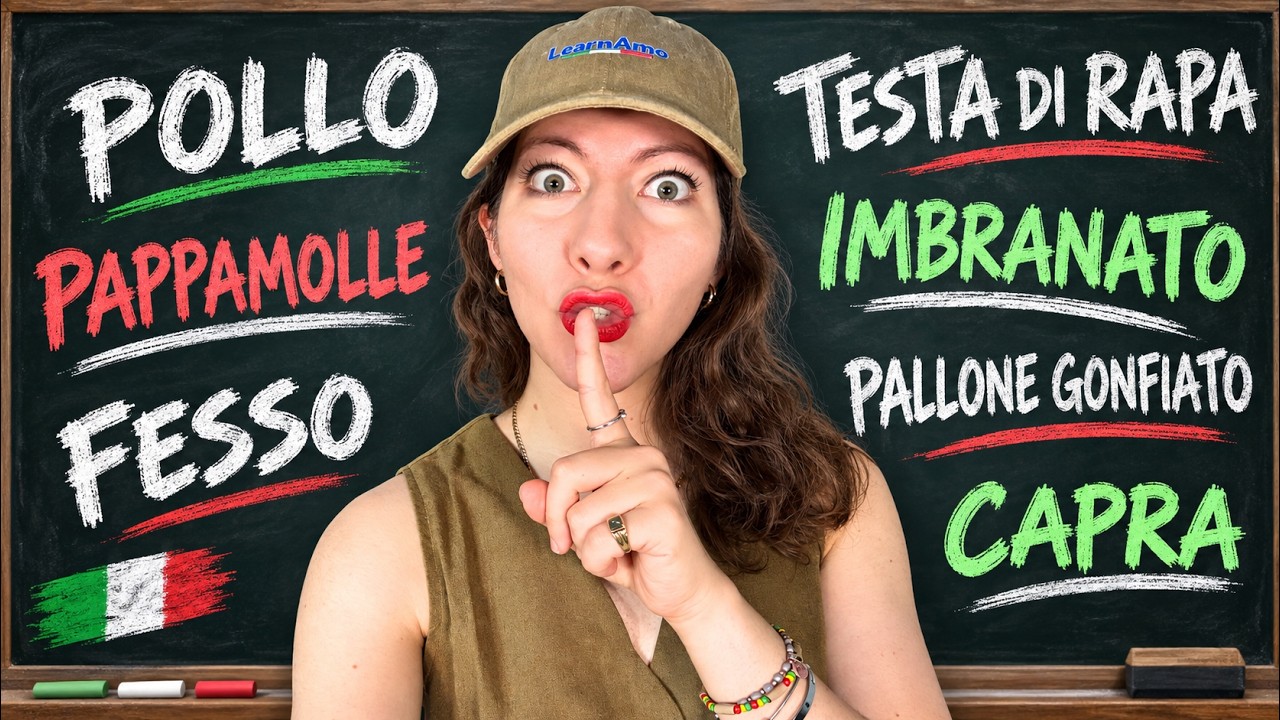
How to Insult Someone Politely in Italian
In this article you’ll find 16 informal Italian insults without swear words, with meanings, examples and etymological curiosities. But first, a fundamental warning: in Italian, with insults, the tone of voice does 90% of the work. The exact same word, said smiling to a friend, is a caress; said with a serious face to a stranger, is a declaration of war. If you want to review the useful phrases for everyday conversation in Italian, you can check the dedicated guide.
Here’s an example of the difference:
- “Ma sei un salame!” [You are such a salame!] → affectionate, almost tender
- “Sei. Un. Salame.” [You. Are. A. Salame.] → a declaration of war
And there’s also a very Italian thing called sfottere (or “prendere in giro” [to tease]): teasing friends is, in Italy, a way to say “I love you”. The closer we are, the more we insult each other. If an Italian never teases you, maybe you’re not their friend yet.
Part 1: Insults for Those Who Aren’t the Sharpest Tool
Let’s start with the insults dedicated to the naive, the ignorant and those who don’t understand things. They are six words you’ll often hear in Italians’ everyday conversations.
1. Pollo
The pollo [chicken] is the naive person, the one who gets tricked easily, the one who believes everything. Examples:
- “Ha comprato un iPhone per strada a 50 euro. Dentro la scatola c’era una patata. Che pollo!” [He bought an iPhone on the street for 50 euros. There was a potato inside the box. What a pollo!]
- “Non fare il pollo, quello ti vuole solo fregare.” [Don’t be a pollo, that guy just wants to trick you.]
Curiosity: there’s also the expression “pollo da spennare” [chicken to pluck], meaning the person to take money from exactly like plucking a chicken’s feathers. If a seller looks at you and smiles too much, be careful.
2. Fesso
The fesso is the fool, the naive one, the one who doesn’t understand how the world works. It’s very widespread especially in Central-Southern Italy. However, the most common use is defensive:
- “Mi hai preso per fesso?” [Did you take me for a fesso?] = do you really think I’m stupid?
- “Non fare il fesso e stammi a sentire.” [Don’t be a fesso and listen to me.]
From this word comes the expression “fare fesso qualcuno” [to make a fesso of someone], meaning to trick, to cheat. For example, “mi hanno fatto fesso” [they made a fesso of me] means “they cheated me” and it’s a passato prossimo very common in speech. There’s also the affectionate diminutive fessacchiotto, which is much more tender and is often used with children.
3. Testa di Rapa
This is for those who don’t understand anything, even when you explain things twenty times. Example: “Te l’ho spiegato tre volte, testa di rapa!” [I’ve explained it to you three times, turnip head!]
Useful variants:
- Zuccone (from zucca = head, literally “pumpkin”): “Studia, zuccone!” [Study, zuccone!]
- Sei di coccio (the coccio is terracotta): “Non capisci proprio, sei di coccio!” [You just don’t get it, you’re made of terracotta!]
- Testa dura: same meaning, but emphasizes stubbornness
Italians insult a lot with vegetables. Besides rapa [turnip], there’s also broccolo [broccoli], registered by dictionaries precisely in the sense of “not-so-bright person”. If someone calls you by the name of a vegetable, they’re not inviting you to dinner.
4. Bischero
This is a gift Tuscany gives us. Bischero means silly, naive, gullible, but in a good-natured way. In Florence it’s practically a filler word: “O bischero, dove vai?” [Hey bischero, where are you going?].
The Legend of the Bischeri Family
In Florence, everyone tells that the word comes from the Bischeri family, who owned houses in the area where Piazza del Duomo stands today. The Municipality wanted to buy them to build Santa Maria del Fiore, but the Bischeri drove up the price so much that they ended up losing everything (some say through expropriation, others say through a fire). Since then, “fare come i Bischeri” [to do like the Bischeri] would mean to make a very stupid choice.
The family really existed and the intersection is still called Canto dei Bischeri, but be careful: linguists consider this story a folk etymology. In dictionaries, in fact, the first meaning of bischero is another: the wooden peg that regulates the strings of guitars and violins. For other similar curiosities, you can check the guide on the most famous Italian proverbs.
5. Capra
Capra [goat] doesn’t exactly mean “stupid”. Dictionaries define it as the person who is ignorant and stubbornly closed in their own ignorance: not only do you not know things, but you have no intention of learning them. Example: “Non sai chi ha scritto la Divina Commedia? Capra!” [You don’t know who wrote the Divine Comedy? Capra!]
Cultural curiosity: this insult became legendary thanks to the art critic Vittorio Sgarbi, famous on television for his verbal aggressiveness and for having shouted at his interlocutors “Capra! Capra! Capra!”. It’s now a national meme.
6. Non è un’Aquila
And here comes the art of the elegant insult: the understatement. You don’t say someone is stupid, you just say they’re not a genius. Example: “È simpaticissimo, eh… però non è un’aquila.” [He’s very nice, eh… but he’s not an eagle.]
Beautiful variants:
- Non è una cima [He/she is not a peak]: “Come studente non è una cima.” [As a student he’s not a peak.]
- Non ha inventato l’acqua calda [He/she didn’t invent hot water]: “Sarà pure laureato, ma non ha inventato l’acqua calda.” [He may have a degree, but he didn’t invent hot water.]
Important note: these are almost always used in third person, meaning to talk badly about someone behind their back. They are the perfect insults for gossip.
Part 2: Insults for Those Who Are Clumsy, Soft or Useless
The second part is dedicated to those who don’t react, who are clumsy, who don’t have character or who don’t count for anything in a situation. They are four of the most used expressions in spoken language.
7. Salame
The salame is the one a bit dumb, a bit sleepy, who doesn’t react. Examples:
- “Non stare lì impalato come un salame, aiutami!” [Don’t just stand there like a salame, help me!]
- “Le piacevi e non le hai detto niente? Sei un salame!” [She liked you and you didn’t say anything? You’re a salame!]
Warning: you also say “sei un salame” to a woman. Salame has no feminine form.
Food is a mine of Italian insults, and dictionaries register them all. Mozzarella and scamorza for those who are weak, inept, without character; pera cotta [cooked pear] for those without energy; pesce lesso [boiled fish] for those without personality. Practically a complete menu.
8. Imbranato / Imbranata
The imbranato is clumsy, awkward, doesn’t know how to do things with their hands (or with anything else). Examples:
- “È così imbranato che è caduto mentre era fermo.” [He’s so imbranato that he fell while standing still.]
- “Scusa, sono un po’ imbranata con la tecnologia.” [Sorry, I’m a bit imbranata with technology.]
It’s useful to know that this is one of the few insults you can use on yourself without problems, as an excuse. And it has a fantastic variant: “sei una frana” [you’re a landslide], meaning you’re a walking natural disaster.
9. Pappamolla
The pappamolla is someone without spirit, without character, who never makes a decision and lets others drag them along. Examples:
- “Non fare il pappamolla, diglielo che ti piace!” [Don’t be a pappamolla, tell her you like her!]
- “Sei un pappamolla, non riesci nemmeno a lamentarti al ristorante.” [You’re a pappamolla, you can’t even complain at the restaurant.]
Variants: smidollato (without marrow, therefore without a spine), rammollito, posapiano, and to raise the level coniglio [rabbit] and fifone, which speak directly of fear.
Curiosity: the word comes from pappa (baby food) + molle (soft). Literally: you’re a soft mush. Dictionaries register the form pappamolle, but in everyday speech you’ll hear “pappamolla” a lot as well. Grammar note: the word never changes form, so you can say both un pappamolla and una pappamolla.
10. Contare Quanto il Due di Coppe
Here’s the most Italian expression of all to say that someone counts for absolutely nothing. Examples:
- “Alle riunioni conta quanto il due di coppe.” [At meetings he counts as much as the two of cups.]
- “In quella famiglia il povero Marco vale quanto il due di coppe quando la briscola è bastoni.” [In that family poor Marco is worth as much as the two of cups when the briscola is clubs.]
Cultural Curiosity: Briscola and Italian Cards
In Italian cards the four suits are coppe (cups), denari (coins), spade (swords) and bastoni (clubs). In the game of briscola, at the beginning a dominant suit is chosen; the two is already the card with the lowest score, and if on top of that it’s not of the briscola suit, then it’s really worth nothing.
The beautiful thing is that the suit changes from region to region: in Messina, for example, it’s said when the briscola is spade; elsewhere bastoni or denari. And in Tuscany there’s also the short version: “conta quanto il due di briscola” [it counts as much as the two of briscola].
One place to learn Italian
Join the LearnAmo AcademyPart 3: Insults for Those Who Have an Unbearable Character
Let’s move on to insults for those who have annoying behaviors: the presumptuous, the rude, those who bother you and those who put you to sleep in ten minutes.
11. Pallone Gonfiato
The pallone gonfiato [inflated balloon] is the presumptuous one, the one who thinks they’re much more important than they are: big outside, empty inside. Example: “Da quando l’hanno promosso è diventato un pallone gonfiato.” [Since they promoted him he’s become a pallone gonfiato.]
Very modern and very useful variant: “tirarsela” [to think highly of oneself].
- “Ma quanto se la tira?!” [But how much does he think of himself?!] = how superior does he think he is?
- “È bravo, però se la tira un po’ troppo.” [He’s good, but he thinks a bit too much of himself.]
If you learn only one expression from this article, learn “se la tira”: Italians use it every day. For other useful expressions in everyday speech, you can check the guide on useful expressions to start a conversation in Italian.
12. Cafone / Cafona
The cafone is the rude one, the one without class, the one who speaks loudly on the phone on the train. Examples:
- “Ha risposto al telefono al ristorante urlando: che cafone!” [He answered the phone at the restaurant shouting: what a cafone!]
- “Non salutare quando entri è da cafoni.” [Not saying hello when you enter is what cafoni do.]
Etymological Curiosity: from Peasant to Rude
Originally cafone simply indicated the peasant of Southern Italy, without offensive intent (you can still find it this way in Ignazio Silone’s novels). The etymology is officially uncertain, but the Accademia della Crusca leans toward a derivation from Latin cavare, meaning “to dig, to turn the earth”: the cafone would therefore be “the one who digs”. The transition to “rough person” is documented from the 18th century, and the word spread throughout Italy after the Unification.
The case of villano is similar but different, as happens with many false friends in Italian: it came from Latin villa, which however wasn’t a luxury house, but a farmstead, a farm. The villano was the one who worked there. Today it means only “rude”.
13. Rompiscatole
The rompiscatole is someone who bothers you continuously, who insists, who doesn’t leave you alone. Examples:
- “Che rompiscatole, mi ha chiamato dieci volte oggi!” [What a rompiscatole, he called me ten times today!]
- “Scusa se faccio la rompiscatole, ma mi serve entro domani.” [Sorry if I’m being a rompiscatole, but I need it by tomorrow.]
Curiosity (fundamental for today’s topic): the word scatole [boxes] here is a euphemism, meaning it substitutes another less polite word. It’s the perfect example of how Italian transforms a swear word into a perfectly polite word.
Useful variants:
- “Che rottura!” [What a drag!]
- “Sei un rompi” (shortened)
- “Scocciatore” and “seccatore” (more neutral, usable also in serious contexts)
- “Peste” [plague] (for lively children)
- “Tafano” [horsefly], the insect that torments animals with its bites, which dictionaries also register for insistent people
14. Sei una Pizza / Che Pizza!
In Italy, “pizza” can be an insult. It’s probably the only negative context in which we use this sacred word. It means boring, very boring. Examples:
- “Quel film era una pizza pazzesca, mi sono addormentata.” [That movie was a crazy pizza, I fell asleep.]
- “Che pizza questa riunione!” [What a pizza this meeting is!]
- “È simpatico?” “No, è una pizza.” [Is he nice? No, he’s a pizza.]
Variants: “che barba!” [what a bore!], “è un mattone” [it’s a brick] (for heavy books and films), “pesce lesso” [boiled fish] (person without personality and without flavor).
Part 4: Insults for Those Who Are Out of Their Mind and for Those Who Are Out of Fashion
We conclude with insults for those who have eccentric ideas (or who really aren’t right in the head) and for those who follow trends in an exaggerated way.
15. Fuori Come un Balcone
It means completely crazy. Example: “Vuole attraversare l’Atlantico in pedalò: è fuori come un balcone!” [He wants to cross the Atlantic on a paddle boat: he’s out like a balcony!]
Curiosity: why the balcony? Because the balcony… is outside. That’s all. And this structure is also productive: you can say “fuori come un terrazzo” [out like a terrace], “fuori come una mensola” [out like a shelf], “fuori come un citofono” [out like an intercom]. As long as the object is outside.
Beautiful variants:
- “Ti ha dato di volta il cervello?” [Has your brain flipped?] = have you gone crazy?
- “Sbroccare” (and the long form “perdere la brocca”): born in the Roman dialect and today very widespread among young people throughout Italy. Watch out for the nuance: it mainly means to lose patience, to explode. Example: “Ieri ho sbroccato in ufficio.” [Yesterday I lost it at the office.]
- “Sei fuso” [you’re blown] (like a blown fuse)
16. Tamarro / Truzzo / Coatto
The tamarro is someone who follows trends in an exaggerated way and without taste: souped-up car, sunglasses at night, very loud music. Example: “Con quella catena d’oro sembra un tamarro.” [With that gold chain he looks like a tamarro.]
According to dictionaries, tamarro probably comes from the Arabic tammār, meaning “date merchant”. It’s a word born in Southern Italy and then spread throughout the country through youth slang.
Geographical Curiosity: Insults Change from Region to Region
This insult changes from region to region:
- Tamarro → of Southern origin, understood everywhere today
- Truzzo and maranza → Northern Italy, especially Milan
- Coatto → Rome (comes from legal language, where coatto means “forced”)
- Burino → Rome, for those who come from the countryside
In general, Italian insults are deeply regional: bischero is Tuscan, fesso is from Central-Southern Italy, sbroccare is Roman. Changing city in Italy means changing the vocabulary of insult.
Bonus: Two Very Italian Insults
Two insults that reflect a typical trait of Italian culture: the very close (for some too close) relationship between parents and adult children.
Mammone
The mammone is the man too attached to his mother. Example: “Ha 40 anni e la mamma gli stira ancora le camicie: è un mammone.” [He’s 40 years old and his mom still irons his shirts: he’s a mammone.]
Bamboccione
The bamboccione is the adult who behaves like a child and still lives with their parents.
Historical curiosity: the word already existed in common language, but it exploded on October 4, 2007, when the then Minister of Economy Tommaso Padoa-Schioppa, in a parliamentary hearing on the budget law, presented an incentive for young people who moved out to live on their own with the phrase: “Mandiamo i bamboccioni fuori di casa” [Let’s send the bamboccioni out of the house]. It was a huge, bipartisan controversy. And the word stuck.
How to Strengthen (or Soften) an Insult in Italian
Here’s the trick to make each insult much stronger or, on the contrary, much more affectionate. They are four strategies that Italians use continuously without realizing it.
Add an Intensifier
Adjectives like vero [true], proprio [really], gran [big] and perfetto [perfect] double the strength of the insult:
- “Sei un vero cafone!” [You’re a real cafone!]
- “Sei proprio un pollo!” [You’re really a pollo!]
- “Sei un gran rompiscatole!” [You’re a big rompiscatole!]
- “Sei un perfetto imbranato!” [You’re a perfect imbranato!]
Use the Structure “Che + Noun!”
It’s one of the most expressive Italian exclamative constructions: it makes the insult immediate and powerful.
- “Che pollo!” [What a pollo!]
- “Che cafone!” [What a cafone!]
- “Che pizza!” [What a pizza!]
Use “Ma Quanto Sei…!”
It adds a touch of surprise and judgment:
- “Ma quanto sei imbranato!” [But how imbranato you are!]
- “Ma quanto se la tira!” [But how much he thinks of himself!]
Use Suffixes to Modulate the Intensity
Italian suffixes are a very powerful tool to make a word more aggressive or more tender.
Suffixes that make the insult stronger:
- -one / -accio: cafonaccio, ignorantone
Suffixes that soften the insult (used with children or with your partner):
- -ino / -ello / -otto: sciocchino, stupidello, fessacchiotto, cafoncello
Grammar Note: Which Insults Change in the Feminine?
Some of these insults change in the feminine, others don’t:
| Behavior | Examples |
|---|---|
| Change in feminine | imbranato → imbranata, cafone → cafona, tamarro → tamarra |
| Never change form | pappamolla, rompiscatole, testa di rapa, pizza |
| Stay masculine also for women | sei un salame, sei un pollo, sei un pallone gonfiato |
| Always feminine for everyone | capra: “Marco è una capra” |
Summary Table of the 16 Insults + Bonus
Here’s a summary of all the insults divided by category, perfect to consult quickly:
| Category | Insults |
|---|---|
| Not the sharpest tool | Pollo / Fesso / Testa di rapa / Bischero / Capra / Non è un’aquila |
| Clumsy or soft | Salame / Imbranato / Pappamolla / Contare quanto il due di coppe |
| Bad character | Pallone gonfiato / Cafone / Rompiscatole / Sei una pizza |
| Crazy or out of fashion | Fuori come un balcone / Tamarro (Truzzo, Coatto, Burino) |
| Cultural bonus | Mammone / Bamboccione |
Frequently Asked Questions
Why Can Insults Be Affectionate in Italy?
Because in Italy there’s a very widespread social practice called sfottere (or “prendere in giro” [to tease]). Among true friends, family members and people you’re close to, joking insults like “sei un salame” [you’re a salame], “che pollo!” [what a pollo!] or “scemo!” [silly!] are used as a sign of affection. The unwritten rule is: the closer we are, the more we tease each other. If an Italian teases you jokingly, with a smile, they probably consider you a friend. Remember however that the tone of voice is everything: the same word said with a serious face to a stranger is instead a real offense. To understand if they’re teasing you or really insulting you, observe the smile, the context and the type of relationship.
What Does “Rompiscatole” Really Mean?
Literally it means “the one who breaks the boxes”, but the word scatole [boxes] is actually a euphemism: it stands for a vulgar word for the male body that we won’t tell you here. In spoken language, the two terms are interchangeable: “the one who breaks the boxes” and its vulgar version have exactly the same meaning, but one is polite and the other isn’t. It’s the perfect example of how Italian has found an elegant formula to express annoyance without slipping into vulgarity. You can use rompiscatole, “che rottura!” [what a drag!] or the abbreviation “sei un rompi” in any context, even formal.
Why Did “Cafone” Originally Mean “Peasant”?
Because originally cafone was a descriptive term of Southern Italy, without offensive intent, that simply indicated the land worker. The most accredited etymology (proposed by the Accademia della Crusca) derives the word from Latin cavare, meaning “to dig, to turn the earth”. The same thing happened with villano, which came from Latin villa (farm, farmstead). The transition to “rough and rude person” is documented from the 18th century onwards and is linked to the urban prejudice against country people, considered “ignorant” and “without manners”. Today the link with the agricultural world is completely lost: cafone means only rude person without class.
How Can I Tell if an Italian Is Insulting Me or Complimenting Me?
The difference lies in three elements: the tone of voice, the smile and the type of relationship. If a friend you know well tells you “Ma sei un salame!” [You’re such a salame!] laughing, they’re teasing you affectionately and saying they care about you. If instead a stranger looks at you seriously and says “Sei un salame” [You’re a salame] emphasizing the words, then it’s a real insult. Another useful indicator is the context: in joking situations (a dinner among friends, a joke in the family), insults are almost always affectionate; in an argument or on a formal occasion, instead, they are always real.
Which Insults Change from Region to Region?
Almost all of them. Italian insults are deeply regional, and in many cases they are understood only in the area of origin. Bischero is typically Tuscan. Fesso is from Central-Southern Italy. Sbroccare was born in Rome (in Roman dialect) but today is widespread among young people throughout Italy. Coatto is Roman; truzzo and maranza are from the North, especially Milan; burino is Roman again but with a different nuance (for those who come from the countryside). For an Italian, changing city often means completely changing the vocabulary of insult.
Want the lesson PDF with exercises and solutions?
Join the LearnAmo AcademyLoading the exercise…
Podcast: Play in new window | Download (17.6MB)
Iscriviti: Apple Podcasts | Spotify | Android | iHeartRadio | Podcast Index | TuneIn | Deezer | RSS | Altri...
