


A wave of cyberattacks has hit in recent weeks the refrigeration systems of hundreds of supermarkets across half of Europe, including Italy. The Italian government has called an emergency meeting at Palazzo Chigi, consumer associations are talking about hybrid warfare and investigators have not yet identified those responsible. In this article you’ll find the reconstruction of the events region by region, the reaction of the authorities, the key vocabulary to understand Italian news about technology and security and a grammatical structure that Italian journalists use continuously in news reporting: the condizionale di cronaca.
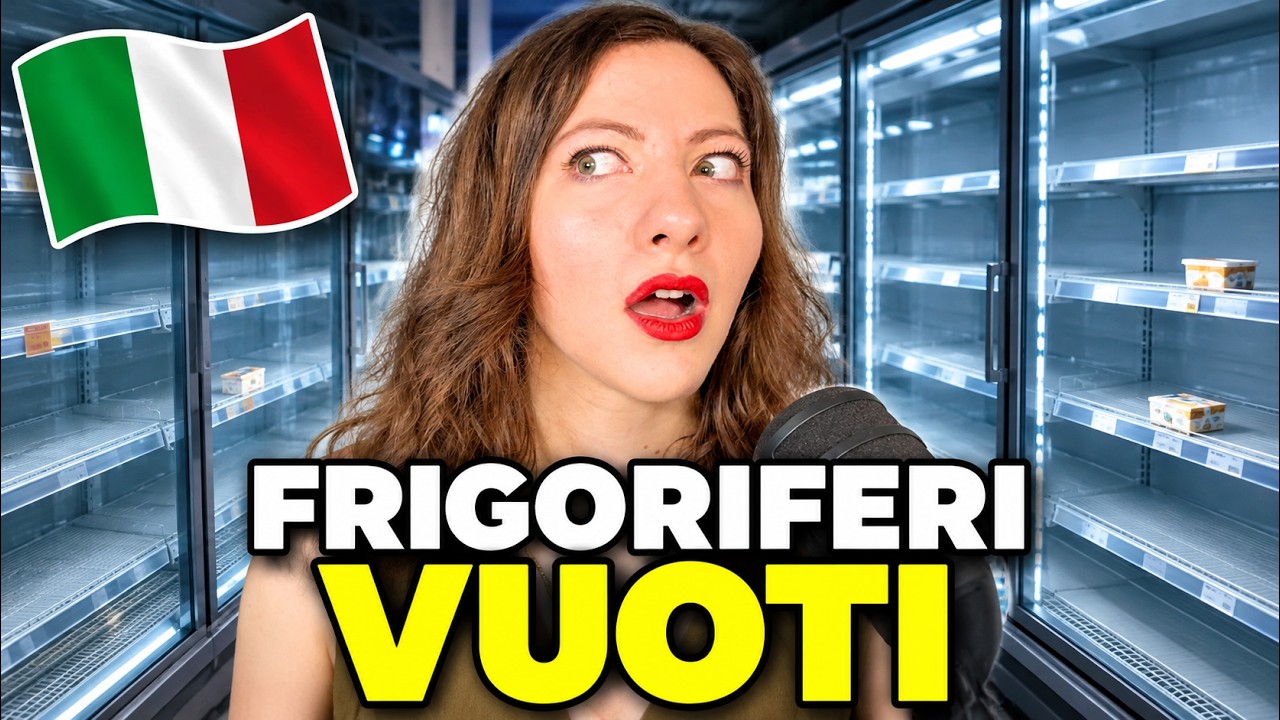
Why Are HACKERS Targeting European Supermarket REFRIGERATORS?
Before going into the details of the story, you need to understand which refrigerators we’re talking about and why they ended up in the crosshairs. The news is still evolving and the numbers still change from one source to another, but the main reconstruction is now consolidated.
Which Refrigerators Are We Talking About?
We’re not talking about domestic refrigerators. Nor did the hackers hit the payment systems of the supermarkets. The target was different: the systems that remotely control the temperature of refrigerators, freezers and refrigerated cells, that is, the large refrigerated counters of the big retail chains — the ones for frozen foods, dairy products and poultry.
Why are these refrigerators connected to the Internet? For efficiency reasons. The temperatures of refrigerated counters are often managed by digital systems, so technicians can intervene remotely for breakdowns and maintenance. This reduces operating costs, but makes the devices vulnerable if the connection is not adequately protected.
The First Case: France in October
The first significant case was recorded in France, in mid-October. In a single night, the hackers made the temperature of many French supermarket refrigerators rise up to 50 degrees, causing fires and the loss of large quantities of food.
The Numbers of the French Attack
According to the French Minister of the Economy, about 700 supermarkets out of 10,000 were hit. The Intermarché chain alone declared about 150 stores affected, with refrigerators at 50 degrees for six hours, and had to throw away all the food for health reasons. In the same days, signs of attacks also came from Belgium, and in Italy the alert was raised on October 13.
The Weak Point: Danfoss, Copeland and Dixell Software
French experts quickly identified the weak point: the breach concerned refrigerators managed by software of the Danish company Danfoss, as well as Copeland and Dixell systems. These are solutions widely used in European big retail, and this explains the speed with which the attack spread from one country to another.
The Second Wave: a November Night across Half of Europe
On the night between November 1 and 2, a second and much more extensive wave arrived. In many countries the attack took place around 2 in the morning, with times that vary slightly from country to country, but it was detected only several hours later, in the morning, when the employees opened the stores.
According to local media, Belgium, Luxembourg, Sweden, Ireland, the Netherlands, Finland and Estonia were hit. In Belgium, Carrefour spoke of 15 stores out of 700. In the following hours, reports came from other countries, such as Germany, Romania and the United Kingdom. In Germany, the federal agency for IT security confirmed the attacks, and some newspapers talk about more than ten countries affected in total. The numbers change from source to source because the situation is still evolving.
What Happened in Italy?
Italy was also involved in the second wave, with a limited but real impact, concentrated mostly in some regions.
Sicily: the Most Affected Region
The most affected Italian region was Sicily. Some Coop points of sale managed on franchise by the Gruppo Radenza were involved, in the provinces of Palermo, Catania and Ragusa, as well as some Conad stores, in Catania, Messina and Palermo. According to some sources, some Decò franchise stores were also involved, but the Arena group, which manages the brand, specified that its supermarkets were not directly hit. In Sicily, the attack would have occurred at four in the morning.
In Palermo, in a supermarket in the city centre, employees detected in the morning that the cells had not maintained the correct temperature and had to empty the counters of frozen foods and poultry. According to those in charge of the store, hackers would have modified the parameters of the installations, setting at 50 degrees devices that normally operate below zero. The delegate of Federdistribuzione for Sicily spoke of reports on about 20 points of sale on the island, specifying that many groups were not breached thanks to updated security systems.
Other Regions: Veneto, Abruzzo, Sardinia
Sicily was not the only region affected. In Veneto, Conad confirmed attacks at two points of sale. In Abruzzo, in Silvi Marina, in the province of Teramo, the temperature of a supermarket’s refrigerators rose anomalously during the night: in an Abruzzese supermarket the actual temperature of the devices reached up to 40 degrees. In Sardinia, a point of sale in Sassari was hit.
Not Only Supermarkets: Food Companies and Canteens
The attacks were not limited to supermarkets. In Emilia-Romagna, the Agency for Cybersecurity detected an attack on a frozen food company. In Tuscany, Siaf was hit, a company that prepares meals for school, hospital and corporate canteens. The company explained that it had immediately discovered the anomaly and that the services did not stop. The total number of Italian stores and companies involved is still being verified: the figures change a lot from one source to another, and no definitive national list exists yet.
The Reaction of the Italian Government
The issue was deemed serious enough to push the government to convene, on Tuesday, November 3, a meeting at Palazzo Chigi with the top officials of the National Cybersecurity Agency and the intelligence services. The meeting was attended by undersecretary Alfredo Mantovano and the Minister of Agriculture Francesco Lollobrigida.
Note for Italian learners: Palazzo Chigi, in Rome, is the seat of the Presidente del Consiglio [Prime Minister], that is, the head of the Italian government. When a journalist says “Palazzo Chigi ha deciso” or “fonti di Palazzo Chigi”, they simply mean “the government”. It’s one of the typical metonymies of the Italian political system.
The Reassuring Message from the Authorities
The government’s message was reassuring: according to the first investigations, in Italy the impact was very limited, with few stores affected compared to the thousands present on the territory. According to the executive, the ones hit were mostly stores with outdated security systems, connected directly to the Internet and with weak authentication mechanisms.
The Advice for Consumers
The authorities’ response to consumers is univocal: no health alarm. Palazzo Chigi specified that there are no cases of health risk related to the thawing caused by the attacks. The National Cybersecurity Agency is passing the reports to the NAS of the Carabinieri for the necessary controls.
The standard advice from the Ministry of Health remains valid: check the integrity of the packaging, respect the temperatures indicated on the label and observe the signs of thawing on frozen foods. A useful indicator: if the frozen foods are all stuck together in one block, it’s likely that they have been thawed and then refrozen.
Stop reading Italian.
Start speaking it.
Online lessons in groups of 4, organised by level and goals, with qualified teachers. Pick the day and time that suit you from the available slots.
Max 4 students:
there’s a seat for you
The Consumer Associations: Codacons and ADOC
The tone of the Italian consumer associations is clearly more worried. The Codacons fears that the attacks may cause food shortages and a price increase. The ADOC, instead, openly speaks of a new form of hybrid warfare and emphasises the country’s fragility from the IT point of view. Two opposite readings compared to the government’s reassuring tone.
Why Is Italy among the Most Exposed Countries?
One figure helps to understand why Italy was also involved. According to the IT security company Forescout, in the world there are 12,976 refrigeration management services accessible via the Internet, in 99 countries. France, Italy and Greece are among the most exposed European countries, that is, with the largest number of devices reachable from the public network without adequate protections.
Who’s behind It? The State of the Investigations
At the moment there is no official attribution and no organisation has claimed responsibility for the most recent attacks. The absence of a claim is a significant fact, because usually hackers ask for a ransom, that is, a sum of money to unlock the systems. In France too, the absence of a ransom request or a claim had surprised investigators.
The Precedent of the Pro-Russian Groups
There is a relevant precedent: according to a Forescout study, since the beginning of 2026 there have been over twenty attacks against refrigeration systems, claimed by pro-Russian hacker groups. Among the targets of those attacks were also supermarkets, warehouses and wineries in Italy. Forescout itself, however, specifies that there are no elements to attribute the most recent attacks to these groups.
The Two Hypotheses: State Operation or Lone Hacker?
In Italy, the Minister of the Interior Matteo Piantedosi spoke of the possibility of a coordinated action at the European level, while Minister Gilberto Pichetto Fratin defined it as a new form of terrorism. The European Union has also taken a position: the European Commissioner for Agriculture Christophe Hansen spoke of a deliberate attempt to hinder food distribution in the EU, while assuring, however, that food security is not at risk for now.
An analyst from the IT security company Sophos, interviewed by The Guardian, indicated two possible scenarios: a state-backed operation to show its capabilities, or the initiative of a lone hacker. Two opposite hypotheses. In the meantime, the Polizia Postale continues the investigations to identify those responsible and reconstruct how the intrusions took place.
The Vocabulary of the News: the Key Words
Let’s now analyse the key words of the story: these are terms you’ll find in many Italian news articles, not just this one. To explore the Italian news vocabulary in depth, you can consult the dedicated guide.
| Word | Meaning | Example |
|---|---|---|
| Attacco hacker / cyberattacco | Cyberattack on digital systems | Un attacco hacker ha colpito i supermercati |
| Un’ondata | Many similar episodes all together | La seconda ondata di attacchi |
| Nel mirino | To be someone’s target | I supermercati sono nel mirino degli hacker |
| Manomettere | To modify secretly to damage | I frigoriferi sono stati manomessi |
| Andare in tilt | To stop working, to crash | Il sistema è andato in tilt |
| Da remoto / a distanza | Without being physically present | Gli attacchi sono partiti da remoto |
| La catena del freddo | The cold chain of a food product | La catena del freddo si è interrotta |
| Scongelare / scongelamento | The opposite of freezing | Lo scongelamento ha rovinato i surgelati |
| Rivendicare | To publicly declare having done something | Nessuno ha rivendicato gli attacchi |
| Il riscatto | Money asked to release something | Non c’è stata richiesta di riscatto |
| NAS e Polizia Postale | Carabinieri for health; police for cybercrime | I NAS controllano i supermercati |
| Allarmismo | Scaring more than necessary | Le autorità invitano a evitare allarmismi |
Two important notes. The verb manomettere is conjugated like mettere: “manomesso, manomettevo, manometterò”. Pay attention also to the distinction between rivendicare and attribuire: if a group rivendica an attack, it’s the group itself saying “siamo stati noi” [it was us], while if investigators attribuiscono an attack to someone, it’s them saying “sono stati loro” [it was them]. In this story, the lack of claim is one of the elements that makes the investigation more complex.
Note on anglicisms: in Italian, “hacker” is an invariable noun. So you say un hacker and gli hacker, without the final “s”. The same rule applies to all loans from English, as you can see in the guide on alternatives to anglicisms in Italian.
The Condizionale di Cronaca: the Grammatical Tool of Journalists
We arrive at one of the most important grammatical structures for those who read Italian news reporting. Do you remember the sentence about the Palermo supermarket? “Secondo i responsabili del negozio, gli hacker avrebbero modificato i parametri degli impianti.” Avrebbero modificato. Why the conditional, if the hackers actually modified them?
How It Works and Why It Exists
In Italian, journalists use the conditional when they report information that is not yet confirmed, or when they relay what another source has said. It’s a way of signalling to the reader: “I’m reporting this information, but I don’t guarantee its veracity 100%, because it comes from another source”. It’s called condizionale di cronaca or condizionale giornalistico, and it’s omnipresent in news articles.
Let’s compare two sentences:
| Sentence | Meaning |
|---|---|
| Gli hacker hanno modificato le temperature | Certain and confirmed fact |
| Gli hacker avrebbero modificato le temperature | Hypothesis, news to be verified |
Condizionale Presente for Current Facts
For present facts, the condizionale presente is used. Examples:
- “Gli hacker sarebbero stranieri.” [The hackers would be foreign.] (= according to some sources, not confirmed)
- “Il direttore conoscerebbe l’identità dei colpevoli.” [The director would know the identity of the culprits.] (= according to some sources he knows, but it’s not verified)
A classic mistake is to write “avrebbe conosciuto” in the past. Attention: if the original verb is in the present (“conosce”), the condizionale di cronaca stays in the present, not in the past.
Condizionale Passato for Past Facts
For past facts, the condizionale passato is used: avere or essere in the conditional + past participle, with all the agreements of the case. Examples:
- “Gli hacker avrebbero attaccato venti supermercati.” [The hackers would have attacked twenty supermarkets.] (verb attaccare, auxiliary avere)
- “L’attacco sarebbe partito dall’estero.” [The attack would have started from abroad.] (verb partire, auxiliary essere: the participle partito agrees with the masculine singular subject)
- “Le temperature sarebbero salite fino a 50 gradi.” [The temperatures would have risen up to 50 degrees.] (the participle salite agrees with le temperature, feminine plural)
Particular case: with the passive form, only the auxiliary is put in the conditional. Look here: “I surgelati sono stati buttati via” → “I surgelati sarebbero stati buttati via.” [The frozen foods would have been thrown away.] The rest doesn’t change.
Pay Attention to the Futuro nel Passato
Not all condizionali passati are condizionali di cronaca. If before there’s a verb in the past like ha detto, ha promesso or pensavo, the condizionale passato can indicate a future action with respect to that moment. It’s the so-called futuro nel passato. For example:
- “Il tecnico ha promesso che sarebbe tornato il giorno dopo.” [The technician promised he would come back the next day.]
Here there’s no news to be verified: the technician simply had to come back at a later moment. The criterion to distinguish the two uses is semantic:
| Meaning | Type |
|---|---|
| “Forse” or “secondo qualcuno” | Condizionale di cronaca |
| “Dopo quel momento” | Futuro nel passato |
Note for English speakers: the condizionale di cronaca also exists in French, but not in English, where “allegedly” or “reportedly” is used. The futuro nel passato, instead, exists in English and is “would”. To summarise: condizionale di cronaca = allegedly, futuro nel passato = would.
A Linguistic Curiosity: Why Italians Say “il Frigo”
One last useful note for everyday conversation: Italians, in everyday speech, hardly ever say “frigorifero”. They say il frigo. It’s masculine and in the plural it remains invariable: un frigo, due frigo, just like la foto / le foto or la moto / le moto. It’s a shortened word, and shortened words in Italian, usually, don’t change in the plural. They belong to the category of invariable nouns and adjectives.
Frequently Asked Questions
Should I Worry about the Frozen Foods I Buy at the Supermarket?
According to Palazzo Chigi and the National Cybersecurity Agency, there are no health risks related to the attacks. The standard advice from the Ministry of Health remains valid: check the integrity of the packaging, respect the temperatures indicated on the label and observe whether the frozen foods are all stuck together in one block, a sign of possible thawing and refreezing.
What Is the Condizionale di Cronaca in Italian?
The condizionale di cronaca (or condizionale giornalistico) is the use of the conditional to report information that is not yet confirmed or that is attributed to another source. It’s a way of signalling “forse” [perhaps] or “secondo qualcuno” [according to someone]. In English it corresponds to the adverb “allegedly”, while in Italian the verb itself changes form. You find it in every news article.
What Is the Difference between “Rivendicare” and “Attribuire”?
Two verbs used a lot in news stories. Rivendicare means “to publicly declare having done something”: the subject is the one who performed the action. Attribuire, instead, means “to indicate as responsible”: the subject are the investigators or the journalists. In this case: no group has claimed the attacks, and no authority has attributed them with certainty yet.
Why in Italian You Don’t Say “gli Hackers”?
Because in Italian loans from foreign languages are invariable. You say un hacker and gli hacker, un film and due film, un bar and tre bar: the “s” of the English plural is never used. It’s one of the most common mistakes of foreign students of intermediate level, and it’s also one of the first signals that an Italian ear immediately notices.
What Are the NAS and the Polizia Postale?
Two acronyms that are heard very often on the news. The NAS (Nuclei Antisofisticazioni e Sanità) are a specialised unit of the Carabinieri that deals with public health and food. The Polizia Postale, despite the name that recalls the postal service, today deals mostly with cybercrime: online fraud, digital scams, hacker attacks. Both have been involved in the investigations on this story.
Want the lesson PDF with exercises and solutions?
Join the LearnAmo AcademyLoading quiz…
Podcast: Play in new window | Download (Duration: 22:11 — 30.5MB)
Iscriviti: Apple Podcasts | Spotify | Android | iHeartRadio | Podcast Index | TuneIn | Deezer | RSS | Altri...