


There’s one mistake that many foreign tourists make in Southern Italy without realizing it, and it can cost more than one hundred euros. But the curious thing is that it’s not even the most serious one on the list. Because there are mistakes that cost you money, and mistakes that cost you something harder to recover: the goodwill of the people in front of you. In this article you’ll discover the 10 most common mistakes in Southern Italy, with the right words and phrases to use in every situation.
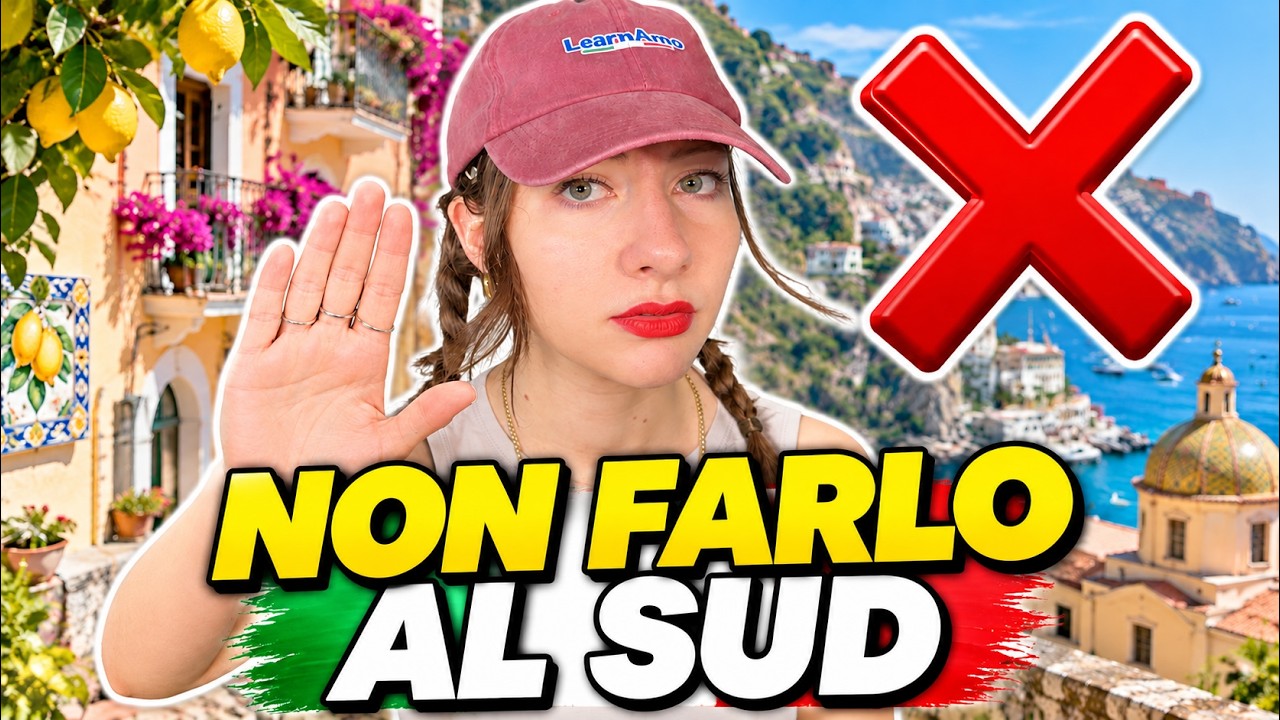
Don’t Do These Things in Southern Italy
Knowing Italian isn’t just about being understood: it’s about not making the other person feel offended or mistreated without realizing it. This is the hardest part of a language. The article is divided into four blocks: mistakes related to time (rhythms and schedules), mistakes at the table, mistakes related to people and places (respect, photos, way of speaking), and finally those related to travel (car and itineraries). To prepare better, you can review the essential Italian phrases for beginners in the dedicated guide.
Block 1: Mistakes Related to Time
The first block gathers mistakes related to the rhythms of life and schedules, which can seem foreign if you come from a different cultural context. In the South, time isn’t just a resource to optimize: it’s something to share.
Mistake 1. Always Being in a Hurry
The first mistake is wanting to do everything quickly. In many places in the South, the pace of life can seem more relaxed, especially in small towns and less touristy areas. It’s not laziness: it’s a different way of conceiving time. In Northern Europe, time is a resource to optimize; in many parts of Southern Italy, time is something to share.
Some concrete examples: you walk into a bar and the barista, before serving you, finishes the conversation with the gentleman next to you. He’s not ignoring you: he’s finishing something he started. You sit down at the restaurant and twenty minutes pass before the first course arrives: it’s normal, food is cooked to order.
The Bill Doesn’t Come on Its Own
The most important thing of all, the one that throws practically every foreign tourist into crisis: the bill doesn’t come on its own. In Italy the waiter will never bring you the bill if you don’t ask for it, because bringing it would mean telling you “hai finito, adesso vai” [you’re done, now leave]. It would be rude. You can stay seated for half an hour chatting, and no one will kick you out. But when you want to leave, you have to say it: “Il conto, per favore!” [The bill, please!].
The phrases you’ll need:
- “Con calma!” [Take it easy!]
- “Non c’è fretta” [There’s no rush]
- “Prenditela comoda” [Take your time]
- “Il conto, per favore” [The bill, please] ← learn this by heart
- “Mo’ arrivo” [I’m coming now]. Mo’ comes from the Latin modo and in the South you’ll hear it constantly. Careful though: it can mean “in ten seconds” or “in twenty minutes”
Mistake 2. Expecting Everything to Always Be Open
Second mistake: taking it for granted that shops, museums, restaurants and services are open throughout the day. This is the mistake that ruins the most vacation afternoons by far, because you get there without suspecting anything: you leave the hotel at two thirty, full of enthusiasm, and find a closed city.
Many businesses, especially in smaller centers, follow the orario spezzato [split schedule]: they open in the morning, close for lunch and early afternoon, and reopen in the late afternoon. The most common traps:
- Churches: many close at noon and reopen around four. If you want to see a baroque interior, go in the morning
- Restaurants: the kitchen has precise hours. If you arrive at three in the afternoon hoping to have lunch, they’ll almost certainly tell you that “la cucina è chiusa” [the kitchen is closed]. And in the evening dinner is late: in many places in the South, restaurants open around eight
- Offices and banks: often work only in the morning
- Museums: watch out for the weekly closing day, which in Italy is very often Monday
- August: in the cities, many businesses close for vacation, sometimes for two or three weeks. You’ll see “Chiuso per ferie” [Closed for vacation] signs everywhere
La Controra: the Sacred Hours of the Afternoon
There’s a beautiful word for the central hours of the afternoon: in Puglia and other parts of the South they’re called la controra. It’s the moment when the sun beats down hard, the streets empty out, the shutters close and everyone rests. It’s almost a sacred ritual: if you phone someone or show up at their house during the controra, you’re committing a small cultural crime.
Useful words to know:
- Orario continuato [continuous hours] → open all day
- Orario spezzato [split hours] → with afternoon break
- Chiuso per turno [closed for shift] → the weekly day off
- Chiuso per ferie [closed for vacation] → closed for holidays
- La cucina è chiusa [the kitchen is closed] → you can no longer eat
- Su prenotazione [by reservation] → you have to call first
Block 2: Mistakes at the Table
Let’s move on to mistakes at the table, those related to choosing a restaurant and respecting traditional recipes. To deepen the specific vocabulary, you can consult the guide on words and expressions at the restaurant.
Mistake 3. Always Eating Near the Main Monuments
Third mistake: sitting down at the first restaurant in front of the most famous monument. A restaurant located in front of a famous monument isn’t necessarily bad: there are excellent ones. But it’s often designed mainly for tourists, and the logic is simple: when customers are people who pass through only once in their life, there’s no need for them to come back. Those who work with the neighborhood locals, on the other hand, have to earn them every day.
How to Recognize a Tourist Trap
The signs of a place designed for tourists: the menu is translated into eight languages and has photos of the dishes; there’s a sign with the words “menù turistico” [tourist menu] at a fixed price; the place is open non-stop from eleven in the morning to midnight (meaning: no one in there is cooking to order); and outside there’s a gentleman inviting you in very insistently.
That gentleman, in Italian, has a beautiful name: he’s called buttadentro [literally “the one who throws you in”]. Yes, exactly the opposite of the buttafuori, the one who throws people out of nightclubs.
The signs of a good place: the menu is short (sometimes handwritten or on a chalkboard) and changes often, a sign that di stagione [in-season] products are used; it’s full of gente del posto [locals]; and no one chases you down the street.
Coperto and Pesce all’Etto: Two Things to Know
The coperto [cover charge]: in many Italian restaurants you’ll find a small amount per person at the bottom of the bill. It’s a normal and legal item, and it must be indicated on the menu. It’s not a scam and it’s not the tip.
The pesce all’etto [fish per hundred grams]: in many seaside trattorias, fresh fish is paid for by weight, and on the menu you’ll see “all’etto”, meaning per hundred grams. If the waiter shows you a beautiful fish and you just say “sì, bello!” [yes, beautiful!], you might end up with a surprising bill. The magic question is: “Quanto viene più o meno?” [How much does it come to, more or less?]. Asking the price beforehand isn’t rude: it’s completely normal.
The right phrases to use:
- “Qual è la specialità della casa?” [What’s the house specialty?]
- “Che cosa mi consiglia?” [What do you recommend?]
- “Vorrei un piatto tipico di qui” [I’d like a typical local dish]
- “Quanto viene più o meno?” [How much does it come to, more or less?]
- “Si mangia bene qui?” [Is the food good here?] ← perfect to ask a passerby on the street
Mistake 4. Asking to Completely Modify Traditional Dishes
Fourth mistake. Here there’s an important difference that’s often confused. Asking for information about ingredients is absolutely normal, especially in the case of allergies, intolerances or dietary needs. It’s not only accepted: in Europe, restaurants are required to know which allergens their dishes contain. So do ask, always, without any embarrassment. No Italian cook will ever be offended because you want to avoid an allergic reaction.
The problem arises when you want to completely transform a traditional recipe: orecchiette with turnip tops without turnip tops, eggplant parmigiana without eggplant, spaghetti alle vongole with chicken. In Italy, a traditional recipe isn’t perceived as a modifiable list of ingredients, but as something that has arrived there through generations. Asking to overturn it sounds a bit like asking to rewrite a poem because we don’t like one word.
There’s also another type of request that raises eyebrows: grated cheese on fish dishes. In Italy it’s not done, and in many kitchens it’s almost a taboo. You can ask, but be prepared for silence.
How an Italian Menu Works
Many foreigners order a first course and expect it to come with a side dish, like a single-plate meal. It doesn’t work that way. The menu is divided into antipasto [appetizer], primo [first course] (pasta, risotto, soup), secondo [main course] (meat or fish) and contorno [side dish] (vegetables, ordered separately). You’re not obliged to order everything: you can perfectly well order just a first course, or just a main with a side. But knowing how it’s organized saves you surprises.
The legitimate questions you can ask without hesitation:
- “Sono allergico/a a…” [I’m allergic to…]
- “Contiene glutine? Contiene frutta secca?” [Does it contain gluten? Does it contain nuts?]
- “Avete un’alternativa senza…?” [Do you have an alternative without…?]
- “C’è qualche piatto vegetariano?” [Is there any vegetarian dish?]
Beware of Only Apparently Vegetarian Dishes
The cuisine of the South is historically a cucina povera [poor cuisine], born from simple and available ingredients (bread, vegetables, legumes, tomato, oil) because for centuries meat was a rare luxury. The result is that there are many extraordinary dishes based on vegetables and legumes. But many seem vegetarian and aren’t, because they contain acciughe [anchovies], sugna [pork lard] or meat broth. So the really useful question isn’t “is it vegetarian?”, but:
- “Ci sono acciughe dentro?” [Are there anchovies in it?]
- “È fatto con la sugna o con l’olio?” [Is it made with lard or with oil?]
And the cappuccino after lunch? You can order it, no one will arrest you. But be prepared for a puzzled look.
Black Friday at LearnAmo
Discounts and gifts until November 30.
Block 3: Mistakes Related to People and Places
This is the most important part, because it concerns respect for people and places. The unwritten rules count as much as the written ones, and knowing them makes the difference between feeling like tourists or being welcomed as guests.
Mistake 5. Entering a Church Dressed for the Beach
Fifth mistake: entering a church dressed as if you had just come out of the water. The churches of Southern Italy are often just steps from the sea, so the temptation is understandable: you're walking in a swimsuit, you see a beautiful portal, you enter. But there's something fundamental to understand: those are not tourist attractions. They are active places of worship, where at that precise moment there may be someone praying, a funeral, a wedding. The fact that they're free and open doesn't make them museums.
Avoid entering in a bathing suit, shirtless or with excessively revealing clothing. The basic rule is simple and applies throughout Italy: covered shoulders and covered knees. Take off your hat, speak softly and don't use flash when it's prohibited.
If there's a service in progress, you can enter silently, staying at the back, without crossing the central nave and without photographing the people who are praying. Or, the more elegant choice, come back later. Practical tip: always keep a light scarf or a pareo in your backpack. It takes up very little space and saves your visit.
The Feste Patronali: a Spectacle to Respect
During the feste patronali [patron saint festivals], meaning the feasts dedicated to the town's protector saint, the churches become the absolute center of city life: processions, marching bands, illuminations, enormous crowds. It's one of the most beautiful spectacles you can see in Southern Italy, but it's something deeply felt, not a performance for tourists. Watch, participate, be moved, but don't get in the middle of the procession to make a better video.
The signs you'll find:
- Vietato l'ingresso con abbigliamento non consono [Entry with inappropriate clothing prohibited]
- Silenzio, luogo sacro [Silence, sacred place]
- Vietato l'uso del flash [Flash prohibited]
- Celebrazione in corso [Service in progress] → there's a Mass
- Zona riservata alla preghiera [Area reserved for prayer]
Mistake 6. Photographing People Without Asking
Sixth mistake: taking photos of people without asking permission. Markets, patron saint festivals and streets of historic centers are very evocative: the light, the colors, the faces. But people are not decorative elements, they don't belong to the urban furnishings.
Before taking a close-up of a vendor, a fisherman, an artisan or an elderly person sitting in front of the house, ask for permission. And there's a situation where this becomes even more important: in many cities of the South (Naples is the most famous example, with its bassi) the ground-floor houses have doors that open directly onto the street, and often stay open. From outside you can see the inside: the kitchen, the bed, the TV on. Photographing in there means photographing someone's home. That the door is open is not an invitation.
Same goes for children: you don't photograph other people's children, ever, in any country.
How to ask for permission:
- "Scusi, posso farLe una foto?" [Excuse me, may I take your photo?]
- "Le dispiace se faccio una foto?" [Do you mind if I take a photo?]
- After: "Grazie mille, gentilissimo!" [Thank you so much, you're very kind!]
Fundamental note: you use the Lei. With a stranger, and especially with an elderly person, using the informal "tu" is a slip that gets noticed immediately. To deepen the difference, you can consult the guide on when to use the formal Lei in Italian.
In most cases the answer will be an enthusiastic "Certo!" [Of course!], accompanied by a pose, a smile and (if you're lucky) a free taste of something. In the South there's an ospitalità [hospitality] that activates only if you take the first step. Asking for permission doesn't close a door for you: it opens ten.
Mistake 7. Making Fun of the Accent or Dialect
Seventh mistake: imitating the accent in a caricatural way. You can perfectly well show curiosity and ask the meaning of a word: on the contrary, it's something people love. The problem is another: it's the funny voice, it's repeating the phrase exaggerating the vowels to make friends laugh, it's the TikTok video with the funny caption.
Often there's no malice, but try to flip the situation: imagine someone imitating your accent while you speak Italian. It's not so funny anymore. A respectful attitude is instead this:
- "Questa espressione è italiana o dialettale?" [Is this expression Italian or dialectal?]
- "Che cosa significa esattamente?" [What does it mean exactly?]
- "Me lo può ripetere? Voglio impararlo!" [Can you repeat it? I want to learn it!]
Ask this question and something almost guaranteed will happen: the person will explain the word to you, then teach you three more, then call a friend to hear how you pronounce it. You'll become the project of the day.
Italian Dialects Are Not Poorly Spoken Italian
There's a serious reason behind all this. The dialetti italiani [Italian dialects] are not "poorly spoken Italian": they are varieties with an autonomous history, born directly from Latin, in parallel with Florentine from which standard Italian comes. For many elderly people, dialect isn't a stylistic choice: it's the language in which they think, in which they learned the names of things, in which their mother called them. Laughing at it touches something deep.
So much so that UNESCO has included about thirty languages and dialects of Italy (including Neapolitan-Calabrian and Sicilian) in its Atlas of the World's Languages in Danger. Beware of an Italian fake news: you'll often read online that "Neapolitan is UNESCO world heritage". It's not true, it's a hoax. UNESCO has classified it as vulnerable, meaning to be protected. Which is very different, and if you think about it, much more serious.
Mistake 8. Calling Everything "Mafia"
Eighth mistake, perhaps the most important of all. Making jokes about the mafia, about crime or about other stereotypes can be deeply offensive. Arriving in Sicily and saying "ah, il padrino!" [ah, The Godfather!] while making the gun gesture isn't funny: it's banal, and it's a joke made in front of people who have actually lived with that phenomenon.
For those who live in those territories, the mafia isn't a film genre. It's something that killed real people, that conditioned economies, that caused entire generations to emigrate. In 1992, within two months, Sicily lost two magistrates, Giovanni Falcone and Paolo Borsellino, killed together with the agents who protected them. Those massacres are still, for many Italians, an open wound.
The Beautiful Part Almost No Tourist Knows
Since 1996 there's been an Italian law that allows confiscating assets from the mafias and returning them to the community: today on those lands there are agricultural cooperatives, agriturismos, businesses run by young people. An association born in Palermo in 2004, Addiopizzo, has created a network of merchants who publicly refuse to pay the pizzo [protection money], and provides a map of the participating shops. You can literally choose where to do your shopping. The Godfather joke is fifty years old. This, on the other hand, is happening now.
The South Doesn't Need to Be Defended, but to Be Known
Some of the best-preserved Doric temples in the world are not in Greece: they're in Italy, in Agrigento and in Paestum. Agrigento itself was the Italian Capital of Culture in 2025. In Matera, the Sassi have been a UNESCO World Heritage Site since 1993 (the first site inscribed in all of Southern Italy) and preserve traces of continuous human presence from the Paleolithic to today. In 2019 Matera was European Capital of Culture.
In Reggio Calabria there are the Riace Bronzes, two absolute masterpieces of Greek sculpture. In Caserta there's the largest royal palace in the world by volume: over two million cubic meters. And then there are Pompeii and Herculaneum, which need no explanation.
If someone tells you that in the South "non si parla bene italiano" [they don't speak Italian well], remind them that the sonetto [sonnet] (yes, that poetic form that Shakespeare would also use) was born in Sicily, at the court of Federico II, in the first half of the 13th century. The Scuola Siciliana [Sicilian School] is considered the starting point of Italian literature. The South doesn't need to be defended: it just needs to be known.
Block 4: Mistakes Related to Travel
The last block concerns practical travel mistakes: the car and the choice of itinerary. Small details that can cost a lot in terms of money (fines) and quality of the experience (crowds, queues, disappointments).
Mistake 9. Driving into Historic Centers Without Checking
Ninth mistake. And here's the one that costs you more than one hundred euros. Many Italian cities have a ZTL, meaning a Zona a Traffico Limitato [Limited Traffic Zone]. Access may be prohibited on certain days or hours, and control almost always happens through cameras placed at the entrances. Foreign tourists also have to respect these restrictions: the camera doesn't distinguish nationalities.
And now the painful part, the one almost no one knows: each entry is a separate fine. If you enter in the morning, exit, and re-enter in the afternoon, that's two fines. If you pass in front of the same camera five times desperately looking for parking, that's five fines. There's no daily limit.
Beware of the GPS
Don't blindly follow the GPS. It just wants to get you there quickly, and it can perfectly well direct you down a road that crosses a ZTL. It doesn't pay the fine: you do. When you see that the GPS is taking you straight to the historic center, stop and check.
Two fundamental tips: if your hotel or B&B is inside the ZTL, don't improvise: write or call before leaving and ask how to proceed. In many cases the property can communicate your license plate to the Municipality to authorize entry. But it must be done before, not after. If you have a rental car, know that the Municipality will contact the agency, the agency will give your data and will also charge you a commission for the trouble.
The Signs to Recognize and the Colors of the Lines
- ZTL — Zona a Traffico Limitato [Limited Traffic Zone]
- Varco attivo [Active gate] → the camera is working: DO NOT enter
- Varco non attivo [Inactive gate] → you can pass
- Eccetto residenti / autorizzati [Except residents / authorized]
- Divieto di sosta [No parking] → you can't leave the car and walk away
- Divieto di fermata [No stopping] → you can't stop even for a second
- Passo carrabile [Driveway] → never park in front!
It's also useful to know that strisce blu [blue lines] indicate paid parking, bianche [white ones] free parking, gialle [yellow ones] reserved parking.
The fine doesn't arrive immediately: the Codice della Strada [Italian Highway Code] gives the authorities 90 days to notify those residing in Italy, but as many as 360 days for those residing abroad. Practically a year of suspense. The advice is simple: leave the car in a parking lot outside the center and walk. The historic centers of the South are made of narrow alleys, staircases and little squares: they're meant to be visited on foot, they were born for this.
Mistake 10. Visiting Only the Famous Places
Tenth and last mistake: following an itinerary that's too crowded. Naples, Capri, Positano, Alberobello, Matera and Taormina are beautiful. But Southern Italy doesn't end in the most famous Instagram photos. And there's a practical problem, in addition to a cultural one: in August, in those places, you'll queue for everything. Queue for the ferry, queue for the restaurant, queue to take the photo in the exact spot everyone else has taken it.
The mistake is ignoring small towns, the aree interne [inland areas], natural parks and lesser-known places, which are often the most authentic, the cheapest and the least crowded.
Ideas for Getting off the Tourist Trail
- Cilento, in Campania, for a spectacular sea with much fewer crowds
- The Gargano hinterland, in Puglia: the Foresta Umbra and Monte Sant'Angelo
- The villages of Basilicata, like Castelmezzano and Pietrapertosa, nestled among the Lucanian Dolomites
- The Val di Noto, in Sicily, with its baroque, UNESCO heritage since 2002
- The Pollino, the largest national park in Italy, straddling Calabria and Basilicata
- Molise, which according to a famous Italian meme "doesn't exist": go verify in person
Three Practical Tips for Traveling Differently
Change the month, not just the place. May, June and September in Southern Italy have perfect weather, much lower prices and no crowds. In August the Italians themselves travel, and it's the worst time.
Look for the sagre. If you come across a sagra [local food festival], stop: it's a village festival dedicated to a typical product, you eat very well, you spend very little and you get to know the real Italy. It's not organized for tourists, and that's exactly why you should go.
In the inland areas you need a car. Trains in the South connect coastal cities well, but to reach mountain villages and parks, public transportation is scarce. Organize in advance.
The words you'll need:
- Un borgo [a small village] → a small, ancient and characteristic town
- L'entroterra [the hinterland] → the inland area, far from the coast
- Fuori dai circuiti turistici [off the tourist trail] → far from mass destinations
- Una sagra [a local food festival] → a village festival dedicated to a typical product
Summary Table of the 10 Mistakes
A summary of all 10 mistakes divided by block, with the keyword to remember, perfect for quick reference:
| Block | Mistake | Keyword |
|---|---|---|
| Time | Always being in a hurry | Il conto, per favore [The bill, please] |
| Time | Expecting everything always open | Orario spezzato / Controra |
| At the table | Eating near monuments | Buttadentro / Coperto |
| At the table | Modifying traditional dishes | Cucina povera / Sugna |
| People and places | Entering church in swimwear | Covered shoulders and knees |
| People and places | Photographing without asking | Scusi, posso farLe una foto? [May I take your photo?] |
| People and places | Making fun of the dialect | Italiano o dialettale? [Italian or dialectal?] |
| People and places | Calling everything "mafia" | Falcone, Borsellino, Addiopizzo |
| Travel | Entering ZTL without checking | Varco attivo [Active gate] |
| Travel | Visiting only famous places | Borgo / Entroterra / Sagra |
Frequently Asked Questions
Why in Italy Does the Waiter Never Bring the Bill?
Because bringing it without you having asked for it would mean saying "hai finito, adesso vai" [you're done, now leave], and it would be considered rude. In Italy, a restaurant meal is a social moment that shouldn't have an imposed deadline: you can stay seated chatting for two hours after coffee, and no one will ever kick you out. When you want to leave, however, you have to be the one to ask for the bill with the phrase "Il conto, per favore!" [The bill, please!]. It's an important cultural rule to know: if you wait for it to come on its own, you could remain seated until night.
What Is the Controra and Why Is It Important to Respect It?
The controra is the name that in Puglia and other parts of the South is given to the central hours of the afternoon (usually between 1 pm and 5 pm), when the sun beats down hard, the streets empty, the shutters close and everyone rests. It's not a simple break: it's a cultural ritual deeply rooted in life in the South. Calling someone or showing up at their house during the controra is considered a small cultural crime, a bit like calling someone at three in the morning in the North.
What Is the ZTL and How Do I Avoid the Fines?
The ZTL is the Zona a Traffico Limitato [Limited Traffic Zone], an area of the historic center where access by car is prohibited on certain days or hours. Control happens through cameras at the entrances, and each passage is a separate fine: there's no daily limit. To avoid fines: (1) don't blindly follow the GPS, which can take you straight into a ZTL; (2) if your hotel is inside the ZTL, contact them first and ask how to authorize your license plate; (3) always read the "Varco attivo" [Active gate] (don't enter) and "Varco non attivo" [Inactive gate] (you can pass) signs; (4) if possible, leave the car in a parking lot outside the center and walk. For those residing abroad, the fine arrives up to 360 days after the fact.
Are Italian Dialects Just a Way of Speaking Italian Poorly?
Absolutely not. The dialetti italiani [Italian dialects] are not incorrect variants of standard Italian: they are autonomous linguistic varieties, born directly from Latin, parallel to Florentine from which standard Italian developed. Neapolitan, Sicilian, Venetian and the others have their own history, their own literature (just think of the Scuola Siciliana [Sicilian School] of the 13th century, considered the origin of Italian literature), their own grammatical system. UNESCO has included about thirty languages and dialects of Italy in its Atlas of the World's Languages in Danger, classifying them as vulnerable. Making fun of a dialect means not recognizing its historical and linguistic dignity.
Which Places in Southern Italy Are Less Touristy but Still Beautiful?
Southern Italy is full of wonderful places far from mass destinations. Some ideas: Cilento in Campania (spectacular sea and much fewer crowds than Capri or Positano); the Gargano hinterland in Puglia, with the Foresta Umbra and Monte Sant'Angelo; the villages of Basilicata like Castelmezzano and Pietrapertosa, nestled among the Lucanian Dolomites; the Val di Noto in Sicily, UNESCO heritage for its baroque; the Pollino, Italy's largest national park between Calabria and Basilicata; and Molise, star of the famous meme "il Molise non esiste" [Molise doesn't exist]. Practical tip: avoid August (Italians travel too and it's the worst month) and look for sagre [local food festivals], village festivals dedicated to a typical product where you eat very well while spending little.
Want the lesson PDF with exercises and solutions?
Join the LearnAmo AcademyLoading the quiz...
Podcast: Play in new window | Download (Duration: 35:24 — 48.6MB)
Iscriviti: Apple Podcasts | Spotify | Android | iHeartRadio | Podcast Index | TuneIn | Deezer | RSS | Altri...