


Has it ever happened to you to be sick in Italy and not know how to explain it to a doctor or the pharmacist? Maybe you pointed at your stomach with a suffering face, hoping they’d figure it out on their own… and walked out with a cough syrup. Expressing pain, symptoms and minor accidents in Italian requires precise structures: in this guide you’ll find all the fundamental expressions, from the two basic constructions (“mi fa male” [it hurts me] and “ho mal di” [I have pain in]) to the reflexive verbs for injuries, through the vocabulary to get by at the doctor’s office and the pharmacy.
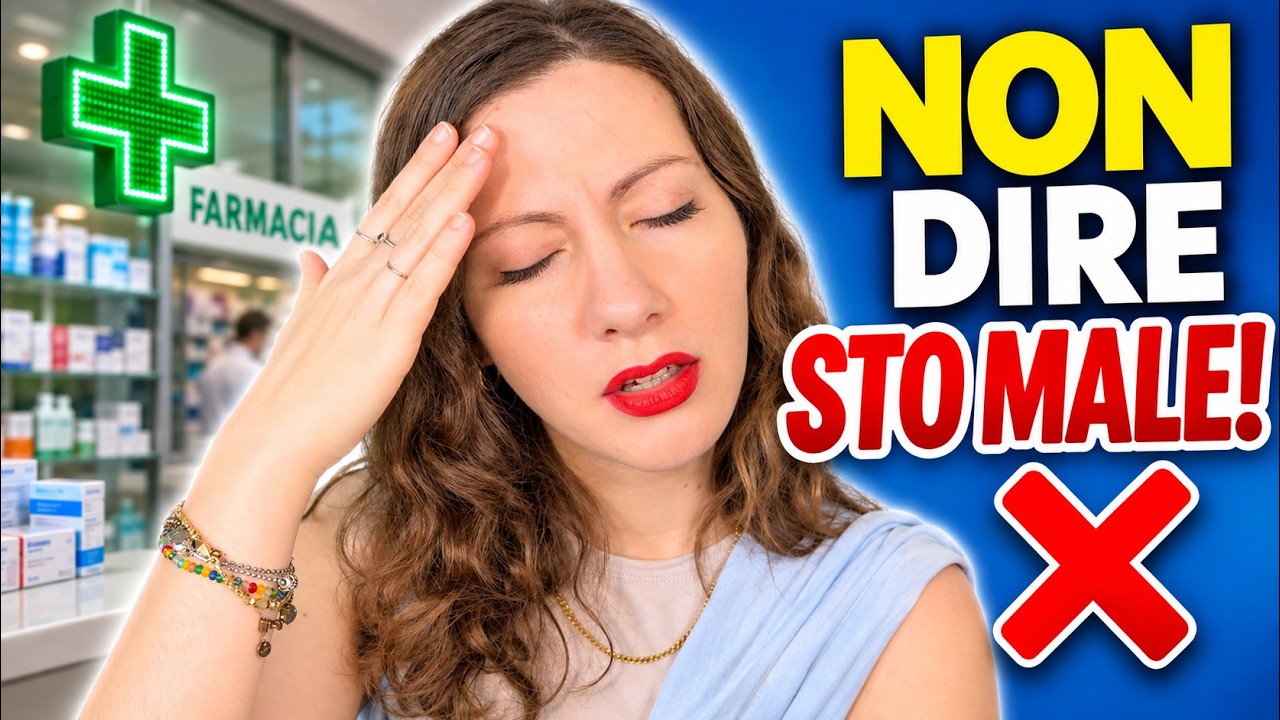
How to Describe a Physical Problem in Italian (Pain, Symptoms, Ailments…)
Talking about health is one of those things you don’t learn in the first months of studying, but which becomes indispensable the first time you get a headache while traveling. Italians, moreover, have an extraordinarily rich vocabulary to tell how they feel: they distinguish a thousand nuances of pain, have specific names for every ailment and some cultural beliefs worth knowing. To go deeper into the parts of the human body, you’ll find everything in the vocabulary of the human body in Italian.
The Two Fundamental Structures: Mi Fa Male and Ho Mal Di
When you need to say that a part of your body hurts, in Italian there are mainly two constructions: “mi fa male + article + part of the body” and “ho mal di + part of the body”. Both are perfectly correct and used all the time, but they have different grammar rules worth knowing well.
The “Mi Fa Male” Structure
The most widely used structure is mi fa male + article + part of the body. Some examples:
- “Mi fa male la testa.” [My head hurts.]
- “Mi fa male lo stomaco.” [My stomach hurts.]
- “Mi fa male il ginocchio.” [My knee hurts.]
The verb fare male [to hurt] works exactly like the verb piacere: the part of the body is the grammatical subject of the sentence, not the person feeling the pain. This has two important consequences worth looking at separately.
Agreement with the Body Part
The verb agrees with the part of the body, not with the person. If the part of the body is plural, the verb becomes plural:
- Mi fa male il piede → “Mi fanno male i piedi.” [My feet hurt.]
- Mi fa male l’occhio → “Mi fanno male gli occhi.” [My eyes hurt.]
- “Dopo la palestra mi fanno male le gambe.” [After the gym my legs hurt.]
It’s the same mechanism of “mi piace la pizza” but “mi piacciono gli spaghetti”.
Pronouns Change with the Person
The indirect pronoun in front of the verb changes based on who feels the pain. Here’s the complete scheme:
| Pronoun | Person | Example |
|---|---|---|
| Mi | to me | “Mi fa male la schiena.” |
| Ti | to you | “Ti fa male la schiena?” |
| Gli | to him | “Gli fa male la schiena.” |
| Le | to her (or to You, formal) | “Le fa male la schiena.” |
| Ci | to us | “Ci fa male la schiena.” |
| Vi | to you (plural) | “Vi fa male la schiena?” |
| Gli | to them | “Gli fa male la schiena.” |
To emphasize the intensity of the pain, you can add “da morire” [to die for] or “tantissimo” [a lot]: “Mi fa male la testa da morire!” [My head is killing me!]. Nobody actually dies, of course: it’s just a way to underline the gravity. Italians, in these expressions, tend to be a bit dramatic.
The “Ho Mal Di” Structure
The second structure, very common in speech, is ho mal di + part of the body, without article. It’s used especially with a limited number of body parts:
- “Ho mal di testa.” [I have a headache.]
- “Ho mal di pancia.” [I have a stomach ache.]
- “Ho mal di gola.” [I have a sore throat.]
- “Ho mal di denti.” [I have a toothache.]
- “Ho mal di schiena.” [I have a backache.]
- “Ho mal di stomaco.” [I have stomach pain.]
- “Ho mal d’orecchi” (or “mal d’orecchie”) [I have an earache.]
- “Ho mal di piedi.” [My feet hurt.] (after a day walking around Rome, a classic!)
Notice a small spelling particularity: you say “mal” and not “male”, because the final -e drops before the preposition di. And it’s absolutely excluded to say “ho mal di la testa”: after di you never put the article.
Curiosity: there are also mal di mare [seasickness], mal d’auto [car sickness] and mal d’aria [airsickness], that is, the nausea felt traveling by boat, car or plane. And then there’s mal d’amore [lovesickness], which unfortunately isn’t cured in the pharmacy.
Mi Fa Male or Ho Mal Di? What’s the Difference
In terms of meaning, there’s practically no difference: the two structures are interchangeable with the body parts listed above. The difference is in usage: “ho mal di” is typical especially with that restricted group of body parts (testa, pancia, gola, denti, schiena, stomaco, orecchi, piedi).
With other body parts — like ginocchio [knee], gomito [elbow], spalla [shoulder] or polso [wrist] — it’s much more natural to use “mi fa male il ginocchio”, or “ho male al ginocchio”, with the articulated preposition. The absolute mistake to avoid is mixing the two constructions:
- “Mi fa mal di testa.” (incorrect, mixes the two structures)
- “Mi fa male la testa.” or “Ho mal di testa.” [My head hurts.]
The Noun Dolore to Be More Precise
When you need to be more precise — especially when speaking with a doctor — the noun dolore [pain] is used:
- “Ho un dolore al petto.” [I have a pain in my chest.]
- “Sento un dolore forte alla spalla.” [I feel a strong pain in my shoulder.]
- “È un dolore acuto / sordo / continuo / che va e viene.” [It’s a sharp / dull / continuous / on and off pain.]
The verb dolere also exists (“mi duole il capo”), but is of very literary register: using it at the doctor’s would sound like coming out of a 19th-century novel.
The Most Common Symptoms: Febbre, Tosse and Raffreddore
The vocabulary of symptoms is rich and largely built with the structure avere + article + symptom. Knowing these terms is indispensable to explain how one feels, both in informal conversation and at the doctor’s.
Expressions with the Verb Avere
Many symptoms are expressed with the verb avere followed by the definite article:
- “Ho la febbre.” [I have a fever.]
- “Ho la tosse.” [I have a cough.]
- “Ho il raffreddore.” [I have a cold.]
- “Ho l’influenza.” [I have the flu.]
- “Ho la nausea.” [I have nausea.]
- “Ho i brividi.” [I have chills.]
- “Ho il naso chiuso” / “Mi cola il naso.” [I have a stuffy nose / My nose is running.]
- “Ho la diarrea.” [I have diarrhea.]
- “Ho le vertigini”, or “mi gira la testa.” [I feel dizzy / My head is spinning.]
- “Ho i crampi” / “Ho un crampo al polpaccio.” [I have cramps / I have a cramp in my calf.]
Other Useful Expressions on Symptoms
Some less obvious but really useful expressions to know:
- “Mi prude il braccio” / “Ho prurito.” [My arm itches / I have an itch.] (when something itches, you want to grattarsi [scratch yourself])
- “Ho bruciore di stomaco.” [I have heartburn.]
- “Ho perso la voce” / “Ho la voce rauca.” [I’ve lost my voice / I have a hoarse voice.]
- “Faccio fatica a respirare.” [I’m having trouble breathing.] (a sentence that can make the difference at the doctor’s)
- “Sono allergico/a a…”: “Sono allergico alla penicillina”, “sono allergica ai gatti.” [I’m allergic to penicillin, to cats.]
And some more general formulas to simply say that you’re not feeling well:
- “Sto male” / “Non sto bene.” [I feel sick / I’m not well.]
- “Non mi sento bene” / “Mi sento poco bene.” [I don’t feel well.]
- “Mi sento debole.” [I feel weak.]
- “Sono stanco morto” / “Sono a pezzi.” [I’m dead tired / I’m wiped out.]
- “Ho la pressione bassa.” [I have low blood pressure.]
- “Ho preso freddo.” [I caught a chill.]
- “Sono raffreddato/a.” [I have a cold.] (very common alternative to “ho il raffreddore”)
The Verbs of Health
Some recurring verbs in the vocabulary of health deserve particular attention:
- Ammalarsi [to get sick]: “Mi sono ammalato proprio il giorno della festa!” [I got sick right on the day of the party!]
- Guarire [to heal / to get better]: “Sono guarito in tre giorni.” [I got better in three days.]
- Misurarsi la febbre [to take one’s temperature]: with the termometro.
- Tossire [to cough]: “io tossisco” (verb in -isc-, like finire).
- Starnutire [to sneeze]: “io starnutisco.”
- Vomitare [to vomit]: no further explanations needed.
Cultural note: when someone sneezes, in Italy you say “Salute!” [Bless you!], and the person who sneezed replies “Grazie!”.
Curiosity: Italians’ Obsessions about Health
Understanding how Italians talk about health also means knowing some very widespread beliefs that aren’t found in grammar books. They are cultural convictions that resist from generation to generation and resurface in every conversation about health, especially when parents or grandmothers are present.
The 37-Degree Fever
For many Italians, especially for men, 37 degrees is already a national tragedy. There’s even a specific expression, “ho qualche linea di febbre” [I have a slight fever], which indicates a temperature slightly higher than normal. Some, with 37.2, go to bed and prepare for the worst.
La Cervicale
If you live in Italy, you’ll often hear “Mi fa male la cervicale”. Technically, cervicale is a part of the vertebral column, in the neck, but in everyday use it has become a real disease in its own right, considered responsible for headaches, dizziness, nausea and a wide range of different symptoms.
Il Colpo d’Aria
The number one enemy of Italian health is the draft. Going out with wet hair, sleeping with air conditioning on, or staying near an open window are all behaviors considered dangerous: they would cause the colpo d’aria [draft blow], from which derive the torcicollo [stiff neck] or the infamous cervicale.
The Swim after Eating
Any child raised in Italy has heard at least one grandmother repeat the phrase: “Non fare il bagno! Hai appena mangiato! Devi aspettare tre ore!” [Don’t go for a swim! You just ate! You have to wait three hours!]. Doctors argue that it’s more a tradition than a scientific rule, but the conviction remains deeply rooted.
Il Colpo della Strega
When you bend down to pick something up from the ground and suddenly feel a very strong pain in your back, in Italian you say you’ve taken the colpo della strega [witch’s blow]. It has nothing to do with magic: it’s an acute lumbago, but the popular name perfectly captures the sensation.
Stop reading Italian.
Start speaking it.
Online lessons in groups of 4, organised by level and goals, with qualified teachers. Pick the day and time that suit you from the available slots.
Max 4 students:
there’s a seat for you
Accidents and Injuries: Reflexive Verbs in the Past
To tell about an accident — a fall, a burn, a sprain — in Italian you mainly use reflexive verbs. It’s a category that follows precise rules, with some typical traps for those coming from other languages.
The Most Common Expressions for Accidents
Here are the most frequent constructions when talking about minor injuries:
- “Mi sono rotto/a il braccio / la gamba / un dito.” [I broke my arm / leg / finger.]
- “Mi sono slogato/a la caviglia / il polso.” [I dislocated my ankle / wrist.]
- “Mi sono storto/a la caviglia”, or “ho preso una storta.” [I twisted my ankle.]
- “Mi sono fatto/a male al ginocchio / alla mano.” [I hurt my knee / hand.]
- “Mi sono tagliato/a il dito.” [I cut my finger.]
- “Mi sono bruciato/a la mano.” [I burned my hand.]
- “Mi sono stirato/a un muscolo.” [I pulled a muscle.]
- “Mi sono scottato/a al sole.” [I got sunburned.] (the red and painful skin is called scottatura)
And some expressions with the verb avere or other verbs:
- “Ho sbattuto la testa contro la porta.” [I hit my head against the door.]
- “Sono caduto/a dalle scale / dalla bici.” [I fell down the stairs / off my bike.]
- “Ho un livido sul braccio.” [I have a bruise on my arm.] (the purple mark that appears after a hit)
- “Mi è venuto un bernoccolo in testa.” [I got a bump on my head.] (the small lump after a hit)
- “Mi ha punto una zanzara / un’ape.” [A mosquito / bee stung me.]
If the injury is serious, you could end up ingessato [in a cast] (with the gesso [cast]) or con i punti [with stitches], in case the doctor has to close a cut with a small suture.
The Three Fundamental Rules of Reflexive Verbs
To correctly use these constructions in the past, there are three rules worth fixing well.
1. The Auxiliary is Always Essere
With reflexive verbs, in the passato prossimo [present perfect] the auxiliary essere is used, not avere:
- “Ho rotto la gamba.” (incorrect when talking about ourselves)
- “Mi sono rotto la gamba.” [I broke my leg.]
Watch out: “ho rotto” is used, but only referring to objects (“ho rotto il bicchiere” [I broke the glass]). When the action falls on a part of our body, the verb is reflexive and wants essere.
2. The Participle Agrees with the Subject
The past participle agrees in gender and number with the person who suffered the accident:
- “Marco si è rotto il braccio.” [Marco broke his arm.]
- “Giulia si è rotta il braccio.” [Giulia broke her arm.]
- “I ragazzi si sono rotti il naso giocando a calcio.” [The boys broke their noses playing soccer.]
3. No Possessive Adjective
It’s the most common mistake for those coming from English. The sentence “I broke my arm” doesn’t translate into Italian as “mi sono rotto il mio braccio”, but simply as “mi sono rotto il braccio”. The reflexive pronoun mi already indicates that the arm belongs to the speaker, so adding the possessive is superfluous:
- “Mi sono rotto il mio braccio.”
- “Mi sono rotto il braccio.” [I broke my arm.]
The same principle applies to fare male: you say “mi fa male la testa”, not “mi fa male la mia testa”.
Mi Fa Male or Mi Sono Fatto Male? The Key Difference
Two similar expressions but with different meanings worth distinguishing carefully:
- Mi fa male describes a current pain: “Mi fa male il piede.” [My foot hurts.] (I feel it now)
- Mi sono fatto male tells about a past accident: “Mi sono fatto male al piede.” [I hurt my foot.] (it happened before)
The two expressions can comfortably coexist in the same sentence: “Ieri mi sono fatto male al piede e oggi mi fa ancora male.” [Yesterday I hurt my foot and today it still hurts.]
At the Doctor’s Office and at the Pharmacy
In Italy, for non-urgent health problems, you go to the medico di base (or medico di famiglia) [family doctor]. At night and on weekends there’s the guardia medica [out-of-hours medical service], and for real emergencies you go to the pronto soccorso [emergency room] or call 112, the single emergency number.
The Doctor’s Questions
In the office, the doctor almost always uses the formal “Lei”. Here are the most frequent questions you might receive:
- “Cosa si sente?” / “Che disturbi ha?” [What are you feeling? / What symptoms do you have?]
- “Dove Le fa male?” [Where does it hurt?]
- “Da quanto tempo ha questi sintomi?” [How long have you had these symptoms?]
- “Ha la febbre?” [Do you have a fever?]
- “È allergico a qualche farmaco?” [Are you allergic to any medication?]
The Vocabulary of Drugs and Remedies
Some fundamental terms often heard at the doctor’s and at the pharmacy:
- La ricetta [the prescription]: the doctor’s document needed to buy certain medicines.
- L’antibiotico, l’antinfiammatorio, l’antidolorifico: the main categories of medicines.
- Lo sciroppo, le compresse (or pastiglie), le gocce, la pomata: the different formulations of medicines.
- Il cerotto [band-aid] and la benda [bandage]: to treat small wounds.
Watch out for a classic false friend: in Italian the word ricetta indicates both the medical prescription and the cooking recipe. An Italian uses the same word for “la ricetta della nonna per la pasta al forno” and for “la ricetta del medico per l’antibiotico”.
A typical sentence you might hear at the doctor’s: “Prenda una compressa due volte al giorno, dopo i pasti.” [Take one tablet twice a day, after meals.] At the pharmacy, instead, it’s enough to explain the problem to receive advice: “Buongiorno, ho mal di gola da tre giorni. Cosa mi consiglia?” [Good morning, I’ve had a sore throat for three days. What do you recommend?]. The pharmacist, in Italy, is an important reference figure, often able to give targeted advice like a small neighborhood doctor.
Curiosity: la Tachipirina
Those who live in Italy sooner or later come across a word that isn’t officially Italian, but is used as if it were: Tachipirina. It’s the commercial name of the most widespread paracetamolo [paracetamol/acetaminophen] in Italy, but Italians use it almost as a common name, a synonym for the medicine itself. “Hai mal di testa? Prendi una Tachipirina.” [Have a headache? Take a Tachipirina.] “Hai la febbre? Prendi una Tachipirina.” “Ti sei lasciato con il fidanzato? Prendi una Tachipirina.”
For those coming from abroad, the practical information is simple: at the pharmacy, asking for “una Tachipirina” is the most immediate way to get paracetamol, and everyone will immediately understand what you mean.
Idiomatic Expressions about Health
Alongside technical vocabulary there is a rich repertoire of idiomatic expressions that Italians use daily to tell how they feel. Some of the most common:
- Stare da cani [to feel like a dog]: to feel terrible. “Ho l’influenza, sto da cani.”
- Sentirsi uno straccio [to feel like a rag]: to be exhausted, without energy.
- Essere KO [to be KO]: to be out of combat, like a boxer after a punch.
- Beccarsi l’influenza [to catch the flu]: informal way to say “ho preso l’influenza”.
- Avere una salute di ferro [to have an iron health]: to never get sick.
- Essere giù di corda [to be down in the dumps]: to be a bit sad or without energy.
- Essere in forma / in gran forma: to feel great.
- Rimettersi in sesto [to get back on track]: to heal, to be well again.
- Mi fa male il cuore [it hurts my heart]: figuratively, “mi dispiace molto” [I’m very sorry]. “Mi fa male il cuore vedere il mio bar preferito chiuso.”
When someone is sick, in Italian you wish them a recovery with formulas like “Guarisci presto!” [Get better soon!], “Rimettiti presto!” or, in a more formal register, “Auguri di pronta guarigione!” [Wishes for a prompt recovery!].
Frequently Asked Questions
What’s the Difference between “Mi Fa Male” and “Ho Mal Di”?
From the point of view of meaning, the two structures are equivalent and interchangeable. The difference concerns usage: “ho mal di” is used especially with a restricted group of body parts (testa, pancia, gola, denti, schiena, stomaco, orecchi, piedi), while with other body parts (ginocchio, gomito, spalla, polso) “mi fa male il ginocchio” is more natural.
Why Do You Say “Mi Sono Rotto il Braccio” and Not “Ho Rotto il Mio Braccio”?
The verb rompersi is reflexive when we talk about a part of our body: it therefore requires the reflexive pronoun (mi) and the auxiliary essere, not avere. Moreover, in Italian, the reflexive pronoun already indicates belonging, so adding the possessive (“il mio braccio”) is redundant and wrong. The correct form is “mi sono rotto il braccio”.
What is the “Colpo d’Aria” for Italians?
The colpo d’aria is a very widespread cultural belief in Italy according to which exposure to cold drafts can cause ailments like torcicollo, cervicale or raffreddore. Italians carefully avoid air conditioning that’s too low, wet hair outdoors and open windows in the car. Science is cautious about this relationship, but culturally the expression is so ingrained that it’s part of everyday vocabulary.
How Do You Ask for a Medicine in Italy without a Prescription?
Many over-the-counter drugs (mild painkillers, cough syrups, band-aids) can be bought at the pharmacy without a medical prescription. Just describe the symptom to the pharmacist: “Buongiorno, ho mal di gola da tre giorni. Cosa mi consiglia?”. For antibiotics, stronger anti-inflammatories and many other drugs, the doctor’s prescription is mandatory.
What Does “Avere Qualche Linea di Febbre” Mean?
It’s a colloquial expression indicating a mild fever, with a body temperature just slightly above normal (around 37.2 – 37.5 °C). It’s used when you don’t have a proper high fever, but you feel something is off. The expression is so widespread that many Italians use it as a justification for staying home from work, even though from a medical standpoint it isn’t a serious condition.
Want the lesson PDF with exercises and solutions?
Join the LearnAmo AcademyLoading quiz…
Podcast: Play in new window | Download (Duration: 31:11 — 42.8MB)
Iscriviti: Apple Podcasts | Spotify | Android | iHeartRadio | Podcast Index | TuneIn | Deezer | RSS | Altri...