


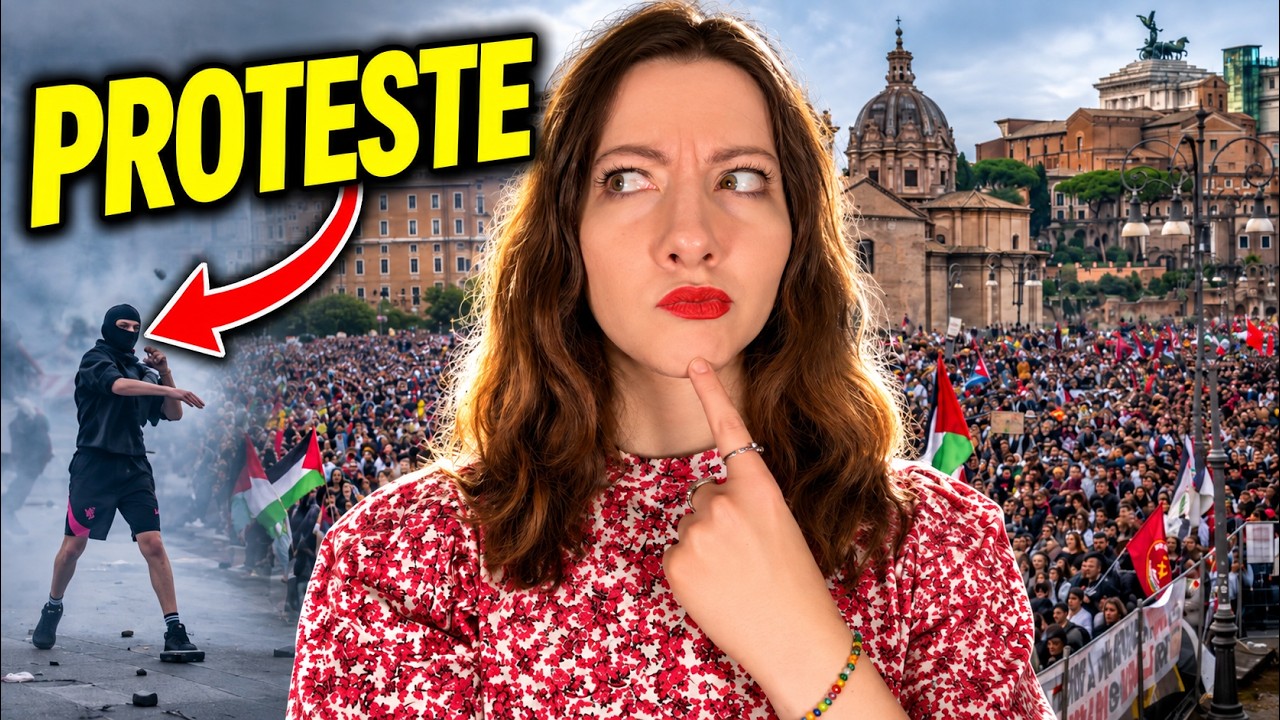
Since mid-October 2026, protests, demonstrations and strikes have been underway in many Italian cities. Thousands of people have taken to the streets to express their anger and demand change. The main reason is carovita [rising cost of living], that is, the increase in the cost of living: in Italy, living costs more and more, because the prices of food, petrol, electricity and rent are rising, while many salaries stay the same. In this guide you’ll find a clear and organised explanation of what’s happening: who’s protesting, why, how the government is reacting and, above all, the key words needed to understand everything, from trade unions to the Constitution.
Why Are Italians Protesting Against the High Cost of Living?
Behind the word “protests” are hidden very different phenomena. In Italy, in the autumn of 2026, at least two distinct movements are overlapping: the mobilisations of hauliers and farmers in the south of the country, linked to the price of diesel, and the demonstrations of students and young people in the big cities of the Centre and North, linked to the cost of living and government policies. Understanding the two phenomena separately helps to grasp what’s really happening and why the issue is so deeply felt, especially in a period of tension over the purchasing power of families.
Purchasing Power: the Key to Understanding the Anger
To understand these protests, it’s necessary to start from an economic concept that affects millions of Italian families: purchasing power. It’s the core of the problem, and the thread that connects all the current mobilisations.
What Does Purchasing Power Mean
Purchasing power indicates the quantity of goods and services that can be bought with a given sum of money. An example clarifies the concept: a person earns 1,500 euros a month. If prices rise but the salary stays the same, with the same money that person will manage to buy fewer things than the previous month. In other words, their purchasing power diminishes. To deepen essential economic vocabulary, there’s also the guide on economics and finance lexicon, useful for following the public debate in Italy.
Who’s Suffering Most Right Now
The decrease in purchasing power particularly hits certain categories: people with low salaries, young people and families who have to pay rent. In Italy, many young people find it difficult to find stable work: some work with temporary contracts, others earn little and don’t manage to become economically independent. For this reason, a significant share continues to live with their parents even after the age of thirty, a phenomenon that for years has represented one of the unresolved knots of Italian society. For specific vocabulary of the world of work, there’s also the guide on Italian expressions about work.
Another deeply felt problem is that of rents. In big cities like Milan, Rome and Bologna, finding housing at an affordable price has become particularly difficult, especially for university students and for those who have just started a working career.
The Main Demands of the Protesters
The demands expressed in the squares focus on some recurring points: higher salaries, greater economic support and more investment in public services, especially in schools and healthcare. By the expression public services are meant the services the State offers to citizens, such as hospitals and schools. In some demonstrations, other claims also emerge, such as criticism of increased military spending and support for Palestine. Not all people who demonstrate, therefore, share the same demands, and it is this plurality of voices that makes the picture more complex.
Two Different Protests: South and Big Cities
Although the mobilisations are happening in the same period, it’s important to distinguish two parallel but different phenomena. The first concerns above all Southern Italy, where lorry drivers and farmers are protesting against the price of diesel. The second concerns the big cities of the Centre and the North, where students, young people and workers are demonstrating against the cost of living and the government’s policies. These are two movements with specific causes and different protagonists, worth analysing separately. The theme of the differences between the various areas of the country is explored in the guide on North vs South in Italy.
The Protest of Lorry Drivers and Farmers
The first phenomenon was born in Southern Italy and has involved specific professional categories, with demands linked to the cost of fuel. It’s an economic protest more than a political one, but with visible consequences on the daily lives of many citizens.
Where the Southern Protests Started
The mobilisations started mainly in Puglia, then spread to other southern regions such as Sicilia, Calabria, Basilicata and Campania. The protesters are mainly the autotrasportatori [goods hauliers] — that is, the people and companies that transport goods with lorries — and the agricoltori [farmers]. Both categories depend directly on the cost of fuel to carry out their daily work.
The Price of Diesel and the Accise
The central problem is the price of diesel, the fuel used by lorries, many cars and numerous agricultural vehicles such as tractors. When diesel becomes more expensive, transporting goods and working in the fields costs more, and the increase risks having consequences also for final consumers: if transporting fruit and vegetables from the field to the supermarket costs more, the selling price can also rise.
Among the reasons for the increase are the accise [excise duties on specific products], that is, the taxes the State applies on certain products, including petrol and diesel. In 2026, some fiscal rules on fuels have changed and some temporary discounts have ended. These changes have directly contributed to the increase in the price of diesel at the pump.
The Road Blocks and Their Consequences
To protest, some lorry drivers organised road blocks, stopping their vehicles at important points of the road network and preventing or slowing down the passage of other vehicles. The consequences became visible quickly: in some areas fuels were missing at the pumps and some supermarkets had difficulty receiving goods. In Sicilia, a part of the lorry drivers decided to suspend the protest after a meeting with Matteo Salvini, Minister of Infrastructure and Transport.
Stop reading Italian.
Start speaking it.
Online lessons in groups of 4, organised by level and goals, with qualified teachers. Pick the day and time that suit you from the available slots.
Max 4 students:
there’s a seat for you
The Protests of Young People in the Big Cities
At the same time, in the big Italian cities, other demonstrations have begun, with very different characteristics from those in the south. Here the protagonists are mainly students and young people, the ways of organising pass partly through social media and the claims have a more political character, linked to the overall choices of the government.
The “No Meloni Day” of 16 October
On 16 October, in Rome, a student demonstration called “No Meloni Day” took place. Giorgia Meloni is the Italian Prime Minister, that is, the person who leads the government. It’s worth recalling an important institutional distinction: in Italy the Presidente del Consiglio [Prime Minister] is the head of the government, while the Presidente della Repubblica [President of the Republic] is the head of State, two different roles with different functions, explored in detail in the guide on the Italian political system. During the demonstration, many students criticised the government’s economic policies and asked for greater investment in education, more work opportunities and concrete measures against carovita.
The Role of Social Media in the Organisation
An important role in organising the protests has been played by social media. Through TikTok, Instagram and Telegram, thousands of young people have seen and shared messages inviting people to take to the streets. It’s an interesting element from the sociological point of view: while in the past big demonstrations were organised mainly by political parties and sindacati [trade unions] — that is, the organisations that represent workers and defend their rights — today some protests are born directly on social media, with more horizontal and less structured dynamics. To deepen the way young Italians talk today, there’s also the guide on Italian slang.
The Clashes with the Police
Not all demonstrations have taken place peacefully. In some cities, moments of tension have emerged, with clashes between groups of protesters and law enforcement. It’s worth distinguishing clearly the different behaviours involved, because news coverage tends to overlap them, while from the point of view of language and reality they are different phenomena.
What Happened in Milan, Turin and Bologna
The most serious episodes occurred mainly in Milan, Turin and Bologna. With the expression forze dell’ordine [law enforcement] are indicated the people who deal with public safety, such as policemen and carabinieri. In Milan, during the protests of 17 and 18 October, some groups threw bottles and firecrackers against the police, and episodes of vandalism and saccheggi [looting] also took place, a term that indicates when a group of people enters shops or other buildings and steals objects, often during situations of disorder. Many people were detained by the police, and among them some were minorenni [minors], that is, under eighteen years old.
The Vocabulary of Demonstrations: Corteo, Slogan, Striscione
It’s important to maintain a firm distinction: to demonstrate doesn’t necessarily mean to use violence. The great majority of people participate in processions peacefully, with signs, slogans and banners. Three key words of the vocabulary of demonstrations are worth remembering:
- Corteo [procession, march]: a demonstration during which people walk together along the streets.
- Slogan [slogan]: a short phrase, often repeated or shouted by the protesters.
- Striscione [banner]: a large piece of fabric or other material on which a message is written.
The episodes of violence, although limited in numbers, have attracted great attention from newspapers and television. It should however be remembered that they don’t necessarily represent all the people who participate in the protests.
The Government’s Response and the Right to Demonstrate
The Italian government, led by Giorgia Meloni, is a centrodestra [centre-right] government, that is, a set of parties that, in general, support conservative positions and right-wing policies, although sometimes having different ideas on specific themes. The government’s reaction has unfolded on two levels: the condemnation of episodes of violence and the announcement of new security measures, with the stated aim of preventing future clashes.
The New Security Measures
Meloni condemned the episodes of violence, underlining that demonstrating is a right, but destroying cities isn’t. To respond to the disorders, the government has presented new security measures, with the stated objective of preventing clashes and punishing those who commit crimes during the demonstrations. Among the described measures are harsher penalties for certain forms of group violence and greater possibilities of preventive intervention by the police. In Milan, a strengthening of the presence of security forces has also been announced.
Article 17 of the Constitution
The new measures are causing debate because in Italy, as in many democracies, the right to demonstrate is protected by the Costituzione [Constitution]. The Costituzione is the fundamental law of the Italian State: it establishes the principles on which the Republic is based and recognises the rights of citizens. Article 17, in particular, recognises the right to “riunirsi pacificamente e senza armi” [assemble peacefully and without weapons]. This means that people can gather to express their opinions and protest against political decisions, in compliance with the rules provided by law. The debate, therefore, revolves around a delicate question: how to guarantee public safety without excessively limiting the right to protest?
The Opposition and the Political Debate
Not all political parties agree with the government’s response. In Italy, the parties that aren’t part of the governing majority are called opposizione [opposition]: their function is, among other things, to monitor and criticise the majority’s decisions, proposing alternative solutions.
The Parties Opposed to the New Rules
Among the main opposition parties are the Partito Democratico, the Movimento 5 Stelle and Alleanza Verdi e Sinistra. These parties have criticised the new security measures, arguing that they could limit the right to demonstrate. According to the government, instead, the new rules serve to protect citizens and to allow peaceful demonstrations to take place. The two positions represent very different readings of what the correct balance between public order and political freedom should be.
The Position of the Mayor of Milan
The mayor of Milan, Giuseppe Sala, has also intervened in the debate. The sindaco [mayor] is the person elected by citizens to administer a Comune [municipality], that is, the basic administrative unit of the Italian territory, which generally corresponds to a city or a town. Sala has acknowledged that many people have understandable reasons to protest, but has condemned the episodes of violence. This distinction is politically important: one can understand the reasons for a protest without approving violent behaviour.
What Could Happen Now?
The demonstrations could continue also in the coming weeks. New protests have been announced in various Italian cities and the theme of carovita remains at the centre of the political debate. The question, however, goes far beyond the clashes in the squares. Many observers wonder how it will be possible to tackle structural problems such as low salaries, housing costs, job insecurity and the economic difficulties of young people, knots that have affected Italian society for decades and that the protests have brought back to the forefront.
At the same time, the government is called to find a balance between the right of citizens to demonstrate and the need to guarantee public safety. These months, therefore, don’t tell only of a moment of political tension, but also return some of the economic and social difficulties of today’s Italy.
Frequently Asked Questions
What Does “Carovita” Exactly Mean?
Carovita indicates the rising cost of living, that is, a phase in which the prices of fundamental goods and services — food, petrol, electricity, rent — grow faster than salaries. The result is a decrease in purchasing power: with the same sum of money, fewer things can be bought than before. The term is in common use in the language of newspapers, in political debate and in everyday conversations about the economic situation.
What’s the Difference between Presidente del Consiglio and Presidente della Repubblica?
These are two different roles with different functions. The Presidente del Consiglio [Prime Minister] is the head of government and leads the political activity of the executive: today this office is held by Giorgia Meloni. The Presidente della Repubblica [President of the Republic], on the other hand, is the head of State, with functions of guarantee and representation: it’s an institutional figure distinct from the government and remains in office for seven years. The two roles never coincide and work on different levels of the Italian political system.
What Are the Accise?
The accise are taxes that the State applies on certain specific products, in particular on petrol and diesel, but also on alcoholic drinks and tobacco. They form part of the price that the consumer pays at the pump or at the till, although they are not always visible at the time of purchase. In 2026, some fiscal rules on fuels have changed and some temporary discounts have ended: the combination of these factors has contributed to the increase in the price of diesel, one of the triggering reasons for the protests in Southern Italy.
Is the Right to Demonstrate Guaranteed by Law?
Yes, the right to demonstrate is protected by the Italian Constitution, in particular by Article 17, which recognises the right of citizens to “riunirsi pacificamente e senza armi” [assemble peacefully and without weapons]. The Constitution is the fundamental law of the Italian State and establishes the principles on which the Republic is based. The right to protest, however, has precise limits, linked above all to respect for public order and safety: it is precisely on where to place these limits that today’s political debate between government and opposition is focused.
Why Are the Southern Protests and Those of the Big Cities Different?
Although they take place in the same period, the two movements have different protagonists, causes and demands. The Southern protests are led mainly by lorry drivers and farmers and are born from a specific reason: the increase in the price of diesel. The protests of the big cities of the Centre and North, on the other hand, are led mainly by students and young people and have a more political character, linked to the government’s overall choices and to the general theme of carovita. These are therefore two parallel phenomena, which overlap in the calendar but which it’s important to read separately to avoid confusing causes and proposals.
Want the lesson PDF with exercises and solutions?
Join the LearnAmo AcademyLoading quiz…
Podcast: Play in new window | Download (Duration: 23:59 — 32.9MB)
Iscriviti: Apple Podcasts | Spotify | Android | iHeartRadio | Podcast Index | TuneIn | Deezer | RSS | Altri...