


In today’s lesson we are going to talk about a bit delicate topic, but that many people find interesting: the differences the Italian language in Northern and Southern Italy, showing you the most important differences between the two spoken forms. Stay with us to learn all the aspects of Italian language!
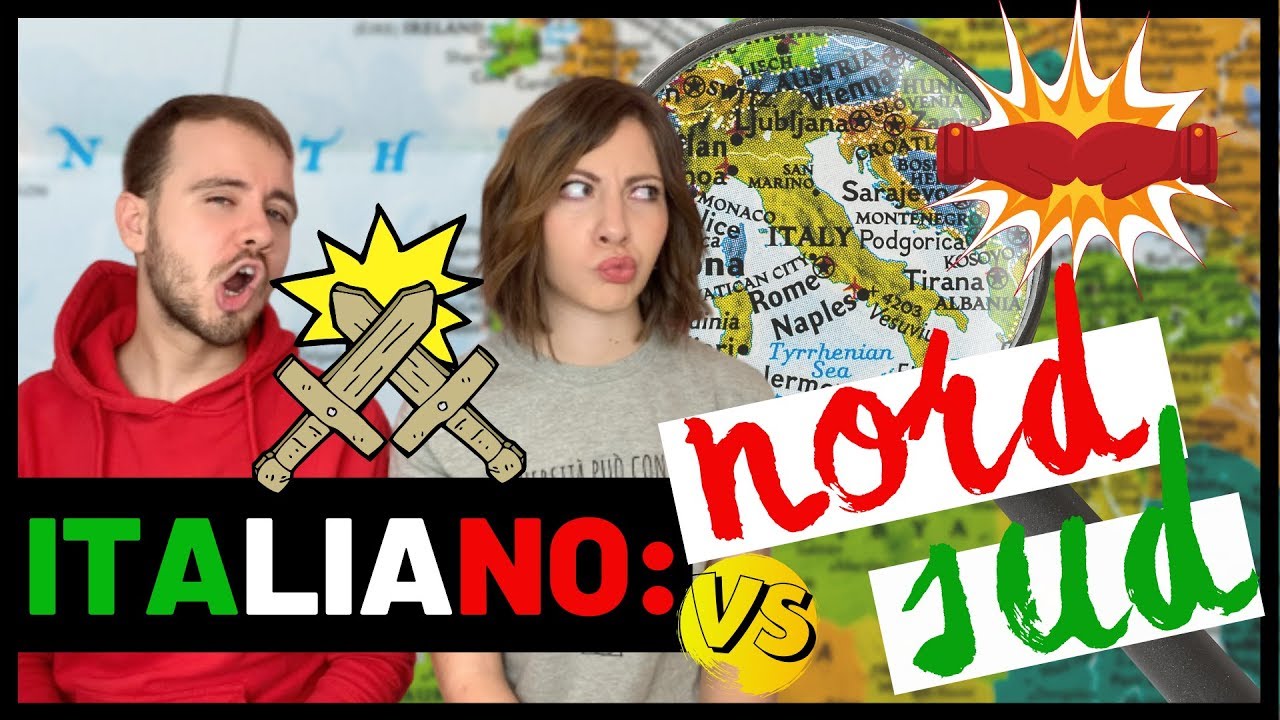
Differences between Northern and Southern Italian language
Let’s begin with the first difference:
1) the use of definite article before first names
In Northern Italy, in cities like Bologna, there’s the tendency to place the definite article before first names.
Example: “Mi ha chiamato la Francesca e mi ha detto che la Michela non vuole uscire”.
Instead, in Southern Italy, people never use the definite article before first names which is also the right form to use in standard Italian
Example: “Mi ha chiamato Francesca e mi ha detto che Michela non vuole uscire” (no article) (Francesca called me to tell me that Michela won’t come)
Moving on we can find differences like:
2) the use of past simple and present perfect
In Northern Italy people tend to use present perfect, except in Tuscany where past simple is still widely used.
Example: “Ieri sono andato al cinema con Luca e ho visto Joker”.
In Southern Italian , instead, people tend to use past simple much more in spoken language, even in relation recent events.
Example:“ieri andai al cinema con Luca e vidi Joker”. (Yesterday I went to the cinema with Luca to watch Joker)
Both forms are correct but it’s recommended to use the “passato remoto” to indicate those events that are far back in time and concluded, and the “passato prossimo” to indicate recent events which affect the present.
3) the use of preposition “A” after some transitive verbs
In Southern Italy, some transitive verbs which hold direct object, are wrongly used with the preposition “A”.
Example: “Chiama a Giancarlo più tardi” (Call Giancarlo later)/“Ieri ho incontrato a Paolo” (Yesterday I met Paolo)/“Ho visto a Massimiliano” (I’ve met Massimiliano)…
Northern people respects Italian standard form and never use the preposition “A” with transitive verbs.
4) the use of the verbs “essere” and “stare”
In Northern Italy, in order to indicate the position of something and someone, people tend to mainly use the verb essere
Example: “il cucchiaio è nel cassetto” (the spoon is in the drawer)
In Southern Italy, instead, in order to indicate the position of something and someone, people tend to alternate the verbs essere and stare;
Example: “il cucchiaio è nel cassetto”/ “il cucchiaio sta nel cassetto” (the spoon is/ is placed in the drawer)
Both the options are grammatically acceptable, but according to some grammar books, the verb essere is used to indicate the temporary position, while the verb stare indicates the usual location.
Do you have doubts about the use of these words? Don’t miss our video-lesson devoted to ESSERE and STARE.
5) the pronunciation of consonants
In Southern Italy, the spoken language in some areas, most of times, is characterized by a sort of doubling of consonants.
Examples: “impossibbile” (impossibble)/ “libbero” (frree)/“abbitudine” (habbit)
This feature which diverges from standard Italian, is not part of Northern Italian spoken language where the pronunciation is:“Impossibile” (impossible), “libero” (free), “abitudine” (habit)
Would you like to improve your pronunciation? Then you should watch our video-lesson on the most difficult Italian words to pronounce.
The last relevant difference is:
6) the use of “tu” and “te”
In Northern Italy, for example in cities like Bologna and Milan, people use “te” instead of “tu”, in spoken language.
Example: “Io sto bene! E te, te come stai?” (What about you? How are you?)/ “Te che hai fatto ieri?”(What did you do yesterday?)
This use of “te” replacing “tu” is not covered by standard form, which is respected, instead, in Southern Italy…
Alright, this last difference concludes our list, but, if you want to relax, you can take a look at our video about the most beautiful unknown places in Italy.
Ah, if you like Graziana’s T-shirt (“la diversità può convivere”), you can buy it in our online store: LearnAmo Collection!
Want the lesson PDF with exercises and solutions?
Join the LearnAmo AcademyCaricamento quiz in corso…
Podcast: Play in new window | Download (Duration: 10:24 — 9.5MB)
Iscriviti: Apple Podcasts | Spotify | Android | iHeartRadio | Podcast Index | TuneIn | Deezer | RSS | Altri...