


How many times have you heard that Italian is the most beautiful language in the world? Or that it’s particularly difficult, with a richer vocabulary than other languages? In this article, you’ll discover the truth about some characteristics of Italian that many consider exclusive, distinguishing real facts from simple common misconceptions.
Is Italian Really the Most Beautiful Language in the World?
The Myth of the Subjunctive
What Is the Subjunctive?
The subjunctive (congiuntivo) is a verb mood used to express doubts, desires, opinions, and possibilities. It’s a verb form that allows you to communicate nuances of meaning that the indicative cannot convey. Here are some practical examples of its use:
| Type of expression | Example with subjunctive | Meaning |
|---|---|---|
| Hope | “Spero che tu stia bene” [I hope you are well] | Expresses a desire |
| Opinion | “Credo che lui sia simpatico” [I think he is nice] | Indicates a personal opinion |
| Desire | “Vorrei che tu venissi con me” [I would like you to come with me] | Communicates a wish |
| Doubt | “Non sono sicuro che abbia capito” [I’m not sure he understood] | Expresses uncertainty |
Italians’ Relationship with the Subjunctive
Italians have a particular relationship with this verb mood. Mistakes in the subjunctive are often perceived as a sign of poor education or lack of schooling. But is the subjunctive really an exclusive characteristic of Italian?
The Truth About the Subjunctive in Other Languages
Absolutely not. If you know another Romance language — Spanish, French, Portuguese, Romanian — you know well that these languages also have a subjunctive. An interesting aspect is that only Italians attach so much importance to this verb mood. Spanish and French speakers have a more relaxed attitude on the subject.
And English? Many Italians think English doesn’t have a subjunctive, considering it an “inferior” language for this reason. But this isn’t correct. English also preserves traces of the subjunctive. For example, in the sentence “I suggest that he be present at the meeting“, that “be” is a subjunctive. This is the so-called subjunctive mood, which still exists in English grammar, although it’s used less frequently than in Italian.
So no, the subjunctive is not something exclusively Italian.
Double Consonants: An Italian Characteristic?
What Are Double Consonants or “Geminates”
Let’s now move on to another characteristic that seems typically Italian: double consonants, also called “geminates” in technical linguistic terminology. These are consonants that are pronounced longer, with more intensity. In Italian, they’re written by doubling the letter: “mamma”, “pizza”, “cappuccino”, “bellissimo”.
Italian indeed uses double consonants much more extensively than other languages. Consider a sentence like:
Example:
“Quell’uomo basso con gli occhiali era simpaticissimo: ogni volta che passavo mi salutava con affetto.” [That short man with glasses was very nice: every time I passed by, he greeted me affectionately.]
The double consonants present are numerous, and this is typical of Italian, which makes pervasive use of this phonetic phenomenon.
Double Consonants in Other Languages
However, double consonants don’t exist only in Italian. Here are some examples from other languages:
| Language | Examples of words with doubles | Notes |
|---|---|---|
| Spanish | “innovación”, “perenne” | The double can be pronounced |
| Catalan | “novel·la” (novel), “cel·la” (cell) | Evident geminate consonants |
| French | Some phonetic cases | Doubles at the phonetic level |
| Japanese | “kitte” (stamp), “nippon” | Distinctive geminate consonants |
| Finnish | “kukka” (flower), “kissa” (cat) | Systematic use of doubles |
The Fundamental Difference: Phonological Value
The substantial difference is this: in Italian, double consonants have a phonological value, meaning they change the meaning of words. The distinction between single and double consonants is therefore essential for communication.
| Single consonant | Double consonant | Difference in meaning |
|---|---|---|
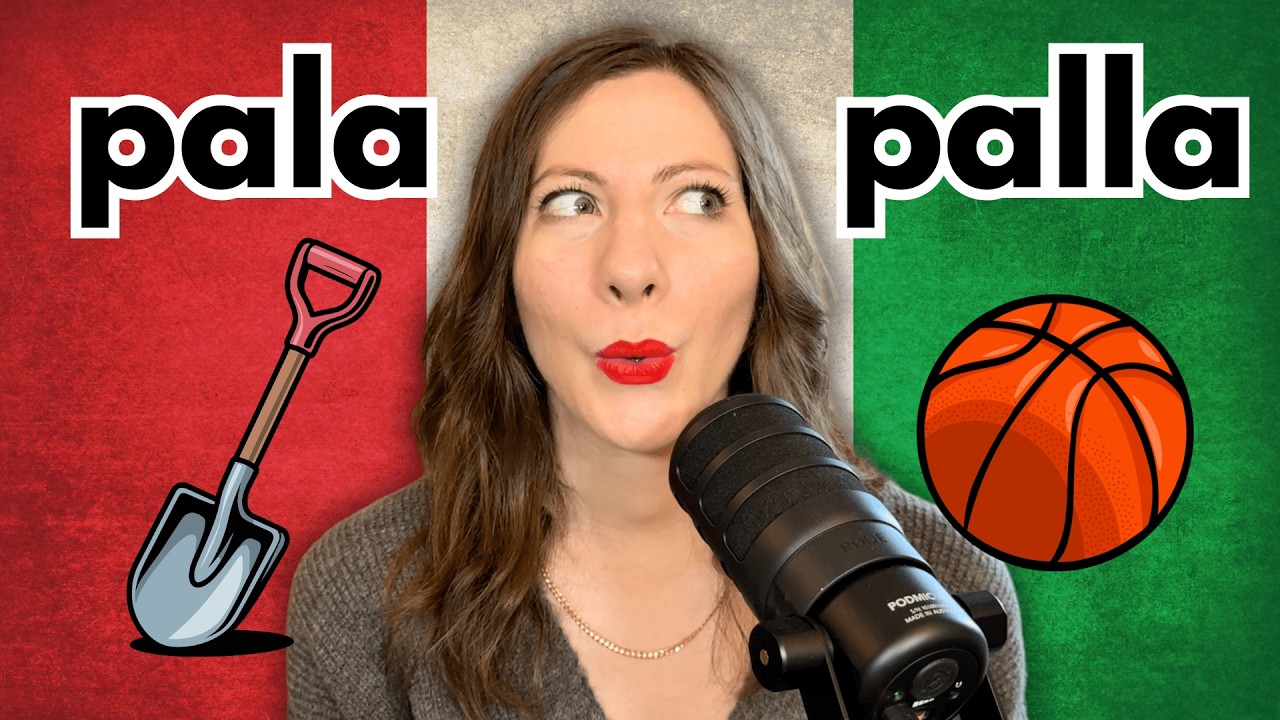
| pala [shovel] | palla [ball] | Tool vs spherical object |
| caro [dear/expensive] | carro [cart] | Adjective vs vehicle |
| note [notes] | notte [night] | Written notes vs dark period |
| casa [house] | cassa [box/cash register] | Dwelling vs container |
| sete [thirst] | sette [seven] | Need to drink vs number |
| fato [fate] | fatto [fact/done] | Destiny vs past participle |
In other languages, however, double consonants are often only phonetic, without impact on meaning. The extensive use of double consonants with distinctive value is therefore a fairly peculiar characteristic of Italian, at least among the major Romance languages.
Some Particular Grammatical Structures of Italian
There are other interesting characteristics that make Italian different from other languages. Let’s analyze them in detail.
Masculine Definite Articles
Definite articles are those small words placed before nouns to indicate something specific: “il”, “lo”, “la”, “i”, “gli”, “le”. Italian has a peculiarity: it possesses two forms for the masculine singular definite article: “il” and “lo”. And in the plural: “i” and “gli”. The use depends on the letter with which the following word begins:
| Singular article | Plural article | When it’s used | Examples |
|---|---|---|---|
| il | i | Before a simple consonant | il libro → i libri [the book → the books] |
| lo | gli | Before s+consonant, z, gn, ps, x, y | lo zaino → gli zaini [the backpack → the backpacks] |
| lo | gli | Before complex consonant clusters | lo psicologo → gli psicologi [the psychologist → the psychologists] |
| l’ | gli | Before a vowel (masculine) | l’amico → gli amici [the friend → the friends] |
This double form is quite particular compared to other Romance languages, where generally there exists only one masculine definite article (like “el” in Spanish or “le” in French).
The Subjunctive with Affirmative Opinions
Another interesting aspect: in Italian, the subjunctive is used after expressions like “penso che” [I think that], “credo che” [I believe that], “mi sembra che” [it seems to me that]. For example:
Example:
“Penso che Marco sia intelligente.” [I think Marco is intelligent.]
In Spanish, French, and Portuguese, however, the indicative is used in these cases:
| Language | Sentence | Verb mood |
|---|---|---|
| Italian | “Penso che Marco sia intelligente” [I think Marco is intelligent] | Subjunctive |
| Spanish | “Creo que Marco es inteligente” | Indicative |
| French | “Je pense que Marco est intelligent” | Indicative |
| Portuguese | “Acho que Marco é inteligente” | Indicative |
This is a use of the subjunctive that is typical of Italian.
Italian Doesn’t Always Use “More” Subjunctive
This doesn’t mean Italian is “more refined”. There are other cases where other languages use the subjunctive and Italian doesn’t:
| Language | Sentence | Verb mood |
|---|---|---|
| Spanish | “Cuando llegues, llámame” [When you arrive, call me] | Subjunctive |
| Italian | “Quando arrivi, chiamami” [When you arrive, call me] | Indicative |
The use of the subjunctive is therefore not uniform across languages: each language has its own specific rules.
The Myth of the Richer Vocabulary
What Is Vocabulary?
Does Italian really have more words than other languages? Before answering, it’s necessary to clarify what is meant by “vocabulary” (lessico). The vocabulary is simply the set of all words in a language, including nouns, verbs, adjectives, adverbs, prepositions, and all other grammatical categories.
The Problem of Counting Words
Many Italians believe that Italian has a richer vocabulary, especially compared to English. However, counting the words of a language is very complicated. First of all: what is a word? “Mangio” [I eat], “mangi” [you eat], “mangiamo” [we eat]… are these three different words or forms of the same word? Are pronouns like “lo”, “la”, “gli” independent words?
These questions demonstrate how difficult it is to establish objective criteria for counting.
The Numbers Compared
| Language | Estimated number of words | Notes |
|---|---|---|
| Italian | 215,000 – 270,000 | According to some calculations |
| English | ~170,000 | According to some dictionaries |
These numbers vary considerably depending on the dictionary used and the counting criteria. There is no universally accepted method for determining the lexical “richness” of a language.
Basic Vocabulary: What Really Matters
In reality, what really matters is the basic vocabulary, that is, the words used in daily life:
| Type of vocabulary | Number of words | Percentage of use |
|---|---|---|
| Italian basic vocabulary | ~6,500 words | 98% of daily sentences |
| Average native speaker’s vocabulary | 15,000 – 20,000 words | Variable |
The vocabulary known by a native speaker depends greatly on education level and reading habits.
Is Italian Really a Difficult Language?
Many claim that Italian is a “difficult” language. But compared to what?
Comparison with Romance Languages
If Italian is compared to other Romance languages, the grammatical complexity turns out to be very similar:
| Language | Grammatical characteristics |
|---|---|
| Spanish | Same verb tenses and moods as Italian |
| French | Equally complex morphology |
| Portuguese | More verb tenses than Italian |
Comparison with Other World Languages
Looking at languages of the world, there are many with decidedly more complex grammars:
| Type of language | Examples | Complex characteristic |
|---|---|---|
| Languages with cases | Russian, German, Finnish | Noun declension (up to 15 cases in Finnish) |
| Tonal languages | Mandarin Chinese, Vietnamese, Thai | Tone changes word meaning |
| Agglutinative languages | Turkish, Hungarian, Japanese | Very long words composed of many suffixes |
| Polysynthetic languages | Inuktitut, Mohawk | A single word can express an entire sentence |
Compared to these languages, Italian actually appears relatively accessible.
So, Is Italian Special?
The correct answer is: yes and no.
Why “No”: Myths to Debunk
No, Italian doesn’t have unique characteristics that make it “superior” to other languages:
| Myth | Reality |
|---|---|
| The subjunctive exists only in Italian | It exists in many Romance languages and also in English |
| Double consonants are exclusive | They also exist in other languages (Catalan, Finnish, Japanese…) |
| Italian has the richest vocabulary | It’s not possible to establish this objectively |
| Italian is the most difficult language | There are languages with much more complex grammars |
Why “Yes”: Every Language Is Unique
Yes, Italian is special, as every language is special. Every language has a unique combination of characteristics and carries with it a culture, a history, a literature, a music that make it unique.
It’s legitimate to love Italian — whether as a native speaker or as a student learning it. However, it’s not necessary to invent false reasons to justify this love. Italian is beautiful for what it is, not because it’s “better” than other languages.
The True Peculiarities of Italian
If one wants to identify some distinctive characteristics of Italian, it’s possible to mention:
| Characteristic | Description | Peculiarity |
|---|---|---|
| Phonological double consonants | Geminates change the meaning | More extensive use than other Romance languages |
| Double masculine article | “Il/lo” and “i/gli” | More articulated system than other languages |
| Subjunctive with opinions | After “penso che” [I think that], “credo che” [I believe that] | Where other Romance languages use the indicative |
| Musicality | All words end in a vowel | Favors singing and poetry |
| Dialectal richness | Great variety of regional dialects | Unique linguistic heritage |
Frequently Asked Questions
Does the Subjunctive Exist Only in Italian?
No. The subjunctive exists in all Romance languages (Spanish, French, Portuguese, Romanian) and also in English, although it’s used less frequently. It’s a verb mood common to many Indo-European languages.
Why Are Double Consonants So Important in Italian?
Because in Italian they have a phonological value: they change the meaning of words. “Pala” [shovel] and “palla” [ball], “caro” [dear] and “carro” [cart] are minimal pairs where only the double consonant distinguishes two completely different words. In other languages, double consonants are often only phonetic, without impact on meaning.
Does Italian Have More Words Than English?
It’s impossible to establish with certainty. Counting the words of a language depends on many factors: how a “word” is defined, whether inflected forms are counted, which dictionary is used. The numbers vary considerably and there is no universally accepted method for this comparison.
Why Do Italians Use the Subjunctive After “Penso Che” While Spanish and French Speakers Don’t?
It’s a matter of different historical evolution of Romance languages. Italian has maintained the use of the subjunctive in contexts where other languages have adopted the indicative. However, there are also opposite cases: Spanish uses the subjunctive in temporal situations where Italian uses the indicative.
Is Italian Really “the Most Beautiful Language in the World”?
The beauty of a language is subjective and depends on cultural, emotional, and personal factors. There is no objective criterion to establish which language is “the most beautiful”. Italian possesses great musicality and a rich literary tradition, but every language has its own unique aesthetic qualities.
How Many Words Must a Foreigner Know to Speak Italian Well?
With approximately 2,000-3,000 words, it’s possible to handle most daily situations. With 6,500 words (the basic vocabulary), about 98% of sentences used in everyday life are covered. For advanced competence, 10,000-15,000 words are needed.
If you want to improve your Italian pronunciation, don’t forget to take a look at the dedicated article.
Do you want to take Italian lessons with our qualified native teachers? Purchase your Italiano Intensivo package!
Want the lesson PDF with exercises and solutions?
Join the LearnAmo AcademyLoading quiz…
Podcast: Play in new window | Download (Duration: 22:49 — 31.6MB)
Iscriviti: Apple Podcasts | Spotify | Android | iHeartRadio | Podcast Index | TuneIn | Deezer | RSS | Altri...