


Italian loves to test us with words that seem like twins but are distant cousins. In this article, you’ll learn to distinguish and correctly use 14 pairs of Italian words that often create confusion among foreigners studying our language.
Mastering these distinctions will make you speak Italian more naturally and precisely, and will save you from some embarrassing blunders!
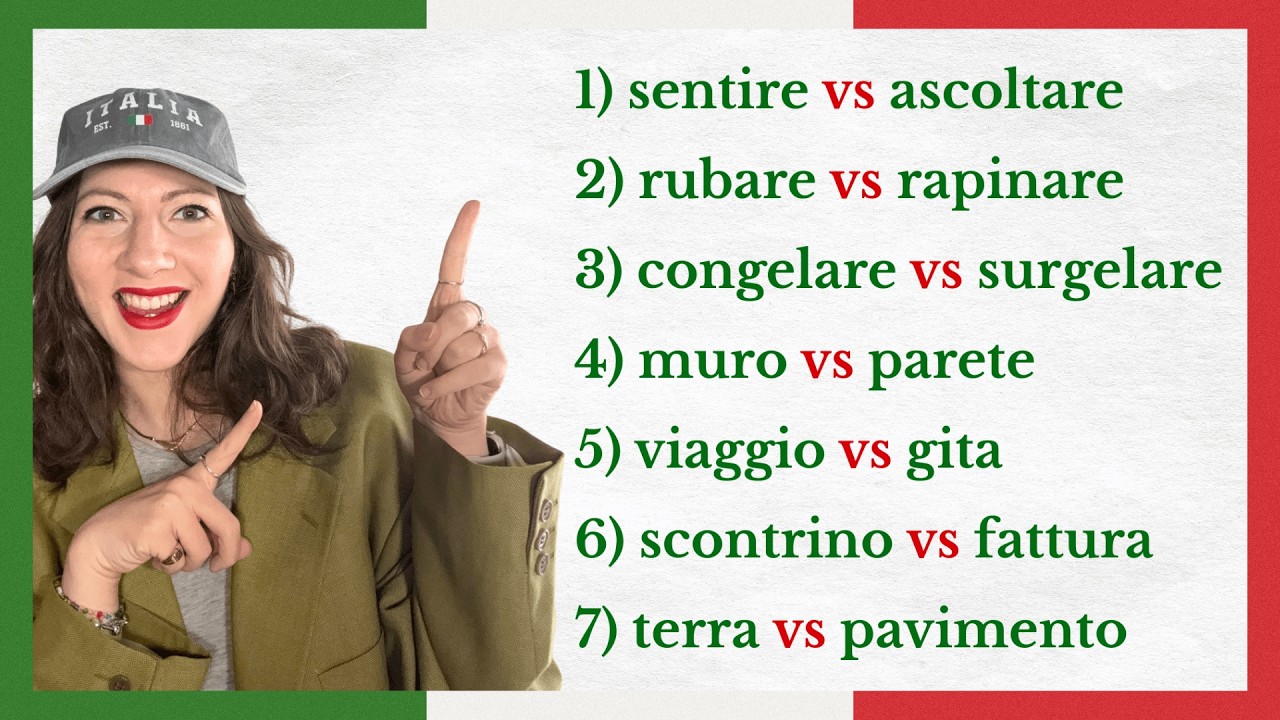
30 Confusing Italian Words
1. VIAGGIO – GITA
Let’s start with viaggio and gita, two words related to the theme of travel. Both mean that you’re moving somewhere, but there’s a big difference!
VIAGGIO [trip/journey] refers to a generally long journey that can last several days or even weeks. It’s a more formal and generic term. Think of a viaggio as something important, maybe with suitcases and hotel reservations.
GITA [trip], instead, indicates a short excursion, usually of just one day, often with recreational or educational purposes. The gita is always something light and pleasant!
Key Differences between Viaggio and Gita
- The viaggio is long, the gita is short
- The viaggio can be for work or pleasure, the gita is almost always for fun
- We say “viaggio d’affari” [business trip], but “gita scolastica” [school trip]
- Economic aspect: a viaggio generally requires a higher budget with hotels, flights, restaurants, while a gita is more economical
- Planning: the viaggio requires advance planning (reservations, itineraries), the gita can also be spontaneous, decided at the last moment
- Luggage: for a viaggio you need heavy suitcases and many clothes, for a gita a light backpack is enough!
Practical Examples of Use
Viaggio:
Examples:
- “Quest’estate farò un viaggio in Giappone di tre settimane [This summer I’ll take a trip to Japan for three weeks].”
- “Il viaggio in treno da Roma a Milano dura circa 3 ore [The train journey from Rome to Milan takes about 3 hours].”
Gita:
Examples:
- “Domenica organizziamo una gita al lago con i bambini [On Sunday we’re organizing a trip to the lake with the kids].”
- “La scuola ha organizzato una gita al museo di arte moderna [The school organized a trip to the modern art museum].”
2. TERRA – SUOLO – PAVIMENTO
Here are three words that all refer to “what we walk on”, but with important differences! Get ready, because things get interesting here.
TERRA [Earth/land] indicates the planet Earth, the natural ground made of rocks, sand, grass, or even the soil on which we cultivate. It’s the most general and versatile word.
SUOLO [soil/ground] is a more technical and formal term that refers to the Earth’s surface or terrain, especially in scientific, agricultural, or geographical contexts.
PAVIMENTO [floor] is the artificial surface found inside buildings, made of tiles, wood, marble, and so on.
How to Distinguish Terra, Suolo and Pavimento
- Terra = natural, outdoors (and also our planet)
- Suolo = technical term for terrain
- Pavimento = artificial, indoors
- Context of use: “Terra” is also used in many idiomatic expressions like “avere i piedi per terra“ [to have one’s feet on the ground] (to be realistic), “cadere a terra” [to fall to the ground], “toccare terra” [to touch ground], while “suolo” and “pavimento” don’t have these figurative uses
- Cleaning: Only the pavimento is “washed” or “cleaned” with a mop! The terra and suolo are not cleaned (if anything, you clean something “from” the floor)
Practical Examples of Use
Terra:
Examples:
- “Gli astronauti sono tornati sulla Terra dopo sei mesi nello spazio [The astronauts returned to Earth after six months in space].”
- “Il bambino gioca con la terra in giardino [The child plays with the dirt in the garden].”
- “Devi essere più realista e avere i piedi per terra! [You need to be more realistic and have your feet on the ground!]” (Idiomatic expression!)
Suolo:
Example:
- “Il suolo di questa regione è molto fertile e adatto alla coltivazione del grano. [The soil of this region is very fertile and suitable for growing wheat.]”
Pavimento:
Examples:
- “Ho pulito il pavimento della cucina con il mocio [I cleaned the kitchen floor with the mop].”
- “Attento! Ho appena lavato il pavimento, è ancora bagnato! [Careful! I just washed the floor, it’s still wet!]”
3. MURO – PARETE
These two words might seem like perfect synonyms, but they’re not! It’s one of the distinctions that confuses even some Italians, so don’t feel bad.
MURO [wall – exterior] is an external, thick and robust structure, generally made of bricks, stone, or cement. Walls separate different buildings or delimit external spaces. Think of muri as something solid and massive, difficult to knock down!
PARETE [wall – interior] is an internal, thinner structure that divides rooms inside a building. Walls are generally plastered and painted, maybe in a nice color you’ve carefully chosen.
Fundamental Differences between Muro and Parete
- Muro = external, thick, structural
- Parete = internal, thinner, dividing
- Structural function: the muro is almost always load-bearing, meaning it supports the weight of the building, while the parete can be just a divider, non-structural
- Material: muri are always in solid masonry (bricks, stone, cement), internal pareti can also be in drywall or other lightweight materials
- Demolition: knocking down a muro requires building permits because it’s structural, moving a dividing parete is much simpler and often doesn’t even require permission!
Practical Examples of Use
Muro:
Examples:
- “Il muro di cinta del giardino è alto tre metri [The garden’s boundary wall is three meters high].”
- “Il muro di Berlino fu abbattuto nel 1989 [The Berlin Wall was knocked down in 1989].”
- “Prima di abbattere quel muro, devi chiedere il permesso al comune perché è portante. [Before knocking down that wall, you need to ask the municipality for permission because it’s load-bearing.]”
Parete:
Examples:
- “Voglio appendere questo quadro alla parete del soggiorno [I want to hang this painting on the living room wall].”
- “Le pareti di questa casa sono sottili, si sente tutto dai vicini! [The walls of this house are thin, you can hear everything from the neighbors!]”
4. CONGELARE – SURGELARE
Both of these words have to do with extreme cold, but beware: they are NOT interchangeable!
CONGELARE [to freeze] means to bring something to a very low temperature until it becomes ice or solidifies. It’s also used figuratively when you’re so cold that you feel like you’re turning into a human popsicle!
SURGELARE [to deep-freeze] is a specific industrial process that brings foods to very low temperatures very quickly to preserve them for a long time while maintaining quality and nutrients. Frozen products are those you find at the supermarket in the freezer section.
Main Differences between Congelare and Surgelare
- Congelare = generic process, can be domestic (even yourself when it’s cold)
- Surgelare = specific industrial process for foods (the professional one)
- Temperature: surgelazione reaches much lower temperatures (at least -18°C) and very quickly, while domestic congelamento is slower and can be less cold
- Ice crystals: rapid surgelazione creates much smaller ice crystals that better preserve the structure, flavor, and nutrients of the food. Slow congelamento creates larger crystals that can damage the food’s cells
- Home vs industrial use: at home, in your freezer, you “congelare” [freeze] foods. In the factory, with special machinery, they “surgela” [deep-freeze]
Practical Examples of Use
Congelare:
Examples:
- “L’acqua della fontana si è congelata a causa del freddo [The fountain water froze due to the cold].”
- “Sto congelando! Possiamo accendere il riscaldamento? [I’m freezing! Can we turn on the heating?]”
- “Ho congelato gli avanzi della cena nel freezer. [I froze the dinner leftovers in the freezer.]” (Domestic process)
Surgelare:
Examples:
- “I piselli surgelati mantengono meglio le vitamine di quelli in scatola. [Frozen peas maintain vitamins better than canned ones.]”
- “Quando faccio la spesa, compro sempre verdure surgelate perché sono più comode e durano di più. [When I shop, I always buy frozen vegetables because they’re more convenient and last longer.]”
5. SENTIRE – ASCOLTARE
Here we have a fundamental distinction between a passive action and an active one! It’s a bit like the difference between passively watching TV and really paying attention to what’s happening.
SENTIRE [to hear] is a verb that indicates the involuntary perception of sounds through the ear. It doesn’t require concentration or will.
ASCOLTARE [to listen] means to voluntarily pay attention to something you hear. It requires concentration and interest. It’s what you do when you put on headphones and focus on your favorite song.
Essential Differences between Sentire and Ascoltare
- Sentire = passive, involuntary (it just happens)
- Ascoltare = active, voluntary (you choose it)
- With other senses: “Sentire” is also used for smell (“sento un buon profumo di caffè” [I smell a nice coffee aroma]), taste (“sento un sapore strano” [I taste a strange flavor]) and physical sensations (“sento caldo” [I feel hot], “sento freddo” [I feel cold], “sento dolore” [I feel pain]). “Ascoltare” instead works ONLY with hearing!
- Paradoxical attention: you can ascoltare even without hearing well (if the volume is too low or there’s noise), or sentire without listening (when someone talks to you but you’re voluntarily ignoring what they’re saying)
- Common expressions: we say “sentirsi male/bene“ [to feel bad/good] to indicate a physical or emotional state, but we never say “ascoltarsi male“! Other expressions can be: “sentire la mancanza di qualcuno” [to miss someone], “non sentirsi apprezzato” [to not feel appreciated]
Practical Examples of Use
Sentire:
Examples:
- “Ho sentito un rumore strano in giardino. [I heard a strange noise in the garden.]”
- “Sento la musica dei vicini, è troppo alta! [I hear the neighbors’ music, it’s too loud!]” (I perceive it, even if I’d rather not)
- “Sento un profumo delizioso! Cosa stai cucinando? [I smell a delicious aroma! What are you cooking?]” (Smell)
- “Non mi sento bene, ho mal di testa [I don’t feel well, I have a headache].” (Physical state)
Ascoltare:
Examples:
- “Ogni sera ascolto un podcast in italiano per migliorare la lingua [Every evening I listen to a podcast in Italian to improve the language].”
- “Ascoltami quando ti parlo! [Listen to me when I’m talking to you!]”
- “Ti ascolto, dimmi tutto! [I’m listening to you, tell me everything!]” (I’m voluntarily paying attention)
6. SCONTRINO – RICEVUTA – FATTURA
Italian tax documents represent one of the most complex areas of the language, creating confusion even among native speakers. Understanding the differences between these three terms is fundamental for correctly managing commercial and administrative transactions. Let’s see the distinctions in detail.
SCONTRINO [receipt – store receipt] is the tax document you receive when you make a purchase in a store, bar, or restaurant. It’s printed by the cash register and contains minimal information: price, date, store name.
RICEVUTA [receipt – formal] is a more detailed document than the scontrino, which confirms payment in a more formal way. It contains more information and can be requested specifically when the scontrino is not enough.
FATTURA [invoice] is the most complete and formal tax document, mandatory for businesses and professionals. It contains all the tax data of the seller and buyer (name, surname, address, VAT number or tax code), and is necessary for accounting.
How to Distinguish Scontrino, Ricevuta and Fattura
- Scontrino = brief, automatic, for small purchases
- Ricevuta = more detailed, intermediate
- Fattura = complete, formal, mandatory for companies
- Legal value: the fattura has full legal value for business accounting and for the tax authorities, while scontrino and ricevuta have more limited value
- Refunds and warranties: to obtain company refunds or exchange a defective product, you often need the ricevuta or fattura; the scontrino alone may not be enough
- Tax deductions: only with the fattura (or a specific tax receipt for certain services) can you deduct expenses from taxes, for example medical expenses, renovations, etc.
Practical Examples of Use
Scontrino:
Example:
- “Per favore, mi dà lo scontrino? Devo cambiare questo prodotto [Please, can you give me the receipt? I need to exchange this product].”
Ricevuta:
Example:
- “Ho bisogno della ricevuta per il rimborso spese [I need the receipt for expense reimbursement].” (To document the expense at work)
Fattura:
Examples:
- “L’idraulico mi ha mandato la fattura per email [The plumber sent me the invoice by email].” (Official document with all the trimmings!)
- “Per detrarre le spese mediche, devi conservare la fattura [To deduct medical expenses, you must keep the invoice].”
- “Mi serve la fattura con i dati della mia azienda per la contabilità [I need the invoice with my company’s data for accounting].”
7. STORIA – STORICO
Attention! Here we’re talking about storico not as a noun (meaning not the person who studies history), but as an adjective!
STORIA [history] is the noun that indicates the narration of past events, or the discipline that studies the past, or even simply a story.
STORICO [historical/historic] as an adjective means “related to history” or “important, memorable, that will remain in history”.
Fundamental Distinctions between Storia and Storico
- Storia = the noun, the facts of the past (the school subject)
- Storico = the adjective, that has historical importance or is memorable
- Plural: “storico“, as an adjective, appears like this: “edifici storici” [historic buildings], “momenti storici” [historic moments]
- Gradability: with the adjective you can say “molto storico” [very historic], “abbastanza storico” [quite historic], “poco storico” [not very historic], but with the noun “storia” it doesn’t work that way.
Practical Examples of Use
Storia:
Examples:
- “Studio storia medievale all’università [I study medieval history at university].”
- “Mi piace leggere storie di avventura prima di dormire [I like to read adventure stories before sleeping].”
Storico:
Examples:
- “Questo palazzo è un edificio storico del 1600 [This building is a historic building from 1600].” (Related to history, ancient and important)
- “Abbiamo assistito a un momento storico: il primo uomo su Marte! [We witnessed a historic moment: the first man on Mars!]”
- “Il centro storico di Roma è bellissimo.” [The historic center of Rome is beautiful.]
- “Questo è un evento molto storico per l’Italia [This is a very historic event for Italy].” (Gradable adjective)
8. RUBARE – RAPINARE
Both of these verbs indicate theft, but with substantially different methods and legal consequences. The distinction between the two terms is important not only from a linguistic point of view, but also legal, since they identify crimes with different severity.
RUBARE [to steal] means to take something that belongs to others, secretly or through deception, without using violence or direct threats to the person. It’s the “silent” crime, the one where you don’t even realize it’s happening.
RAPINARE [to rob] means to take possession of something using violence or direct threats toward a person. It’s a much more serious crime.
Crucial Differences between Rubare and Rapinare
- Rubare = without direct violence, secretly
- Rapinare = with violence or threats toward people
- Presence of the victim: in theft (rubare) the victim is often not present or doesn’t notice anything at the moment; in rapina the victim is present and directly threatened
- Legal penalty: rapinare is considered a much more serious crime by Italian law, with much more severe penalties than simple furto [theft]
- Object of the verb: you ruba “something” (the object), but you rapina “someone” or “a place” (rapinare una banca [to rob a bank], rapinare una persona [to rob a person], rapinare un negozio [to rob a store])
Practical Examples of Use
Rubare:
Examples:
- “Qualcuno mi ha rubato il portafoglio in metro! [Someone stole my wallet on the subway!]”
- “I ladri hanno rubato la macchina mentre era parcheggiata [The thieves stole the car while it was parked].”
- “Hanno rubato dei quadri dal museo di notte. [They stole paintings from the museum at night.]” (Secretly, without violence)
Rapinare:
Examples:
- “Tre uomini armati hanno rapinato la banca stamattina [Three armed men robbed the bank this morning].”
- “Il negozio è stato rapinato ieri sera: i banditi hanno minacciato il proprietario con una pistola [The store was robbed last night: the bandits threatened the owner with a gun].”
- “Hanno rapinato un passante in pieno centro città [They robbed a passerby in the city center].” (The victim was present and threatened)
9. PROFESSIONALE – PROFESSIONISTA
Here’s a deceptive pair! They seem like two peas in a pod but in reality they’re two completely different grammatical categories.
PROFESSIONALE [professional] is an adjective that means “related to a profession” or “of high quality, done competently”. You use it when you want to say that something is really well done, with competence!
PROFESSIONISTA [professional] is a noun that indicates a person who performs a profession, especially in a qualified and paid manner. It’s the person, not the quality!
Substantial Differences between Professionale and Professionista
- Professionale = adjective, describes quality or relationship with work (the characteristic)
- Professionista = noun, the person (the individual in the flesh)
- Use with nouns: we say “corso professionale” [professional course], “atteggiamento professionale” [professional attitude], “fotocamera professionale” [professional camera] (adjective qualifies the noun), but “un professionista del marketing” [a marketing professional], “una professionista esperta” [an expert professional] (noun = the person)
- Opposites: “dilettante” [amateur] or “amatoriale” [amateurish] are the opposites of both, but are used differently: “atteggiamento non professionale” [unprofessional attitude] vs “non è un professionista, è un dilettante” [he’s not a professional, he’s an amateur]
Practical Examples of Use
Professionale:
Examples:
- “Ho bisogno di una fotocamera professionale per il mio lavoro [I need a professional camera for my work].” (Adjective: high quality)
- “Il suo comportamento è sempre molto professionale [His/her behavior is always very professional].” (Competent, correct, reliable)
- “Hai un atteggiamento poco professionale! [You have an unprofessional attitude!]” (Adjective)
Professionista:
Examples:
- “Mia sorella è una professionista nel campo del marketing [My sister is a professional in the marketing field].” (Noun: the person who works in that sector)
- “Per questo progetto servono dei professionisti esperti [For this project we need experienced professionals].” (Qualified people, not amateurs!)
- “Non è un vero professionista, è solo un dilettante [He’s not a real professional, he’s just an amateur].” (Noun)
Stop reading Italian.
Start speaking it.
Online lessons in groups of 4, organised by level and goals, with qualified teachers. Pick the day and time that suit you from the available slots.
Max 4 students:
there’s a seat for you
10. DISTINTO – DISTINTIVO
This pair of words represents a particularly interesting case of false friends within the same language. Despite the phonetic and orthographic similarity, the two terms have completely different grammatical functions and meanings, making it essential to understand their differences for correct use.
DISTINTO [distinct/distinguished] as an adjective means “separate, different” or “elegant, refined” when talking about people or behaviors.
DISTINTIVO [distinctive/badge] as an adjective means “that distinguishes, that characterizes” or as a noun indicates a symbol or badge that identifies a group or person.
Differences to Keep in Mind between Distinto and Distintivo
- Distinto = separate, or elegant
- Distintivo = that distinguishes, or the badge/symbol (the identifying mark)
- In formal letters: we always write “Distinti saluti“ [Kind regards] as a polite closing formula, never “distintivi saluti” (which would be completely wrong!)
- Fixed collocations: “centro distinto” is NOT said, nor is “centro distintivo“. However, you can say “tratto distintivo” [distinctive feature], “segno distintivo” [distinguishing mark], “elemento distintivo” [distinctive element]
Practical Examples of Use
Distinto:
Examples:
- “Questi sono due problemi distinti, vanno trattati separatamente [These are two distinct problems, they should be treated separately].” (Separate, different from each other)
- “È un signore molto distinto, sempre elegante e gentile [He’s a very distinguished gentleman, always elegant and kind].” (Refined, with class)
- “Distinti saluti, Marco [Kind regards, Marco].” (Closing formula in formal emails)
Distintivo:
Examples:
- “Il sorriso è il tratto distintivo di Maria [The smile is Maria’s distinctive feature].” (What characterizes her and makes her recognizable)
- “I poliziotti portano un distintivo sulla giacca [Police officers wear a badge on their jacket].” (Noun: the metal badge)
- “L’humor è l’elemento distintivo del suo stile di insegnamento [Humor is the distinctive element of his/her teaching style].” (What characterizes it)
11. SDRAIARSI – STENDERSI
These two reflexive verbs both describe the action of assuming a horizontal position, but present slightly different nuances of use and connotations. Understanding when to use one or the other enriches expressive precision and naturalness of communication.
SDRAIARSI [to lie down] means to put oneself in a horizontal position to rest, generally on something comfortable like a bed or sofa.
STENDERSI [to stretch out/to lie down] has the same meaning as sdraiarsi, but can also mean “to stretch out completely” or “to extend oneself”. It’s slightly less common than sdraiarsi in everyday language.
Interesting Differences between Sdraiarsi and Stendersi
- Sdraiarsi = more common, implies relaxation
- Stendersi = synonym, but also “to stretch out the body” (less frequent)
- “Stendere” has other completely different meanings: stendere i panni [to hang laundry] (to hang clothes to dry), stendere la pasta [to roll out dough] (to flatten it with a rolling pin), stendere qualcuno nel pugilato [to knock someone out in boxing] (to knock them down with a knockout). “Sdraiarsi” only has the meaning of lying down horizontally
- Linguistic register: “sdraiarsi” is more neutral and common, “stendersi” can sound slightly more formal or literary in certain contexts
Practical Examples of Use
Sdraiarsi:
Examples:
- “Dopo pranzo mi piace sdraiarmi sul divano per un po’. [After lunch I like to lie down on the sofa for a while.]”
- “Il gatto si è sdraiato al sole. [The cat lay down in the sun.]”
Stendersi:
Examples:
- “Mi sono steso sul letto per riposarmi [I lay down on the bed to rest].”
- “Il bambino si è steso per terra per giocare con le macchinine [The child lay down on the floor to play with toy cars].”
Other meanings of “stendere”:
Examples:
- “Devo stendere i panni ad asciugare [I have to hang the laundry to dry].”
- “La nonna stende la pasta per fare le tagliatelle [Grandma rolls out the dough to make tagliatelle].”
- “Il pugile ha steso l’avversario con un gancio [The boxer knocked out his opponent with a hook].”
12. FINIRE DI – FINIRE PER
In this case, the preposition that follows the verb determines a radical change in meaning. The choice between “di” and “per” is not interchangeable and reflects two completely distinct concepts: the completion of a planned action VS the unexpected result of a process.
FINIRE DI + infinitive [to finish (doing something)] means “to complete an action, to finish something one was doing”.
FINIRE PER + infinitive [to end up (doing something)] means “in the end, as a result, to do something (often unexpectedly or as a consequence)”. It’s when things take a turn you didn’t expect.
Key Differences between Finire Di and Finire Per
- Finire di = to complete a voluntary action
- Finire per = to end up doing something as a consequence
- Intentionality: “finire di” always implies an intentional action that you had planned to complete, while “finire per” often indicates something unplanned, inevitable, or that happens by chance.
- Time: “finire di” refers to the precise moment when you complete an ongoing action, “finire per” looks at the final result of a longer process.
Practical Examples of Use
Finire di:
Examples:
- “Ho finito di leggere il libro ieri sera [I finished reading the book last night].”
- “Quando finisci di lavorare? [When do you finish working?]”
- “Devo finire di preparare la cena prima che arrivino gli ospiti [I have to finish preparing dinner before the guests arrive].” (Complete the action)
Finire per:
Examples:
- “Abbiamo discusso per ore e abbiamo finito per litigare [We discussed for hours and ended up arguing].” (As a result of the discussion, we ended up arguing…)
- “Se continui a mangiare dolci, finirai per ingrassare [If you keep eating sweets, you’ll end up gaining weight].” (As an inevitable consequence, this will happen)
- “Volevo solo dare un’occhiata, ma ho finito per comprare tre paia di scarpe! [I just wanted to have a look, but I ended up buying three pairs of shoes!]” (Unplanned result)
13. NOTARE – RENDERSI CONTO
Both indicate that you become aware of something, but beware: the mental process is very different.
NOTARE [to notice] means to observe something with the eyes, to perceive a visual detail or change. It’s more immediate and concrete.
RENDERSI CONTO [to realize] means to understand, comprehend a situation, often after reflection or with the passage of time. It’s more mental and profound.
Substantial Differences between Notare and Rendersi Conto
- Notare = to observe, to see (immediate process, visual)
- Rendersi conto = to understand, to comprehend (reflective process, mental)
- Time of realization: you “nota” [notice] immediately, while “ci si rende conto” [you realize] even after time, sometimes days or years later!
- Object: you notano specific and concrete things (a detail, a visible change), while ci si rende conto of situations, truths, more abstract or complex concepts
- Grammatical construction: “rendersi conto” can be followed by either “DI” or “CHE” (“Mi sono reso conto DI essere in ritardo” [I realized I was late] or “Mi sono reso conto CHE ero in ritardo” [I realized THAT I was late]), while “notare” only uses “CHE” or direct object (“Ho notato CHE sei triste” [I noticed THAT you’re sad], “Ho notato un errore” [I noticed an error])
Practical Examples of Use
Notare:
Examples:
- “Hai notato che Maria ha cambiato taglio di capelli? [Did you notice that Maria changed her haircut?]”
- “Non avevo notato che c’era una macchia sulla camicia [I hadn’t noticed there was a stain on the shirt].” (I hadn’t seen it with my eyes)
- “Ho notato un errore nel documento [I noticed an error in the document].” (Immediate visual observation)
Rendersi conto:
Examples:
- “Mi sono reso conto che studiare l’italiano è più difficile di quanto pensassi [I realized that studying Italian is harder than I thought].” (I understood, I comprehended through reflection)
- “Dopo anni, si è resa conto che quella era stata la decisione giusta [After years, she realized that had been the right decision].” (She understood with time and experience)
- “Mi sono reso conto di aver sbagliato tutto [I realized I got everything wrong].” (Deep understanding)
14. DIRE – PARLARE
Let’s conclude with two fundamental verbs of communication! If you’re learning Italian, these two are absolutely essential.
DIRE [to say/to tell] means to express something with specific words, to communicate precise information. You always say something TO someone. It’s the specific content of communication!
PARLARE [to speak/to talk] means to use one’s voice to communicate in general, to converse, to have a discussion. You speak WITH someone or ABOUT something. It’s the general act of communicating!
Fundamental Differences between Dire and Parlare
- Dire = to communicate specific information (to say something precise)
- Parlare = to communicate in general, to converse (the act of using one’s voice)
- Prepositions: Dire + che + sentence; Parlare + di + topic / con + person
- Direct object: “dire” can have a direct object (“dire qualcosa” [to say something], “dire la verità” [to tell the truth]), while “parlare” CANNOT have a direct object. You cannot say “parlare qualcosa” [to speak something] – it’s grammatically wrong!
- Direct quotations: only with “dire” can you report someone’s exact words (“Ha detto: ‘Ciao, come stai?‘” [He/she said: ‘Hi, how are you?’]), you CANNOT do this with “parlare“
- Languages: we say “parlare italiano” [to speak Italian], “parlare inglese” [to speak English] (language ability), but you CANNOT say “dire italiano“
- Truth and lies: you can “dire la verità” [tell the truth] or “dire bugie” [tell lies], but you CANNOT “parlare la verità” or “parlare bugie“
Practical Examples of Use
Dire:
Examples:
- “Marco mi ha detto che viene alla festa [Marco told me he’s coming to the party].” (Specific information communicated)
- “Cosa hai detto? Non ho sentito [What did you say? I didn’t hear].”
- “Non dire bugie! [Don’t tell lies!]”
- “Dì la verità! [Tell the truth!]” (Express what is true)
- “Maria ha detto: ‘Arrivo tra cinque minuti.’ [Maria said: ‘I’ll arrive in five minutes.’]” (Direct quote)
Parlare:
Examples:
- “Parlo italiano e inglese [I speak Italian and English].” (Language ability)
- “Ieri ho parlato con Giovanni per due ore. [Yesterday I spoke with Giovanni for two hours.]” (I had a long conversation)
- “Di cosa state parlando? [What are you talking about?]” (Which topic are you discussing right now?)
- “Quel bambino non parla ancora, ha solo un anno [That child doesn’t speak yet, he’s only one year old].” (Doesn’t use his voice to communicate yet)
- “Dobbiamo parlare di un argomento importante [We need to talk about an important topic].” (Discuss)
Summary Table of Word Pairs
To facilitate your study and quick reference, here’s a summary table with all 14 word pairs analyzed:
| Pair | First Word | Second Word | Main Difference |
|---|---|---|---|
| 1 | Viaggio | Gita | Long vs short, Formal vs informal |
| 2 | Terra | Suolo / Pavimento | General vs technical, Natural vs artificial |
| 3 | Muro | Parete | External/thick vs internal/thin |
| 4 | Congelare | Surgelare | Home process vs industrial |
| 5 | Sentire | Ascoltare | Passive/involuntary vs active/voluntary |
| 6 | Scontrino | Ricevuta / Fattura | Basic vs detailed vs complete/formal |
| 7 | Storia | Storico | Noun vs adjective |
| 8 | Rubare | Rapinare | Without violence vs with violence |
| 9 | Professionale | Professionista | Adjective (quality) vs noun (person) |
| 10 | Distinto | Distintivo | Separate/elegant vs characteristic/badge |
| 11 | Sdraiarsi | Stendersi | More common vs less frequent (same basic meaning) |
| 12 | Finire di | Finire per | To complete vs to result (consequence) |
| 13 | Notare | Rendersi conto | Visual observation vs mental understanding |
| 14 | Dire | Parlare | Specific content vs general act of communicating |
Frequently Asked Questions (FAQ)
How Can I Remember All These Differences?
The best way to memorize these distinctions is through constant practice. Create flashcards with example sentences for each pair of words, write your own sentences using these terms correctly, and try to notice these words when you read Italian texts or watch movies and TV series. Spaced repetition is key: review the word pairs at regular intervals (after one day, then after three days, then after a week, etc.).
Are There Other Confusing Word Pairs in Italian?
Absolutely yes! The Italian language is rich with similar word pairs that create confusion. Some other common pairs include: portare/prendere, prestare/prendere in prestito, andare/venire, sapere/conoscere, guardare/vedere, and many more. Keep studying and you’ll always discover new nuances of the language!
Is It Serious If I Make Mistakes Using These Words?
Don’t worry too much! Mistakes are a natural part of the learning process. In most cases, context will make clear what you mean, even if you use the wrong word. However, mastering these distinctions will help you communicate with greater precision and make you seem more fluent and natural. Italians will always appreciate your effort to learn the language, so don’t be afraid to speak for fear of making mistakes!
Do These Distinctions Apply in All Italian Dialects?
The distinctions presented in this article refer to standard Italian, the one taught in schools and used in national media. In regional dialects, some of these words might be used differently or there might be completely different terms to express the same concepts. If you travel to different regions of Italy, you might notice these local variations, which are part of the country’s linguistic richness!
If these word pairs have intrigued you and you’d like to keep exploring the nuances of Italian, check out the prepositions test in our dedicated article.
Do pronominal verbs trip you up and fill you with doubts? Turn confusion into confidence with our exclusive course: “Da «Non ce la faccio più» a «Ora me la cavo»: i verbi pronominali in 30 giorni.” With fun, bite-size lessons and targeted practice, you’ll learn to use them naturally in just one month.
Want the lesson PDF with exercises and solutions?
Join the LearnAmo AcademyLoading quiz…
Podcast: Play in new window | Download (Duration: 34:30 — 79.0MB)
Iscriviti: Apple Podcasts | Spotify | Android | iHeartRadio | Podcast Index | TuneIn | Deezer | RSS | Altri...