


Have you ever wondered why Italians say:
“Ma che mi combini?” [But what are you up to?] instead of “Ma che combini?” [What are you doing?];
“Mangia tutta la pasta, a mamma” [Eat all the pasta, for mom] instead of “Mangia tutta la pasta” [Eat all the pasta]
With this guide, you will finally learn to understand and use the DATIVO ETICO [ethical dative], a colloquial grammatical structure typically Italian that will make your Italian much more natural and authentic.
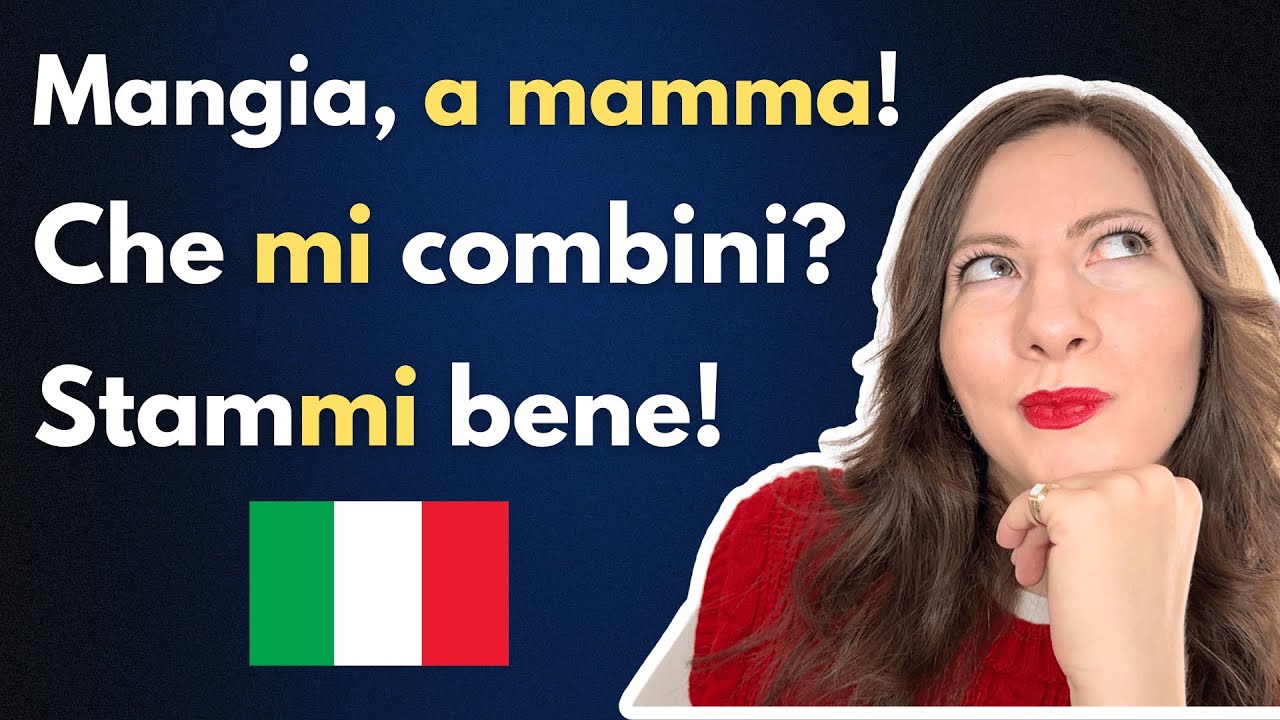
The Dativo Etico in Italian: What It Is and How It Works
What is the Dativo Etico?
The dativo etico is a personal pronoun (mi, ti, ci, vi) that is added to a sentence NOT to indicate who receives the action, but to express the emotional participation of the speaker or listener.
Example:
- “Ma che combini?” [What are you doing?] = neutral question
- “Ma che mi combini?” [What are you doing to me?] = question with emotional involvement (I’m worried)
Why is it Called “Dativo Etico”?
DATIVO [dative]: In Latin grammar, the dative was the case used for the indirect object (to whom? for whom?). In Italian, even though we no longer have Latin cases, we still use this term for some pronouns that indicate “to whom” or “for whom” the action occurs.
ETICO [ethical]: From the Greek “ethikos” (related to character, feelings), it expresses precisely this: an emotional, affective, psychological involvement. It doesn’t have a true grammatical function, but an emotional one!
Remember: It’s as if you’re adding a little piece of heart to the sentence!
The Grammatical Structure
The dativo etico is formed using these unstressed pronouns:
| Pronoun | Person | Function | Example |
|---|---|---|---|
| mi | 1st singular | Expresses the emotional participation of the speaker | Non mi sbagliare l’esame questa volta! [Don’t you fail the exam this time!] |
| ti | 2nd singular | Involves the interlocutor in the action | Stavo camminando e indovina chi ti incontro? [I was walking and guess who I bump into?] |
| ci | 1st plural | Expresses the emotional participation of the speaker (plural) | Stacci bene! [Take care of yourself!] |
| vi | 2nd plural | Involves the interlocutors in the action | Tua madre vi arriva domani? [Is your mother arriving tomorrow?] |
ATTENTION! The forms “gli“, “le” or “loro” do not exist for the dativo etico. Only these four pronouns are used!
Position of the Pronoun
| Verb Mood | Position | Example |
|---|---|---|
| Finite moods (indicative, subjunctive, conditional) | Before the verb | Che mi combini? [What are you up to?] |
| Imperative | After the verb (attached) | Mangiatemi tutto! [Eat everything for me!] |
| Infinitive | After the verb (attached) | Non farmi sciocchezze! [Don’t do silly things!] |
| Gerund | After the verb (attached) | Studiandomi bene, otterrai buoni risultati [By studying well, you’ll get good results] |
Main Uses of the Dativo Etico
1. Expressing Concern or Affectionate Interest
This is the most common use! It’s used to show that the speaker is emotionally involved in the action.
Examples:
- “Non mi prendere freddo!” [Don’t catch a cold!] (a worried mother talking to her son)
- “Studiatemi bene per l’esame!” [Study well for the exam!] (a teacher who cares about his students) In these cases, the speaker doesn't receive the action, but expresses their emotional involvement.
2. Expressing Surprise or Disapproval
The dativo etico is also used to express astonishment, wonder or disapproval:
Examples:
- “E adesso cosa mi hai inventato?” [And now what have you come up with?] (what are you thinking?!)
- “Mi è diventato un ribelle!” [He’s become a rebel on me!] (my son has changed and I’m surprised)
3. Emphasizing a Command or Request
When you want to make an imperative stronger or more affectionate, add the dativo etico:
Comparison:
| Without dativo etico | With dativo etico |
| “Non prendere freddo!” [Don’t catch a cold!] | “Non prendermi freddo eh!” [Don’t you catch a cold!] (more emphatic) |
| “State attenti!” [Be careful!] | “Statemi attenti in classe!” [You be careful in class!] (more personal) |
4. Expressing Annoyance or Impatience
Sometimes the dativo etico is used to express irritation:
Examples:
- “Non mi toccare niente!” [Don’t touch anything!] (I’m annoyed)
- “Che mi avete combinato?” [What have you done?] (I’m irritated)
- “Non mi fate rumore!” [Don’t make noise!] (I’m impatient)
The Affectionate Construction with “A Nonna”, “A Mamma”, “A Papà”
This is a VERY SWEET and VERY TYPICAL construction of colloquial Italian that confuses many foreigners! You’ve surely heard, especially from Italian grandmothers, phrases like:
- “Mangia, a nonna!” [Eat, for grandma!]
- “Dormi, a mamma!” [Sleep, for mom!]
- “Studia, a papà!” [Study, for dad!]
- “Sta’ buono, a nonno!” [Be good, for grandpa!]
What Does it Mean Exactly?
When a grandmother says “Mangia, a nonna!”, she is NOT asking the child to feed her!
She’s saying:
- “Mangia per far contenta la nonna” [Eat to make grandma happy]
- “Mangia, fallo per la nonna” [Eat, do it for grandma]
- “Mangia, così la nonna è felice” [Eat, so grandma is happy]
It’s a very tender way of expressing that the child’s action emotionally affects the grandmother. It’s like saying: “Se tu mangi, io sono contenta. Se tu non mangi, io sono triste e preoccupata.” [If you eat, I’m happy. If you don’t eat, I’m sad and worried.]
The Structure
| Formula: Imperative/Verb + comma + “a” + family name | |
|---|---|
| Phrase | Meaning |
| “Dormi, a mamma!” [Sleep, for mom!] | Sleep to keep mom calm |
| “Guarisci presto, a nonna!” [Get well soon, for grandma!] | Get well soon, so grandma stops worrying |
| “Sta’ attento, a papà!” [Be careful, for dad!] | Be careful, to keep dad calm |
| “Finisci i compiti, a zia!” [Finish your homework, for auntie!] | Finish your homework, to make auntie happy |
| “Non piangere, a nonno!” [Don’t cry, for grandpa!] | Don’t cry, because grandpa suffers to see you like this |
Why Do Italians (Especially Grandparents) Use It?
| Reason | Explanation |
|---|---|
| Express deep affection | It’s a way to say “I care so much about you and what you do” |
| Motivate gently | Instead of giving a dry command, they appeal to the child’s feelings |
| Create an emotional bond | They make the child understand that their actions have an impact on the loved one’s feelings |
| Generational tradition | It’s a formula passed down from generation to generation, part of the typical language of Italian grandparents |
When Is It Used?
This construction is mainly used:
- In the family: especially with small children
- By elderly people: grandmothers and grandfathers use it a lot!
- In very affectionate situations: to express tenderness and concern
- To encourage or console: “Mangia, a nonna!” when the child has no appetite
IMPORTANT: This construction is used almost exclusively with: nonna/nonno [grandma/grandpa], mamma/papà [mom/dad] (although less frequent), zia/zio [aunt/uncle] (occasionally).
It is NOT used with friends, colleagues, or in formal situations. It would be strange to say “Studia, al professore!” or “Lavora, al capo!”. This is a formula reserved for the closest family affections!
Regional Differences
| Region | Frequency of Use |
|---|---|
| Centro-Sud Italia [Central-Southern Italy] | Very commonly used, part of families’ daily language |
| Isole (Sicilia, Sardegna) [Islands (Sicily, Sardinia)] | Very common, felt as natural and affectionate |
| Nord Italia [Northern Italy] | Present, but slightly less frequent |
This construction is even more common in older generations. Italian grandparents use it very often!
An Interesting Comparison
| Type | Phrase | Tone |
|---|---|---|
| Neutral | “Mangia la minestra” [Eat the soup] | Simple command |
| With standard dativo etico | “Mangiami la minestra” [Eat the soup for me] | I am emotionally involved |
| With “a nonna” | “Mangia, a nonna!” [Eat, for grandma!] | Do it for me, to make me happy (the sweetest and most affectionate!) |
Stop reading Italian.
Start speaking it.
Online lessons in groups of 4, organised by level and goals, with qualified teachers. Pick the day and time that suit you from the available slots.
Max 4 students:
there’s a seat for you
Differences with Other Pronouns
It’s important to distinguish the dativo etico from other uses of pronouns. Let’s see some fundamental differences:
Dativo Etico vs. Indirect Object
| Type | Example | Explanation | Test |
|---|---|---|---|
| Indirect object | “Dammi il libro!” [Give me the book!] | The book is given TO ME, I receive it | “Dai il libro?” [Give the book?] ✗ (information is missing: to whom?) |
| Dativo etico | “Mangiami la pasta” [Eat the pasta for me] | I don’t eat, but I’m emotionally involved | “Mangia la pasta” [Eat the pasta] ✓ (makes sense, so it’s dativo etico) |
How to distinguish them? If you can remove the pronoun and the sentence still makes complete logical sense, it’s probably a dativo etico!
Dativo Etico vs. Reflexive Pronoun
| Type | Example | Explanation |
|---|---|---|
| Reflexive | “Mi lavo le mani” [I wash my hands] | I wash MY hands |
| Dativo etico | “Lavami le mani prima di mangiare!” [Wash your hands before eating!] | A mother telling her son to wash his hands, with emotional involvement |
When NOT to Use the Dativo Etico
| Situation | WRONG Example | CORRECT Example |
|---|---|---|
| Very formal situations | “Presidente, mi ascolti attentamente” [President, listen to me carefully] | “Presidente, ascolti attentamente” [President, listen carefully] |
| Formal written texts | Official documents, formal letters, scientific articles with dativo etico | Avoid the dativo etico completely |
| With strangers | “Mi studi bene!” [Study well for me!] (to a stranger) | “Studi bene!” [Study well!] |
| “a nonna/mamma” construction outside family | “Lavora bene, al capo!” [Work well, for the boss!] | Never use this form outside the family context! |
REMEMBER: When the sentence becomes ambiguous, sometimes adding the pronoun can create confusion, so it’s better to be clear!
Practical Examples to Practice
Analyze these sentences and identify if there’s a DATIVO ETICO (and what type), or NO (and in that case, what function do the pronouns have).
Example 1: “Mi Hanno Rubato il Portafoglio!”
Analysis: In this case “mi” is an indirect object: they stole THE WALLET FROM ME. I am the person from whom it was stolen.
Conclusion: It is NOT a dativo etico!
Test: If we remove the “mi“, the sentence doesn’t make sense: “Hanno rubato il portafoglio” (from whom? essential information is missing).
Example 2: “Non Mi Fare Sciocchezze!”
Analysis: The speaker isn’t doing the silly things, but expresses concern for the other person.
Conclusion: Standard DATIVO ETICO!
Test: If we remove the “mi“, the sentence still makes sense: “Non fare sciocchezze!” [Don’t do silly things!]. The “mi” only adds emotional involvement.
Example 3: “Dormi, a Mamma!”
Analysis: The mother isn’t sleeping, but asks the child to sleep to keep her calm.
Conclusion: Affectionate construction with “a mamma“!
Meaning: “Dormi, per far contenta la mamma” [Sleep, to make mom happy] or “Dormi, così la mamma è serena” [Sleep, so mom is calm]. It’s very typical of family language, especially used with children!
Example 4: “Studiatemi Bene Questa Lezione!”
Analysis: The teacher doesn’t receive the study, but expresses their interest and concern that students study well.
Conclusion: Standard DATIVO ETICO!
Test: We can say “Studiate bene questa lezione” [Study this lesson well] and the sentence makes complete sense.
Example 5: “Mangia Tutta la Minestra, a Nonna!”
Analysis: The grandmother isn’t eating the soup, but is asking her grandchild to eat it to make her happy.
Conclusion: Very sweet construction with “a nonna“!
Meaning: “Mangia tutta la minestra, così la nonna è contenta” [Eat all the soup, so grandma is happy]. This is exactly the typical phrase that an Italian grandmother would say to her grandchild!
Example 6: “Mi Sveglio Sempre alle 7.”
Analysis: I wake myself up.
Conclusion: It is NOT a dativo etico! “Mi” is a reflexive pronoun, part of the reflexive verb “svegliarsi” [to wake up].
Summary Chart
| Feature | Dativo Etico |
|---|---|
| Pronouns used | mi, ti, ci, vi |
| Function | Express emotional participation |
| Test to recognize it | Can be removed and the sentence still makes complete sense |
| Linguistic register | Colloquial, informal |
| Where NOT to use it | Formal situations, official texts, with strangers |
| Special construction | “a nonna/mamma/papà” (only in family with children) |
| Emotions expressed | Concern, affection, surprise, disapproval, annoyance |
Final tip: When you hear an Italian say “mi raccomando” [I beg you], “non mi fare sciocchezze” [don’t do silly things] or a grandmother saying “Dormi, a nonna!” [Sleep, for grandma!], now you know exactly what’s happening and how much affection is behind those words! This structure so Italian and so expressive, including that very tender construction with “Mangia, a nonna!” [Eat, for grandma!], perfectly represents the warmth of Italian families!
If this topic interests you and you want to delve deeper, we recommend reading the article dedicated to Italian reflexive verbs!
Do pronominal verbs trip you up and fill you with doubts? Turn confusion into confidence with our exclusive course: “Da «Non ce la faccio più» a «Ora me la cavo»: i verbi pronominali in 30 giorni.” With fun, bite-size lessons and targeted practice, you’ll learn to use them naturally in just one month.
Want the lesson PDF with exercises and solutions?
Join the LearnAmo AcademyLoading quiz…
Podcast: Play in new window | Download (Duration: 30:20 — 41.9MB)
Iscriviti: Apple Podcasts | Spotify | Android | iHeartRadio | Podcast Index | TuneIn | Deezer | RSS | Altri...