


The Italian vocabulary contains around 270,000 words, but in everyday life we always use the same ones! Studies show that about 50% of everything we say is made up of the same 150-200 words. By mastering the most frequent words, you’ll be able to understand most Italian conversations.
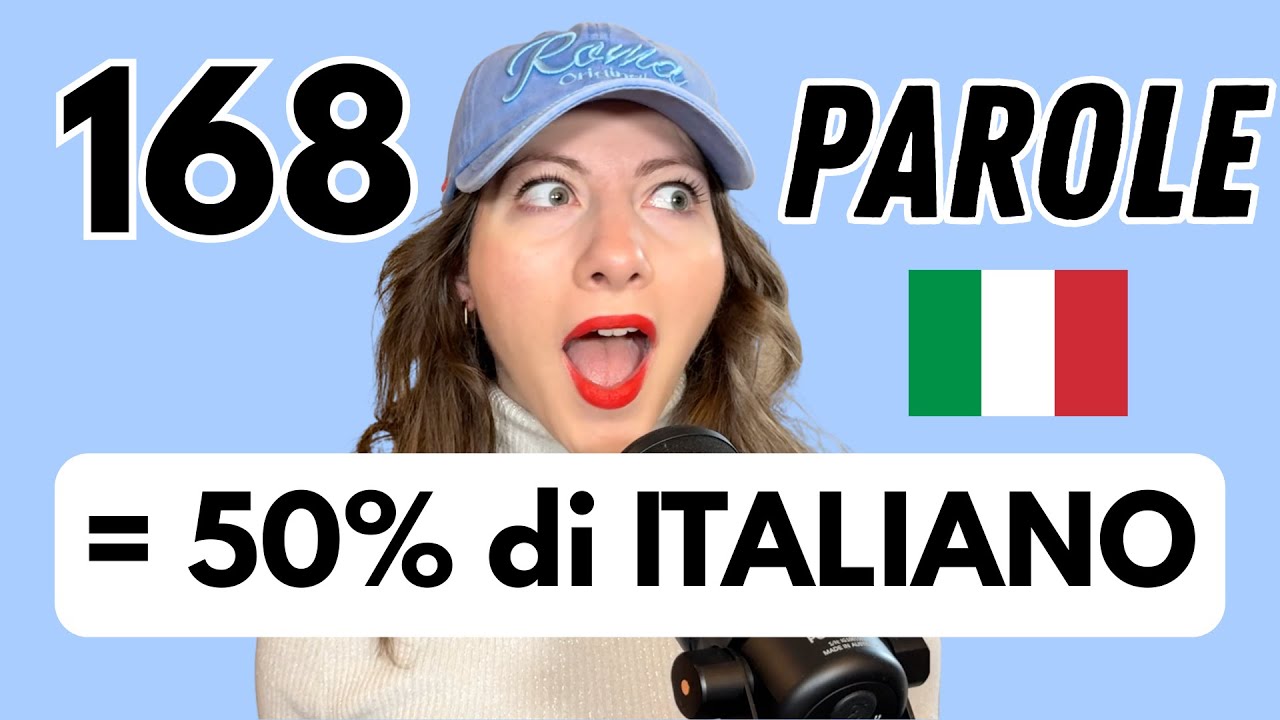
The 220 Most Common Italian Words: Complete Guide to Essential Vocabulary
Nouns: The Words That Name the World
The noun (also called “name”) is a fundamental word we use to identify people, animals, things, places, or abstract concepts. It’s the protagonist of the sentence: without it, we wouldn’t know what we’re talking about.
Categories of Nouns
| Category | Examples |
|---|---|
| People | mamma [mom], dottore [doctor], studente [student], bambino [child] |
| Animals | gatto [cat], cane [dog], farfalla [butterfly] |
| Things | tavolo [table], telefono [phone], pizza [pizza] |
| Places | Roma [Rome], parco [park], ristorante [restaurant], casa [house] |
| Abstract concepts | amore [love], felicità [happiness], libertà [freedom], tempo [time] |
The 30 Most Common Nouns in Italian
| N° | Noun | Meaning | Example |
|---|---|---|---|
| 1 | Cosa [thing] | An object, an element, something indefinite | Mi piace questa cosa. [I like this thing] |
| 2 | Tempo [time] | Hours, minutes, the duration of something | Non ho tempo per uscire stasera. [I don’t have time to go out tonight.] |
| 3 | Giorno [day] | A period of 24 hours | Che bel giorno! C’è il sole! [What a beautiful day! The sun is out!] |
| 4 | Anno [year] | A period of 12 months, 365 days | Quest’anno voglio imparare l’italiano! [This year I want to learn Italian!] |
| 5 | Uomo [man] | An adult male human being | Quell’uomo con la barba è mio zio. [That man with the beard is my uncle.] |
| 6 | Donna [woman] | An adult female human being | La donna con i capelli rossi è la mia professoressa. [The woman with red hair is my professor.] |
| 7 | Mondo [world] | Planet Earth and everything it contains | L’Italia è il paese più bello del mondo! [Italy is the most beautiful country in the world!] |
| 8 | Vita [life] | Existence, the period between birth and death | La vita è troppo breve per essere tristi. [Life is too short to be sad.] |
| 9 | Mano [hand] | The body part at the end of the arm | Dammi la mano, attraversiamo la strada. [Give me your hand, let’s cross the street.] |
| 10 | Parte [part] | A portion, a piece of something | Questa è la parte più difficile del libro. [This is the most difficult part of the book.] |
| 11 | Occhio [eye] | The body organ with which we see | Ha gli occhi verdi come il mare. [She has green eyes like the sea.] |
| 12 | Casa [house/home] | The place where you live, your dwelling | Torno a casa alle sette. [I’m going home at seven.] |
| 13 | Momento [moment] | An instant, a brief period of time | Aspetta un momento, arrivo subito! [Wait a moment, I’ll be right there!] |
| 14 | Paese [country/village] | A nation, or a small inhabited center | L’Italia è un paese con molta storia. [Italy is a country with a lot of history.] |
| 15 | Modo [way] | The manner in which something is done | Non mi piace il suo modo di parlare. [I don’t like his way of speaking.] |
| 16 | Punto [point] | A mark, a precise position, a topic | Questo è un punto importante. [This is an important point.] |
| 17 | Lavoro [work/job] | The activity you do to earn money, profession | Il mio lavoro è molto interessante. [My job is very interesting.] |
| 18 | Fatto [fact] | Something that happened, a real event | Questo è un fatto, non un’opinione. [This is a fact, not an opinion.] |
| 19 | Problema [problem] | A difficulty, a situation to solve | Nessun problema, ti aiuto io! [No problem, I’ll help you!] |
| 20 | Gente [people] | People in general, a group of individuals | C’è molta gente in piazza oggi. [There are many people in the square today.] |
| 21 | Notte [night] | The dark period, when the sun is not there | Buonanotte! Dormi bene! [Good night! Sleep well!] |
| 22 | Acqua [water] | The transparent liquid we drink | Vorrei un bicchiere d’acqua, per favore. [I would like a glass of water, please.] |
| 23 | Ora [hour/now] | A period of 60 minutes, or the present moment | Che ora è? Sono le tre. [What time is it? It’s three o’clock.] |
| 24 | Parola [word] | A sound or group of letters with a meaning | Non trovo le parole giuste. [I can’t find the right words.] |
| 25 | Città [city] | A large urban center with many inhabitants | Milano è una città molto moderna. [Milan is a very modern city.] |
| 26 | Amico [friend] | A dear person with whom you have an emotional bond | Marco è il mio migliore amico. [Marco is my best friend.] |
| 27 | Famiglia [family] | The group of people related by kinship | La mia famiglia è molto grande. [My family is very large.] |
| 28 | Strada [street/road] | The path where people walk | Questa strada porta al centro. [This street leads to the center.] |
| 29 | Bambino [child] | A very young human being | Il bambino gioca nel parco. [The child plays in the park.] |
| 30 | Cuore [heart] | The organ that pumps blood, symbol of love | Ti amo con tutto il cuore! [I love you with all my heart!] |
Pronouns: The Words That Replace Nouns
The word “pronoun” comes from Latin and literally means “in place of the noun”. The pronoun is a word that replaces a noun to avoid repeating it too many times. Without pronouns we would say: “Marco is nice. Marco lives in Rome. Marco works in a bank.” With pronouns instead: “Marco is nice. He lives in Rome and works in a bank.”
Subject Personal Pronouns
Subject personal pronouns indicate who performs the action of the verb. They are the first words you learn when studying a language.
| N° | Pronoun | Person | Example |
|---|---|---|---|
| 31 | Io [I] | 1st singular | Io sono italiana. [I am Italian.] |
| 32 | Tu [you] | 2nd singular | Tu sei molto gentile. [You are very kind.] |
| 33 | Lui [he] | 3rd singular masculine | Lui è mio fratello. [He is my brother.] |
| 34 | Lei [she] | 3rd singular feminine | Lei è la mia insegnante. [She is my teacher.] |
| 35 | Noi [we] | 1st plural | Noi siamo studenti. [We are students.] |
| 36 | Voi [you (plural)] | 2nd plural | Voi siete fantastici! [You are fantastic!] |
| 37 | Loro [they] | 3rd plural | Loro vivono a Napoli. [They live in Naples.] |
Linguistic curiosity: In Italian, we often omit the subject pronoun because the verb ending already tells us who is performing the action. For example: “Sono italiana” instead of “Io sono italiana” – it’s already understood that I’m talking about myself!
Object Personal Pronouns
Object personal pronouns indicate who receives the action or to whom/for whom something is done. They are divided into direct pronouns (answering the question “who?” or “what?”) and indirect pronouns (answering the question “to whom?”).
| N° | Pronoun | Type | Example |
|---|---|---|---|
| 38 | Me [me] | Stressed | Questo regalo è per me? [Is this gift for me?] |
| 39 | Te [you] | Stressed | Penso sempre a te. [I always think of you.] |
| 40 | Lo [him/it] | Direct (him/it) | Lo vedo ogni giorno. [I see him every day.] |
| 41 | La [her/it] | Direct (her/it) | La chiamo domani. [I’ll call her tomorrow.] |
| 42 | Li [them (m.)] | Direct (them, masculine) | Li ho incontrati al bar. [I met them at the bar.] |
| 43 | Le [them (f.)] | Direct (them, feminine) | Le ho comprate ieri. [I bought them yesterday.] |
| 44 | Ci [us] | Direct/Indirect (us) | Ci vediamo domani! [See you tomorrow!] |
| 45 | Vi [you (pl.)] | Direct/Indirect (you) | Vi aspetto alle otto. [I’ll wait for you at eight.] |
| 46 | Gli [to him/to them] | Indirect (to him/to them) | Gli ho dato il libro. [I gave him the book.] |
| 47 | Ne [of it/some] | Partitive | Ne vuoi un po’? [Do you want some?] |
Demonstrative Pronouns
Demonstrative pronouns are used to point to something or someone by specifying their position in space or time relative to the speaker. Questo/a/i/e indicates something near; quello/a/i/e indicates something far.
| N° | Pronoun | Gender/Number | Example |
|---|---|---|---|
| 48 | Questo [this] | Masculine singular | Questo è il mio cane. [This is my dog.] |
| 49 | Quello [that] | Masculine singular | Quello è il ristorante che ti dicevo. [That is the restaurant I was telling you about.] |
| 50 | Questa [this] | Feminine singular | La mia pizza è questa! [My pizza is this one!] |
| 51 | Quella [that] | Feminine singular | Mia cugina è quella. [My cousin is that one. ] |
| 52 | Questi [these] | Masculine plural | Questi sono i miei genitori. [These are my parents.] |
| 53 | Quelli [those] | Masculine plural | Quelli sono i miei libri preferiti. [Those are my favorite books.] |
Indefinite Pronouns
Indefinite pronouns are used when we don’t want to or can’t be precise about who or what we’re talking about. They indicate something or someone in a vague, generic way.
| N° | Pronoun | Use | Example |
|---|---|---|---|
| 54 | Qualcuno [someone] | Indeterminate person (affirmative) | C’è qualcuno in casa? [Is anyone home?] |
| 55 | Nessuno [no one] | No person | Nessuno mi ha detto niente! [No one told me anything!] |
| 56 | Qualcosa [something] | Indeterminate thing (affirmative) | Vuoi qualcosa da bere? [Do you want something to drink?] |
| 57 | Niente/Nulla [nothing] | No thing | Non ho capito niente. [I didn’t understand anything.] |
| 58 | Tutto [everything] | The totality (singular) | Ho mangiato tutto! [I ate everything!] |
| 59 | Tutti [everyone] | The totality (plural, people) | Tutti amano la pasta! [Everyone loves pasta!] |
| 60 | Altro [other/another] | Something/someone different | Ti piace il caffè? Ne vuoi un altro? [Do you like coffee? Do you want another one?] |
| 61 | Molto [much/a lot] | Large quantity | Ho molto da fare oggi. [I have a lot to do today.] |
| 62 | Poco [little/few] | Small quantity | Serve tempo e io ne ho poco. [It takes time and I have little of it.] |
| 63 | Tanto [so much] | Large quantity (intensive) | Bene? Te ne voglio tanto.[Honey? I love you so much.] |
Relative and Interrogative Pronouns
Relative pronouns connect two sentences by referring to an element already mentioned. They work like a bridge between two ideas! Interrogative pronouns are used to ask questions about people, things, quantity, or quality.
| N° | Pronoun | Type | Example |
|---|---|---|---|
| 64 | Che [that/which/who] | Relative | Il film che ho visto era bellissimo. [The movie that I saw was beautiful.] |
| 65 | Chi [who] | Relative/Interrogative | Chi dorme non piglia pesci! [He who sleeps doesn’t catch fish!] |
| 66 | Cui [whom/which] | Relative | La persona di cui ti parlavo è arrivata. [The person I was telling you about has arrived.] |
| 67 | Quale [which] | Relative/Interrogative | Non so quale scegliere. [I don’t know which one to choose.] |
| 68 | Che cosa / Cosa [what] | Interrogative | Che cosa fai stasera? [What are you doing tonight?] |
| 69 | Quanto [how much] | Interrogative | Quanto costa questo? [How much does this cost?] |
| 70 | Dove [where] | Interrogative | Dove vai? [Where are you going?] |
| 71 | Perché [why] | Interrogative | Perché piangi? [Why are you crying?] |
Verbs: The Heart of the Italian Sentence
The verb is the heart of the sentence, the most important word. Without a verb, there is no sentence. It expresses an action (eating, running, speaking), a state (being, staying, seeming), or an event (happening, occurring). It also tells us when something happens and who performs the action.
Auxiliary Verbs
Auxiliary verbs (“auxiliary” means “that helps”) are verbs that help other verbs form compound tenses, like the present perfect. In Italian, there are two auxiliary verbs: ESSERE (to be) and AVERE (to have).
| N° | Auxiliary | Use | Simple Example | Compound Example |
|---|---|---|---|---|
| 72 | Essere [to be] | State, identity, verbs of movement | Sono felice di conoscerti! [I’m happy to meet you!] | Sono andato a Roma. [I went to Rome.] |
| 73 | Avere [to have] | Possession, transitive verbs | Ho due gatti e un cane. [I have two cats and a dog.] | Ho mangiato la pizza. [I ate the pizza.] |
Modal Verbs
Modal verbs (also called “servile” because they “serve” other verbs) express the modality with which an action is performed: whether it’s possible, necessary, desired, or if one has the ability to do it. They are always followed by another verb in the infinitive!
| N° | Verb | Expresses | Example |
|---|---|---|---|
| 74 | Potere [can/to be able to] | Possibility/Ability | Posso aiutarti? [Can I help you?] |
| 75 | Dovere [must/to have to] | Necessity/Obligation | Devo studiare per l’esame. [I have to study for the exam.] |
| 76 | Volere [to want] | Desire/Intention | Voglio un gelato al cioccolato! [I want a chocolate ice cream!] |
| 77 | Sapere + infinitive [to know how to] | Acquired ability | Sai suonare la chitarra? [Do you know how to play the guitar?] |
Most Common Verbs
Fundamental Action Verbs
| N° | Verb | Example |
|---|---|---|
| 78 | Fare [to do/to make] | Cosa fai di bello oggi? [What are you up to today?] |
| 79 | Dire [to say/to tell] | Cosa hai detto? Non ho sentito. [What did you say? I didn’t hear.] |
| 80 | Andare [to go] | Vado al supermercato. Ti serve qualcosa? [I’m going to the supermarket. Do you need anything?] |
| 81 | Venire [to come] | Vieni alla festa sabato? [Are you coming to the party on Saturday?] |
| 82 | Vedere [to see] | Vedo che sei stanco. Riposati! [I see that you’re tired. Rest!] |
| 83 | Dare [to give] | Mi dai una mano? [Can you give me a hand?] |
| 84 | Stare [to stay/to be] | Come stai? Tutto bene? [How are you? All good?] |
| 85 | Sapere [to know] | Non so dove ho messo le chiavi! [I don’t know where I put the keys!] |
| 86 | Pensare [to think] | Penso che tu abbia ragione. [I think you’re right.] |
| 87 | Credere [to believe] | Non ci credo! È incredibile! [I don’t believe it! It’s incredible!] |
| 88 | Trovare [to find] | Ho trovato un ristorante fantastico! [I found a fantastic restaurant!] |
| 89 | Prendere [to take] | Prendo un caffè, grazie. [I’ll have a coffee, thanks.] |
| 90 | Mettere [to put] | Metti la giacca, fa freddo! [Put on your jacket, it’s cold!] |
Communication and Perception Verbs
| N° | Verb | Example |
|---|---|---|
| 91 | Parlare [to speak] | Parli italiano molto bene! [You speak Italian very well!] |
| 92 | Sentire [to hear/to feel] | Senti che profumo di pizza! [Smell that pizza aroma!] |
| 93 | Capire [to understand] | Non capisco questa parola. [I don’t understand this word.] |
| 94 | Chiamare [to call] | Ti chiamo dopo. [I’ll call you later.] |
| 95 | Guardare [to watch/to look] | Guardiamo un film insieme? [Shall we watch a movie together?] |
| 96 | Aspettare [to wait] | Aspettami! Arrivo! [Wait for me! I’m coming!] |
| 97 | Leggere [to read] | Leggo un libro ogni mese. [I read a book every month.] |
| 98 | Scrivere [to write] | Scrivo una mail al mio capo. [I’m writing an email to my boss.] |
Movement Verbs
| N° | Verb | Example |
|---|---|---|
| 99 | Partire [to leave/to depart] | Parto domani mattina presto. [I’m leaving tomorrow morning early.] |
| 100 | Arrivare [to arrive] | A che ora arrivi? [What time are you arriving?] |
| 101 | Tornare [to return] | Torno subito! [I’ll be right back!] |
| 102 | Entrare [to enter] | Posso entrare? [May I come in?] |
| 103 | Uscire [to go out] | Esco con gli amici stasera. [I’m going out with friends tonight.] |
| 104 | Passare [to pass/to stop by] | Passa a trovarmi quando vuoi! [Stop by to see me whenever you want!] |
| 105 | Rimanere [to stay/to remain] | Rimango a casa stasera. [I’m staying home tonight.] |
Everyday Life Verbs
| N° | Verb | Example |
|---|---|---|
| 106 | Lavorare [to work] | Lavoro in un’azienda italiana. [I work for an Italian company.] |
| 107 | Mangiare [to eat] | Mangiamo fuori stasera? [Shall we eat out tonight?] |
| 108 | Dormire [to sleep] | Ho dormito benissimo stanotte! [I slept very well last night!] |
| 109 | Giocare [to play] | I bambini giocano in giardino. [The children are playing in the garden.] |
| 110 | Vivere [to live] | Vivo in Italia da cinque anni. [I’ve been living in Italy for five years.] |
| 111 | Aprire [to open] | Apri la finestra, per favore. [Open the window, please.] |
| 112 | Chiudere [to close] | Chiudi la porta, c’è corrente! [Close the door, there’s a draft!] |
Other Essential Verbs
| N° | Verb | Example |
|---|---|---|
| 113 | Sembrare [to seem] | Sembri stanco oggi. [You seem tired today.] |
| 114 | Piacere [to like] | Mi piace molto questo corso! [I really like this course!] |
| 115 | Cercare [to look for] | Cerco le mie chiavi da un’ora! [I’ve been looking for my keys for an hour!] |
| 116 | Portare [to bring/to carry] | Ti porto un regalo! [I’m bringing you a gift!] |
| 117 | Lasciare [to leave/to let] | Lascia stare, non preoccuparti. [Let it go, don’t worry.] |
| 118 | Conoscere [to know (people/places)] | Conosci quel ragazzo? [Do you know that guy?] |
| 119 | Perdere [to lose] | Ho perso il treno! [I missed the train!] |
| 120 | Finire [to finish] | Ho finito i compiti! [I finished the homework!] |
| 121 | Cominciare/Iniziare [to begin/to start] | Il film comincia alle nove. [The movie starts at nine.] |
| 122 | Cambiare [to change] | Devo cambiare lavoro. [I need to change jobs.] |
| 123 | Provare [to try] | Prova questo dolce, è squisito! [Try this dessert, it’s delicious!] |
| 124 | Ricordare [to remember] | Non ricordo il suo nome. [I don’t remember his name.] |
Stop reading Italian.
Start speaking it.
Online lessons in groups of 4, organised by level and goals, with qualified teachers. Pick the day and time that suit you from the available slots.
Max 4 students:
there’s a seat for you
Adjectives: The Words That Describe
The adjective is a word that is “added” to the noun to describe, qualify, or determine it better. It tells us WHAT something or someone is LIKE. In Italian, the adjective must agree with the noun in gender (masculine/feminine) and number (singular/plural). Examples: Il ragazzo alto [The tall boy] / La ragazza alta [The tall girl] / I ragazzi alti [The tall boys] / Le ragazze alte [The tall girls].
Qualifying Adjectives
Qualifying adjectives describe a quality of the noun: how it looks, what characteristics it has, what sensations it provokes.
| N° | Adjective | Meaning | Example |
|---|---|---|---|
| 125 | Grande [big/great] | Of notable dimensions | Roma è una grande città. [Rome is a big city.] |
| 126 | Piccolo [small] | Of reduced dimensions | Ho un piccolo appartamento. [I have a small apartment.] |
| 127 | Bello [beautiful] | Aesthetically pleasing | Che bella giornata! [What a beautiful day!] |
| 128 | Brutto [ugly/bad] | Not aesthetically pleasing | Che brutto tempo oggi! [What bad weather today!] |
| 129 | Buono [good] | Of positive quality, tasty | Questo vino è molto buono. [This wine is very good.] |
| 130 | Cattivo [bad] | Of negative quality | Non è una cattiva idea. [It’s not a bad idea.] |
| 131 | Nuovo [new] | Recent, just acquired | Ho comprato un telefono nuovo. [I bought a new phone.] |
| 132 | Vecchio [old] | Ancient, from a long time ago | Questa è una vecchia foto. [This is an old photo.] |
| 133 | Lungo [long] | Of great extension | È stata una lunga giornata. [It was a long day.] |
| 134 | Alto [tall/high] | Of elevated stature | Mio fratello è molto alto. [My brother is very tall.] |
| 135 | Giovane [young] | Of little age | È una ragazza giovane e ambiziosa. [She’s a young and ambitious girl.] |
| 136 | Stesso [same] | Identical | Abbiamo la stessa età. [We are the same age.] |
| 137 | Ultimo [last] | Final, that comes at the end | Questo è l’ultimo treno. [This is the last train.] |
| 138 | Primo [first] | Initial, that comes at the beginning | È il mio primo viaggio in Italia! [It’s my first trip to Italy!] |
| 139 | Vero [true/real] | Real, authentic | È una storia vera. [It’s a true story.] |
| 140 | Possibile [possible] | That can happen | È possibile cambiare la data? [Is it possible to change the date?] |
| 141 | Certo [certain/sure] | Sure, convinced | Sono certo che andrà tutto bene. [I’m certain everything will be fine.] |
| 142 | Solo [only/alone] | Only, solely | Sono solo stanco, niente di grave. [I’m just tired, nothing serious.] |
| 143 | Proprio [own] | Personal, specific | Ho visto con i miei propri occhi! [I saw it with my own eyes!] |
| 144 | Diverso [different] | Different, not the same | Siamo molto diversi, ma siamo amici. [We are very different, but we are friends.] |
Possessive Adjectives
Possessive adjectives indicate to whom something or someone belongs. In Italian, unlike other languages, the possessive adjective is almost always preceded by the article. Examples: il mio libro [my book], la tua casa [your house].
| N° | Person | Masc. sing. | Fem. sing. | Masc. plur. | Fem. plur. |
|---|---|---|---|---|---|
| 145 | I | mio [my] | mia [my] | miei [my] | mie [my] |
| 146 | You | tuo [your] | tua [your] | tuoi [your] | tue [your] |
| 147 | He/She | suo [his/her] | sua [his/her] | suoi [his/her] | sue [his/her] |
| 148 | We | nostro [our] | nostra [our] | nostri [our] | nostre [our] |
| 149 | You (pl.) | vostro [your] | vostra [your] | vostri [your] | vostre [your] |
| 150 | They | loro [their] (invariable) | |||
Important exception! With singular family member names, we don’t use the article. Examples: mia madre [my mother], tuo fratello [your brother], sua sorella [his/her sister]. But in the plural, yes. Examples: i miei genitori [my parents], le tue sorelle [your sisters].
Adverbs: The Words That Modify
The adverb is an invariable word (it never changes form!) that serves to modify or specify the meaning of a verb (Corro velocemente [I run quickly]), an adjective (È molto bella [She is very beautiful]), another adverb (Parla troppo piano [He speaks too quietly]), or an entire sentence (Purtroppo non posso venire [Unfortunately I can’t come]). Adverbs answer questions like: How? When? Where? How much? Why?
Adverbs of Negation
| N° | Adverb | Example |
|---|---|---|
| 151 | Non [not] | Non capisco. [I don’t understand.] |
| 152 | Mai [never] | Non arrivo mai in ritardo. [I never arrive late.] |
Adverbs of Quantity
| N° | Adverb | Example |
|---|---|---|
| 153 | Più [more] | Non ne posso più! [I can’t take it anymore!] |
| 154 | Molto [very/much] | Ti amo molto. [I love you very much.] |
| 155 | Poco [little] | Mangio poco la sera. [I eat little in the evening.] |
| 156 | Tanto [so much] | Grazie tanto! [Thanks so much!] |
Adverbs of Time
| N° | Adverb | Example |
|---|---|---|
| 157 | Sempre [always] | Ti penso sempre. [I always think of you.] |
| 158 | Ora/Adesso [now] | Adesso devo andare. [I have to go now.] |
| 159 | Ancora [still/again] | Vuoi ancora un po’ di pasta? [Do you want some more pasta?] |
| 160 | Già [already] | Hai già mangiato? [Have you already eaten?] |
| 161 | Poi [then] | Prima mangiamo, poi usciamo. [First we eat, then we go out.] |
| 162 | Prima [before/first] | Prima il dovere, poi il piacere! [Duty first, then pleasure!] |
| 163 | Dopo [after] | Ci vediamo dopo. [See you later.] |
| 164 | Subito [immediately] | Vengo subito! [I’m coming right away!] |
| 165 | Presto [soon/early] | Ci vediamo presto! [See you soon!] |
| 166 | Tardi [late] | È tardi, devo andare. [It’s late, I have to go.] |
Adverbs of Place
| N° | Adverb | Example |
|---|---|---|
| 167 | Qui/Qua [here] | Vieni qui! [Come here!] |
| 168 | Lì/Là [there] | Il ristorante è là, dietro l’angolo. [The restaurant is there, around the corner.] |
| 169 | Vicino [near] | Abito vicino alla stazione. [I live near the station.] |
| 170 | Lontano [far] | Roma è lontano da qui. [Rome is far from here.] |
| 171 | Fuori [outside] | Andiamo fuori! [Let’s go outside!] |
Adverbs of Manner and Other Useful Adverbs
| N° | Adverb | Type | Example |
|---|---|---|---|
| 172 | Bene [well] | Manner | Stai bene? [Are you okay?] |
| 173 | Male [badly] | Manner | Mi sento male. [I feel sick.] |
| 174 | Così [so/like this] | Manner | Perché sei così felice? [Why are you so happy?] |
| 175 | Insieme [together] | Manner | Facciamolo insieme! [Let’s do it together!] |
| 176 | Come [how/like] | Manner/Interrogative | Come stai? [How are you?] |
| 177 | Anche [also/too] | Additive | Anche io voglio venire! [I want to come too!] |
| 178 | Solo/Soltanto [only] | Limitative | Ho solo cinque minuti. [I only have five minutes.] |
| 179 | Forse [maybe/perhaps] | Dubitative | Forse vengo anch’io. [Maybe I’ll come too.] |
| 180 | Quasi [almost] | Approximative | Sono quasi arrivato. [I’m almost there.] |
| 181 | Proprio [really/exactly] | Reinforcing | È proprio vero! [It’s really true!] |
Prepositions: The Words That Connect
Prepositions are invariable words that serve to connect words or sentences, establishing a relationship between them. They indicate relationships of place (Vado a Roma [I’m going to Rome]), time (Arrivo tra un’ora [I’ll arrive in an hour]), manner (Parlo con calma [I speak calmly]), cause (Tremo per il freddo [I’m shivering from the cold]), and possession (Il libro di Marco [Marco’s book]).
Simple Prepositions
In Italian, there are nine fundamental simple prepositions: di, a, da, in, con, su, per, tra, fra. These can combine with articles to form articulated prepositions (del, al, dal, nel, sul…).
| N° | Preposition | Main Use | Example |
|---|---|---|---|
| 182 | Di [of/from] | Origin, possession, material | Sono di Roma. [I’m from Rome.] |
| 183 | A [to/at] | Destination, time | Vado a scuola. [I’m going to school.] |
| 184 | Da [from/by/at] | Provenance, agent | Vengo da te alle cinque. [I’m coming to your place at five.] |
| 185 | In [in] | Location, means | Vivo in Italia. [I live in Italy.] |
| 186 | Con [with] | Company, instrument | Esco con Maria. [I’m going out with Maria.] |
| 187 | Su [on] | Position above | Il libro è sul tavolo. [The book is on the table.] |
| 188 | Per [for] | Purpose, recipient | Questo regalo è per te. [This gift is for you.] |
| 189 | Tra/Fra [between/in] | Interval of time/space | Arrivo tra dieci minuti. [I’ll arrive in ten minutes.] |
Other Useful Prepositions
| N° | Preposition | Example |
|---|---|---|
| 190 | Senza [without] | Caffè senza zucchero, per favore. [Coffee without sugar, please.] |
| 191 | Sopra [above] | L’aereo vola sopra le nuvole. [The plane flies above the clouds.] |
| 192 | Sotto [under] | Il gatto è sotto il letto. [The cat is under the bed.] |
| 193 | Dentro [inside] | Cosa c’è dentro la scatola? [What’s inside the box?] |
| 194 | Verso [toward] | Cammino verso casa. [I’m walking toward home.] |
| 195 | Dopo [after] | Ci vediamo dopo cena. [See you after dinner.] |
| 196 | Durante [during] | Non parlare durante il film! [Don’t talk during the movie!] |
| 197 | Fino [until] | Aspetto fino alle cinque. [I’ll wait until five.] |
Articles: The Small but Fundamental Words
The article is a small word placed before the noun that gives us information about it: whether it’s masculine or feminine, whether it’s singular or plural, whether it’s specific (definite) or generic (indefinite). Example: Il gatto [The cat] → a specific cat, one I know; Un gatto [A cat] → any cat, generic.
Definite Articles
Definite articles are used when we talk about something specific, known, already mentioned.
| N° | Article | Use | Example |
|---|---|---|---|
| 198 | Il [the] | Masculine singular before consonant | Il sole splende. [The sun is shining.] |
| 199 | Lo [the] | Masculine singular before s+consonant, z, gn, ps, x, y | Lo studente studia. [The student is studying.] |
| 200 | La [the] | Feminine singular | La luna è bella. [The moon is beautiful.] |
| 201 | L’ [the] | Singular before vowel | L’amore è tutto. [Love is everything.] |
| 202 | I [the] | Masculine plural before consonant | I ragazzi giocano. [The boys are playing.] |
| 203 | Gli [the] | Masculine plural before vowel, s+consonant, z… | Gli amici sono importanti. [Friends are important.] |
| 204 | Le [the] | Feminine plural | Le ragazze ridono. [The girls are laughing.] |
Indefinite Articles
Indefinite articles are used when we talk about something generic, non-specific, mentioned for the first time.
| N° | Article | Use | Example |
|---|---|---|---|
| 205 | Un [a/an] | Masculine singular | Ho visto un film. [I saw a movie.] |
| 206 | Uno [a/an] | Masculine singular before s+consonant, z… | C’è uno sbaglio. [There’s a mistake.] |
| 207 | Una [a/an] | Feminine singular | Vorrei una pizza. [I would like a pizza.] |
| 208 | Un’ [a/an] | Feminine singular before vowel | Ho un’idea! [I have an idea!] |
Conjunctions: The Words That Unite Ideas
Conjunctions are invariable words that serve to unite words, sentences, or parts of a sentence. They are like the glue that holds ideas together! There are different types: copulative (add), disjunctive (give alternatives), adversative (oppose), causal (explain the cause), and temporal (indicate time).
The 12 Most Common Conjunctions
| N° | Conjunction | Type | Function | Example |
|---|---|---|---|---|
| 209 | E [and] | Copulative | Unites two elements | Pane e Nutella. [Bread and Nutella.] |
| 210 | O [or] | Disjunctive | Gives an alternative | Tè o caffè? [Tea or coffee?] |
| 211 | Ma [but] | Adversative | Contrasts | È piccolo ma accogliente. [It’s small but cozy.] |
| 212 | Però [however] | Adversative | Contrasts | Mi piace, però è caro. [I like it, however it’s expensive.] |
| 213 | Perché [because] | Causal | Explains the cause | Studio perché voglio imparare. [I study because I want to learn.] |
| 214 | Che [that] | Declarative | Introduces a subordinate | Penso che sia giusto. [I think that it’s right.] |
| 215 | Se [if] | Conditional | Introduces a condition | Se vuoi, possiamo uscire. [If you want, we can go out.] |
| 216 | Quando [when] | Temporal | Indicates time | Chiamami quando arrivi. [Call me when you arrive.] |
| 217 | Come [as/like] | Modal | Indicates manner | Fai come vuoi. [Do as you wish.] |
| 218 | Mentre [while] | Temporal | Indicates simultaneity | Ascolto musica mentre cucino. [I listen to music while I cook.] |
| 219 | Quindi/Dunque [therefore/so] | Conclusive | Indicates consequence | Quindi, cosa facciamo? [So, what do we do?] |
| 220 | Anche se [even if] | Concessive | Introduces a concession | Esco anche se piove. [I’m going out even if it rains.] |
Summary of the 220 Words by Category
| Category | Number of Words | Numbering | Importance |
|---|---|---|---|
| Nouns | 30 | 1-30 | Name people, things, concepts |
| Pronouns | 41 | 31-71 | Replace nouns, avoid repetition |
| Verbs | 53 | 72-124 | Express actions, states, events |
| Adjectives | 26 | 125-150 | Describe and qualify nouns |
| Adverbs | 31 | 151-181 | Modify verbs, adjectives, sentences |
| Prepositions | 16 | 182-197 | Connect elements of the sentence |
| Articles | 11 | 198-208 | Determine the noun |
| Conjunctions | 12 | 209-220 | Unite words and sentences |
| TOTAL | 220 | 1-220 | Foundation of everyday vocabulary |
Frequently Asked Questions
How Many Words Do I Need to Know to Speak Italian?
Linguistic studies show that with the 220 most frequent words you can understand about 50% of everyday conversations. For basic fluent conversation, knowing between 1,000 and 2,000 words is sufficient. An advanced level requires about 5,000-10,000 words.
Why Is the Subject Pronoun Often Omitted in Italian?
Italian is a “pro-drop” language, which means the subject pronoun can be omitted because the verb ending already indicates who is performing the action. For example, “mangio” can only refer to “io” [I], so saying “io mangio” is redundant, although grammatically correct.
What Is the Difference Between “Sapere” and “Conoscere”?
Sapere [to know] is used for information, facts, and acquired skills. Examples: So nuotare [I know how to swim], So che Roma è in Italia [I know that Rome is in Italy]. Conoscere [to know/to be acquainted with] is used for people, places, and things you are familiar with. Examples: Conosco Marco [I know Marco], Conosco bene Firenze [I know Florence well].
When Do You Use “Essere” and When “Avere” as Auxiliary?
Essere [to be] is used with: movement verbs (andare [to go], venire [to come], partire [to leave]), reflexive verbs (lavarsi [to wash oneself], svegliarsi [to wake up]), verbs indicating change of state (nascere [to be born], morire [to die], diventare [to become]). Avere [to have] is used with most transitive verbs (mangiare [to eat], vedere [to see], comprare [to buy]).
How Do I Know Which Preposition to Use?
Unfortunately, there is no universal rule: Italian prepositions often depend on idiomatic usage. However, some general guidelines help: “a” [to/at] for destination and time (vado a Roma [I go to Rome], alle tre [at three]); “di” [of/from] for possession and origin (il libro di Marco [Marco’s book], sono di Milano [I’m from Milan]); “da” [from/by] for provenance and duration (vengo da casa [I’m coming from home], studio da due anni [I’ve been studying for two years]).
Why Does the Article Change Before Different Words?
The Italian article changes for reasons of euphony (pleasant sound). “Lo” and “gli” are used before words starting with s + consonant, z, gn, ps, x, y because they make pronunciation smoother. Before a vowel, “l'” is used to avoid hiatus (the meeting of two vowels).
Are you interested in this topic? Learn more about when to use the article and when not to use it on the dedicated page.
Do pronominal verbs trip you up and fill you with doubts? Turn confusion into confidence with our exclusive course:“Da «Non ce la faccio più» a «Ora me la cavo»: i verbi pronominali in 30 giorni”. With fun, bite-size lessons and targeted practice, you’ll learn to use them naturally in just one month.
Want the lesson PDF with exercises and solutions?
Join the LearnAmo AcademyLoading quiz…
Podcast: Play in new window | Download (Duration: 48:57 — 112.0MB)
Iscriviti: Apple Podcasts | Spotify | Android | iHeartRadio | Podcast Index | TuneIn | Deezer | RSS | Altri...