


Have you ever been unsure whether to use the imperfetto or the passato prossimo when telling a story in Italian? In this complete guide, you’ll discover the 8 most important grammar topics to master the B1-B2 level, those that will allow you to speak Italian with greater precision and confidence, avoiding the most common mistakes.
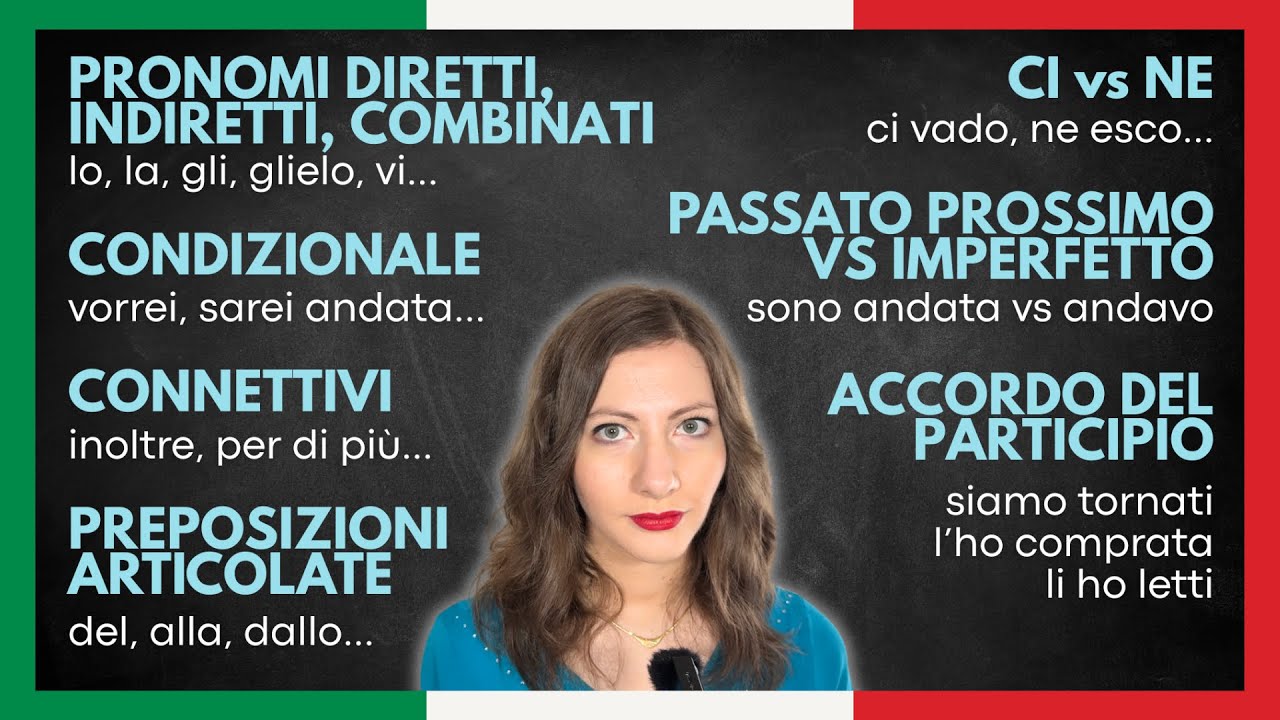
Essential Topics for the B1–B2 Level of Italian
1. Imperfetto vs Passato Prossimo: The Battle of Tenses
This is the million-dollar question for any Italian learner! The distinction between these two verb tenses represents one of the most significant obstacles in learning the Italian language, but once you understand the mechanism, choosing the correct one will become natural.
The Passato Prossimo
The passato prossimo is used to indicate a completed action, with a clear and defined beginning and end. When you say “Ieri ho mangiato una pizza” [Yesterday I ate a pizza], you are communicating that the action was completed: the pizza was entirely consumed and the event is finished.
The Imperfetto
The imperfetto, on the other hand, describes an ongoing action, a past habit, or a description of states and situations. For example: “Da piccolo mangiavo sempre la pizza il venerdì” [When I was little, I always ate pizza on Fridays] expresses a repeated habit over time, while “Mentre mangiavo, è squillato il telefono” [While I was eating, the phone rang] presents an ongoing action that is interrupted by a specific event.
Practical Examples of Usage
Consider this complex sentence: “Quando ero piccolo [description of state], abitavo a Roma [habit]. Un giorno ho deciso [specific and concluded action] di trasferirmi a Milano.” [When I was little, I lived in Rome. One day I decided to move to Milan.] In this example, you can observe how the imperfetto creates the narrative background while the passato prossimo introduces the action that breaks this continuity.
| Verb Tense | Function | Example |
|---|---|---|
| Passato Prossimo | Completed and punctual action | Ieri ho comprato un libro [Yesterday I bought a book] |
| Imperfetto | Habitual action | Da bambino leggevo ogni sera [As a child, I read every evening] |
| Imperfetto | Description/state | La casa era grande e luminosa [The house was big and bright] |
| Imperfetto | Ongoing action (background) | Mentre dormivo, è arrivato Marco [While I was sleeping, Marco arrived] |
2. Past Participle Agreement: The Fundamental Rules
This topic terrifies many students, but it’s simpler than you might think once you understand the basic rules. Past participle agreement follows precise patterns that, once internalized, will become automatic.
Agreement with the Auxiliary ESSERE
When the auxiliary verb is ESSERE, the past participle always agrees with the subject in gender and number. This rule admits no exceptions:
- Example: “Maria è andata” [Maria went] (feminine singular)
- Example: “I ragazzi sono partiti” [The boys left] (masculine plural)
- Example: “Le ragazze sono arrivate” [The girls arrived] (feminine plural)
Agreement with the Auxiliary AVERE
With the auxiliary AVERE, the past participle normally remains unchanged: “Ho mangiato” [I ate], “Abbiamo studiato” [We studied], “Hanno lavorato” [They worked]. However, there is a fundamental exception that concerns direct object pronouns.
The Exception with Direct Pronouns LO, LA, LI, LE
When the direct pronouns LO, LA, LI, LE precede the verb, the past participle must agree with the pronoun:
- Example: “La pizza? L’ho mangiata!” [The pizza? I ate it!] (agreement with LA pizza, feminine singular)
- Example: “I libri? Li ho letti!” [The books? I read them!] (agreement with I libri, masculine plural)
- Example: “Le scarpe? Le ho comprate!” [The shoes? I bought them!] (agreement with LE scarpe, feminine plural)
| Pronoun | Gender/Number | Example |
|---|---|---|
| LO | Masculine singular | Il caffè? Lo ho bevuto → L’ho bevuto [The coffee? I drank it] |
| LA | Feminine singular | La torta? La ho mangiata → L’ho mangiata [The cake? I ate it] |
| LI | Masculine plural | I documenti? Li ho firmati [The documents? I signed them] |
| LE | Feminine plural | Le lettere? Le ho spedite [The letters? I sent them] |
3. Complex Connectives: Speaking Like a Native
Connectives represent the secret to sounding fluent in Italian. Abandoning the continuous repetition of “e, e, e…” [and, and, and…] and moving to more sophisticated connectives immediately transforms the quality of your speech, making it more elegant and structured.
Connectives to Add Information
When you want to add information to what has already been said, you can use various expressions that enrich your speech:
- Inoltre, per di più, oltretutto [Furthermore, moreover, besides]: Example: “Quel film è noioso. Inoltre, è troppo lungo!” [That movie is boring. Furthermore, it’s too long!]
- Non solo… ma anche [Not only… but also]: Example: “Non solo è bella, ma anche intelligente” [She is not only beautiful but also intelligent]
- In aggiunta, peraltro [In addition, moreover]: Example: “Il ristorante ha ottimi piatti. In aggiunta, i prezzi sono ragionevoli” [The restaurant has excellent dishes. In addition, the prices are reasonable]
Connectives to Express Contrast
To express opposition or contrast between two ideas, Italian offers numerous possibilities:
- Tuttavia, però, eppure [However, yet, nevertheless]: Example: “Studia molto, tuttavia non prende bei voti” [He studies a lot, however he doesn’t get good grades]
- Mentre, invece [While, instead]: Example: “Io amo il caffè, mentre tu preferisci il tè” [I love coffee, while you prefer tea]
- Al contrario, d’altra parte [On the contrary, on the other hand]: Example: “Pensavo fosse facile. Al contrario, si è rivelato molto complesso” [I thought it was easy. On the contrary, it turned out to be very complex]
Connectives to Indicate Consequence
To connect a cause to its effect, use consequence connectives:
- Perciò, quindi, dunque [Therefore, so, hence]: Example: “Piove, perciò prendi l’ombrello” [It’s raining, therefore take the umbrella]
- Di conseguenza, pertanto [Consequently, therefore]: Example: “Non ha studiato, di conseguenza è stato bocciato” [He didn’t study, consequently he failed]
- Per questo motivo, ecco perché [For this reason, that’s why]: Example: “Era stanco. Per questo motivo è andato a dormire presto” [He was tired. For this reason, he went to sleep early]
| Function | Formal Connectives | Informal Connectives |
|---|---|---|
| Addition | Inoltre [furthermore], per di più [moreover], in aggiunta [in addition] | Anche [also], e poi [and then], pure [as well] |
| Contrast | Tuttavia [however], nonostante ciò [despite this], eppure [yet] | Però [but], ma [but], invece [instead] |
| Consequence | Pertanto [therefore], di conseguenza [consequently], dunque [hence] | Quindi [so], perciò [therefore], così [so] |
| Cause | Poiché [since], dato che [given that], in quanto [as] | Perché [because], siccome [since], visto che [seeing that] |
4. Articulated Prepositions: When Prepositions Merge with Articles
Articulated prepositions are formed from the fusion of simple prepositions (di, a, da, in, su) and definite articles. This combination is a distinctive feature of the Italian language and requires in-depth knowledge to be mastered.
Complete Chart of Articulated Prepositions
| + | IL | LO | LA | L’ | I | GLI | LE |
|---|---|---|---|---|---|---|---|
| DI [of] | del | dello | della | dell’ | dei | degli | delle |
| A [to/at] | al | allo | alla | all’ | ai | agli | alle |
| DA [from] | dal | dallo | dalla | dall’ | dai | dagli | dalle |
| IN [in] | nel | nello | nella | nell’ | nei | negli | nelle |
| SU [on] | sul | sullo | sulla | sull’ | sui | sugli | sulle |
Main Uses of Articulated Prepositions
Each articulated preposition maintains the meaning of the simple preposition from which it derives:
- DEL, DELLA, DEGLI, DELLE: express possession or belonging → Examples: “Il libro del professore” [The teacher’s book], “La casa della nonna” [Grandma’s house]
- AL, ALLA, AI, ALLE: indicate direction or destination → Examples: “Vado al cinema” [I’m going to the cinema], “Scrivo alla direttrice” [I’m writing to the director]
- DAL, DALLA, DAI, DALLE: express origin or motion from a place → Examples: “Vengo dal medico” [I’m coming from the doctor], “Torno dalla palestra” [I’m coming back from the gym]
- NEL, NELLA, NEI, NELLE: indicate state in an enclosed place → Examples: “Il gatto è nel giardino” [The cat is in the garden], “Viviamo nella città” [We live in the city]
- SUL, SULLA, SUI, SULLE: express position on top of → Examples: “Il libro è sul tavolo” [The book is on the table], “Cammino sulla spiaggia” [I’m walking on the beach]
Special Cases with Country Names
With names of nations, there are specific rules to follow:
- Singular countries: Examples: “Vado in Italia” [I’m going to Italy], “Vivo in Francia” [I live in France] (without article)
- Plural countries: Examples: “Vado negli Stati Uniti” [I’m going to the United States], “Viaggio nei Paesi Bassi” [I’m traveling to the Netherlands] (with articulated preposition)
- Countries with mandatory article: Examples: “Vado nel Regno Unito” [I’m going to the United Kingdom], “Viaggio nella Repubblica Ceca” [I’m traveling to the Czech Republic]
5. Direct and Indirect Pronouns: Understanding Who Does What to Whom
Pronouns replace nouns to avoid repetition and make speech more fluid. The distinction between direct and indirect pronouns is fundamental for constructing correct sentences in Italian.
Direct Pronouns
Direct pronouns answer the questions “what?” or “whom?” and replace the direct object:
| Person | Singular | Plural |
|---|---|---|
| 1ª persona [1st person] | MI [me] | CI [us] |
| 2ª persona [2nd person] | TI [you] | VI [you all] |
| 3ª persona maschile [3rd person masculine] | LO [him/it] | LI [them] |
| 3ª persona femminile [3rd person feminine] | LA [her/it] | LE [them] |
Practical example: “Vedi Marco?” → “Sì, lo vedo” [Do you see Marco? → Yes, I see him] (I see WHOM? Marco = LO)
Indirect Pronouns
Indirect pronouns answer the question “to whom?” and replace the indirect object:
| Person | Singular | Plural |
|---|---|---|
| 1ª persona [1st person] | MI [to me] | CI [to us] |
| 2ª persona [2nd person] | TI [to you] | VI [to you all] |
| 3ª persona maschile [3rd person masculine] | GLI [to him] | GLI/LORO [to them] |
| 3ª persona femminile [3rd person feminine] | LE [to her] | GLI/LORO [to them] |
Practical example: “Telefoni a Maria?” → “Sì, le telefono” [Are you calling Maria? → Yes, I’m calling her] (I’m calling TO WHOM? To Maria = LE)
How to Distinguish Which Pronoun to Use
To understand which pronoun to use, formulate a question about the sentence:
- Example: “Mangio la mela” [I eat the apple] → “Mangio che cosa?” [I eat what?] → LA mela → “La mangio” [I eat it] (direct pronoun)
- Example: “Parlo a Giovanni” [I speak to Giovanni] → “Parlo a chi?” [I speak to whom?] → A Giovanni → “Gli parlo” [I speak to him] (indirect pronoun)
Stop reading Italian.
Start speaking it.
Online lessons in groups of 4, organised by level and goals, with qualified teachers. Pick the day and time that suit you from the available slots.
Max 4 students:
there’s a seat for you
6. Combined Pronouns: When Pronouns Go in Pairs
Combined pronouns represent one of the most challenging aspects for Italian learners. They are used when both an indirect pronoun (“to whom“) and a direct pronoun (“what“) appear in the same sentence.
The Formation of Combined Pronouns
When pronouns combine, they undergo transformations:
- MI, TI, CI, VI become → ME, TE, CE, VE
- GLI and LE (singular) both become → GLIE- (followed by LO, LA, LI, LE, NE)
Complete Chart of Combined Pronouns
| + | LO | LA | LI | LE | NE |
|---|---|---|---|---|---|
| MI [to me] | me lo | me la | me li | me le | me ne |
| TI [to you] | te lo | te la | te li | te le | te ne |
| GLI/LE [to him/her] | glielo | gliela | glieli | gliele | gliene |
| CI [to us] | ce lo | ce la | ce li | ce le | ce ne |
| VI [to you all] | ve lo | ve la | ve li | ve le | ve ne |
Practical Examples of Usage
- Example: “Do il libro a Marco” → “Glielo do” [I give the book to Marco → I give it to him] (GLI = to Marco, LO = the book)
- Example: “Presto la macchina a te” → “Te la presto” [I lend the car to you → I lend it to you]
- Example: “Racconto la storia a loro” → “Gliela racconto” [I tell the story to them → I tell it to them]
- Example: “Compro i fiori per mia madre” → “Glieli compro” [I buy flowers for my mother → I buy them for her]
- Example: “Porto le chiavi a voi” → “Ve le porto” [I bring the keys to you → I bring them to you]
7. CI and NE: The Multifunctional Pronominal Particles
These two small words possess extraordinary versatility in the Italian language. Understanding their multiple uses is essential to reach an advanced level of linguistic competence.
The Functions of the Particle CI
The particle CI can replace various elements in the sentence:
- A place (complement of state or motion to a place): Example: “Vai a Roma?” → “Sì, ci vado domani” [Are you going to Rome? → Yes, I’m going there tomorrow]
- A topic introduced by “a”: Example: “Credi ai fantasmi?” → “No, non ci credo” [Do you believe in ghosts? → No, I don’t believe in them]
- An idea or thought: Example: “Pensi alla festa?” → “Sì, ci penso sempre” [Are you thinking about the party? → Yes, I always think about it]
- With pronominal verbs: volerci [to take/require], metterci [to take time], entrarci [to have to do with] → Example: “Quanto ci vuole per arrivare?” [How long does it take to arrive?]
The Functions of the Particle NE
The particle NE has different and complementary functions to CI:
- A quantity (partitive): Example: “Quanti fratelli hai?” → “Ne ho due” [How many brothers do you have? → I have two (of them)]
- A topic introduced by “di”: Example: “Parli di politica?” → “Preferisco non parlarne” [Do you talk about politics? → I prefer not to talk about it]
- Origin (motion from a place): Example: “Vieni dal cinema?” → “Sì, ne vengo ora” [Are you coming from the cinema? → Yes, I’m coming from there now]
- With idiomatic expressions: non poterne più [can’t take it anymore], andarsene [to leave], fregarsene [not to care] → Example: “Non ne posso più!” [I can’t take it anymore!]
| Particle | Replaces | Example |
|---|---|---|
| CI | Place (a/in + place) [Luogo] | Vai al mare? → Ci vado [Are you going to the beach? → I’m going there] |
| CI | Topic (a + thing) [Argomento] | Credi a questo? → Ci credo [Do you believe this? → I believe it] |
| NE | Quantity [Quantità] | Hai soldi? → Ne ho pochi [Do you have money? → I have little] |
| NE | Topic (di + thing) [Argomento] | Parli del film? → Ne parlo [Are you talking about the movie? → I’m talking about it] |
| NE | Origin (da + place) [Provenienza] | Vieni da scuola? → Ne vengo [Are you coming from school? → I’m coming from there] |
8. The Conditional: The Art of Italian Linguistic Diplomacy
The conditional is not just for expressing unrealistic dreams and wishes. It is the mood of elegance and courtesy, the one that allows you to express yourself in a refined and diplomatic way in Italian.
Formation of the Present Conditional
The present conditional is formed from the future stem with specific endings:
| Person | PARLARE [to speak] | CREDERE [to believe] | PARTIRE [to leave] |
|---|---|---|---|
| Io [I] | parlerei [I would speak] | crederei [I would believe] | partirei [I would leave] |
| Tu [you] | parleresti [you would speak] | crederesti [you would believe] | partiresti [you would leave] |
| Lui/Lei [he/she] | parlerebbe [he/she would speak] | crederebbe [he/she would believe] | partirebbe [he/she would leave] |
| Noi [we] | parleremmo [we would speak] | crederemmo [we would believe] | partiremmo [we would leave] |
| Voi [you all] | parlereste [you would speak] | credereste [you would believe] | partireste [you would leave] |
| Loro [they] | parlerebbero [they would speak] | crederebbero [they would believe] | partirebbero [they would leave] |
Main Uses of the Conditional
The conditional is used in various communicative situations:
- Courtesy and polite requests: Example: “Potresti aiutarmi?” [Could you help me?] (much more polite than “Puoi aiutarmi?” [Can you help me?])
- Expressing wishes: Examples: “Vorrei un caffè” [I would like a coffee], “Mi piacerebbe visitare Venezia” [I would like to visit Venice]
- Giving advice: Examples: “Al posto tuo, studierei di più” [If I were you, I would study more], “Dovresti riposare” [You should rest]
- Expressing doubts or suppositions: Example: “Secondo me, Marco avrebbe circa 30 anni” [In my opinion, Marco would be about 30 years old]
- Unconfirmed news: Example: “Secondo i giornali, il presidente sarebbe malato” [According to the newspapers, the president is said to be ill]
The Past Conditional
The past conditional is formed with the present conditional of AVERE or ESSERE + the past participle of the main verb:
- Example: “Sarei venuto alla festa, ma ero malato” [I would have come to the party, but I was sick]
- Example: “Avrei comprato quella casa, ma costava troppo” [I would have bought that house, but it cost too much]
- Example: “Ti avrei chiamato, ma ho perso il telefono” [I would have called you, but I lost my phone]
The Conditional Sentence
The conditional is frequently used in conditional sentences, in combination with the subjunctive:
- Possible hypothesis (second type): Example: “Se fossi ricco, comprerei una villa al mare” [If I were rich, I would buy a villa by the sea] (Se + imperfect subjunctive + present conditional)
- Impossible hypothesis in the past (third type): Example: “Se avessi studiato, avrei passato l’esame” [If I had studied, I would have passed the exam] (Se + past perfect subjunctive + past conditional)
| Type | Structure | Example |
|---|---|---|
| 1° tipo [1st type] (realtà [reality]) | Se + indicativo [indicative], indicativo/imperativo [indicative/imperative] | Se piove, prendo l’ombrello [If it rains, I take the umbrella] |
| 2° tipo [2nd type] (possibilità [possibility]) | Se + cong. imperfetto [imperfect subjunctive], cond. presente [present conditional] | Se vincessi, viaggerei [If I won, I would travel] |
| 3° tipo [3rd type] (impossibilità [impossibility]) | Se + cong. trapassato [past perfect subjunctive], cond. passato [past conditional] | Se fossi partito, sarei arrivato [If I had left, I would have arrived] |
Frequently Asked Questions
What Is the Main Difference Between Passato Prossimo and Imperfetto?
The passato prossimo describes concluded and punctual actions, with a defined beginning and end (“Ieri ho mangiato una pizza” [Yesterday I ate a pizza]). The imperfetto instead expresses habitual actions, descriptions of states, or ongoing actions in the past that serve as background to other actions (“Da bambino mangiavo sempre la pizza il venerdì” [As a child, I always ate pizza on Fridays]).
When Should I Make the Past Participle Agree with AVERE?
The past participle with the auxiliary AVERE agrees only when preceded by the direct pronouns LO, LA, LI, LE. In this case, the participle must agree in gender and number with the pronoun: “La torta? L’ho mangiata” [The cake? I ate it] (feminine singular), “I libri? Li ho letti” [The books? I read them] (masculine plural).
How Do I Know Whether to Use a Direct or Indirect Pronoun?
Formulate a question: if the answer is “what?” or “whom?” without a preposition, use a direct pronoun (lo, la, li, le). If the answer is “to whom?“, use an indirect pronoun (mi, ti, gli, le, ci, vi). Example: “Chiamo Marco” [I call Marco] (Whom do I call? = LO chiamo [I call him]) vs “Telefono a Marco” [I call Marco] (To whom do I call? = GLI telefono [I call him]).
What Is the Difference Between CI and NE?
CI generally replaces elements introduced by the preposition “a” or “in” (places, topics): “Vai a Roma?” → “Ci vado” [Are you going to Rome? → I’m going there]. NE replaces elements introduced by the preposition “di” or “da” (quantities, topics, origin): “Parli del film?” → “Ne parlo” [Are you talking about the movie? → I’m talking about it]; “Quanti ne vuoi?” → “Ne voglio due” [How many do you want? → I want two].
Why Is the Conditional Important for Sounding Polite in Italian?
The conditional softens requests and makes them more courteous and diplomatic. The difference between “Puoi aiutarmi?” [Can you help me?] (indicative, more direct) and “Potresti aiutarmi?” [Could you help me?] (conditional, gentler) is significant in Italian culture, where form and courtesy in social interactions are very important.
How Are Combined Pronouns Formed?
Combined pronouns unite an indirect pronoun (to whom?) with a direct one (what?). The indirect always precedes the direct and undergoes transformations: MI→ME, TI→TE, CI→CE, VI→VE, while GLI and LE both become GLIE- (written attached to the direct pronoun): “Do il libro a lei” → “Glielo do” [I give the book to her → I give it to her].
Did you enjoy this article? Before mastering the secrets of the intermediate level, make sure you have solid foundations: explore Italian for beginners in the dedicated article.
Do pronominal verbs trip you up and fill you with doubts? Turn confusion into confidence with our exclusive course: “Da «Non ce la faccio più» a «Ora me la cavo»: i verbi pronominali in 30 giorni.” With fun, bite-size lessons and targeted practice, you’ll learn to use them naturally in just one month.
Want the lesson PDF with exercises and solutions?
Join the LearnAmo AcademyLoading quiz…
Podcast: Play in new window | Download ()
Iscriviti: Apple Podcasts | Spotify | Android | iHeartRadio | Podcast Index | TuneIn | Deezer | RSS | Altri...