


With this comprehensive guide, you will discover 6 perfect Italian films for every level of language proficiency, from absolute beginner (A1) to expert (C2). First of all, we will see 2 films suitable for beginner levels (A1-A2), with simple dialogues and easy-to-understand situations. Then we will cover 2 films for intermediate levels (B1-B2), where the language becomes more natural and rich. And finally, we will explore 2 films for advanced levels (C1-C2), with complex language and deep cultural references.
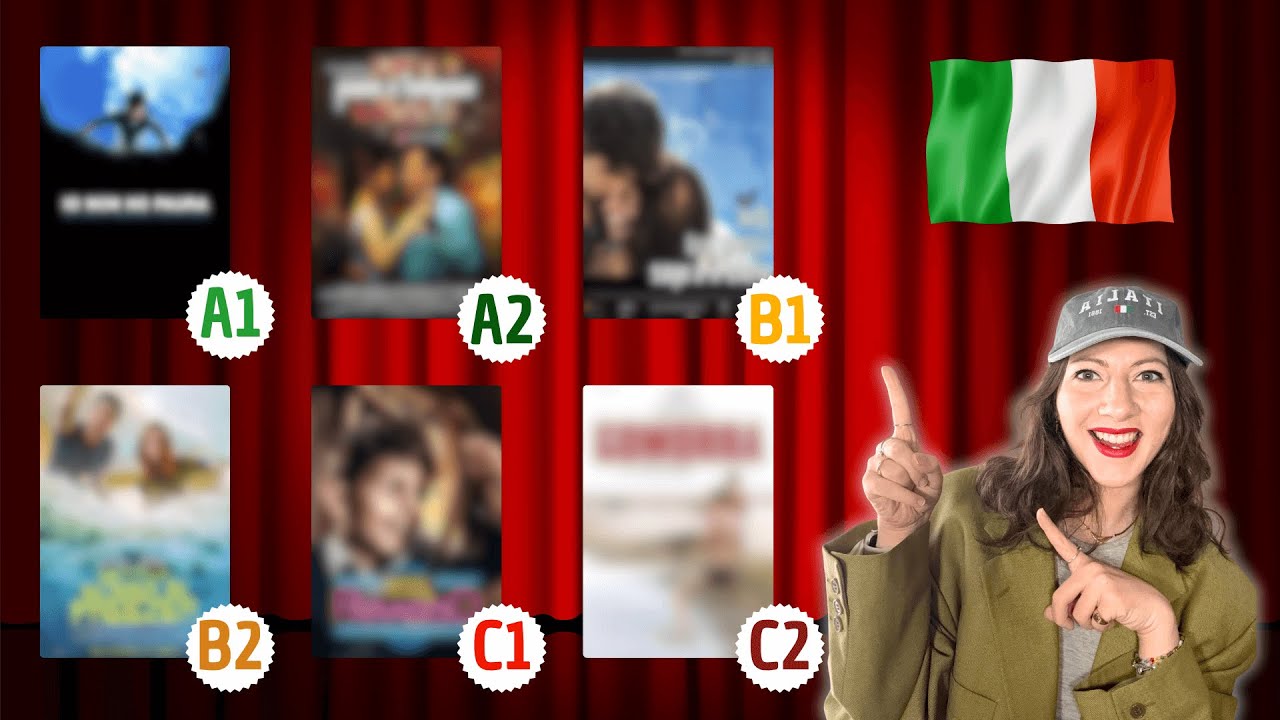
6 Films to Learn Italian (From Level A1 to Level C2)
Level A1-A2: Beginners
1. “Io non ho paura” (2003) – Level A1
This film by Gabriele Salvatores is a true gem for those starting to study Italian! “Io non ho paura” [I’m Not Scared] tells the story of Michele, a 10-year-old boy who lives in a small town in Southern Italy in the 1970s. During the summer, while playing in the wheat fields with his friends, Michele discovers a terrible secret that will change his life.
Why is this film perfect for A1 level?
First of all, the protagonist is a child, so many dialogues are simple and direct, just like the language used with children. The sentences are short and clear. The characters speak slowly and in an understandable way. The narrative pace is ideal for those taking their first steps in the Italian language, allowing them to easily follow the plot without getting lost in more complex linguistic details.
What will you learn with this film?
Lots of everyday life and family vocabulary: mamma [mom], papà [dad], fratello [brother], sorella [sister], amico [friend]. You will hear simple expressions like “Vieni qui!” [Come here!], “Ho paura” [I’m scared], “Cosa fai?” [What are you doing?]. Moreover, the film mainly uses the present indicative and the present perfect, the two fundamental verb tenses for beginners.
An interesting detail: the film shows the Southern Italian countryside, with its beautiful landscapes and white houses under the sun. You will also learn what life was like in Italy in the 1970s, a very particular historical period. And don’t worry if you don’t understand everything at first: the images and the emotions of the characters will help you a lot in following the story!
Tip for beginners
Watch the film with Italian subtitles! This way you can read and listen at the same time, and your brain will absorb the words more easily. This multimodal learning technique is scientifically proven as one of the most effective methods for language acquisition.
2. “Pane e tulipani” (2000) – Level A2
This is one of the most beloved Italian films! “Pane e tulipani” [Bread and Tulips] tells the story of Rosalba, a housewife who is forgotten by her family during a tourist trip. Instead of getting angry, she decides to take a break from her life and goes to Venice, where she begins a new adventure full of discoveries, unexpected encounters, and possibilities for personal rebirth.
Why is it perfect for A2 level?
This film is perfect for A2 level because the dialogues are natural but not too fast. The characters speak clearly and use standard Italian, without difficult dialects. The plot is easy to follow and very engaging: impossible to get bored! The linear story allows elementary level students to focus on the language without having to decipher complex plots or intricate twists.
What will you learn with this film?
Lots of everyday life vocabulary: grocery shopping, house hunting, talking with neighbors, ordering at a restaurant. Moreover, you will hear many authentic Italian expressions, those that Italians really use every day. For example, when Rosalba says “Basta!” [Enough!], she expresses a feeling we all know. You will also learn useful phrases for daily social interactions, such as greeting, introducing yourself, asking for information, and expressing preferences.
An interesting detail: the film shows the beauty of Venice in a poetic way. So, in addition to learning Italian, you will also take a virtual trip to one of the most beautiful cities in the world. Due piccioni con una fava [Two pigeons with one bean], as we say in Italy! (That is: two results with one effort!) The film’s cinematography is extraordinary and captures the magical atmosphere of the lagoon city in all seasons.
Important cultural aspects
The film offers a glimpse of contemporary Italian society, showing traditional family roles and their change. You will see how Italian pensioni [guesthouses] work, the hospitality system in small family-run guesthouses, and daily life in a unique city like Venice. Furthermore, the film explores universal themes such as the search for oneself, the courage to change, and the importance of friendship.
Level B1-B2: Intermediate
3. “Tre metri sopra il cielo” (2004) – Level B1
This film is a classic for young Italians! “Tre metri sopra il cielo” [Three Meters Above the Sky] is the love story between Step, a rebellious boy who loves motorcycles, and Babi, a studious and quiet girl. It’s practically the modern Italian “Romeo and Juliet”! The story explores the conflict between two different worlds, that of youthful rebellion and that of social conventions, against the backdrop of contemporary Rome.
Why is it perfect for B1 level?
The protagonists are teenagers, so the language is young, fresh, and full of colloquial expressions. You will learn how young Italians really speak, with all those words and phrases you will never find in textbooks! For example, you will hear expressions like “Che figata!” [How cool!], “Mi fai impazzire!” [You drive me crazy!], “Non ci posso credere!” [I can’t believe it!].
The dialogues are faster compared to films for beginners, but the story is so engaging that you will understand what is happening anyway. Moreover, there are many action and emotion scenes that help understand without needing to comprehend every single word. The body language and facial expressions of the actors provide valuable clues to follow the narrative.
What will you learn with this film?
The Italian youth slang and romantic expressions that Italian young people use to flirt and declare their feelings. You will also learn vocabulary related to the world of motorcycles, Italian high school, parties, and Roman nightlife. The film will introduce you to the use of affectionate diminutives typical of Italian spoken among young people, like “amore” [love], “tesoro” [treasure], “bella” [beautiful].
Fun warning
After this film, you might develop a strange desire to buy a motorcycle and do crazy races through Rome! But please, be responsible! The film shows risky behaviors that are part of cinematic narrative but should not be imitated in real life. However, the film’s soundtrack, rich with Italian and international pop music, is perfect for creating motivating study playlists.
4. “Metti la nonna in freezer” (2018) – Level B2
Now let’s raise the level a bit with an all-Italian comedy! Claudia is a young art restorer who has been in a work crisis for some time, and to get by is forced to rely solely on her elderly grandmother Birgit’s finances. At the sudden death of the latter, to avoid bankruptcy, the girl, together with her friends and colleagues Rossana and Margie, reaches the drastic decision to hide and preserve her grandmother’s corpse in the freezer, planning a scam to continue collecting her pension.
The situation degenerates when Simone appears in Claudia’s life, a clumsy but incorruptible marshal of the Guardia di Finanza [Financial Police], who after a love disappointment threw himself headlong into work, thus becoming his colleagues’ nightmare due to his diligence. Simone falls in love at first sight, beginning to assiduously court the girl without suspecting the scam in the least; on the contrary, Claudia fears that the man is investigating her, thus leading her, together with her friends, to devise various stratagems to keep the truth about her grandmother hidden.
Why is it perfect for B2 level?
This film represents an interesting linguistic challenge because it mixes standard Italian with contemporary colloquial language. The dialogues are fast, full of cultural references and double meanings typical of Italian comedy. You will need to be attentive to catch all the nuances and irony of situations. The intricate plot requires a good understanding of the language to follow the various twists and complications that follow one another.
What will you learn with this film?
Vocabulary related to modern daily life: economic problems, rent, Italian bureaucracy (which is famous for being complicated!). Moreover, you will learn a lot about the Italian housing system, social security, and Roman popular culture.
The film also introduces specific vocabulary related to the Guardia di Finanza (Italian tax police), tax audits, pensions, and the Italian bureaucratic system. You will hear technical terms explained in practical contexts that will help you understand how these aspects of Italian society work.
Fun curiosity
This film, despite the macabre plot (a dead grandmother in the freezer!), is actually a sweet and moving comedy. Italians love this type of “black” comedies that mix absurd situations with real emotions. It’s typical Italian humor: laughing at tragic situations to make them more bearable! This cinematic tradition has its roots in the commedia all’italiana [Italian-style comedy] of the 1960s and 1970s, which addressed serious social themes with lightness and irony.
Important cultural details
The film perfectly shows life in Roman public housing, with nosy neighbors (ficcanaso [nosy], that is curious, who want to know everything!), gossip, sense of community. It’s a piece of authentic Italy that is rarely seen in tourist films! And the acting is excellent: the two protagonists, Fabio De Luigi and Miriam Leone, are very talented actors who make even the most absurd situation believable. The film also offers a glimpse of the economic crisis that hit Italy in recent years and the difficulties many young people face in finding stable work.
Level C1-C2: Advanced
5. “Nuovo Cinema Paradiso” (1988) – Level C1
Here we have an absolute masterpiece! “Nuovo Cinema Paradiso” [Cinema Paradiso] by Giuseppe Tornatore is one of the most beloved Italian films of all time, Oscar winner for best foreign film. It tells the story of Totò, a Sicilian child who in the 1940s and 1950s falls in love with cinema thanks to his friendship with Alfredo, the projectionist of the town’s cinema.
The film’s complex plot
The film is constructed following a long flashback that recounts the life of Salvatore, Totò to everyone, a successful director who is intimately unhappy. The story, set in a town in post-war Sicily, moves from the protagonist’s early childhood years, a war orphan but with an irrepressible passion for cinema. Precisely because of this passion, from a young age he befriends Alfredo, projectionist of the town cinema Paradiso.
Alfredo will be a father figure for the child and capable of precious advice that will accompany Salvatore throughout his life; conversely, Alfredo will find in Salvatore a source of pride and support even following the terrible fire that will make him forever physically but not emotionally blind.
Why is this film perfect for C1 level?
The language is rich and varied: it ranges from standard Italian to Sicilian dialects, from expressions of the 1940s to more modern language. It’s like taking a journey through different linguistic registers and different eras of the Italian language. It’s not very easy, but it’s absolutely understandable for an advanced level student who wants to challenge themselves!
The film is structured on different time planes: the past of Totò as a child and adolescent, and the present of Salvatore (grown-up Totò) who has become a famous director. This complex structure requires attention and good command of the language to follow the changes in register and era. The use of multiple flashbacks and temporal ellipses requires a sophisticated understanding of cinematic narrative.
What will you learn with this film?
A poetic and cinematic Italian, perfect for understanding post-war Italian culture. You will learn terms related to cinema, Sicily, town life. You will better understand 20th century Italian society and how it changed over time. You will listen to dialogues full of emotion, nostalgia, and popular wisdom. You will also hear phrases in Sicilian dialect, but don’t worry: the context will help you a lot to understand!
You will learn specific vocabulary of the cinematic world: pellicola [film], proiezione [projection], sala [theater], schermo [screen], censura [censorship]. You will discover how ecclesiastical censorship worked in Italy and how cinema represented a window to the world for small rural communities. The film also offers an immersion in Sicilian popular culture, with its traditions, superstitions, and its particular way of experiencing social relationships.
Moving curiosity
The final scene of the film, with the montage of kisses censored by the town priest, is considered one of the most beautiful and moving sequences in cinema history. You won’t be able to hold back tears! And if you don’t cry… well, maybe you don’t have a heart! Just kidding, of course! This scene symbolically represents the protagonist’s emotional liberation and his reunion with the past.
The unforgettable soundtrack
The soundtrack by Ennio Morricone is so famous that it is still used today all over the world. So, in addition to Italian, you will also learn to appreciate one of the most iconic music pieces of Italian cinema. The film’s main theme has become a universal symbol of nostalgia and love for cinema, recognized and loved even by those who have never seen the film.
6. “Gomorra” (2008) – Level C2
Warning: this film is the ultimate linguistic challenge! “Gomorra” [Gomorrah], based on the book by Roberto Saviano, tells the harsh reality of the camorra napoletana [Neapolitan Camorra], the criminal organization that controls many areas of Naples and Campania. The film presents multiple intertwined stories that show different aspects of the criminal empire, from toxic waste management to drug trafficking, from territorial control to counterfeit high fashion.
Why does this film represent the linguistic Mount Everest?
Because the characters speak mainly in Neapolitan dialect! And Neapolitan dialect is very, very different from standard Italian. It’s practically like a different language. For example, in Italian we say “Che cosa vuoi?” [What do you want?], but in Neapolitan it becomes “Che vvuò?” If you can understand this film without subtitles, congratulations: your Italian is at native speaker level!
Neapolitan dialect has its own grammatical structure, with different verb conjugations, different pronouns, and syntax that may seem reversed compared to standard Italian. The phonetics is completely different: vowels are pronounced more openly, double consonants have an even more marked distinctive function, and there are sounds that don’t exist in standard Italian.
Why is this film perfect for C2 level?
This film forces you to do an incredible exercise for the ear. You will have to concentrate a lot, use context to understand, pay attention to gestures (and Southern Italians gesture a lot!). You will also learn many dialectal expressions and Neapolitan slang that are part of Italy’s linguistic richness.
The film also presents different regional varieties of Neapolitan, because the characters come from different neighborhoods of Naples and the province. This linguistic variety represents an additional challenge but offers a complete immersion in the linguistic reality of Southern Italy.
What will you learn with this film?
The vocabulary includes terms related to crime, illegal economy, street life. They are certainly not the words you would use at an elegant dinner, but they are part of Italian linguistic reality and will help you understand films, TV series, Italian rap songs, and many other cultural products that talk about these themes. Moreover, you will better understand the social and cultural complexities of Southern Italy.
You will also learn to recognize sociolinguistic differences: how the way of speaking changes depending on age, neighborhood of origin, role in the criminal hierarchy. The film offers a true course in applied sociolinguistics to contemporary Neapolitan reality.
Fundamental advice
Watch this film with Italian subtitles! They will save your life. And if some parts are too difficult, don’t get discouraged: even many Italians from Northern Italy have difficulties with Neapolitan dialect! This film is for true experts who want to explore the regional varieties of the Italian language. Consider watching it multiple times: the first time with Italian subtitles, the second time focusing on specific scenes, the third time trying to understand without subtitles.
Important cultural note
“Gomorra” [Gomorrah] had an enormous impact on Italian society, bringing to the world’s attention the problem of organized crime. Roberto Saviano, the author of the book, has been living under police protection since he published his investigation. So this film is not just a linguistic exercise, but also a very important social testimony.
The film won numerous international awards, including the Grand Jury Prize at Cannes, and was acclaimed by world critics for its raw realism and narrative strength. It also inspired a TV series of enormous success that continues the book’s narrative, offering even more opportunities for linguistic immersion for advanced students.
How to Optimize Learning with Films
Effective Viewing Techniques
To maximize language learning through films, it’s important to follow some proven teaching strategies. First of all, watch the film more than once: the first viewing with subtitles in your native language to understand the plot, the second with Italian subtitles to connect sounds and writing, the third without subtitles to test your comprehension.
Take notes of new expressions you hear and look them up in a dictionary. Pause during the film to repeat the dialogues aloud, imitating the pronunciation and intonation of the actors. This shadowing exercise (simultaneous repetition) is extremely effective for improving pronunciation and fluency.
Creating an Optimal Learning Environment
Watch films in a quiet environment where you can concentrate without distractions. Keep a notebook handy to write down new words, interesting expressions, or grammatical constructions you want to study more thoroughly. After watching the film, look for reviews in Italian or online discussions about the film to see how Italians talk about it and to enrich your critical-cinematic vocabulary.
Integrating Films into Your Study Plan
Films should not completely replace traditional study of grammar and vocabulary, but integrate them harmoniously. Dedicate at least one hour per week to watching films in Italian, choosing films appropriate to your level. Alternate lighter and more accessible films with more challenging films to keep motivation high while continuing to progress.
After watching a film, try to discuss it with other Italian students or native speakers, online or in person. This will allow you to practice the vocabulary learned in a real communicative context and to consolidate your understanding of the film’s plot and themes.
Benefits of Learning through Films
Watching films in Italian offers numerous advantages that go well beyond simple language learning. First of all, it allows you to train your ear to the different accents and speaking speeds of real Italian, very different from that of school textbooks. Films expose you to authentic language, with all its imperfections, interruptions, idiomatic expressions, and sayings that characterize natural communication.
Moreover, films are a window onto Italian culture: through the stories, characters, and settings, you can better understand how Italians think, what their values are, their traditions, their social problems. This type of cultural competence is fundamental for communicating effectively in a foreign language and for avoiding cultural misunderstandings.
Films make learning more enjoyable and motivating. Instead of studying vocabulary lists or doing repetitive grammar exercises, you find yourself immersed in engaging stories that capture your emotional attention. This emotional involvement facilitates memorization and makes learning more lasting. When you learn a new word or expression in an emotionally significant context, you are much more likely to remember it long-term.
Finally, watching films in Italian helps you develop oral comprehension, one of the most difficult skills to acquire in a foreign language. You will have to get used to understanding speakers who don’t articulate every word perfectly, who speak quickly, who use contracted or dialectal forms. This is exactly the preparation you need to communicate successfully in the real world.
Other Recommended Films by Level
For Beginners (A1-A2)
Besides the two films already mentioned, other perfect titles for beginners include “La vita è bella” [Life Is Beautiful] by Roberto Benigni, with clear dialogues and an emotionally engaging plot, and “Mediterraneo” by Gabriele Salvatores, with a slow pace and visually understandable situations. Even Italian animated films like “La gabbianella e il gatto” [Lucky and Zorba] can be excellent for this level, with simple and clear language.
For Intermediate Levels (B1-B2)
For intermediate level students, we also recommend “Perfetti sconosciuti” [Perfect Strangers] by Paolo Genovese, a contemporary film with natural dialogues and modern situations, or “Smetto quando voglio” [I Can Quit Whenever I Want], a brilliant comedy about the Italian university world. “La grande bellezza” [The Great Beauty] by Paolo Sorrentino offers more refined but still accessible language, with splendid images of Rome that aid comprehension.
For Advanced Levels (C1-C2)
Advanced students can explore the classics of Italian neorealism like “Ladri di biciclette” [Bicycle Thieves] by Vittorio De Sica or “Roma città aperta” [Rome, Open City] by Roberto Rossellini, historically important but linguistically challenging films. Also “Il conformista” [The Conformist] by Bernardo Bertolucci and “Otto e mezzo” [8½] by Federico Fellini represent stimulating challenges for those who want to deepen their understanding of literary and poetic Italian.
Cinema as a Cultural Bridge
Watching films in Italian is not just a way to learn the language, but also to immerse yourself in the culture, understand how Italians think, what makes them laugh, what moves them. It’s like taking a trip to Italy without leaving home! Each film represents a piece of Italian history, a testimony of how society has changed, how customs have evolved, how Italians have faced their collective and individual problems.
Italian cinema has a glorious tradition that has influenced world cinema. From the masterpieces of neorealism that revolutionized cinematic language, to Italian-style comedies that made generations of spectators laugh, to auteur films that won awards at the world’s most prestigious festivals. Studying Italian through films also means coming into contact with this extraordinary cultural heritage.
Each film you watch brings you a little closer to the Italian mentality, helps you understand the cultural references that Italians take for granted, prepares you for real interactions with Italian native speakers. When you talk with an Italian and make reference to a film they also know, you will immediately feel a connection, common ground on which to build the conversation. Cinema is a universal language that unites people beyond linguistic barriers.
Don’t be afraid to experiment with different genres: comedies, dramas, thrillers, historical films, romantic films. Each genre will offer you specific vocabulary and expose you to different communicative situations. And remember: learning through films must be fun! If you don’t like a film, don’t force yourself to finish it just because “it’s good for learning Italian.” Choose films that really interest you, that you’re passionate about, that make you want to understand every word.
Happy viewing and happy studying! Your journey into Italian cinema has just begun, and wonderful discoveries await you!
If you’re interested in expanding your culture on Italian films, read this article on how to use subtitles!
Access Italian websites and content from anywhere in the world with total security with NordVPN! Use the coupon code LEARNAMO to get a special discount!
Caricamento quiz in corso…
Podcast: Play in new window | Download (Duration: 29:44 — 41.1MB)
Iscriviti: Apple Podcasts | Spotify | Android | iHeartRadio | Podcast Index | TuneIn | Deezer | RSS | Altri...