


In this article, we talk about something very useful and also fun: how to create opposites of words using prefixes in Italian!
Do you know what happens when an Italian says “Questa situazione è comoda” (This situation is comfortable) and then adds a small “S” in front? It becomes “scomoda” (uncomfortable)! It’s like a linguistic magic wand! But be careful, because not all prefixes work with all words… and that’s where things get tricky, as we Italians like to say!
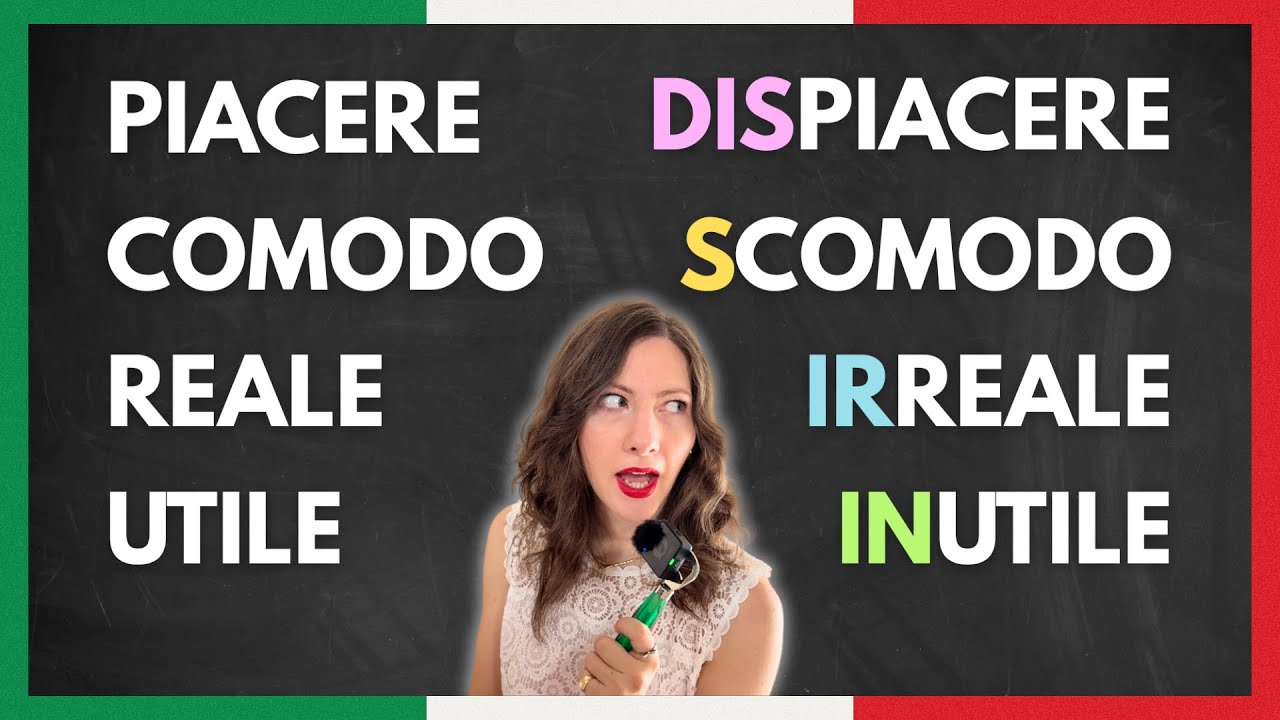
Prefixes that Create Opposites in Italian
What are Negation Prefixes?
Negation prefixes are small parts that we put in front of a word to create the opposite meaning. It’s like putting glasses on backwards: everything flips!
In Italian, the most common prefixes for creating opposites are:
- S- (the most used!)
- IN- (and its variants)
- DIS-
- A- (rarer, but it exists!)
These small grammatical elements are like linguistic transformers that completely change the meaning of a word. Mastering them is fundamental for those who want to enrich their Italian vocabulary and express themselves with greater precision.
The S- Prefix: The King of Opposites
The S- prefix is the true protagonist when it comes to creating opposites. It’s like the superhero of Italian prefixes! This prefix is particularly productive in the Italian language and can be applied to a wide range of adjectives and nouns.
Practical Examples with S-
| Original Word | With S- Prefix | Meaning in English |
|---|---|---|
| Comodo | Scomodo | Uncomfortable |
| Fortunato | Sfortunato | Unlucky |
| Contento | Scontento | Unhappy |
| Leale | Sleale | Disloyal |
| Vantaggioso | Svantaggioso | Disadvantageous |
| Collegato | Scollegato | Disconnected |
| Proporzionato | Sproporzionato | Disproportionate |
Fun curiosity: Do you know why we say “essere sfortunati” [being unlucky]? Because fortune has abandoned us! And when we say someone is sleale [disloyal], it’s as if they’ve removed “loyalty” from their behavior! The S- prefix often has this function of “deprivation” or “removal”.
Watch Out for Exceptions!
S- doesn’t always work. Some examples of important exceptions:
- Bello → ~~Sbello~~ ❌ (Does NOT exist!)
- Bello → Brutto ✅ (this is the correct form)
- Buono → ~~Sbuono~~ ❌ (Does NOT exist!)
- Buono → Cattivo ✅ (correct form)
- Grande → ~~Sgrande~~ ❌ (Does NOT exist!)
- Grande → Piccolo ✅ (correct form)
These exceptions exist because the Italian language has deep historical roots, and some opposites derive from completely different words rather than from negation prefixes.
The IN- Prefix and Its Magical Transformations
The IN- prefix is a bit like a chameleon: it changes form depending on the letter that follows! This phenomenon is called “phonetic assimilation” and makes pronunciation more fluid and natural.
IN- remains IN-
When the word starts with vowels or specific consonants:
| Original Word | With IN- Prefix | Meaning |
|---|---|---|
| Adatto | Inadatto | Unsuitable |
| Capace | Incapace | Incapable |
| Fedele | Infedele | Unfaithful |
| Utile | Inutile | Useless |
| Giusto | Ingiusto | Unjust |
| Sicuro | Insicuro | Insecure |
IN- becomes IM- (before P, B, M)
This transformation happens to make pronunciation more fluid and natural:
| Original Word | With IM- Prefix | Meaning |
|---|---|---|
| Possibile | Impossibile | Impossible |
| Probabile | Improbabile | Improbable |
| Maturo | Immaturo | Immature |
| Perfetto | Imperfetto | Imperfect |
| Morale | Immorale | Immoral |
Little trick to remember: Try saying “IN-possibile” quickly… it’s difficult, right? That’s why it becomes “IM-possibile”! The Italian language is lazy and prefers the easier path!
IN- becomes IL- (before L)
| Original Word | With IL- Prefix | Meaning |
|---|---|---|
| Legale | Illegale | Illegal |
| Logico | Illogico | Illogical |
| Leggibile | Illeggibile | Illegible |
| Limitato | Illimitato | Unlimited |
IN- becomes IR- (before R)
| Original Word | With IR- Prefix | Meaning |
|---|---|---|
| Reale | Irreale | Unreal |
| Responsabile | Irresponsabile | Irresponsible |
| Regolare | Irregolare | Irregular |
| Razionale | Irrazionale | Irrational |
The DIS- Prefix: When Things Separate
DIS- often indicates separation, deprivation or negation. It’s particularly used with verbs and nouns that indicate actions or states.
| Original Word | With DIS- Prefix | Meaning |
|---|---|---|
| Onesto | Disonesto | Dishonest |
| Ordinato | Disordinato | Messy |
| Piacere | Dispiacere | Displeasure |
| Armare | Disarmare | To disarm |
| Accordo | Disaccordo | Disagreement |
| Attenzione | Disattenzione | Inattention |
Cultural curiosity: In Italy, when something is disordinato [messy], we say it’s “un casino”! But don’t confuse it with the gambling casino… it’s just a colorful way to say “che disordine [what a mess]!”
The DIS- prefix has Latin origins and often maintains the meaning of “removal” or “separation” from the original action or quality. It’s very productive in forming verbs with opposite meaning.
Stop reading Italian.
Start speaking it.
Online lessons in groups of 4, organised by level and goals, with qualified teachers. Pick the day and time that suit you from the available slots.
Max 4 students:
there’s a seat for you
The A- Prefix: The Mysterious One
A- is rarer in common Italian, but it’s very important in technical and scientific contexts. It derives from ancient Greek and often indicates the absence of a quality.
| Original Word | With A- Prefix | Meaning | Context |
|---|---|---|---|
| Tipico | Atipico | Atypical | General |
| Simmetrico | Asimmetrico | Asymmetrical | Mathematics/Art |
| Morale | Amorale | Amoral | Philosophy |
| Sociale | Asociale | Antisocial | Psychology |
| Normale | Anormale | Abnormal | Medicine |
The A- prefix is particularly frequent in scientific and medical language, where terminological precision is fundamental for distinguishing specific conditions and phenomena.
Advanced Tricks to Avoid Mistakes
1. The Ear Rule
If a combination sounds strange, it’s probably wrong! For example, “s-bello” sounds terrible, so it doesn’t exist. Phonetic intuition is often an excellent indicator.
2. The Dictionary and Usage Frequency Test
When in doubt, always check! Not all words accept all prefixes. Additionally, some forms exist theoretically but are rarely used in everyday speech.
3. Learn Groups and Word Families
Many words from the same family follow the same rule:
- Possibile/Impossibile, Probabile/Improbabile, Prevedibile/Imprevedibile (same IM- prefix)
- Legale/Illegale, Logico/Illogico, Leggibile/Illeggibile (same IL- prefix)
- Comodo/Scomodo, Contento/Scontento, Cortese/Scortese (same S- prefix)
4. Attention to Context and Register
Some prefixes are more formal than others. For example:
- A- is often more technical and formal
- S- is more colloquial and common
- IN- is neutral and versatile
- DIS- is often dramatic or emphatic
Common Mistakes to Absolutely Avoid
| ❌ WRONG | ✅ CORRECT | Explanation |
|---|---|---|
| “Questa torta è instrana“ | “Questa torta è strana“ | “Strano” [Strange] doesn’t have an opposite with a prefix! |
| “Lui è molto disbello“ | “Lui è molto brutto“ | Lexical opposite, not prefixal |
| “Sono molto inmalato“ | “Sono molto malato“ | “Malato” [Sick] doesn’t have a common positive opposite |
| “La situazione è sbuona“ | “La situazione è cattiva“ | Specific lexical opposite |
Practical Exercises for LearnAmici
Try to create the opposites of these words (answers are at the end!):
Basic Exercise
- Felice → ?
- Giusto → ?
- Sicuro → ?
- Preciso → ?
- Paziente → ?
Advanced Exercise
- Regolare → ?
- Morale → ?
- Ordinato → ?
- Probabile → ?
- Tipico → ?
- Leale → ?
- Collegato → ?
- Maturo → ?
Deep Dive: The Historical Evolution of Prefixes
The formation of opposites through prefixes has ancient roots in the Italian language. The S- prefix derives from the Latin “EX-” or “DE-“, while IN- maintains the original Latin form. DIS- also comes from Latin and indicates separation, while A- has Greek origins.
Understanding these origins helps to better intuit which prefix to use with which word and why some combinations sound more natural than others. The Italian language has maintained these structures for over a thousand years, adapting them to modern communication needs.
Practical Tips for Daily Use
Remember, dear LearnAmici: Italian is like a puzzle. Every piece (including prefixes!) has its right place. Don’t be afraid to make mistakes, because even we Italians sometimes get confused!
The important thing is practice, practice, practice! And if a word seems strange to you, trust your instinct… often the ear is right!
Also, read a lot in Italian: novels, newspapers, online articles. Constant exposure to the language will help you develop that natural intuition that allows us to automatically choose the right prefix.
Memorization Strategies
- Create mental associations: “S-comodo = senza comfort” [without comfort]
- Use spaced repetition: review words at increasing intervals
- Practice in context: use words in complete sentences
- Play with the language: invent funny sentences with opposites
Frequently Asked Questions about Prefixes
Can I use multiple prefixes together?
Generally, no. Italian prefers one prefix per word. Forms like “s-in-capace” don’t exist.
How do I know if a word with a prefix really exists?
The best rule is to check the dictionary and listen to native speakers. If a form is never used in spoken or written language, it’s probably not correct.
Do prefixes change the gender of words?
No, prefixes maintain the original gender: “la fortuna” → “la sfortuna”, “il giusto” → “l’ingiusto”.
Are there regional differences in the use of prefixes?
The standard use of prefixes is fairly uniform throughout Italy. However, some regional dialects can influence the preference for certain prefixes in colloquial contexts.
Summary and Final Greetings
So LearnAmici, now you know how to transform positive words into negative ones with a simple prefix! It’s not difficile [difficult], on the contrary… it’s facile [easy]! (See? I just used an opposite without a prefix!)
Remember the key points:
- S- is the most common and versatile
- IN- changes form according to the following letters
- DIS- often indicates separation
- A- is more technical and formal
- Not all words accept all prefixes
- The ear is a good judge!
See you in the next video for more grammatical adventures! And remember: keep being pazienti [patient] with yourselves… never impazienti [impatient] when studying Italian!
Exercise Answers
Basic Exercise:
- Felice → Infelice
- Giusto → Ingiusto
- Sicuro → Insicuro
- Preciso → Impreciso
- Paziente → Impaziente
Advanced Exercise:
- Regolare → Irregolare
- Morale → Immorale
- Ordinato → Disordinato
- Probabile → Improbabile
- Tipico → Atipico
- Leale → Sleale
- Collegato → Scollegato
- Maturo → Immaturo
If you’re interested in improving your pronunciation, read this article about the most difficult sounds of the Italian language!
Do you want to take Italian lessons with our qualified native teachers? Purchase your Italiano Intensivo package!
Want the lesson PDF with exercises and solutions?
Join the LearnAmo AcademyCaricamento quiz in corso…
Podcast: Play in new window | Download (Duration: 12:32 — 28.7MB)
Iscriviti: Apple Podcasts | Spotify | Android | iHeartRadio | Podcast Index | TuneIn | Deezer | RSS | Altri...
This is so helpful, thank you so much! The explanations are great, and the exercises really helped solidify what I learned.
Thank you so much, Amy! 😊