


The passive form is one of the trickiest topics in Italian grammar, and almost all students make the same mistakes. In this article, you’ll discover the 5 most common errors with the passive form and learn how to avoid them once and for all.
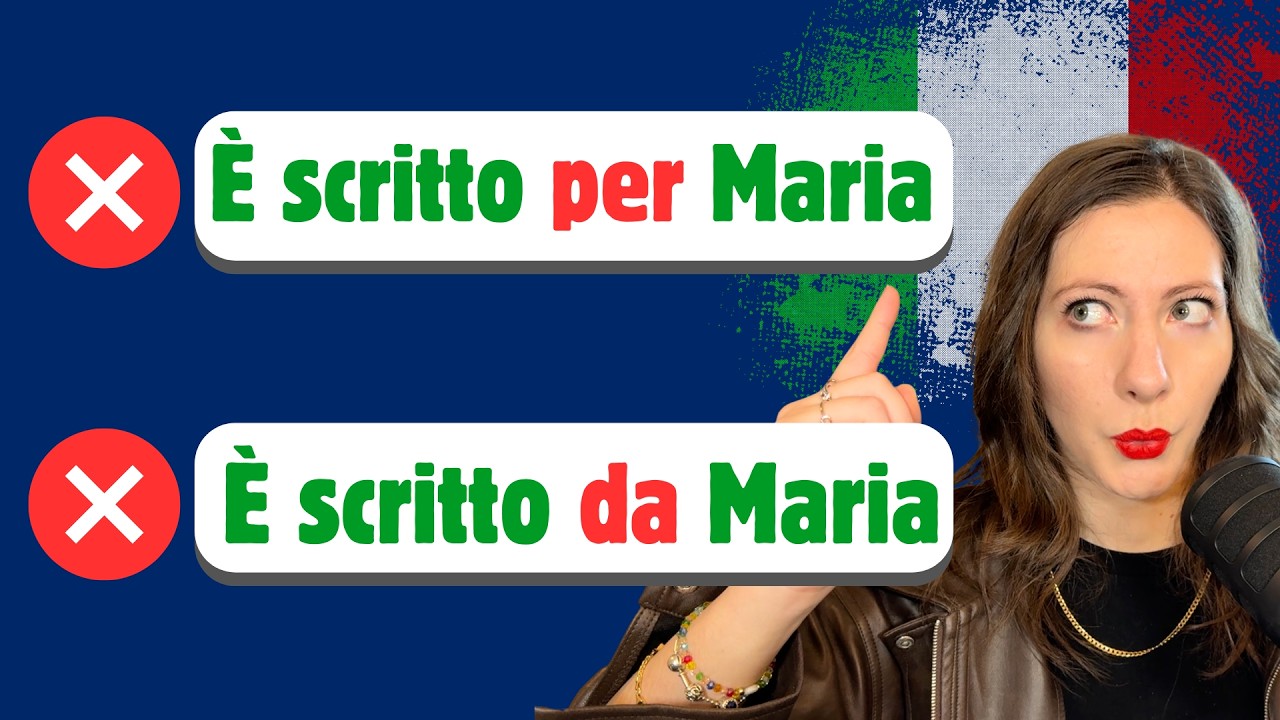
5 Mistakes with the Passive Form in Italian
Mistake #1: Using the Auxiliary AVERE
Let’s start with the basics. This is the most serious mistake and, unfortunately, also very common among Italian students. Some students construct sentences like:
Example:
“La pizza ha mangiata da Marco.” [The pizza has eaten by Marco.]
This is completely wrong. In Italian, the only auxiliary to form the passive is ESSERE. Always. Without exceptions.
Example:
“La pizza è mangiata da Marco.” [The pizza is eaten by Marco.]
How to Transform an Active Sentence into Passive
To better understand the transformation mechanism, let’s analyze a clear and detailed example.
Active Sentence
Example:
Marco mangia la pizza. [Marco eats the pizza.]
- Marco = subject (who performs the action)
- mangia = verb
- la pizza = direct object (who receives the action)
Passive Sentence
Example:
La pizza è mangiata da Marco. [The pizza is eaten by Marco.]
- La pizza = new subject
- è mangiata = verb in passive form (essere + past participle)
- da Marco = agent (who performs the action)
As you can see, three fundamental changes occur in the transformation:
- The direct object becomes the subject
- The verb becomes essere + past participle
- The original subject becomes the “agent” and is introduced with the preposition DA
Transitive and Intransitive Verbs: A Fundamental Distinction
Not all verbs can have a passive form. Only transitive verbs (those that can take a direct object) can be transformed into the passive.
Examples:
“Il libro è letto da Maria.” [The book is read by Maria.] (leggere = transitive, you can read something)
“Il parco è andato da Maria.” [The park is gone by Maria.] (andare = intransitive, you can’t “go something”)
A simple trick to recognize transitive verbs: if in the active sentence you can answer the question “What?” after the verb, then the verb is transitive and you can form the passive.
Examples:
- Marco mangia… che cosa? [Marco eats… what?] → La pizza. Transitive!
- Maria va… che cosa? [Maria goes… what?] → ??? Intransitive!
Mistake #2: Using the Wrong Preposition for the Agent
This mistake is closely related to the first one and concerns that little word that introduces the agent in the passive sentence. Many students make errors like:
Examples:
“La pizza è mangiata per Marco.” [The pizza is eaten for Marco.]
“La pizza è mangiata di Marco.” [The pizza is eaten of Marco.]
But the correct preposition is only one: DA!
Example:
“La pizza è mangiata da Marco.” [The pizza is eaten by Marco.]
Why Is This Mistake So Common?
The origin of this mistake often depends on the student’s native language:
- Spanish speakers often use “per” because in Spanish they say “por” (La pizza es comida por Marco).
- English speakers sometimes use “di” because in English they say “by”, which in other contexts translates as “di” (a book by Hemingway = un libro di Hemingway).
But remember: in Italian, for the agent of the passive, you always use DA.
Correct Examples with the Preposition DA
Examples:
- Questo quadro è stato dipinto da Caravaggio. [This painting was painted by Caravaggio.]
- La lettera sarà scritta da me. [The letter will be written by me.]
- I biscotti sono stati preparati da mia nonna. [The cookies were prepared by my grandmother.]
- L’America fu scoperta da Cristoforo Colombo. [America was discovered by Christopher Columbus.]
- La Divina Commedia è stata scritta da Dante Alighieri. [The Divine Comedy was written by Dante Alighieri.]
Mistake #3: Confusing the Present Passive with the Past
This mistake is very sneaky and depends on how the passato prossimo works in Italian. Look at this sentence:
Example:
“La pizza è mangiata.” [The pizza is eaten.]
Many students think: “I see two words: ‘è’ + ‘mangiata’. Two words = passato prossimo!” WRONG!
This sentence is in the present passive, not in the past! The secret is this: in the passive, the tense is determined ONLY by the auxiliary ESSERE.
Table of Verb Tenses in the Passive
| Verb Tense | Passive Form | Number of Words |
|---|---|---|
| Present (Presente) | La pizza è mangiata [The pizza is eaten] | 2 words |
| Present Perfect (Passato prossimo) | La pizza è stata mangiata [The pizza has been eaten] | 3 words |
| Imperfect (Imperfetto) | La pizza era mangiata [The pizza was eaten] | 2 words |
| Past Perfect (Trapassato prossimo) | La pizza era stata mangiata [The pizza had been eaten] | 3 words |
| Simple Past (Passato remoto) | La pizza fu mangiata [The pizza was eaten] | 2 words |
| Preterite Perfect (Trapassato remoto) | La pizza fu stata mangiata [The pizza had been eaten] | 3 words |
| Simple Future (Futuro semplice) | La pizza sarà mangiata [The pizza will be eaten] | 2 words |
| Future Perfect (Futuro anteriore) | La pizza sarà stata mangiata [The pizza will have been eaten] | 3 words |
As you can see, for the passato prossimo passive you need three words: essere (in present) + stato/a/i/e + past participle.
The Difference Is Fundamental
Examples:
- La pizza è mangiata [The pizza is eaten] = Present (someone is eating it now, in general)
- La pizza è stata mangiata [The pizza has been eaten] = Passato prossimo (someone has already eaten it)
It’s a huge difference! Confusing them can create great misunderstandings in communication. Imagine being in a restaurant and saying “La pizza è mangiata” [The pizza is eaten] (present) instead of “La pizza è stata mangiata” [The pizza has been eaten] (past): the waiter might think someone is still eating the pizza, instead of understanding that it’s already finished.
Mistake #4: Always Replacing ESSERE with VENIRE
Perhaps you’ve heard that in Italian you can also use the verb VENIRE to form the passive. And it’s true!
Example:
La pizza viene mangiata da Marco. [The pizza is being eaten by Marco.]
This sentence is perfectly correct and means the same thing as “La pizza è mangiata da Marco.” [The pizza is eaten by Marco.]
But be careful: there’s an important rule!
The Fundamental Rule of VENIRE
VENIRE can ONLY be used with simple tenses.
Simple tenses are: present, imperfect, passato remoto, simple future, present subjunctive, imperfect subjunctive, present conditional.
Examples:
La pizza viene mangiata. [The pizza is being eaten.] (present)
La pizza veniva mangiata. [The pizza was being eaten.] (imperfect)
La pizza verrà mangiata. [The pizza will be eaten.] (future)
But with compound tenses? No, you can’t!
Examples:
La pizza è venuta mangiata. → WRONG!
La pizza è stata mangiata. [The pizza has been eaten.] → CORRECT!
Comparative Table: ESSERE vs VENIRE
| Tense | With ESSERE | With VENIRE |
|---|---|---|
| Present (Presente) | è mangiata [is eaten] | viene mangiata [is being eaten] |
| Imperfect (Imperfetto) | era mangiata [was eaten] | veniva mangiata [was being eaten] |
| Simple Past (Passato remoto) | fu mangiata [was eaten] | venne mangiata [was eaten] |
| Simple Future (Futuro semplice) | sarà mangiata [will be eaten] | verrà mangiata [will be eaten] |
| Present Perfect (Passato prossimo) | è stata mangiata [has been eaten] | è venuta mangiata [WRONG] |
| Past Perfect (Trapassato prossimo) | era stata mangiata [had been eaten] | era venuta mangiata [WRONG] |
| Future Perfect (Futuro anteriore) | sarà stata mangiata [will have been eaten] | sarà venuta mangiata [WRONG] |
Why Does the Alternative with VENIRE Exist?
“Venire” is often used to give a more dynamic sense to the action, to emphasize that something is happening at that moment. Additionally, “venire” can help avoid ambiguity: the sentence “La porta è chiusa” [The door is closed] could mean both “The door is being closed (by someone)” and “The door is in a closed state.” Using “La porta viene chiusa” [The door is being closed] eliminates the ambiguity and clearly indicates an action in progress.
Stop reading Italian.
Start speaking it.
Online lessons in groups of 4, organised by level and goals, with qualified teachers. Pick the day and time that suit you from the available slots.
Max 4 students:
there’s a seat for you
Mistake #5: Not Recognizing “Hidden” Passive Structures
And here we are at the last mistake, perhaps the most insidious of all. There are some structures that are passive… but don’t look passive! Many students don’t recognize them and therefore don’t understand them. Let’s look at three very common ones.
1) ANDARE + Past Participle
Example:
“Questo lavoro va fatto entro domani.” [This work must be done by tomorrow.]
What does it mean? It means that this work must be done by tomorrow. It’s an obligation, a necessity.
The structure andare + past participle has a passive meaning with a sense of duty/necessity.
Other Examples with ANDARE + Participle
Examples:
- Le regole vanno rispettate. [The rules must be respected.] = Le regole devono essere rispettate.
- Questo documento va firmato. [This document must be signed.] = Questo documento deve essere firmato.
- I compiti vanno consegnati venerdì. [The homework must be submitted on Friday.] = I compiti devono essere consegnati venerdì.
- La carne va cotta bene. [The meat must be cooked well.] = La carne deve essere cotta bene.
- Questi medicinali vanno presi a stomaco pieno. [These medicines must be taken on a full stomach.] = Questi medicinali devono essere presi a stomaco pieno.
Attention: “andare” also follows the rule from point 4! It is used only in simple tenses.
Examples:
Il lavoro va fatto. [The work must be done.] (present)
Il lavoro andava fatto. [The work had to be done.] (imperfect)
Il lavoro è andato fatto. → Wrong!
2) Past Participle Alone (Absolute Participle)
Example:
“Fatte queste premesse, possiamo continuare.” [Having made these premises, we can continue.]
This structure is called absolute participle and has a passive value. It means: “After these premises have been made…”
The participle, placed at the beginning of the sentence, indicates an action already completed that precedes the main action.
Other Examples of Absolute Participle
Examples:
- Letto il libro, ho capito tutto. [Having read the book, I understood everything.] = Dopo che il libro è stato letto (da me)…
- Finiti i compiti, sono uscito. [Having finished the homework, I went out.] = Dopo che i compiti sono stati finiti…
- Considerati tutti i fattori, la decisione è stata difficile. [Having considered all the factors, the decision was difficult.] = Dopo che tutti i fattori sono stati considerati…
- Superato l’esame, ho festeggiato. [Having passed the exam, I celebrated.] = Dopo che l’esame è stato superato…
- Aperta la porta, entrò nella stanza. [Having opened the door, he/she entered the room.] = Dopo che la porta fu aperta…
This structure is widely used in written and formal language, but it is also heard in spoken Italian. If you don’t recognize it, you risk not understanding the meaning of the sentence.
3) The Passive “SI”
Example:
“In Italia si mangia molta pasta.” [In Italy, a lot of pasta is eaten.]
This sentence does not mean that someone eats themselves (that would be reflexive!). It means: “In Italy, a lot of pasta is eaten” / “In Italy, people eat a lot of pasta.”
It’s the famous SI passivante (passive SI): it is used when we don’t want to or can’t specify who performs the action.
How to Recognize the Passive SI
The verb agrees with the noun that follows:
Examples:
- Si mangia molta pasta [A lot of pasta is eaten] (pasta = singular → singular verb)
- Si mangiano molti spaghetti [A lot of spaghetti is eaten] (spaghetti = plural → plural verb)
- Si legge un libro [A book is read] / Si leggono molti libri [Many books are read]
- Si parla l’italiano [Italian is spoken] / Si parlano molte lingue [Many languages are spoken]
Common Examples of the Passive SI
The passive SI is extremely common in Italian. You will hear and read it everywhere:
Examples:
- Qui si parla italiano. [Italian is spoken here.] (= L’italiano è parlato qui)
- Non si accettano carte di credito. [Credit cards are not accepted.] (= Le carte di credito non sono accettate)
- Come si dice “hello” in italiano? [How do you say “hello” in Italian?] (= Come è detto “hello” in italiano?)
- In questo negozio si vendono prodotti biologici. [In this shop, organic products are sold.] (= Prodotti biologici sono venduti)
- Affittasi appartamento. [Apartment for rent.] (= Un appartamento viene affittato – very common form in advertisements)
If you don’t recognize this structure, you will miss a huge part of everyday Italian communication!
Summary of Mistakes and Solutions
| Mistake | Wrong Example | Correct Form |
|---|---|---|
| Using AVERE as auxiliary | La pizza ha mangiata | La pizza è mangiata [The pizza is eaten] |
| Using wrong preposition | Mangiata per/di Marco | Mangiata da Marco [Eaten by Marco] |
| Confusing present and past | “È mangiata” = past | “È mangiata” = present [is eaten]; “È stata mangiata” = past [has been eaten] |
| Using VENIRE in compound tenses | È venuta mangiata | È stata mangiata [Has been eaten] |
| Not recognizing passive forms | Not understanding “va fatto”, “si mangia” | Recognize ANDARE+part. [must be done], passive SI [is eaten], absolute participle |
Frequently Asked Questions
Can I Omit the Agent in a Passive Sentence?
Yes, absolutely! The agent can be omitted when it is not important, not known, or when you want to emphasize the action itself rather than who performs it. For example: “La pizza è stata mangiata” [The pizza has been eaten] (it doesn’t matter by whom), “Il problema è stato risolto” [The problem has been solved] (the important thing is that it’s solved). This form is very common especially in journalistic and bureaucratic language.
Is There a Difference between “Dalla” and “Da” + Article?
The preposition DA combines with definite articles to form articulated prepositions: dal, dallo, dalla, dall’, dai, dagli, dalle. You use the article when the following noun requires it: “La torta è stata preparata dalla nonna” [The cake was prepared by the grandmother] (la nonna), “Il quadro fu dipinto dal maestro” [The painting was painted by the master] (il maestro), but “La lettera sarà scritta da Maria” [The letter will be written by Maria] (proper name without article).
When Is It Better to Use the Active Form Instead of the Passive?
The active form is generally preferred in everyday speech because it is more direct and natural. The passive form is more used when you want to emphasize the object of the action, when the agent is unknown or irrelevant, in formal, scientific and journalistic language, and when describing processes or procedures. For example, it is preferable to say “Marco ha mangiato la pizza” [Marco ate the pizza] in normal conversation, but “La pizza è stata mangiata” [The pizza has been eaten] if you want to talk about the pizza.
Must the Past Participle Agree with the Subject?
Yes, in the passive form the past participle must always agree in gender and number with the subject of the sentence: “La pizza è mangiata” [The pizza is eaten] (feminine singular), “Il panino è mangiato” [The sandwich is eaten] (masculine singular), “Le pizze sono mangiate” [The pizzas are eaten] (feminine plural), “I panini sono mangiati” [The sandwiches are eaten] (masculine plural). This agreement is mandatory and not respecting it constitutes a grammatical error.
Are There Other Verbs Besides VENIRE and ANDARE for the Passive?
Yes, there are also other verbs that can form passive constructions with particular nuances. The verb RESTARE/RIMANERE + participle indicates the result of an action: “La porta è rimasta aperta” [The door remained open] (resulting state). The verb FINIRE can be used in colloquial contexts: “Il vaso è finito rotto” [The vase ended up broken]. However, ESSERE remains the main and universal auxiliary for the passive form in Italian.
How Is the Passive Formed with Modal Verbs (Dovere, Potere, Volere)?
With modal verbs, the passive can be formed in two ways: with modal + essere + participle or with modal + passive infinitive. For example: “La lettera deve essere scritta” [The letter must be written] or “La lettera deve scriversi” (less common). Other examples: “Il problema può essere risolto” [The problem can be solved], “Il lavoro vuole essere fatto bene” [The work wants to be done well]. In these cases, the modal verb is conjugated normally and the infinitive “essere” remains unchanged.
Did you find this topic useful? Keep improving: learn when to use and when not to use the article in Italian.
Do you want to take Italian lessons with our qualified native teachers? Purchase your Italiano Intensivo package!
Want the lesson PDF with exercises and solutions?
Join the LearnAmo AcademyCaricamento quiz in corso…
Podcast: Play in new window | Download (Duration: 35:59 — 82.3MB)
Iscriviti: Apple Podcasts | Spotify | Android | iHeartRadio | Podcast Index | TuneIn | Deezer | RSS | Altri...