


Italian grammar presents numerous nuances in the use of prepositions and time adverbs that often create confusion even among the most advanced students. In this comprehensive guide, we will explore the differences and correct uses of DA, NEL, PER, FA, MENTRE, DURANTE, GIÀ, ANCORA, PIÙ, MAI, APPENA and PROPRIO, providing detailed explanations, practical examples and clear rules to master these fundamental elements of the Italian language.
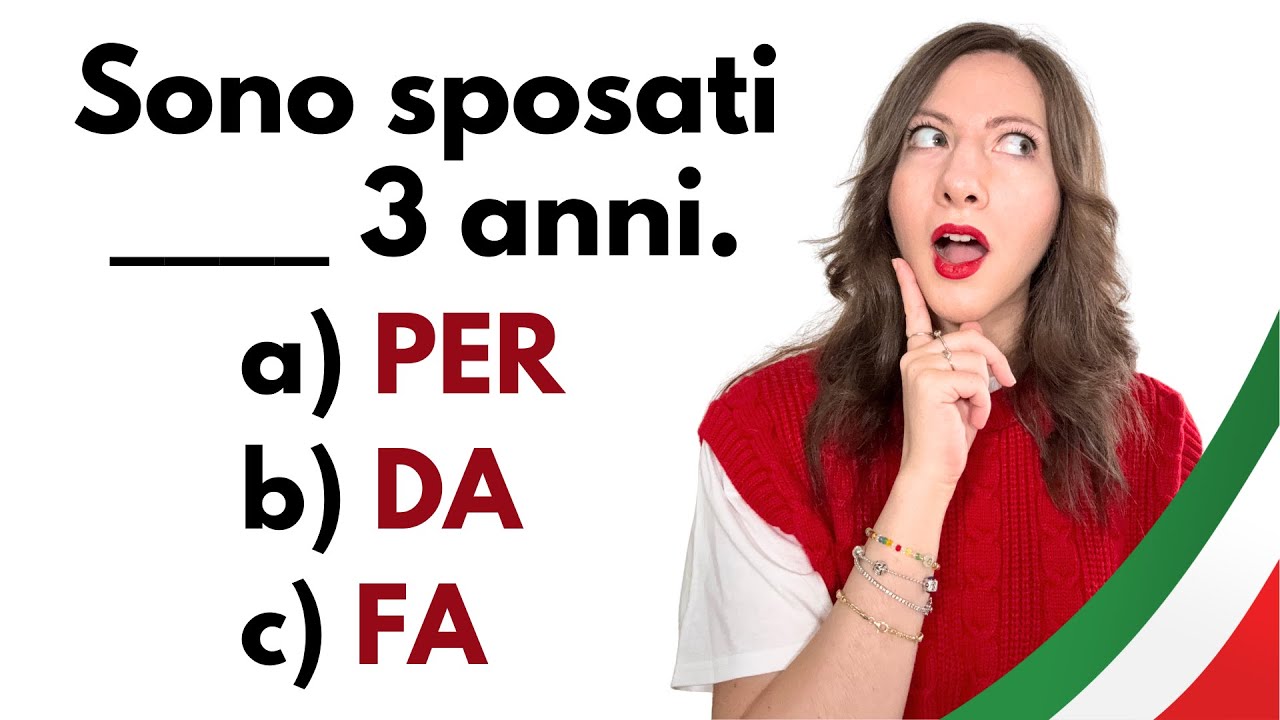
Italian Grammar: the Most Common Time Prepositions and Adverbs
Temporal Prepositions: DA – NEL – PER – FA
These four prepositions are fundamental for expressing temporal relations in Italian, but each has a specific meaning and particular use that it’s important to distinguish clearly.
Analysis of Examples and Solutions
Let’s analyze the provided examples with their respective solutions:
- Example: “Sono stati sposati PER 5 anni” [They were married for 5 years] → PER indicates the duration of an action that began and ended in the past
- Example: “Si sono sposati 3 anni FA” [They got married 3 years ago] → FA expresses the time elapsed since a completed event
- Example: “Si sono sposati NEL 2008” [They got married in 2008] → NEL is always used with years
- Example: “Sono sposati DA 10 anni” [They have been married for 10 years] → DA for continuous duration
- Example: “Si sono sposati A ottobre” [They got married in October] → A is used with months
Fundamental Rules for Correct Use
PER is used to indicate a completed action in the past with a determined duration. It’s perfect for expressing time periods that had a beginning and end:
- Example: “Ho studiato italiano per tre anni” [I studied Italian for three years] (and now I’ve stopped)
- Example: “Abbiamo vissuto a Roma per cinque anni” [We lived in Rome for five years] (but now we live elsewhere)
- Example: “Ha lavorato in quella ditta per dieci anni” [He worked at that company for ten years] (before changing jobs)
DA expresses an action that continues at the moment one speaks. It’s the preposition of continuity and actuality:
- Example: “Studio italiano da tre anni” [I have been studying Italian for three years] (and I continue to study it)
- Example: “Viviamo a Roma da cinque anni” [We have been living in Rome for five years] (and we still live there)
- Example: “Lavora in quella ditta da dieci anni” [He has been working at that company for ten years] (and he still works there)
FA indicates the time elapsed since something happened relative to the present moment. It’s always placed after the temporal indication:
- Example: “Ho iniziato a studiare italiano tre anni fa” [I started studying Italian three years ago]
- Example: “Ci siamo trasferiti a Roma cinque anni fa” [We moved to Rome five years ago]
- Example: “Ha iniziato a lavorare in quella ditta dieci anni fa” [He started working at that company ten years ago]
NEL + year is the standard construction to indicate a specific year, while A + month is used for months of the year:
- Example: “Mi sono laureato nel 2020″ [I graduated in 2020]
- Example: “Mi sono laureato a luglio” [I graduated in July]
- Example: “Mi sono laureato a luglio del 2020″ [I graduated in July 2020]
MENTRE – DURANTE – GERUND: Simultaneity
These two words express contemporaneity between two actions, but follow completely different grammatical rules that are fundamental to know.
Analysis of Practical Examples
Let’s look at the examples with their respective solutions:
- Example: “Passeggiando per il centro, ho incontrato Paolo” [Walking through downtown, I met Paolo] → GERUND used alone
- Example: “Mentre passeggiavo per il centro, ho incontrato Paolo” [While I was walking through downtown, I met Paolo] → MENTRE + imperfect
- Example: “Durante la mia passeggiata per il centro, ho incontrato Paolo” [During my walk through downtown, I met Paolo] → DURANTE + noun
MENTRE + IMPERFETTO: The Golden Rule
MENTRE must be always followed by a verb in the imperfect tense. This combination creates a perfect temporal framework to express:
- Durative actions in the past: Example: “Mentre leggevo, ascoltavo musica” [While I was reading, I was listening to music]
- Two simultaneous actions: one durative (imperfect) and one punctual (passato prossimo)
- Interruptions: Example: “Mentre cucinavo, è suonato il telefono” [While I was cooking, the phone rang]
The imperfect in this context always indicates an action in progress that is interrupted or accompanied by another action.
DURANTE + SOSTANTIVO: The Nominal Construction
DURANTE must be always followed by a noun and never by a conjugated verb. This preposition creates more formal and elegant constructions:
- Example: “Durante la lezione, gli studenti prendevano appunti” [During the lesson, the students took notes]
- Example: “Durante il viaggio, abbiamo visto paesaggi stupendi” [During the trip, we saw beautiful landscapes]
- Example: “Durante la riunione, abbiamo discusso il progetto” [During the meeting, we discussed the project]
The GERUNDIO: The Simplified Contemporary Action
The gerund is used alone to indicate a durative contemporary action to the main one, creating more concise and dynamic sentences:
- Example: “Correndo al lavoro, ho perso le chiavi” [Running to work, I lost my keys]
- Example: “Studiando per l’esame, ho imparato molte cose nuove” [Studying for the exam, I learned many new things]
- Example: “Ascoltando musica, mi rilasso sempre” [Listening to music, I always relax]
Time Adverbs: GIÀ – ANCORA – PIÙ – MAI
These four adverbs are essential for expressing temporal aspects and action modalities, each with specific meanings and uses that determine important nuances in speech.
Detailed Solutions and Explanations
Let’s analyze each example with the correct solution and explanation of the meaning:
- Example: “Paolo non è ANCORA arrivato, perciò non possiamo cominciare a mangiare” [Paolo hasn’t arrived yet, so we can’t start eating]
ANCORA in a negative context expresses an expected action that hasn’t happened yet. It indicates that Paolo is expected to arrive, but so far he hasn’t arrived. The action is pending.
- Example: “Paolo è GIÀ arrivato, è stato davvero puntuale” [Paolo has already arrived, he was really punctual]
GIÀ indicates an action completed before expected or sooner than anticipated. It expresses positive surprise for the timeliness.
- Example: “Paolo non è MAI venuto a trovarci quando abitavamo in quella casa” [Paolo never came to visit us when we lived in that house]
MAI expresses absolute negation in the past. It indicates that during the entire period when one lived in that house, Paolo never came even once.
- Example: “Ho litigato con Paolo: non voglio vederlo PIÙ” [I argued with Paolo: I don’t want to see him anymore]
PIÙ indicates the cessation of a future action. It expresses the decision to definitively interrupt the relationship with Paolo because of the argument.
Advanced Uses and Specific Contexts
ANCORA has multiple meanings depending on the context:
- Continuity: Example: “Sta ancora piovendo” [It’s still raining] (continues to rain)
- Repetition: Example: “Ancora una volta” [Once again] (another time)
- Additional quantity: Example: “Voglio ancora pasta” [I want more pasta] (another portion)
GIÀ can express:
- Anticipation: Example: “È già qui” [He’s already here] (before expected)
- Confirmation: Example: “Sì, l’ho già fatto” [Yes, I’ve already done it] (it’s completed)
- Temporal emphasis: Example: “Già nel 1800” [Already in 1800] (even then)
MAI changes meaning with context:
- Total negation: Example: “Non l’ho mai visto” [I’ve never seen him] (not even once)
- Interrogation: Example: “Hai mai visitato Roma?” [Have you ever visited Rome?] (at least once?)
- Exclamation: Example: “Mai visto niente del genere!” [Never seen anything like it!] (expresses amazement)
PIÙ in negative contexts:
- Definitive cessation: Example: “Non fumo più” [I don’t smoke anymore] (I quit definitively)
- Current impossibility: Example: “Non posso più aspettare” [I can’t wait anymore] (it has become impossible)
- Change of state: Example: “Non è più giovane” [He’s no longer young] (he has aged)
APPENA and PROPRIO: The Adverbs of Intensity and Time
These two adverbs are extremely versatile and can assume different meanings depending on the context in which they are used.
Analysis of Examples and Solutions
- Example: “Maria è APPENA tornata dal lavoro e sta preparando la cena” [Maria has just returned from work and is preparing dinner]
APPENA in this case indicates that the action was completed very recently. Maria returned from work very recently, practically now.
- Example: “Questo libro è PROPRIO interessante, lo consiglio a tutti” [This book is really interesting, I recommend it to everyone]
PROPRIO here functions as emphasis, equivalent to “very,” “really,” “truly.” It intensifies the adjective “interesting.”
- Example: “APPENA vedo Paolo, gli darò il messaggio” [As soon as I see Paolo, I’ll give him the message]
APPENA means “as soon as”, “at the exact moment when,” “exactly when.” It indicates immediate simultaneity between seeing Paolo and giving the message.
- Example: “Non riesco PROPRIO a capire questo problema di matematica” [I really can’t understand this math problem]
PROPRIO emphasizes the negation, equivalent to “really,” “at all,” “absolutely.” It underlines the total impossibility of understanding.
The Multiple Uses of APPENA
APPENA can have three main meanings:
- Temporal – recent past: Example: “Ho appena finito di mangiare” [I just finished eating] (very recently)
- Temporal – future simultaneity: Example: “Appena arriva, lo chiamo” [As soon as he arrives, I’ll call him] (at the moment he arrives)
- Quantitative – scarcity: Example: “Ho appena dieci euro” [I only have ten euros] (only ten euros, few)
Additional examples to clarify the different uses:
- Example: “Il treno è appena partito” [The train has just left] (time: a few minutes ago)
- Example: “Appena finisco il lavoro, vengo da te” [As soon as I finish work, I’ll come to you] (immediate simultaneity)
- Example: “È alto appena un metro e mezzo” [He’s only one and a half meters tall] (quantity: only, just)
The Nuances of PROPRIO
PROPRIO is a polysemic adverb with different uses:
- Positive emphasis: Example: “È proprio bravo” [He’s really good] (very, really good)
- Negative emphasis: Example: “Non capisco proprio niente” [I don’t understand anything at all] (absolutely nothing)
- Precision/exactness: Example: “È proprio lui” [It’s exactly him] (exactly him, no doubt)
- Personal possession: Example: “La mia propria casa” [My own house] (belonging to me personally)
Contextual examples for each use:
- Example: “Questo gelato è proprio buono!” [This ice cream is really good!] (intensification: very good)
- Example: “Non me l’aspettavo proprio” [I really didn’t expect it] (negative emphasis: not at all)
- Example: “È proprio quello che cercavo” [It’s exactly what I was looking for] (exactly that)
- Example: “L’ho visto con i propri occhi” [I saw it with my own eyes] (mine personally)
Summary Table of Uses
| Adverb | Meaning | Example | Context |
|---|---|---|---|
| APPENA | Recent time | Example: “È appena arrivato” [He just arrived] | Present perfect |
| APPENA | Simultaneity | Example: “Appena lo vedo, lo saluto” [As soon as I see him, I greet him] | Future/present |
| APPENA | Scarce quantity | Example: “Costa appena 5 euro” [It costs only 5 euros] | Numbers/measures |
| PROPRIO | Positive emphasis | Example: “È proprio bello” [It’s really beautiful] | Intensification |
| PROPRIO | Negative emphasis | Example: “Non ci riesco proprio” [I really can’t do it] | Strong negation |
| PROPRIO | Exactness | Example: “È proprio così” [It’s exactly like that] | Precise confirmation |
Common Errors and How to Avoid Them
Many Italian students make recurring errors in the use of these prepositions and adverbs. Here are the most frequent ones with corrections:
Errors with Temporal Prepositions
- ERROR: “Studio italiano per tre anni” [I study Italian for three years] (if I continue studying)
CORRECT: “Studio italiano da tre anni” [I have been studying Italian for three years] - ERROR: “Mi sono sposato da 2010” [I got married since 2010]
CORRECT: “Mi sono sposato nel 2010” [I got married in 2010] or “Sono sposato dal 2010” [I have been married since 2010] - ERROR: “L’ho incontrato tre anni prima” [I met him three years before]
CORRECT: “L’ho incontrato tre anni fa” [I met him three years ago]
Errors with MENTRE and DURANTE
- ERROR: “Mentre la lezione, ho preso appunti” [During the lesson, I took notes]
CORRECT: “Durante la lezione, ho preso appunti” [During the lesson, I took notes] or “Mentre seguivo la lezione, ho preso appunti” [While I was following the lesson, I took notes] - ERROR: “Durante che mangiavo, è arrivato Paolo” [During that I was eating, Paolo arrived]
CORRECT: “Mentre mangiavo, è arrivato Paolo” [While I was eating, Paolo arrived]
Errors with Time Adverbs
- ERROR: “Non è ancora venuto mai” [He hasn’t yet come never]
CORRECT: “Non è ancora venuto” [He hasn’t come yet] or “Non è mai venuto” [He has never come] - ERROR: “Già non ci vado più” [Already I don’t go there anymore]
CORRECT: “Non ci vado già più” [I don’t go there already anymore] or “Non ci vado più” [I don’t go there anymore]
Additional Practical Exercises
To consolidate understanding of these grammatical elements, it’s important to practice with targeted exercises that allow you to internalize the rules.
Exercise 1: Complete with DA, PER, FA, NEL, A
- Ho iniziato a lavorare qui _____ il 2019 [I started working here _____ 2019]
- Lavoro in questa ditta _____ sei anni [I’ve been working at this company _____ six years]
- Ho lavorato nella mia precedente azienda _____ cinque anni, poi mi sono trasferito [I worked at my previous company _____ five years, then I moved]
- Mi sono trasferito qui tre anni _____ [I moved here three years _____]
- Il mio contratto è iniziato _____ settembre [My contract started _____ September]
Solutions: nel – da – per – fa – a
Exercise 2: Choose between MENTRE, DURANTE, GERUND
- _____ studiavo, mia sorella guardava la TV [_____ I was studying, my sister was watching TV]
- _____ lo studio, è importante fare pause regolari [_____ studying, it’s important to take regular breaks]
- _____ per strada, ho incontrato un vecchio amico [_____ on the street, I met an old friend]
- _____ la pausa pranzo, esco sempre a fare due passi [_____ lunch break, I always go out for a walk]
Solutions: Mentre – Durante – Camminando [Walking] (gerund) – Durante
Exercise 3: Insert GIÀ, ANCORA, PIÙ, MAI
- Non ho _____ visitato il Giappone, ma mi piacerebbe andarci [I have _____ visited Japan, but I would like to go there]
- Marco non abita _____ qui, si è trasferito a Milano [Marco doesn’t live here _____, he moved to Milan]
- Sono le 8 e Sara è _____ in ufficio, è sempre puntualissima [It’s 8 o’clock and Sara is _____ in the office, she’s always very punctual]
- Sto _____ aspettando l’autobus, dovrebbe arrivare a momenti [I’m _____ waiting for the bus, it should arrive any moment]
Solutions: mai – più – già – ancora
Frequently Asked Questions (FAQ)
Q: What’s the main difference between “da” and “per” with time expressions?
A: “DA” is used for actions that continue in the present (Example: “Studio italiano da tre anni” [I have been studying Italian for three years] = I continue to study it), while “PER” is used for completed actions in the past (Example: “Ho studiato italiano per tre anni” [I studied Italian for three years] = then I stopped).
Q: Can I use “durante” with a verb?
A: No, “durante” must always be followed by a noun. To use a verb, you must use “mentre” + imperfect.
Q: Does “appena” always mean “a short time ago”?
A: No, “appena” can also mean “as soon as” (future simultaneity) or “only” (scarce quantity). The context determines the meaning.
Q: When do I use “proprio” for emphasis?
A: “Proprio” is used to intensify both positive statements (Example: “È proprio bravo” [He’s really good]) and negative ones (Example: “Non capisco proprio niente” [I don’t understand anything at all]). It’s equivalent to “very,” “really,” “at all.”
Summary of Main Rules
To master these grammatical elements, always remember:
- DA = continuity in the present
- PER = completed duration in the past
- FA = time elapsed since a past event
- MENTRE = always + verb in imperfect
- DURANTE = always + noun
- GIÀ = anticipated or completed action
- ANCORA = pending or continuous action
- PIÙ (with negation) = definitive cessation
- MAI = absolute negation
- APPENA = recent time, simultaneity, or scarce quantity
- PROPRIO = emphasis or precision
Mastery of Italian Grammar
The correct understanding and application of these prepositions and adverbs is fundamental to achieving fluency in spoken and written Italian. Each grammatical element analyzed contributes to creating precise nuances of meaning that allow for accurate expression of temporal relations, action aspects, and communicative intensity. Constant practice through concrete examples and awareness of specific rules will allow you to use these linguistic tools with confidence and naturalness, significantly enriching your competence in the Italian language.
If you’re interested in learning other Italian grammar rules, read this article about già vs ancora and their meaning!
Do you want to take Italian lessons with our qualified native teachers? Purchase your Italiano Intensivo package!
Stop reading Italian.
Start speaking it.
Online lessons in groups of 4, organised by level and goals, with qualified teachers. Pick the day and time that suit you from the available slots.
Max 4 students:
there’s a seat for you
Loading quiz…
Podcast: Play in new window | Download (Duration: 15:54 — 36.4MB)
Iscriviti: Apple Podcasts | Spotify | Android | iHeartRadio | Podcast Index | TuneIn | Deezer | RSS | Altri...