


In this lesson, we want to talk about a topic that is very important for those who want to improve their Italian and learn how to use words correctly in different situations and contexts. Specifically, we will look at some informal expressions and their formal versions, using a lot of examples that will help you understand and memorize them. Are you ready? Let’s get started!
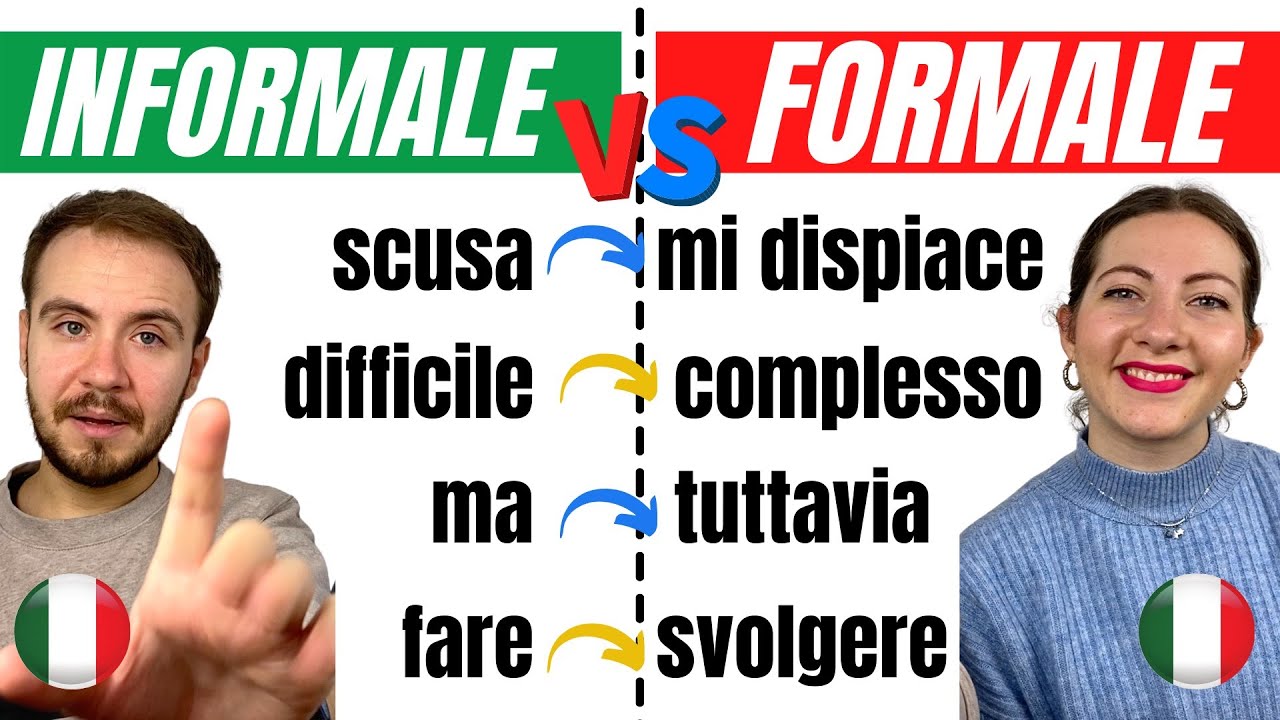
FORMAL and INFORMAL expressions in Italian
The Italian language, just like many other languages, is characterized by a certain degree of variability in the diaphasic dimension, which means that it has different varieties based on the context in which we are speaking or writing. In other words, according to the situation, the speaker will choose whether to use a word or another, adapting his/her speech to the circumstances.
Indeed, there are a lot of words that are perceived as “formal”, whereas others are perceived as “informal”:
- the first ones are used mainly in serious situations, for instance, a meeting with our boss or with a professor, or more generally, with anyone who has a social or professional position that is above ours;
- on the contrary, the second ones are employed in less serious contexts, for example, during a conversation with a friend, with our parents, or generally with our peers.
Often, it is difficult to distinguish between formal and informal expressions for people who are not native Italian speakers. That is because it is a type of difference that is generated at the social level, in the practical use of the language, and only those who use the language daily with other people have a good perception of the difference between formal and informal words. But don’t worry: we are here to help you learn how to use these formal and informal expressions that will be very useful in daily conversation.
Let’s make a practical example: let’s suppose that you need to send a text to your friend and an email to your boss to let them know that tomorrow you have an undelayable commitment. Therefore, you will not be able to go to your friend’s birthday and to the meeting with your colleagues.
So you will say to your friend:
Ciao Rebe! Scusa se te lo dico solo ora, ma il mio dentista mi ha chiamato stamattina e mi ha fissato un appuntamento per domani all’una, quindi mi sa che non riesco a venire al tuo compleanno. Mi dispiace un sacco. Spero comunque di rivederti presto! Un bacio, Graziana.
Hi Rebe! I’m sorry to tell you this just now, but my dentist has called me this morning and gave me an appointment for tomorrow at 13:00, so I guess I can’t make it for your birthday. I’m really sorry. Anyway, I hope to see you soon! Kisses, Graziana.
Whereas, you will something like this to your boss:
Gentile Dottor Rossi,
La presente mail è per informarla che domani purtroppo non potrò essere presente alla riunione con i colleghi, poiché ho dovuto fissare un appuntamento dal medico per le ore 13. Nella speranza di non aver creato alcun disagio, la ringrazio per la comprensione e le porgo i miei cordiali saluti.
Graziana
Dear Mr. Rossi,
This email is to inform you that unfortunately tomorrow I will not be able to be present at the meeting with my colleagues, as I had to make a doctor’s appointment at 1 p.m. I hope that I have not created any discomfort. Thank you for your understanding.
Best regards
Graziana
The first difference that we can notice between the two texts is related to the pronouns used to refer to the friend and the boss. In the first text, we use the pronoun “tu” because we are talking to a friend, a person we know well. Whereas in the second text, we use the pronoun “lei” either because we do not have an intimate relationship with our interlocutor, we do not know them very well, or because the interlocutor is in a position which is above ours, or is older than us. Using the pronoun “lei” implies conjugating the verbs in the third person singular and feminine, even though we are speaking to a male, like in this example. We can see it, for instance, in “informarla”, “la ringrazio” and “le porgo”.
Therefore, first of all, to distinguish a formal speech from an informal one, we can look at the pronouns used to refer to the interlocutor: if the person who is writing or speaking is using the pronoun “lei”, then it is highly possible that he/she is also using other formal expressions.
In the mail to your boss, there are some signs of formality such as:
- “poiché” instead of “perché”
- “le ore 13” instead of “l’una”
- “nella speranza di” instead of “spero di”
- “disagio” instead of “problema”
- “la ringrazio” instead of “grazie”
- “le porgo i miei cordiali saluti” instead of an informal greeting like “ciao” or “a presto”.
ESPRESSIONI UTILI
Now let’s see some useful expressions that are used in everyday life in formal contexts and informal ones:
| INFORMAL | FORMAL |
| Ciao!
Hello!/ Hi! | Buongiorno / Buonasera / Buon pomeriggio / Salve
Good morning/ Good evening / Good afternoon |
| A presto! / Ci vediamo!
See you soon! / See you! | Arrivederci / Cordiali saluti (solo nello scritto)
Goodbye / Best regards (only in written language) |
| Scusa
“Scusami per l’altra sera” Sorry “Sorry for last night“ | Mi dispiace / Mi rincresce
“Mi dispiace per ciò che è accaduto martedì sera” I apologize / I regret “I apologize for what happened Tuesday night“ |
| Ma
“L’ho chiamato, ma non risponde” But “I called him, but he did not answer“ | Tuttavia / Ad ogni modo
“Ho provato a contattarlo, tuttavia non ho ricevuto risposta” However / In any way “I tried calling him; however, I did not receive an answer“ |
| Dire
“Volevo dirti che…” Tell “I wanted to tell you that…“ | Informare / comunicare
“Ci tenevo a informarla che…” / “Volevo comunicarle che…” Inform / Report “I wanted to inform you that… / I wanted to report that…“ |
| Aiutare
“Mi puoi aiutare a scrivere la mail?” Help “Can you help me write this email?“ | Assistere / coadiuvare
“Potrebbe gentilmente assistermi nella stesura della mail?” Tend to / Assist “Could you please assist me in writing this email?“ |
| Fare
“Ho fatto tutto quello che mi hai chiesto” Do “I did everything you asked” | Svolgere / eseguire
“Ho svolto tutti i compiti che mi aveva affidato” Carry out / Perform “I carried out all the tasks entrusted to me“ |
| Difficile
“Il lavoro che ho fatto è stato difficile” Difficult “The work I did was difficult“ | Complesso
“Il lavoro da me svolto è stato complesso” Complicated “The activity I carried out was complicated” |
| Un sacco / tanto
“Il film mi è piaciuto un sacco” A lot/ Really “I really liked the movie“ | Decisamente / Alquanto
“Ho decisamente apprezzato il film” Definitely / Certainly “I definitely enjoyed the film“ |
And so on!
As a matter of fact, the Italian language has a lot of alternatives and synonyms that can be used to indicate the same thing. Therefore, it is impossible to make a list of all the formal/informal matches. The only way to master the Italian language so well that you can distinguish with no problems formal expressions from informal ones is to practice, to listen, to read, and to write a lot.
Anyway, we hope that this lesson gave you a good overview of formal and informal expressions. If you want to further analyze the matter of the pronouns TU and LEI (and voi), we suggest you watch the video exclusively focused on these two pronouns.
Want the lesson PDF with exercises and solutions?
Join the LearnAmo AcademyLet’s see if you’ve mastered the contents of this class. Have a go at completing the exercises!
Caricamento quiz in corso…
Podcast: Play in new window | Download (Duration: 9:11 — 8.4MB)
Iscriviti: Apple Podcasts | Spotify | Android | iHeartRadio | Podcast Index | TuneIn | Deezer | RSS | Altri...