

'/%3E%3Cpath%20fill='%23b2b2b2'%20d='M241%20382q0%2016%2017%2026%2017%2011%2042%2011t42-11q16-11%2017-26V269H241'/%3E%3Cpath%20fill='%239f7e00'%20d='M241%20379q0%2014%208%2023%209%209%2021%209%2014%200%2021-9%209-9%209-23V269h-59'/%3E%3Cpath%20d='M241%20339v-70h59v110q0%2014-9%2023l-6%205v-68h-15v72q-8%200-14-4v-68zm59%2040c0%2022%2015%2032%2029%2032%2021%200%2030-18%2030-32v-40h-59'/%3E%3Cpath%20fill='%239f7e00'%20d='M266%20277v5h2v12h-3v-5h2v-5h-9v5h2v5h-4v9h3v18h-5v10h34v-10h-5v-18h3v-9h-4v-5h2v-5h-9v5h2v5h-3v-12h2v-5zm42%20101q0%2010%206%2017%206%206%2015%207%2010-1%2016-7%206-7%206-17v-29h-43'/%3E%3Ccircle%20fill='%230044ad'%20cx='329.5'%20cy='372'%20r='6'/%3E%3Cellipse%20fill='%230044ad'%20cx='300'%20cy='340'%20rx='16'%20ry='21'/%3E%3C/svg%3E)
You know, cooking is an important part of Italian culture and there are a lot of foreigners around the world who wants to recreate Italian recipes at home because Italian restaurants abroad are not always… really Italian… However, very often Italian recipes are only available in Italian, and this can become an obstacle, because even those people who have a fairly advance level of Italian do not always kwon all the verbs in the recipes. For this reason, between each step, they have to stop and look up the word in the dictionary in order to see which example best suit the context, etc. Today we’ll see the most common and important verbs that you will find in Italian recipes! Are you ready? Let’s get started right away and be careful: you may find your mouth watering!
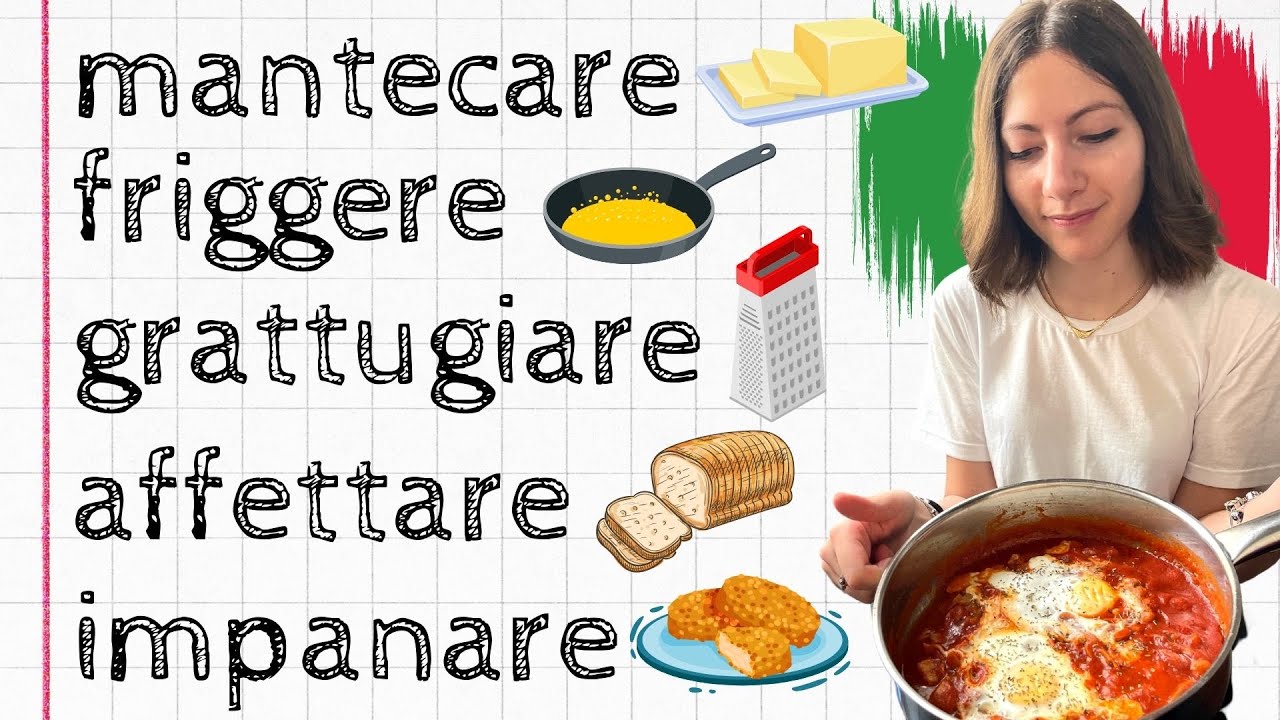
Italian Cooking Verbs
CUCINARE vs CUOCERE
First, let me answer a question that many foreigners have: what is the difference between the verbs CUOCERE e CUCINARE?
CUCINARE (to cook)- it refers to the different steps you need to follow to prepare a dish, which means not only the cooking itself, but also all the other actions that are necessary for the final result.
CUOCERE – it refers to the transformation of food from raw to cooked, through the process of heating it up with a flame or some other heat. And that’s it.
Another interesting fact is that the Italian language does not have a corresponding verb for the English verb “to bake”. In fact, in Italian we say CUOCERE AL FORNO (to cook in the oven). So, if you want to say something such as “I like baking”, you should change the structure of the sentence and use something like “Mi piace preparare le torte”(I like preparing cakes), “Mi piace preparare dolci” (I like preparing desserts), “Mi piace preparare piatti al forno” (I like preparing food in the oven) and so on… Yes, I know, it’s not very nice… But what about your language? Do you have a corresponding verb for “to bake”? Let me know! Now… let’s go on!
The most frequently used verbs in Italian recipes
BOLLIRE (to boil) – to heat until steam bubbles form
SBOLLENTARE (to parboil) – to plunge a food for a few minutes in boiling water without fully cooking it
CUOCERE AL VAPORE (to cook with steam/to steam it) – cooking method that avoids direct contact between the water and the food
CUOCERE A BAGNOMARIA (to cook in bain marie/to cook in a double boiler) – cooking method that involves plunging one container with food into a larger one containing hot or boiling water
LESSARE (to simmer) – to cook food plunging it in boiling water or boiling broth
GRIGLIARE (to grill) – to cook on a grill (often with hot coals)
AFFUMICARE (to smoke) – to expose the food to smoke in order to keep it or give it a distinctive flavour
FRIGGERE (to fry) – cooking method that involves plunging a food into oil or other boiling and melted fats
SOFFRIGGERE (to fry lightly/to sauté) – to leave a food in oil or butter for a few minutes, until it becomes golden brown
PELARE (to peel) – to remove the rind of vegetables with a knife or a specific tool
AMALGAMARE (to mix) – to mix different ingredients together until obtaining a homogeneous mixture
AMMOLLARE (to soften) – to plunge and keep a food in water or other liquids in order to soften it
APPASSIRE (to dry out) – to soften vegetables by cooking them in a pan with oil or butter, on a very low heat and with a lid on, so that they do not lose their colour
ARROSTIRE (to roast) – to cook meat, fish, or other food in the oven, on a spit or on a grill, without adding water
BRASARE (to braise) – to cook food on a low heat in a hermetically sealed pot with little liquid
DORARE -1) to cook food in condiment so that it reaches a golden-blonde colour -2) to brush the top of a pastry with egg yolk before baking it
IMBIONDIRE (to fry golden brown) – to leave chopped vegetables in oil or butter over high heat until they become light, golden (blonde)
ROSOLARE (to brown) – to brown food in oil or butter on a low heat
SCOTTARE (to sear/to lightly cook) – to lightly cook a food (especially meat or fish) on all sides on the well-heated surface of a pot, pan, grill or in boiling water, without it losing its internal juices
FRULLARE (to blend/to whip) – to chop and to grind different ingredients in a blender in order to obtain frothy and/or creamy mixtures
GRATINARE (to cook au gratine/to gratinate) – to cook in the oven food products that are covered with cheese or breadcrumbs so that a light crust forms on their surface
GUARNIRE (to garnish) – to decorate dishes with different elements that are used to to add flavour to the main ingredients
CONDIRE (to season) – to make food tastier and/or more nourishing by adding special ingredients, such as oil, vinegar and spices to it
IMBURRARE (to grease with butter) – to spread a light layer of butter on the containers before cooking the food
MESCOLARE (to blend/to stir) – to stir a bunch of ingredients (even if they have different textures, but mostly liquids) until they form a homogeneous mixture
METTERE A BAGNO (to soak) – to leave a solid food in cold water for a few hours, in order to make its cooking easier and faster (especially for legumes)
IMPANARE (to coat with breadcrumbs/to crumb) – before cooking the food, dip it into egg wash and then in breadcrumbs
INFARINARE (to dredge with flour) – to dip a food in flour before cooking it
INFORNARE (to bake, to put in the oven) – to put a baking pan in the oven in order to cook its contents
MARINARE (to marinate) – to keep a food dipped in a seasoning that is enriched with herbs and spices for a specific time before cooking it, in order to give it a particular flavour or to keep it longer
MACERARE (to macerate/to steep) – to keep a food dipped in a liquid (wine or vinegar for example) for a very long time, longer than the grinding
MACINARE (to grind/to mill) – to reduce food into pieces or into powder with a grinder or other tools
MANTECARE (to cream/to thicken) – to work on an almost ready dish for a long time, on a very low heat or off heat, while constantly stirring to make it softer and creamier. A little butter or cheese is often added to achieve this result
MONTARE (to whip/to whisk/to beat) – to beat a mixture with a whisk or a blender in order to make it fluffier and frothier, increasing its volume
SALTARE (IN PADELLA) (to stir-fry) – to brown any food in seasoning, over high heat, to make it absorb sauce or other seasonings
SFILETTARE (to fillet) – when referring to fish: remove the skin, bones and head from the fish and cut the remaining pieces into fillets
STUFARE (to stew) – to cook certain foods on a low heat and with closed lid with butter and/or other strong-flavoured seasonings, such as onions, laurel, garlic, etc.
UNGERE (to grease/to oil) – to apply a thin layer of oil or fat to the sides of a mould or another container
TRITARE (to mince/to chop up) – to mince an ingredient into extremely small pieces
TAGLIARE A CUBETTI (to cut into cubes) – to cut an ingredient into small, cube-shaped pieces
AFFETTARE (to slice) – to cut a food into slices
SCIOGLIERE (to melt) – to turn a solid food into liquid by heating it or by putting it into another liquid and stirring it
FONDERE (to melt/to liquefy) – to melt a solid food by using heat
SETACCIARE (to sift) – using a powdered ingredient, separate the finer parts from the thicker parts using a special tool, the sieve
SBATTERE – STRAPAZZARE (to beat/to scramble) – to shake with energy a liquid food
COSPARGERE (CON) (to sprinkle) – to cover the surface of a food with an ingredient
SALARE (to salt) – to add salt to something
PEPARE – to season with pepper
SPREMERE (to squeeze) – to squash something hard, either by hand or with a special tool, to release the liquid it contains
IMPASTARE (to knead) – to mix different ingredients into a homogeneous dough using your hands
GRATTUGIARE (to grate) – to reduce food into very small fragments using a grater
SBUCCIARE (to peel) – to remove the skin (the outer part) of fruit or vegetables
VERSARE (liquido o solido) (to pour something liquid or solid) – to bring a liquid out of a container by tilting or tipping it in order to put it in another container
SPIANARE (to level/to roll out) – to level and even out a surface by removing the different unevenness
INZUPPARE(to soak/to dunk) – to put a food into a liquid so that it completely absorbs that liquid
SCOLARE (to strain) – to remove cooking or rinsing water from a particular food or vegetable
ASSAGGIARE (to taste/to try) – to try a dish and to eat it in small pieces to judge it
MORDERE / TIRARE UN MORSO (to bite) – to grasp a piece of food with the teeth
DILUIRE (to dilute) – to thin a liquid, usually by adding water to it
SPALMARE (to spread) – to spread a pasty or semi-liquid food on a flat surface
DECORARE (to decorate) – to make a dish more beautiful using decorative ingredients
IMPIATTARE – to arrange food on a plate, often with a certain elegance or with decorations, in order to make it look good
SMINUZZARE (to crumble) – to break a food into small bits with the help of your hands
INFIAMMARE (to flame) – to light a liquor that has been sprinkled on a dish while it is being served
FARE LA SCARPETTA (to mop your plate with bread) – to collect the remaining sauce on the plate with a piece of bread
Let me know in the comments which of these actions you do the most when preparing food! I would also like to remind you that, if you want to make sure you understand all the Italian recipes, you can complete the vocabulary from this lesson with the one dedicated to kitchen utensils!
Want the lesson PDF with exercises and solutions?
Join the LearnAmo AcademyCaricamento quiz in corso…
Podcast: Play in new window | Download (Duration: 11:25 — 10.5MB)
Iscriviti: Apple Podcasts | Spotify | Android | iHeartRadio | Podcast Index | TuneIn | Deezer | RSS | Altri...