


First of all: thank you very much! From your comments and views, it looks like you love the series of videos about the 5 most common mistakes foreigners make concerning a specific topic: the subjunctive, the word QUALCOSA, the verb TRATTARSI DI…This video follows the same series, so get ready for the 5 most common mistakes foreigners make about a pretty feared topic: the SI Impersonale!
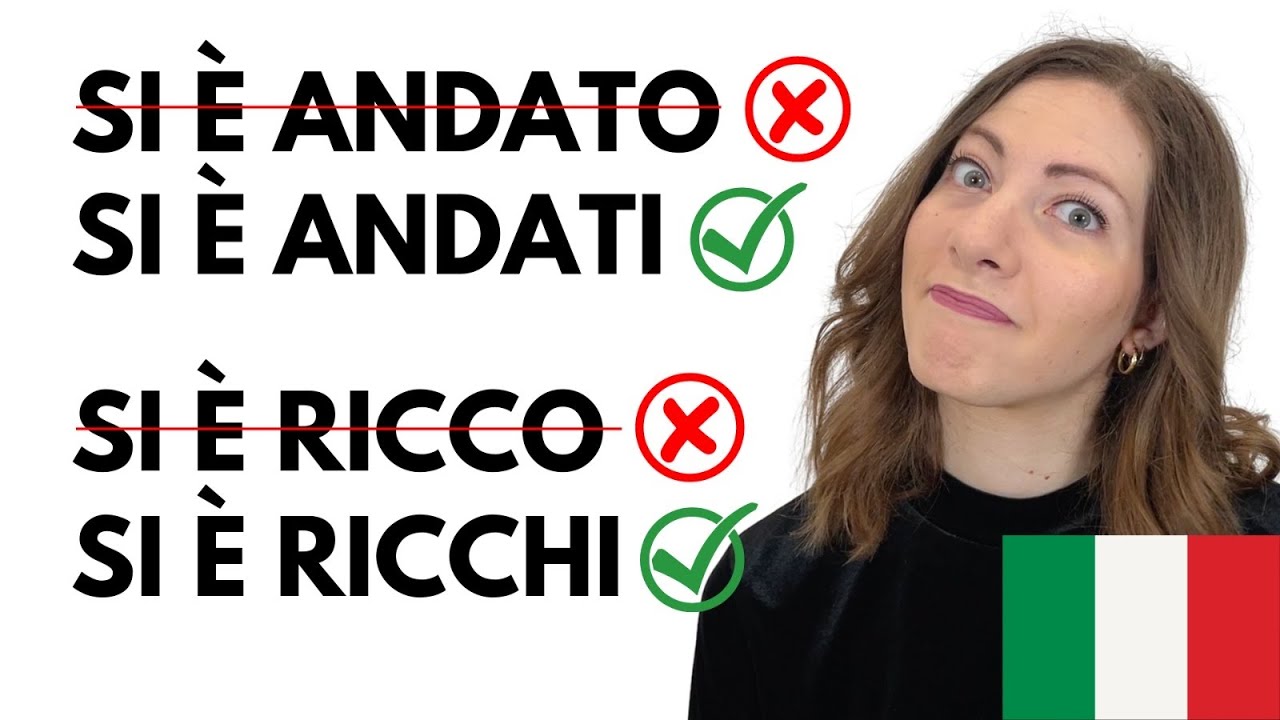
“SI” Impersonale in Italian: the 5 most common mistakes
“But the SI impersonale is very easy! You just need to use the particle SI + the verb in the third person singular! “What could it be?”
Don’t let youself mislead! Be able to speak fluent requires a more deepened knowledge!
Here are the 5 most common mistakes foreigners make with the Italian SI impersonale.
1. SI COMPRA LE COSE
Many foreigners follow the si impersonale “general rule” (si + verb in the third person singular) blindly. Unfortunately, it is not so easy, as I told you before.
For example, the sentence “Si compra le cose” is wrog! The correct form would be “Si comprano le cose”.
Why?
Let’s make things clear.
In this case the particle SI works as PASSIVIZING; moreover, the verb has got a direct object (le cose). In this case, the verb’s direct object is the subject of a passive sentence, therefore the verb agrees with that.
I will show you with an example. If I say
Si comprano le bevande
In this sentence, “le bevande” is the direct object, but it is also the subject of the sentence if I convert it in the passive form (Le bevande sono comprate).
Well, to put it in terms, when you use the PASSIVAZING SI with a transitive verb that relies on a plural direct object, the verb will need to be conjugate in the third person singular (si mangiano i panini, si vedranno le stelle, si troveranno i soldi…).
Remember: if the direct object is singular, the verb will be conjugate in the third person singular.
Example:
Le scelte si fanno in pochi secondi e si scontano per il tempo restante. Paolo Giordano
2. SI LO FA
Many foreigners are mistaken when, with the SI impersonale, they need to use another pronoun, too. Where to place the one and the other? Which one goes first? Which one then?
“Si lo fa?”
“Se lo fa?”
“Lo si fa?”
“Lo se fa?”
It sounds like a list of notes…
Well, the correct form is “Lo si fa”.
Actually, there is one thing you can be sure of: the SI impersonale always goes immediately before the verb. Consequently, any other pronoun must be added before the particle SI.
And what about the form “se lo fa”? It sounds correctly, isn’t it? It’s true! There is, but it has another meaning! In this sentence, indeed, we still have two pronouns together, but the SI is not impersonal, rather a reflective SI, referred to a third person singular (him or her).
For example:
Mario si fa il bagno. —> Mario se lo fa.
Do you notice the difference? This sentence has Mario as subject, so it can’t be impersonal.
Example:
Si dice che l’amore rende ciechi. Fa ben di più, rende sordi, paralizza. Quando viene il mal d’amore, si diventa come la mimosa che subito si chiude, nessun grimaldello riesce ad aprirla e più le si fa violenza, più si chiude. Søren Kierkegaard
3. SI HA MANGIATO BENE
Compound tenses, as always, cause more confusion compared to the present tense, and this happens with the impersonal SI, too.
For example, a very widespread mistake is the use, in the simple past, of the auxiliary “have” with the verbs that normally use the auxiliary “have”.
So? Which one is the mistake here?
Well, the auxiliary to form compound tenses after the SI impersonale is always the verb “to be”. The past participle, then, changes depending on the typology of the verb in question.
“Mangiare” is a transitive verb, so the the past participle remains in the basic form (in -o): the correct form would be “si è mangiato bene”.
Example:
Quando si è parlato molto, si è detto sempre qualcosa che sarebbe stato meglio tacere. Confucio
And this directly leads us to the next mistake.
4. SI È ANDATO
If you say “si è mangiato” or “si è detto”, you’ll also say “si è andato”? No!
As I told you earlier, you need to see the typology of the verb in question. The verbs that form compound tenses with the auxiliary “be” (some intransitive and reflective verbs) assume the plural form of the past participle.
So, the correct form will be “si è andati” (or andate, if there are just women).
Oh my Godness, how many rules!
I’ll explain you them specifically in the video about how to form and how to use the impersonal SI.
Example:
C’è un solo tipo di shock peggiore rispetto all’imprevisto: il previsto per il quale ci si è rifiutati di prepararsi. Mary Renault
5. SI È RICCO
“I’m using the verb in singular”, you’re thinking, “so the adjective must be singular, too”…
But it doesn’t! The correct form is “si è ricchi”, with the verb in singular but the adjective in plural! (Or “si è ricche” if you are talking about women only).
Again: this is worth any adjective or substantive that follows the SI impersonale, even though the verb is conjugate in the third person singular.
Example:
È facile apparire intelligenti, quando si è belli! Vittorio Emanuele III di Savoia re d’Italia
Fiuuuu! We did it! What do you think about it? Is everything clearer now? I hope so! Challenge yourself with some sentence in the comments! I’ll wait for them!
Speaking of the King of Italy Vittorio Emanuele III of Savoy, don’t miss our video about the history of the House of Savoy, the Italian Royal Family! It’s a very interesting video that you could use also to practice your listening skills in following a story. And don’t forget to study Italian with native language teachers on italki.
Want the lesson PDF with exercises and solutions?
Join the LearnAmo AcademyCaricamento quiz in corso…
Podcast: Play in new window | Download (Duration: 15:38 — 18.1MB)
Iscriviti: Apple Podcasts | Spotify | Android | iHeartRadio | Podcast Index | TuneIn | Deezer | RSS | Altri...