


What’s your biggest dream? Maybe to buy a house, to become famous or to meet your soulmate, to have more friends…And that’s okay, of course! But if your answer is “to sound like a native Italian speaker”, this is the right video for you! In fact, I will show you some really common expressions in everyday language, mostly used among young people! You’ll find interlayers and exclamations used in informal contexts to express surprise, indignation, bewilderment and other feelings.
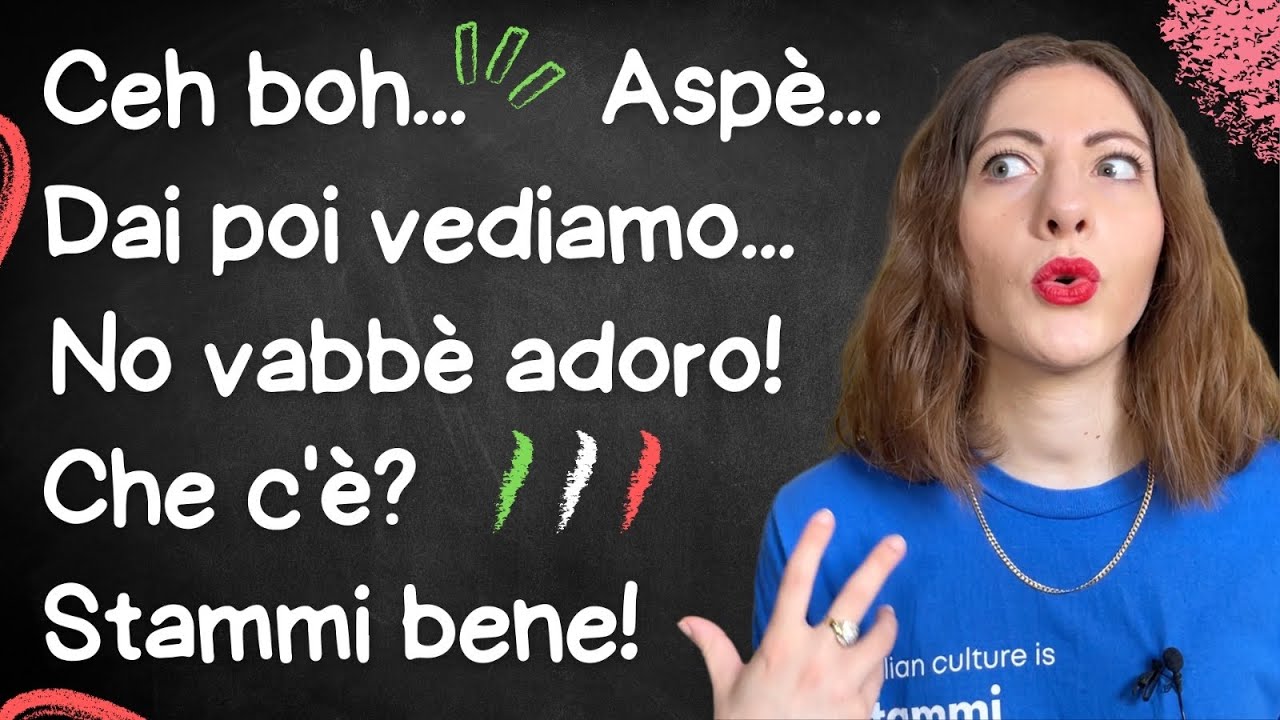
Common expressions in everyday language
Here are the most used colloquial expressions in Italian:
- Ceh boh…
It’s used to express: uncertainty , when we’re not sure about something; disbelief, when we’re speechless and we can’t believe something; contempt for something that we don’t like.
Examples:
Vorrei trasferirmi all’estero, ma ho paura di non riuscire a trovare un lavoro… Ceh boh… Con il tipo di laurea che ho, chi mi assumerebbe fuori dall’Italia?
Ho aiutato Stefania a superare l’esame e non mi ha neanche detto un “grazie”… Ceh boh… Non le farò più un favore! Almeno un po’ di riconoscenza…
Sei rimasto seduto al tuo posto sull’autobus nonostante quella vecchietta ti avesse chiesto di cederle il posto. Ceh boh… So che anche tu sei stanco, ma te lo ha persino chiesto…
- Ma che veramente?
It’s used to express surprise, both in a positive and in a negative sense. In the first case it can express amazement for something that we don’t expect; in the second case it expresses dismay and disbelief when we’re in a situation that catches us off guard but which we don’t really like or accept.
Examples:
Ma che veramente? Hai comprato i biglietti per il concerto? Ma che figata!
Hai raccontato il mio segreto a Marco? Ma che veramente? Cioè non ci si può fidare proprio di te!
- No vabbè adoro!
It expresses enthusiasm, surprise, contentment, happiness regarding something. It’s pronounced in a very enthusiastic and happy tone of voice.
Examples:
Vi sposate tra un anno? No vabbè adoro! E avete già scelto il posto in cui volete celebrare il matrimonio?
Ad Amsterdam? No vabbè adoro! Ho sempre voluto visitare quella città!
- Che vuoi, una foto?
It expresses discomfort when someone watches us insistently, stares at us making us feel uncomfortable. Obviously, this is not a polite way of expressing ourselves, because it underlines all the discomfort and impatience that the situation provokes in us.
Examples:
Scusa, che vuoi, una foto? No perché mi fissi da un’ora e non mi sembra di conoscerti…
- Dai, poi vediamo… / Poi vediamo, dai…
This expression is used to keep vague when we’re trying to avoid giving a precise answer. We use it to answer an awkward question, a question that we don’t want to answer because we would end offending or hurting our interlocutor.
Examples:
Ah state organizzando una vacanza? Ah grazie per avermi invitata! Eh… Poi vediamo dai… Devo valutare un po’ di cose e vi faccio sapere!
Se puoi lavorare per noi? Non so ora… È possibile, devo parlare con qualcuno… Dai, poi vediamo…
- No vabbè…
This expression indicates disappointment, shock but also a little bit of anger; in this case, we don’t know what to say because what we see/hear seems absurd, senseless or unrealistic.
Examples:
No vabbè… Vuoi andare al funerale con questo vestito rosso? Ma ti sembra normale?
Ah quindi non avevi studiato nulla ma pretendevi di superare l’esame? No vabbè… Tu non sai cosa sia il sacrificio!
- Stammi bene!
This is an expression used to dismiss someone, very used by Italian speakers at the end of a conversation. By saying “stammi bene”, we let the other people know that we care about them and their health.
Examples:
Ciao Sara! Mi ha fatto molto piacere rivederti dopo così tanto tempo. Adesso però ci teniamo in contatto eh! Stammi bene!
However, it can also be used ironically or sarcastically. For example, after a heated discussion, one of the interlocutors can dismiss the other saying “Stammi bene”, meaning “You didn’t understand anything about what I said, so stick to your guns”.
Ma hai sentito almeno quello che ho detto? Boh con te è come parlare al muro! Vuoi solo avere ragione tu e non ascolti mai cos’hanno da dire gli altri. Vabbè, stammi bene! Me ne vado, tanto non si può discutere con te!
- E niente…
This expression is very used in everyday conversations, mainly in two different occasions: as an interlayer put here and there in a speech to make the interlocutor understand that there are a lot of details or that what we are telling is trivial. But is’t also used at the end of a speech, to indicate that it’s finished and the other person can join the conversation by saying something, since we don’t have anything to add.
Examples:
La festa? No la festa è andata bene… Eravamo tutti mascherati… C’era un servizio di catering, il cibo era buono, tutto straniero: messicano, giapponese, thailandese! E niente… Ah poi c’erano ovviamente le bevande. Abbiamo ballato un po’… E niente… Dopo la mezzanotte sono tornata a casa.
Ha fatto un brutto incidente ed è morto sul colpo: era distratto perché stava parlando al telefono con la sua ragazza e lei voleva lasciarlo. Non ha fatto caso al semaforo rosso e così è passato, a grande velocità. Da destra arrivava un autobus, che non ha fatto in tempo a fermarsi prima. Così c’è stato lo scontro. E niente… […] Eh sì… Per i genitori è stato un duro colpo!
- Che c’è?
This is a very common expression, and it’s used in 2 main contexts: to express a bit of irritation, discomfort when someone is disturbing or calling us, even if we are doing something else. If used in this way, it’s a bit rude. So, we use this expression only with people who are pretty close to us. We don’t use it with acquaintances, because we would give a very bad impression.
Exmples:
- Graziana!
- Che c’è? Sto lavorando!
Che c’è? Perché mi guardi così? Non potevo indossare qualcosa di più sobrio…
We can also say “Che c’è?” to someone who seems sad or lost in thought, in order to make sure he’s okay and ask what’s the problem. In this case it’s not rude to use it, but it’s nonetheless very informal.
Examples:
Che c’è? Non ti vedevo così di cattivo umore da quando avevi quel lavoro che detestavi… È successo qualcosa?
Parlami, non tenerti tutto dentro… Che c’è? Ho fatto qualcosa che ti ha dato fastidio?
- Aspè!
It’s not difficult to understand this expression. It’s an abbreviation: in particular, the abbreviation of “Aspetta!”, the imperative form of the verb aspettare (to wait). It’s used to stop someone who is either walking too fast and we can’t keep up with him, or talking too fast, maybe about a complex subject and we can’t follow the reasoning. It’s obviously informal and used in colloquial contexts.
Examples:
No no no aspè! Non ho capito niente… Ricomincia da capo. Chi ha fregato chi? Luca? Ha fregato i suoi fratelli dopo la morte dei genitori? No vabbè….
All right! These were all the expressions used in everyday language by Italian native speakers. Did you like them? Now, if you want to relax, try our test on Italian gestures!
And don’t forget to take a look at our online store LearnAmo Collection!
Want the lesson PDF with exercises and solutions?
Join the LearnAmo AcademyCaricamento quiz in corso…
Podcast: Play in new window | Download (Duration: 14:58 — 17.5MB)
Iscriviti: Apple Podcasts | Spotify | Android | iHeartRadio | Podcast Index | TuneIn | Deezer | RSS | Altri...