


Have you ever wondered why some foreigners speak Italian so naturally and sophisticatedly that they almost seem like native speakers? The secret lies in mastering certain advanced grammar topics. These 10 topics will allow you to express yourself with the precision and elegance of a true Italian!
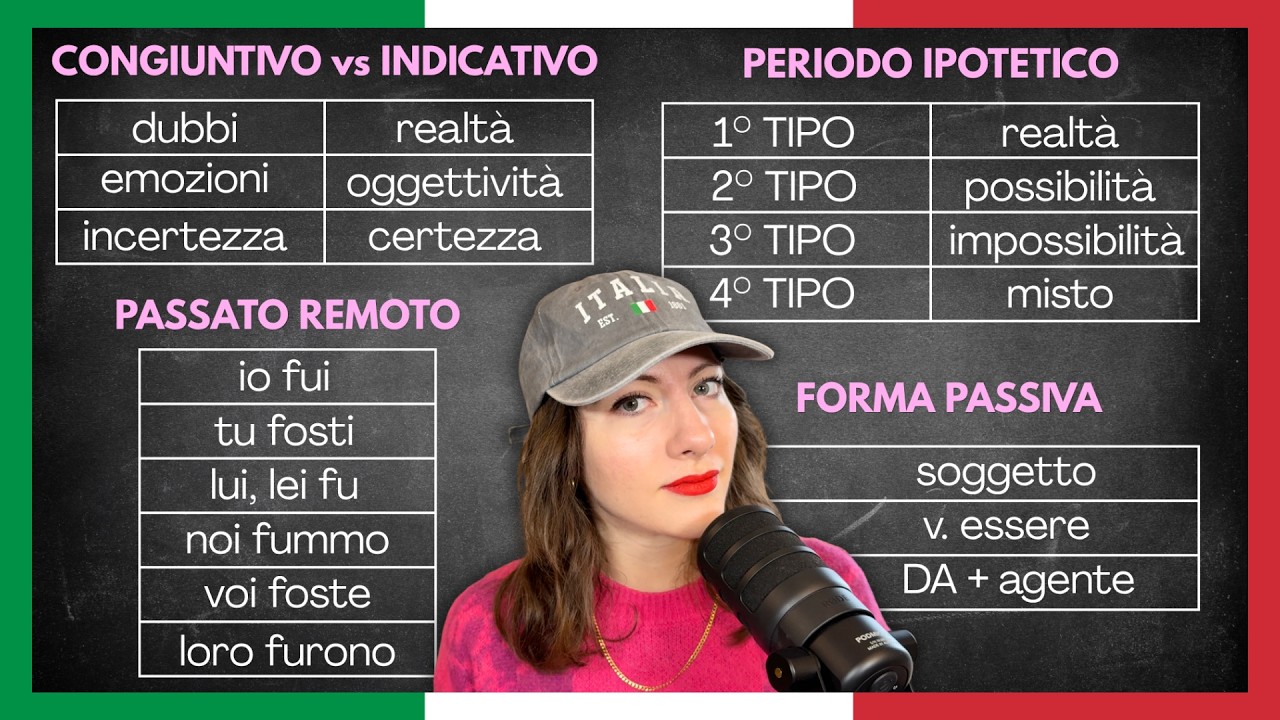
The 10 C2 Topics That Will Make You Speak Like an Italian
1. Congiuntivo vs Indicativo [Subjunctive vs Indicative]: The Choice That Makes the Difference
This is the real trial by fire: knowing how to choose between subjunctive and indicative will make you seem like a true expert in the Italian language. The fundamental distinction lies in the degree of certainty you want to express.
L’Indicativo: Il Modo della Certezza [The Indicative: The Mood of Certainty]
The indicative is the mood of reality, concrete facts, and certainties. It is used when you want to express something objective and verifiable.
Examples:
- “So che Marco è a casa” [I know that Marco is at home] → I am certain!
- “È vero che piove“ [It’s true that it’s raining] → It’s a verifiable fact!
- “Vedo che hai studiato” [I see that you have studied] → It’s evident from the results!
Il Congiuntivo: Il Modo del Dubbio [The Subjunctive: The Mood of Doubt]
The subjunctive is the mood of opinions, doubts, and hypotheses. It is used when you want to express something subjective or uncertain.
Examples:
- “Penso che Marco sia a casa” [I think that Marco is at home] → But I’m not sure
- “Credo che piova“ [I believe it’s raining] → It’s my personal opinion
- “Suppongo che abbia studiato” [I suppose he/she has studied] → It’s an assumption
Summary Table: Verbs That Require Indicative vs Subjunctive
| Verbi + INDICATIVO [Verbs + INDICATIVE] | Verbi + CONGIUNTIVO [Verbs + SUBJUNCTIVE] |
|---|---|
| Sapere [To know]: “So che è vero” [I know it’s true] | Pensare, credere, supporre [To think, believe, suppose]: “Penso che sia giusto” [I think it’s right] |
| Essere sicuro [To be sure]: “Sono sicuro che viene” [I’m sure he’s coming] | Sembrare, parere [To seem, appear]: “Sembra che abbia ragione” [It seems he’s right] |
| Vedere [To see]: “Vedo che è stanco” [I see that he’s tired] | Dubitare [To doubt]: “Dubito che venga” [I doubt he’ll come] |
| È vero/certo/evidente che [It’s true/certain/evident that]: “È vero che parla bene” [It’s true that he speaks well] | Sperare, desiderare, volere [To hope, wish, want]: “Spero che tu stia bene” [I hope you’re well] |
| Ricordare [To remember]: “Ricordo che era qui” [I remember he was here] | Temere, avere paura [To fear, be afraid]: “Temo che sia tardi” [I’m afraid it’s late] |
The Trick to Never Make Mistakes
Always ask yourself: “Is it a fact or an opinion?” If it’s a verifiable fact, use the indicative. If it’s an opinion, a doubt, or a hope, use the subjunctive.
Conjunctions That Always Require the Subjunctive
| Congiunzione [Conjunction] | Esempio [Example] |
|---|---|
| Benché, sebbene, nonostante [Although, even though, despite] | “Benché sia stanco, continuo a lavorare” [Although I’m tired, I continue to work] |
| Affinché, perché (scopo) [So that, in order that (purpose)] | “Studio affinché tu sia orgoglioso di me” [I study so that you’ll be proud of me] |
| Prima che [Before] | “Esci prima che piova“ [Go out before it rains] |
| Senza che [Without] | “È partito senza che io lo sapessi“ [He left without me knowing] |
| A meno che [Unless] | “Vengo a meno che tu non voglia“ [I’ll come unless you don’t want me to] |
2. La Forma di Cortesia: L’Eleganza Italiana [The Polite Form: Italian Elegance]
In Italian, politeness is not just a matter of “please” and “thank you,” but a complete grammatical system that demonstrates respect and good manners. Mastering the polite form will make you appear refined and respectful in any formal context.
Il Lei Formale [The Formal Lei]
We use the third person singular feminine to address people we don’t know, elderly people, superiors, or in formal contexts such as offices, elegant shops, and universities.
Transformation in Verb Tenses
| Tempo Verbale [Verb Tense] | Informale (Tu) [Informal (You)] | Formale (Lei) [Formal (You)] |
|---|---|---|
| Presente [Present] | “Tu vai” [You go] | “Lei va” [You go (formal)] |
| Presente [Present] | “Tu hai” [You have] | “Lei ha” [You have (formal)] |
| Presente [Present] | “Tu sei” [You are] | “Lei è” [You are (formal)] |
| Passato prossimo [Present Perfect] | “Tu sei andato” [You went] | “Lei è andato/a” [You went (formal)] |
| Imperfetto [Imperfect] | “Tu eri” [You were] | “Lei era” [You were (formal)] |
| Futuro [Future] | “Tu andrai” [You will go] | “Lei andrà” [You will go (formal)] |
Transformation with Pronouns
| Tipo di Pronome [Type of Pronoun] | Informale (Tu) [Informal (You)] | Formale (Lei) [Formal (You)] |
|---|---|---|
| Diretto [Direct] | “Ti vedo” [I see you] | “La vedo” [I see you (formal)] |
| Indiretto [Indirect] | “Ti telefono” [I’ll call you] | “Le telefono” [I’ll call you (formal)] |
| Con i verbi [With verbs] | “Ti do questo” [I give you this] | “Le do questo” [I give you this (formal)] |
| Riflessivo [Reflexive] | “Ti siedi” [You sit down] | “Si siede” [You sit down (formal)] |
L’Imperativo Formale: Un Segreto Importante [The Formal Imperative: An Important Secret]
The formal imperative is formed using the present subjunctive! This is a detail that many students overlook.
| Imperativo Informale (Tu) [Informal Imperative (You)] | Imperativo Formale (Lei) [Formal Imperative (You)] |
|---|---|
| “Ascolta!” [Listen!] | “Ascolti!” [Listen! (formal)] |
| “Vieni qui!” [Come here!] | “Venga qui!” [Come here! (formal)] |
| “Dimmi!” [Tell me!] | “Mi dica!” [Tell me! (formal)] |
| “Siediti!” [Sit down!] | “Si sieda!” [Sit down! (formal)] |
| “Stai attento!” [Be careful!] | “Stia attento!” [Be careful! (formal)] |
| “Fa’ presto!” [Hurry up!] | “Faccia presto!” [Hurry up! (formal)] |
| “Non parlare!” [Don’t talk!] | “Non parli!” [Don’t talk! (formal)] |
| “Non andare!” [Don’t go!] | “Non vada!” [Don’t go! (formal)] |
Quando Passare dal Lei al Tu [When to Switch from Lei to Tu]
In Italy, the switch from Lei to tu is an important social moment. Usually, the older person or the superior proposes the switch to tu. You can say: “Possiamo darci del tu?” [Can we use tu with each other?] or “Diamoci del tu!” [Let’s use tu with each other!]
Cultural curiosity: In some regions of southern Italy, the “Voi” [You – plural form used as formal singular] is still used as a polite form, especially with elderly people: “Voi come state? Voi avete bisogno di qualcosa?” [How are you? Do you need anything?] This use is very formal and respectful, even more so than “Lei”!
Mistakes to Absolutely Avoid
- “Lei hai ragione” → Mixing Lei with the second person
- “Lei ha ragione” [You are right (formal)]
- “La chiamo più tardi” → When speaking directly to the person (wrong pronoun)
- “Le telefono più tardi” [I’ll call you later (formal)]
3. Il Si Impersonale: Parlare in Generale [The Impersonal Si: Speaking in General]
The impersonal “si” is a typically Italian construction that has no direct equivalent in many languages! Mastering it makes your Italian much more natural and less “translated.”
Formazione Base [Basic Formation]
SI + verb in the third person singular or plural
When the Impersonal Si Is Used
| Uso [Use] | Esempio [Example] | Significato [Meaning] |
|---|---|---|
| Per generalizzare [To generalize] | “In Italia si mangia bene” [In Italy one eats well] | = People eat well |
| Per dare istruzioni [To give instructions] | “Si prende il treno e si scende alla seconda fermata” [You take the train and get off at the second stop] | = You take the train… |
| Per evitare “io” o “tu” [To avoid “I” or “you”] | “Come si dice in italiano?” [How do you say it in Italian?] | = How do you/we say…? |
| Nelle ricette [In recipes] | “Si mescolano le uova con lo zucchero” [The eggs are mixed with sugar] | = Mix the eggs… |
| Nei cartelli [On signs] | “Non si fuma”, “Si prega di non disturbare” [No smoking, Please do not disturb] | = Smoking is forbidden |
The Fundamental Agreement Rule
| Tipo di Verbo [Type of Verb] | Regola [Rule] | Esempio [Example] |
|---|---|---|
| Transitivo + oggetto singolare [Transitive + singular object] | Singular verb | “Si vende casa” [House for sale] |
| Transitivo + oggetto plurale [Transitive + plural object] | Plural verb | “Si vendono case” [Houses for sale] |
| Intransitivo [Intransitive] | Always singular | “Si va al mare”, “Si dorme bene qui” [One goes to the beach, One sleeps well here] |
Il Si Impersonale con i Verbi Riflessivi [The Impersonal Si with Reflexive Verbs]
When the verb is already reflexive, the impersonal “si” becomes “ci si“:
- “Lavarsi” [To wash oneself] → “Ci si lava“ [One washes oneself] (= people wash themselves)
- “Divertirsi” [To have fun] → “Ci si diverte“ [One has fun] (= people have fun)
- “Alzarsi” [To get up] → “Ci si alza presto” [One gets up early] (= people get up early)
4. Il Periodo Ipotetico: Tutte le Possibilità [The Conditional Sentence: All the Possibilities]
The conditional sentence expresses hypothetical situations, dreams, regrets, or possibilities. It is formed by two parts: the protasi [if-clause] (the condition, introduced by “se”) and the apodosi [main clause] (the consequence). There are three main types!
I Tre Tipi di Periodo Ipotetico [The Three Types of Conditional Sentences]
| Tipo [Type] | Significato [Meaning] | Struttura [Structure] | Esempio [Example] |
|---|---|---|---|
| PRIMO TIPO [FIRST TYPE] | Reality (likely to happen) | SE + present indicative → present indicative/future/imperative | “Se piove, prendo l’ombrello”; “Se studierai, passerai l’esame” [If it rains, I take the umbrella; If you study, you’ll pass the exam] |
| SECONDO TIPO [SECOND TYPE] | Possibility (unlikely) | SE + imperfect subjunctive → present conditional | “Se fossi ricco, comprerei una Ferrari”; “Se avessi tempo, verrei con te” [If I were rich, I would buy a Ferrari; If I had time, I would come with you] |
| TERZO TIPO [THIRD TYPE] | Impossibility (didn’t happen) | SE + past perfect subjunctive → past conditional | “Se avessi studiato, avrei passato l’esame”; “Se fossi venuto, ti saresti divertito” [If I had studied, I would have passed the exam; If you had come, you would have had fun] |
The Most Common Mistake to Avoid
- “Se avrei…” → NEVER! After SE you never use the conditional!
- “Se avessi…” [If I had…] → Always subjunctive after SE!
Il Periodo Ipotetico Misto [The Mixed Conditional Sentence]
You can mix past and present when the cause is in the past but the consequence is in the present.
SE + past perfect subjunctive → present conditional
- “Se avessi studiato di più (passato), ora sarei più preparato (presente)” [If I had studied more (past), now I would be more prepared (present)]
5. Il Discorso Indiretto: Riportare le Parole Altrui [Indirect Speech: Reporting Others’ Words]
When you report what someone said, you can’t simply repeat their words. You must transform the sentence following precise rules. This is called “indirect speech” and it is essential for recounting conversations, giving news, or reporting information.
- Discorso diretto [Direct speech]: “Marco dice: ‘Vado al cinema'” [Marco says: ‘I’m going to the cinema’]
- Discorso indiretto [Indirect speech]: “Marco dice che va al cinema” [Marco says that he’s going to the cinema]
Cosa Cambia nel Discorso Indiretto [What Changes in Indirect Speech]
| Elemento [Element] | Discorso Diretto [Direct Speech] | Discorso Indiretto [Indirect Speech] |
|---|---|---|
| Pronomi [Pronouns] | “Io” [I] | “lui/lei” [he/she] |
| Possessivi [Possessives] | “Mio” [My] | “suo” [his/her] |
| Indicatori di tempo [Time indicators] | “Oggi” [Today] | “quel giorno” [that day] |
| Indicatori di tempo [Time indicators] | “Domani” [Tomorrow] | “il giorno dopo” [the next day] |
| Indicatori di tempo [Time indicators] | “Ieri” [Yesterday] | “il giorno prima” [the day before] |
| Indicatori di luogo [Place indicators] | “Qui” [Here] | “lì” [there] |
| Verbi (imperativo) [Verbs (imperative)] | “Vieni!” [Come!] | “di venire” [to come] |
Transformation of Verb Tenses (with main verb in the past)
| Discorso Diretto [Direct Speech] | Discorso Indiretto [Indirect Speech] |
|---|---|
| “Marco ha detto: ‘Vado al cinema'” [Marco said: ‘I’m going to the cinema’] | “Marco ha detto che andava al cinema” [Marco said that he was going to the cinema] |
| “Marco ha detto: ‘Sono andato'” [Marco said: ‘I went’] | “Marco ha detto che era andato“ [Marco said that he had gone] |
| “Marco ha detto: ‘Andrò'” [Marco said: ‘I will go’] | “Marco ha detto che sarebbe andato“ [Marco said that he would go] |
Stop reading Italian.
Start speaking it.
Online lessons in groups of 4, organised by level and goals, with qualified teachers. Pick the day and time that suit you from the available slots.
Max 4 students:
there’s a seat for you
6. La Consecutio Temporum: La Concordanza dei Tempi [The Sequence of Tenses: The Agreement of Tenses]
The consecutio temporum (literally “sequence of tenses”) is the art of making verb tenses agree in complex sentences. It is fundamental when the sentence has a main clause and a subordinate clause, especially with the subjunctive.
Quando la Frase Principale è al Presente [When the Main Clause Is in the Present]
| Rapporto Temporale [Temporal Relationship] | Tempo da Usare [Tense to Use] | Esempio [Example] |
|---|---|---|
| Contemporaneità [Simultaneity] | Present subjunctive | “Penso che sia intelligente” [I think he’s intelligent] |
| Anteriorità [Anteriority] | Past subjunctive | “Penso che sia stato bravo” [I think he was good] |
| Posteriorità [Posteriority] | Future or subjunctive | “Penso che sarà/sia bravo” [I think he will be good] |
Quando la Frase Principale è al Passato [When the Main Clause Is in the Past]
| Rapporto Temporale [Temporal Relationship] | Tempo da Usare [Tense to Use] | Esempio [Example] |
|---|---|---|
| Contemporaneità [Simultaneity] | Imperfect subjunctive | “Pensavo che fosse intelligente” [I thought he was intelligent] |
| Anteriorità [Anteriority] | Past perfect subjunctive | “Pensavo che fosse stato bravo” [I thought he had been good] |
| Posteriorità [Posteriority] | Past conditional | “Pensavo che sarebbe stato bravo” [I thought he would be good] |
The Trick to Not Make Mistakes
On the timeline, where is the action located in relation to the main clause? Before, at the same time, or after? The answer will guide you in choosing the correct tense.
7. Il Passato Remoto: Il Tempo dei Narratori [The Remote Past: The Tense of Storytellers]
The passato remoto is the tense of narration, history, and literature. It is used especially in written narration (books, newspaper articles) and in southern Italy also in everyday speech. In the north, however, it has almost disappeared from spoken language.
Formazione dei Verbi Regolari [Formation of Regular Verbs]
| Persona [Person] | PARLARE (-ARE) [TO SPEAK] | VENDERE (-ERE) [TO SELL] | PARTIRE (-IRE) [TO LEAVE] |
|---|---|---|---|
| Io [I] | parlai | vendei/vendetti | partii |
| Tu [You] | parlasti | vendesti | partisti |
| Lui/Lei [He/She] | parlò | vendé/vendette | partì |
| Noi [We] | parlammo | vendemmo | partimmo |
| Voi [You pl.] | parlaste | vendeste | partiste |
| Loro [They] | parlarono | venderono/vendettero | partirono |
Verbi Irregolari Comuni [Common Irregular Verbs]
| Verbo [Verb] | Io [I] | Tu [You] | Lui/Lei [He/She] | Noi [We] | Voi [You pl.] | Loro [They] |
|---|---|---|---|---|---|---|
| ESSERE [TO BE] | fui | fosti | fu | fummo | foste | furono |
| AVERE [TO HAVE] | ebbi | avesti | ebbe | avemmo | aveste | ebbero |
| FARE [TO DO/MAKE] | feci | facesti | fece | facemmo | faceste | fecero |
| DARE [TO GIVE] | diedi | desti | diede | demmo | deste | diedero |
| DIRE [TO SAY] | dissi | dicesti | disse | dicemmo | diceste | dissero |
| VENIRE [TO COME] | venni | venisti | venne | venimmo | veniste | vennero |
| VEDERE [TO SEE] | vidi | vedesti | vide | vedemmo | vedeste | videro |
When the Passato Remoto Is Used
- Azioni completamente concluse nel passato [Actions completely finished in the past]: Example: “Dante nacque nel 1265″ [Dante was born in 1265]
- Narrativa [Narrative]: Example: “Il cavaliere entrò nel castello e vide la principessa” [The knight entered the castle and saw the princess]
- Eventi storici [Historical events]: Example: “Colombo scoprì l’America nel 1492″ [Columbus discovered America in 1492]
Passato Remoto vs Passato Prossimo
- “Ieri ho mangiato la pizza” [Yesterday I ate pizza] → Emotionally closer, common usage in the north
- “Nel 1889 la regina Margherita mangiò la prima pizza” [In 1889 Queen Margherita ate the first pizza] → Distant, historical, narrative
8. I Verbi Pronominali: Quando il Pronome Cambia Tutto [Pronominal Verbs: When the Pronoun Changes Everything]
Pronominal verbs are verbs that, when combined with pronominal particles like CI, NE, LA, SI, completely change meaning. They are idiomatic and typically Italian: using them will make you sound much more natural.
I Verbi Pronominali Più Importanti [The Most Important Pronominal Verbs]
| Verbo Pronominale [Pronominal Verb] | Significato [Meaning] | Formazione [Formation] | Esempi [Examples] |
|---|---|---|---|
| FARCELA | To manage, to succeed | FARE + CI + LA | “Ce la faccio!” [I can do it!] = I succeed!; “Non ce la faccio più!” [I can’t take it anymore!] = I’m exhausted! |
| ANDARSENE | To leave, to go away | ANDARE + SI + NE | “Me ne vado!” [I’m leaving!] = I’m going away!; “Se n’è andato senza salutare” [He left without saying goodbye] |
| CAVARSELA | To get by, to manage | CAVARE + SI + LA | “Come te la cavi con l’italiano?” [How do you manage with Italian?]; “Me la sono cavata bene” [I managed well] |
| PRENDERSELA | To get upset, to take offense | PRENDERE + SI + LA | “Non te la prendere!” [Don’t get upset!] = Don’t be angry!; “Se l’è presa con me” [He got angry with me] |
| METTERCI | To take (time) | METTERE + CI | “Quanto ci metti ad arrivare?” [How long does it take you to arrive?]; “Ci ho messo due ore” [It took me two hours] |
| VOLERCI | To be necessary, to take | VOLERE + CE + NE | “Ci vogliono tre ore” [It takes three hours]; “Ci vuole pazienza!” [Patience is needed!] |
| FREGARSENE | To not care, to be indifferent | FREGARE + SI + NE | “Me ne frego!” [I don’t care!] = I don’t mind!; “Se ne frega di tutto” [He doesn’t care about anything] |
9. Le Forme Implicite: Infinito, Gerundio e Participio [Implicit Forms: Infinitive, Gerund, and Participle]
Implicit forms are called so because they do not have an explicit subject. They make your Italian more elegant, concise, and natural, avoiding sentences that are too long and repetitive.
L’Infinito [The Infinitive]
| Uso [Use] | Esempio [Example] |
|---|---|
| Con preposizioni [With prepositions] | “Sono uscito senza salutare“ [I left without saying goodbye] |
| Come soggetto [As subject] | “Fumare fa male” [Smoking is bad for you] |
| Dopo verbi modali [After modal verbs] | “Devo andare“, “Posso parlare“ [I have to go, I can speak] |
| Dopo lasciare/fare [After lasciare/fare] | “Mi ha fatto ridere“, “Lascia perdere“ [He made me laugh, Forget about it] |
Il Gerundio [The Gerund]
| Funzione [Function] | Esempio [Example] | Significato [Meaning] |
|---|---|---|
| Contemporaneità [Simultaneity] | “Camminando, ho incontrato Marco” [While walking, I met Marco] | = While I was walking |
| Causa [Cause] | “Essendo stanco, sono andato a letto” [Being tired, I went to bed] | = Because I was tired |
| Modo [Manner] | “Ho risolto il problema pensandoci bene“ [I solved the problem by thinking about it carefully] | = How? By thinking about it |
Attenzione [Attention]: The subject of the gerund must be the same as the main clause!
- “Camminando, la borsa si è rotta“ → The bag doesn’t walk!
- “Camminando, ho rotto la borsa“ [While walking, I broke the bag]
Il Participio [The Participle]
| Uso [Use] | Esempio [Example] |
|---|---|
| Come aggettivo [As adjective] | “Una ragazza sorridente“, “Un libro interessante“ [A smiling girl, An interesting book] |
| Nelle frasi implicite [In implicit clauses] | “Finito il lavoro, sono andato a casa” [After finishing work, I went home] (= After I finished) |
| Participio assoluto [Absolute participle] | “Arrivati a casa, abbiamo cenato” [Having arrived home, we had dinner] |
Frequently Asked Questions
What Is the Most Common Mistake with the Subjunctive?
The most common mistake is using the indicative after opinion verbs like “pensare” [to think], “credere” [to believe], and “supporre” [to suppose]. Remember: if you’re expressing a personal opinion, always use the subjunctive! “Penso che sia giusto” [I think it’s right] and not “Penso che è giusto”.
Can I Use the Conditional After “Se”?
Absolutely not! After “se” you always use the indicative (first type) or the subjunctive (second and third type), never the conditional. “Se avessi tempo, verrei” [If I had time, I would come] is correct; “Se avrei tempo, verrei” is a serious mistake.
When Should I Use the Passato Remoto Instead of the Passato Prossimo?
The passato remoto is used for historical events, in literary narrative, and in everyday speech in southern Italy. In northern Italy, the passato prossimo is preferred even for events far back in time. In formal and literary writing, the passato remoto is always appropriate for concluded and distant events.
How Do I Remember Pronominal Verbs?
Pronominal verbs should be memorized as complete expressions with their idiomatic meaning. Don’t try to translate them literally because they would lose their meaning. Use them frequently in everyday conversations to internalize them: “Ce la faccio!” [I can do it!], “Me ne vado!” [I’m leaving!], “Non te la prendere!” [Don’t get upset!] are expressions you’ll hear and use every day.
What Is the Difference Between “Si Impersonale” and “Si Passivante”?
Actually, they are the same construction seen from different perspectives! “Si parla italiano” can be interpreted as “people speak Italian” (impersonal) or as “Italian is spoken” (passive). The important thing is that the verb agrees with the object when it’s plural: “Si vendono case” [Houses are sold] (not “si vende case”).
How Does the Consecutio Temporum Work with the Subjunctive?
The key rule is to consider the temporal relationship between the main clause and the subordinate clause. If the main clause is in the present and the action of the subordinate is simultaneous, use the present subjunctive; if it’s anterior, use the past subjunctive. If the main clause is in the past, shift everything: imperfect subjunctive for simultaneity, past perfect subjunctive for anteriority, past conditional for posteriority.
Want to explore Italian at every level? Take a look at the articles dedicated to topics for beginner level and topics for intermediate level.
Buy our new book “Il Principe Marco e le parole del mondo” and learn Italian step by step through an engaging story, practical exercises, and thorough grammar review, from beginner to advanced level.
Want the lesson PDF with exercises and solutions?
Join the LearnAmo AcademyLoading quiz…
Podcast: Play in new window | Download (Duration: 50:11 — 45.9MB)
Iscriviti: Apple Podcasts | Spotify | Android | iHeartRadio | Podcast Index | TuneIn | Deezer | RSS | Altri...