


In this lesson we are going to deal with a quite difficult topic: causative verbs, also known as fattitivi. We are talking about the verbs “lasciare” (let) and “fare” (make/have), so if you want to clarify your doubts, stay with us!
Lasciare (let) and Fare (make/have): use and differences
Causative verbs introduce actions that are not done by their subjects, because they (don’t) command or (don’t) let other people to perform them.
Example: “Il professore ha fatto scrivere un testo ai suoi studenti” (The teacher made his students write a text)
The grammatical subject is, in fact, “il professore” (the teacher), but those performing the action are actually “i suoi studenti” (his students) because the teacher commanded them to write.
The causative clause consists of:
1 – subject that (doesn’t) command(s) or (doesn’t) allow other people to perform the action;
2 – the verb FARE o LASCIARE (conjugated into the appropriate tense);
3 – verb that expresses the action (always in the infinitive);
4 – subject that performs the action
Using “lasciare” rather than “fare”, or vice versa, is not a random choice:
1) The verb fare has the meaning of “comandare” (to command), “imporre” (to impose), “obbligare” (to force), ”spingere” (to push) someone to perform an action.
Example: “Mio nonno farà riparare i termosifoni al tecnico” (My grandfather will have the repairman fix the heater)
WATCH OUT!
If the verb in the infinitive is transitive (involving a direct object), we’ll have a subject performing the action that is preceded by the preposition A.
In this case, if you want to turn the subject performing the action into a pronoun (possibly because it was already mentioned or it’s known to the interlocutor), you need to use indirect pronouns!
Example: “Mio nonno gli farà riparare i termosifoni” (My grandfather will have him fix the heater)
If the verb in the infinitive is intransitive (not involving a direct object), we won’t have any preposition before the subject performing the action!
Example: “Mio cugino ha fatto entrare in ufficio la sua amica” (My cousin let his friend into the office)
Therefore, in this case, if you want to turn the subject performing the action into a pronoun, you need to use direct pronouns.
Example: “Mio cugino l’ha fatta entrare in ufficio” (My cousin let her into the office)
If you’re interested, you can take a look at our video one the use of direct and indirect pronouns.
ONLY with the verb FARE, il subject performing the action might go without saying, might be unknown or not relevant, therefore it can be omitted.
Example: “Mio nonno farà riparare i termosifoni” (My grandfather will have the heater fixed)
2) The verb lasciare, on the other hand, is less intense than fare, in fact, it has the meaning of “permettere” (to allow), “concedere” (to concede), someone to do something.
Example: “I genitori hanno lasciato uscire il figlio” (The parents let their son out) (Also in this sentence there are all the elements of a causative clause)
Unlike when we use the verb “fare”, with the verb “lasciare”, the subject performing the action, indicated by the verb in infinitive, is always expressed, even by a pronoun; in fact, the same rules regarding transitive and intransitive verbs shall remain valid
Example: “I genitori lo hanno lasciato uscire” (The parents let him out)
It must also be said that causative clauses, both with the verb “fare” and with the verb “lasciare”, can be positive and negative
Examples: “Mio nonno non farà riparare i termosifoni al tecnico” (My grandfather won’t have the repairman fix the heater)
“I genitori non hanno lasciato uscire il figlio” (The parents didn’t let their son out)
We are almost at the end of our lesson, there are only two aspects to analyse left:
ONLY with the causative verb lasciare we can use the explicit form, without the verb in the infinitive form, by conjugating the verb expressing the permitted action to the subjunctive.
Examples: “Lascia parlare tua figlia!” will be: “Lascia che tua figlia parli!” (Let your daughter speak!)
Or
“I nostri genitori non ci hanno lasciato guardare la TV!” will be: “I nostri genitori non hanno lasciato che noi guardassimo la TV!” (Our parents didn’t let us watch the TV!)
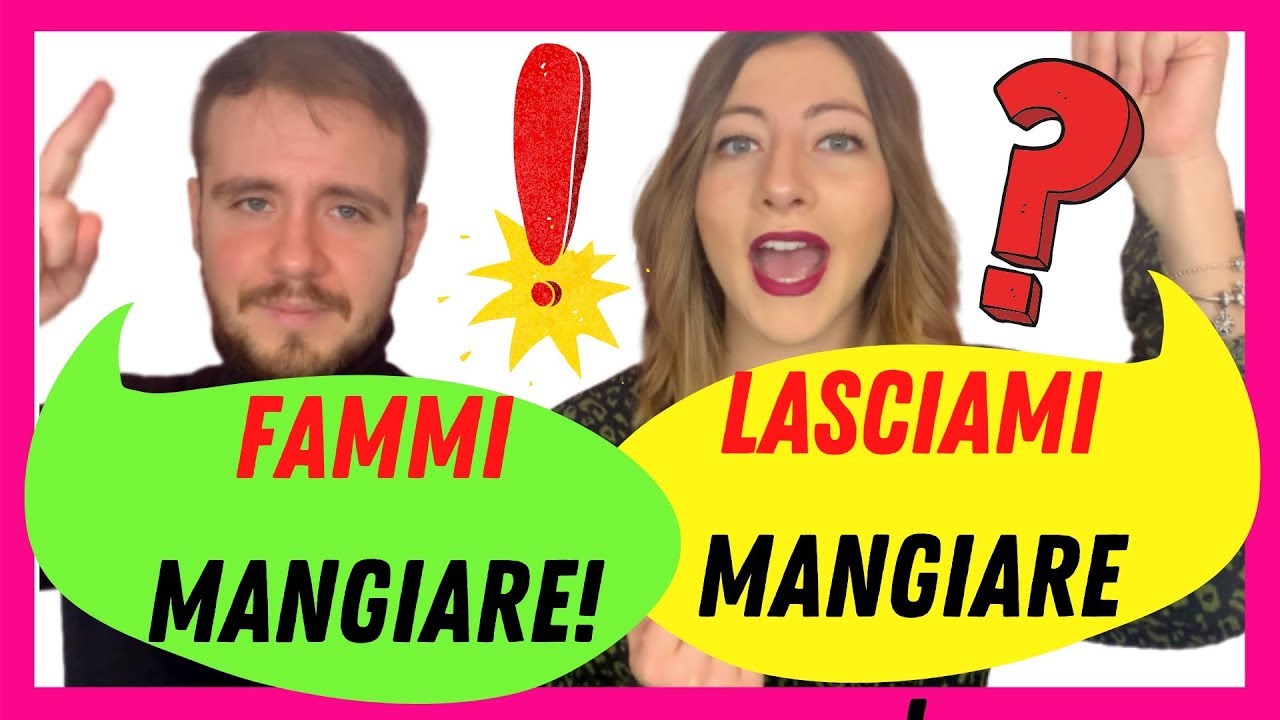
The verb fare, on the other hand, is very often used by Italians with the meaning of lasciare.
Esempio: “Fammi studiare per favore” instead of “Lasciami studiare per favore” (Please, let me study)
or
“Esci dalla camera e fammi dormire” instead of “Esci dalla camera e lasciami dormire”. (Get out of my room and let me sleep!)
Alright, our lesson has come to an end! Try to write a couple of sentences with the causative verbs and we will correct them and let us know if you still have doubts about this topic and we will respond promptly!
If you want to relax you can watch the video on the sexiest words in Italian language in order to impress the people you like!
And don’t forget to buy our book Italiano Colloquiale: Parole ed Espressioni per Tutti I Giorni: it’s indispensable if you really want to speak like a native!
Want the lesson PDF with exercises and solutions?
Join the LearnAmo AcademyCaricamento quiz in corso…
Podcast: Play in new window | Download (Duration: 10:05 — 9.2MB)
Iscriviti: Apple Podcasts | Spotify | Android | iHeartRadio | Podcast Index | TuneIn | Deezer | RSS | Altri...
Thanks for your excellent Italian lessons
There is a typo from your side and should be
Get Out Of My Room