


“Ieri ho mangiato” or “ieri mangiavo”? “Sono andato” or “andai”? “Avevo finito” or “ebbi finito”? If your brain gets slightly tangled in front of these pairs, I have good news: you’ve landed exactly where you needed to. Italian has as many as five past tenses, and picking the right one at the right moment is one of the trickiest hurdles for anyone studying our language. In this article we’re setting theory aside: today I’m putting you to the test with 39 exercises and the explained solution for each one.
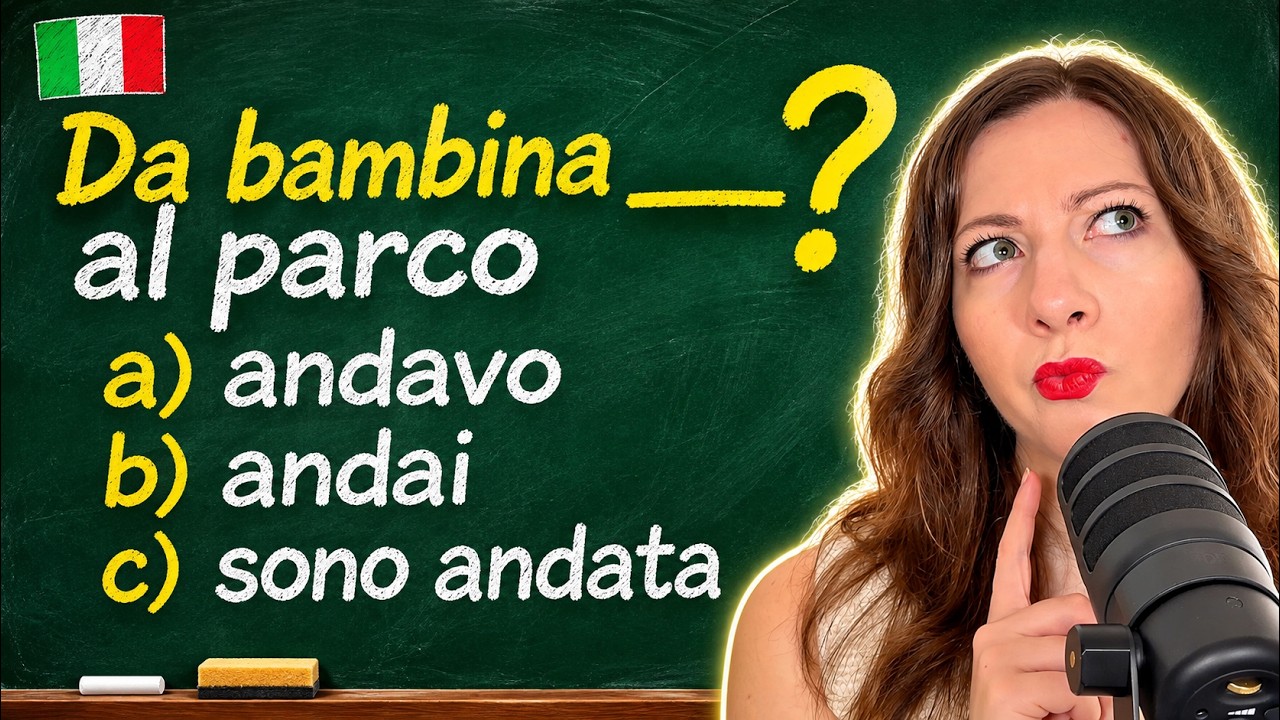
The PAST TENSE in Italian: The Complete Quiz
A quick review before you dive into the test, so no one can say “hey, but I didn’t know that”. The five past tenses of Italian are: passato prossimo, imperfetto, trapassato prossimo, passato remoto and trapassato remoto. Let’s look at them one by one.
The Five Past Tenses in Brief
The passato prossimo (ho mangiato, sono andata) tells a completed action, often recent or connected to the present. It’s the past you use the most when chatting: “Ieri ho visto un bel film” [Yesterday I saw a good movie]. To dive deeper, you can check out the guide on the passato prossimo and the past participle.
The imperfetto (mangiavo, andavo) is instead the tense for description, habits and actions that were ongoing in the past: “Da bambino giocavo a calcio” [As a child I used to play football], “Faceva freddo” [It was cold], “Mentre leggevo…” [While I was reading…].
The Line and Point Trick
To avoid confusing imperfetto and passato prossimo, think of the timeline. The imperfetto is a line that continues (————): it describes a situation that lasts, without a precise beginning and end (what things were like, what was happening, what people usually did). The passato prossimo (and the remoto) is instead a point on that line (•): a single, precise action that happens in a moment and ends.
- Action that lasts → line → imperfetto: “Faceva freddo”, “Io leggevo”, “Ogni giorno andavo a scuola” [It was cold, I was reading, Every day I went to school]
- Punctual, completed fact → point → passato prossimo: “Ieri ho comprato un libro”, “È entrato in casa” [Yesterday I bought a book, He entered the house]
To dive deeper into the contrast between these two tenses, you can read the guide on passato prossimo and imperfetto compared.
Trapassato Prossimo, Passato Remoto and Trapassato Remoto
The trapassato prossimo (avevo mangiato, ero andato) is the “past of the past”: an action that happened before another already-past action. “Quando sono arrivato, il treno era già partito” [When I arrived, the train had already left].
The passato remoto (mangiai, andai) expresses a completed action far away in time or somehow detached from the present. It’s the undisputed sovereign of tales, fairy tales, novels and history books: “Dante nacque nel 1265” [Dante was born in 1265]. Small curiosity: in Southern Italy the passato remoto is in excellent health and you’ll hear it even for very recent facts. In Sicily “ieri mangiai” [yesterday I ate] is completely normal!
And then there’s the trapassato remoto (ebbi mangiato, fui andato), the real collector’s rarity of Italian grammar. You’ll encounter it almost exclusively in books, after words like dopo che, appena, quando, paired with a passato remoto. But no worries: you’ll see it only at the end, as a closing gem.
| Tense | Use | Example |
|---|---|---|
| Passato prossimo | Completed action, recent or connected to the present | “Ieri ho visto un bel film” [Yesterday I saw a good movie] |
| Imperfetto | Description, habit, ongoing action | “Da bambino giocavo a calcio” [As a child I played football] |
| Trapassato prossimo | Action that happened before another past action | “Il treno era già partito” [The train had already left] |
| Passato remoto | Completed, distant action, typical of books and tales | “Dante nacque nel 1265” [Dante was born in 1265] |
| Trapassato remoto | Very rare, after “dopo che”, “appena”, “quando” | “Appena ebbe finito, uscì” [As soon as he had finished, he left] |
Part 1 — Multiple Choice
The test is divided into three parts, with increasing difficulty, plus a final challenge. Let’s start with some multiple choice questions, just to warm up the engines. For each sentence choose the option that convinces you the most among the three. Golden rule: first you answer off the top of your head, then you check. Reading the solutions in advance doesn’t count!
The 10 Questions of Part 1
- Da bambina, ogni estate ______ dai nonni in campagna.
a) sono andata b) andavo c) andai - Le mie amiche ______ ieri sera senza nemmeno avvisarmi!
a) hanno uscito b) sono uscito c) sono uscite - Quando siamo entrati in sala, il film ______ già ______.
a) è già cominciato b) era già cominciato c) cominciava già - Leonardo da Vinci ______ moltissimi dipinti.
a) fece b) facé c) faceva - ______ una volta un re molto potente…
a) C’è stato b) C’era c) Ci fu - Alessandro Manzoni ______ “I Promessi Sposi”.
a) scriveva b) scrisse c) ha scrivuto - Stamattina ______ un caffè al volo prima di uscire.
a) presi b) prendevo c) ho preso - Da piccolo ______ molta paura del buio.
a) ho avuto b) avevo c) ebbi - Ieri mattina Luca ______ tardi e ha perso l’autobus.
a) ha svegliato b) si è svegliato c) si svegliava - In pochi secoli i Romani ______ un impero immenso.
a) costruerono b) costruirono c) costruivano
Solutions of Part 1
1. → B. “Da bambina, ogni estate andavo dai nonni” [As a little girl, every summer I went to my grandparents’]. “Ogni estate” signals a habit repeated in the past, and habits are the realm of the imperfetto. Small trick: if you see “ogni”, “sempre”, “di solito”, “da bambino/a”… think of the imperfetto right away.
2. → C. “Le mie amiche sono uscite“ [My friends went out]. Two things here: first, the verb “uscire” wants the auxiliary essere (not “hanno uscito”!); second, with essere the participle agrees with the subject. “Amiche” is feminine plural → uscite. Watch out for this double trap: right auxiliary + right agreement.
3. → B. “Il film era già cominciato“ [The movie had already started]. There are two moments in the past: first the movie starts, then we enter. For the action that happened before another past action, you use the trapassato prossimo. Like “quando sono arrivato, tu avevi già mangiato” [when I arrived, you had already eaten].
4. → A. “Leonardo fece moltissimi dipinti” [Leonardo made a great many paintings]. Here we’re in historical narration, distant in time: passato remoto. And watch out: “fare” has one of the most irregular passati remoti out there: feci, facesti, fece, facemmo, faceste, fecero. To be learned by heart, no way around it!
5. → B. “C’era una volta un re…” [Once upon a time there was a king…]: it’s the magic formula that opens all Italian fairy tales, and it always goes in the imperfetto (c’era), never in the passato remoto (ci fu) nor in the passato prossimo (c’è stato). The reason? It describes a background, a starting situation, and the background, as you now know, wants the imperfetto.
6. → B. “Manzoni scrisse I Promessi Sposi” [Manzoni wrote The Betrothed]. Literary and biographical context, single completed action in a distant past → passato remoto (scrivere → scrissi, scrivesti, scrisse…). The option “ha scrivuto” simply doesn’t exist: the correct participle would be “scritto”. When speaking, many would also say “ha scritto”, and it’s not wrong; but in books and when we tell history, the passato remoto is the master of the house.
7. → C. “Stamattina ho preso un caffè” [This morning I had a coffee]. Recent and completed action, which we normally talk about in conversation → passato prossimo. “Presi” (passato remoto) would sound here like a 19th-century novel, and “prendevo” (imperfetto) would suggest a habit, not the single gesture of this morning.
8. → B. “Da piccolo avevo molta paura del buio” [As a little boy I was very afraid of the dark]. Description of a state that lasted in time (to be afraid is a state, not a single action) → imperfetto, our line. And “da piccolo/a” is almost always a signal of the imperfetto.
9. → B. “Luca si è svegliato tardi” [Luca woke up late]. Two things: it’s a single completed action from yesterday → passato prossimo; and it’s a reflexive verb (svegliarsi), which wants the auxiliary essere → si è svegliato. Never “ha svegliato” when it’s reflexive! To dive deeper, take a look at the guide on reflexive and reciprocal verbs.
10. → B. “I Romani costruirono un impero” [The Romans built an empire]. Historical, distant and completed fact → passato remoto. It’s a regular verb in -ire: costru-ii, costru-isti, costru-ì, costru-immo, costru-iste, costru-irono. The form “costruerono” doesn’t exist, and “costruivano” is imperfetto (it would give the idea of a repeated action, not of the great completed result). When speaking you’ll also hear “hanno costruito”, but in history books the passato remoto reigns.
Part 2 — Complete with the Right Tense
Here the options disappear: you have to conjugate the verb in parentheses yourself, in the indicated tense. Keep an eye on the three enemies as always: wrong auxiliaries, irregular participles and forgotten agreements!
The 10 Exercises of Part 2
- Ieri Marco (perdere, passato prossimo) ______ le chiavi di casa e non è più riuscito a entrare.
- Da giovane, mia nonna (lavorare, imperfetto) ______ in una piccola sartoria.
- Quando siamo arrivati alla stazione, il treno (partire, trapassato prossimo) ______ già ______.
- Secondo la leggenda, Giulio Cesare (dire, passato remoto) ______: “Il dado è tratto”.
- I nostri antenati (venire, passato remoto) ______ in Italia più di cento anni fa.
- Mentre tu (dormire, imperfetto) ______ beato, io ho preparato la colazione per tutti.
- Appena (io) (finire, trapassato remoto) ______ di parlare, tutti si misero a ridere.
- Le foglie (cadere, passato prossimo) ______ tutte durante l’autunno.
- Il viaggio in nave (essere, passato remoto) ______ lungo e faticoso.
- Non avevo più fame, perché (io – mangiare, trapassato prossimo) ______ da poco.
Solutions of Part 2
1. → ha perso. Passato prossimo of “perdere”, with the auxiliary avere. Watch out for the participle, which is irregular: not “perdato”, but perso (there also exists “perduto”, more poetic, but in everyday language “perso” wins).
2. → lavorava. Imperfetto: “da giovane” + an action that lasted in time = description of a period of life. Classic imperfetto case.
3. → era già partito. Trapassato prossimo: the train left before we arrived. The first action, in the more distant past, goes to the trapassato. Auxiliary essere (partire requires it) → era partito (the train, masculine singular).
4. → disse. Passato remoto of “dire”, very irregular: dissi, dicesti, disse, dicemmo, diceste, dissero. Curiosity: the phrase “Il dado è tratto” [The die is cast] (in Latin alea iacta est) Caesar allegedly pronounced while crossing the Rubicon river, now determined to go all the way. A past… quite remote, indeed!
5. → vennero. Passato remoto of “venire”: venni, venisti, venne, venimmo, veniste, vennero. Another irregular verb to keep an eye on. “Più di cento anni fa” takes us far in time: perfect for the passato remoto.
6. → dormivi. Imperfetto: it’s the ongoing action, the background (you sleeping) on which the completed action is inserted (I preparing breakfast). Action that lasts → imperfetto; punctual fact → passato prossimo. Do you remember the line and the point?
7. → ebbi finito. And here it is, the very rare trapassato remoto! It’s used almost only after dopo che, appena, quando, together with a verb in the passato remoto in the main clause (here: “si misero a ridere”). It indicates an action finished immediately before another. If it seems difficult, good news: in everyday language you’ll almost never use it. But now you know how to recognize it, and make a great impression!
8. → sono cadute. Passato prossimo of “cadere”, with the auxiliary essere → participle agreed with the subject: “foglie” is feminine plural → cadute. Cadere is part of the verbs of movement or change that want essere.
9. → fu. Passato remoto of “essere”, irregular and fundamental: fui, fosti, fu, fummo, foste, furono. You’ll use it constantly in tales, so learn it well!
10. → avevo mangiato. Trapassato prossimo: the action (eating) happened before another moment in the past (no longer being hungry). It’s the “past of the past” → avevo mangiato (auxiliary avere).
Black Friday at LearnAmo
Discounts and gifts until November 30.
Part 3 — Passato Prossimo or Imperfetto?
And here we are at the most feared duel of all: passato prossimo against imperfetto! In each sentence you have to choose the right tense and conjugate the verb. The reminder is always the same: background, description and habit call for the imperfetto; the single completed action calls for the passato prossimo.
The 9 Exercises of Part 3
- Mentre (io – camminare) ______ per strada, (vedere) ______ un mio vecchio amico d'infanzia.
- Ieri (fare) ______ un tempo bellissimo, così (noi – andare) ______ a fare un picnic.
- Da bambino, Luca (avere) ______ i capelli biondi e ricci.
- L'estate scorsa (loro – visitare) ______ il Giappone per la prima volta.
- Ogni domenica la nonna (preparare) ______ il ragù per tutta la famiglia.
- (Squillare) ______ il telefono proprio mentre (io – fare) ______ la doccia.
- Quando abitavo a Roma, (io) (prendere) ______ sempre l'autobus per andare al lavoro.
- Appena (arrivare) ______ a casa, (io) (accendere) ______ subito il riscaldamento.
- Da giovane, mia madre (essere) ______ sempre allegra e (avere) ______ moltissimi amici.
Solutions of Part 3
1. → camminavo / ho visto. "Camminare" is the ongoing action, the background (imperfetto); "vedere l'amico" is the single, sudden event that interrupts it (passato prossimo). The pattern "mentre + imperfetto… + passato prossimo" is one of the most frequent ever!
2. → faceva / siamo andati. "Faceva bel tempo" is a description of the background → imperfetto (weather, how the day was, is almost always imperfetto!). "Siamo andati" is instead the decided and completed action → passato prossimo.
3. → aveva. "Da bambino… i capelli biondi" is a physical description in the past → imperfetto. There is no completed action: we're telling how Luca was as a child, and that's it.
4. → hanno visitato. A single and completed action ("l'estate scorsa", "per la prima volta") → passato prossimo. Here we're not describing anything: we're telling a precise and finished fact.
5. → preparava. "Ogni domenica" = repeated habit → imperfetto. The magic little word "ogni" should already trigger your imperfetto alarm!
6. → è squillato / facevo. Watch out for the order! Here the punctual fact is the phone that rings → passato prossimo; the background, the ongoing action, is the shower → imperfetto. Compared to sentence 1 the order is reversed, but the logic is identical: action that lasts (the line) → imperfetto, single event (the point) → passato prossimo.
7. → prendevo. "Sempre" + an action repeated every day = habit, a situation that lasted → the line → imperfetto. The signals "sempre", "ogni giorno", "di solito" almost always call for the imperfetto.
8. → sono arrivato/a / ho acceso. Watch out: here there is no background line! They are two single completed actions, one after the other (first I arrive, then I turn on): two points on the timeline → both in the passato prossimo. Important lesson: not every past is imperfetto!
9. → era / aveva. Two descriptions of how the mother was as a young woman (cheerful, with lots of friends): characteristics that lasted in time, the line that continues → imperfetto for both.
The Final Challenge: A Fairy Tale to Complete
We've reached the toughest and most fun exercise: a little fairy tale all to complete! This time you have to make all the past tenses coexist in the same text: the imperfetto to describe and for habits, the passato remoto for the events of the story, the trapassato prossimo for what had already happened… and, at the end, even a trapassato remoto, just to close with a bang!
The Text of the Fairy Tale
C'___(1)___ (essere) una volta un giovane pescatore che ___(2)___ (vivere) in un piccolo villaggio in riva al mare. Ogni mattina ___(3)___ (svegliarsi) all'alba e ___(4)___ (andare) a pescare, proprio come ___(5)___ (fare) suo padre e suo nonno prima di lui.
Un giorno, mentre ___(6)___ (gettare) la rete in acqua, ___(7)___ (sentire) una voce misteriosa. Era un pesce dorato, che gli ___(8)___ (dire): «Liberami, e realizzerò il tuo più grande desiderio!».
Il pescatore, che in vita sua non ___(9)___ (vedere) mai niente di simile, lo liberò subito. E dopo che il pesce ___(10)___ (sparire) tra le onde, la sua vita cambiò per sempre.
Solutions of the Final Challenge
(1) → era. "C'era una volta" [Once upon a time]: the magic formula of fairy tales, always in the imperfetto because it describes the starting situation.
(2) → viveva. Imperfetto: describes where and how the protagonist lived. Background, not action → imperfetto.
(3) → si svegliava. "Ogni mattina" = habit → imperfetto (and it's a reflexive verb: si svegliava).
(4) → andava. Still daily habit ("ogni mattina… andava a pescare") → imperfetto.
(5) → faceva. "Come faceva suo padre": another habit, this time of the father and grandfather → imperfetto.
(6) → gettava. Ongoing action introduced by "mentre" → imperfetto. It's the background on which something is about to happen.
(7) → sentì. And here's a nice point on the timeline! The single, sudden event that starts the story. In a fairy tale, events are told in the passato remoto: sentì (sentire → sentii, sentisti, sentì…).
(8) → disse. Another event of the story → passato remoto, and irregular on top of that: disse (dire → dissi, dicesti, disse…). You had already met it in Part 2, do you remember?
(9) → aveva visto. "Non aveva mai visto niente di simile": something that (hadn't) happened before the moment of the story → trapassato prossimo. It's the "past of the past" of the fisherman.
(10) → fu sparito. And here comes the grand finale: the trapassato remoto! "Dopo che il pesce fu sparito…" [After the fish had disappeared…] expresses an action completed immediately before another action in the passato remoto ("la sua vita cambiò" [his life changed]). Do you remember the rule? Dopo che / appena / quando + trapassato remoto, together with a passato remoto in the main clause. Very rare, very elegant: if you've made it this far, congratulations!
Your Result
At this point count your correct answers and find out where you stand. In total there are 39 questions (Part 1 + Part 2 + Part 3 + Final Challenge): when a sentence contains two verbs to conjugate, it counts as one point only if you get both right.
| Score | Level | Advice |
|---|---|---|
| From 33 to 39 correct | Top class | Past tenses no longer hold any mystery for you |
| From 22 to 32 correct | Excellent level | Polish the trickiest cases (passato remoto and the passato prossimo/imperfetto pair) |
| Less than 22 correct | To strengthen | Review the theory and grind exercises, then retake this test |
Frequently Asked Questions
How Many Past Tenses Are There in Italian?
In Italian there are five past tenses in the indicative mood: passato prossimo (ho mangiato), imperfetto (mangiavo), trapassato prossimo (avevo mangiato), passato remoto (mangiai) and trapassato remoto (ebbi mangiato). Each one has a specific use: the passato prossimo for recent and completed actions, the imperfetto for habits and descriptions, the trapassato prossimo for the "past of the past", the passato remoto for facts far in time (or typical of tales and books), and the trapassato remoto is now limited almost exclusively to literary texts.
What Is the Difference between Passato Prossimo and Imperfetto?
The passato prossimo describes completed, precise and punctual actions: things that happened and are finished ("Ieri ho mangiato una pizza" [Yesterday I ate a pizza]). The imperfetto describes continuous, habitual actions, descriptions and background situations: how things were, what was happening ("Da bambino mangiavo sempre la pizza" [As a child I always ate pizza], "C'era il sole e faceva caldo" [The sun was out and it was hot]). The practical trick is the metaphor of the line and the point: action that lasts → line → imperfetto; punctual fact → point → passato prossimo. The classic example that helps fix the rule: "Mentre dormivo, è suonato il telefono" [While I was sleeping, the phone rang] (sleeping = background line → imperfetto; ringing = sudden point → passato prossimo).
When Do You Use the Passato Remoto and When the Passato Prossimo?
The general rule says that the passato prossimo is used for recent actions or ones connected to the present ("Stamattina ho preso un caffè" [This morning I had a coffee]), while the passato remoto is used for actions far in time or detached from the present, typical of books, history and tales ("Dante nacque nel 1265" [Dante was born in 1265]). But in reality use depends a lot also on the region: in Northern Italy the passato remoto has almost disappeared from speech (people say "ieri ho mangiato" even for historical facts), while in the South it's very much alive and you'll hear it even for very recent facts: in Sicily "ieri mangiai" is completely normal. School teaches the classic rule, but real Italian is more flexible.
Why Is "C'Era una Volta" Always in the Imperfetto?
Because "C'era una volta" [Once upon a time] is the magic formula with which all Italian fairy tales open, and serves to describe a starting situation, a background on which the story will develop. And as you know, background and description always want the imperfetto. You never say "C'è stata una volta" (passato prossimo) nor "Ci fu una volta" (passato remoto): it would be grammatically possible but would sound very strange to Italian ears. If one day you write a fairy tale in Italian, now you know exactly where to start!
Is the Trapassato Remoto Still Used Today?
Practically no. The trapassato remoto (ebbi mangiato, fui andato) is now limited almost exclusively to literary texts and novels. In everyday spoken language you'll never use it: in its place the trapassato prossimo or the passato prossimo is used. When you encounter it in books, however, recognizing it is important: it's always found after dopo che, appena, quando, paired with a passato remoto in the main clause ("Appena ebbe finito di parlare, tutti si misero a ridere" [As soon as he had finished speaking, everyone burst out laughing]). It indicates an action completed immediately before another action in the passato remoto. Learning to produce it is not essential, but knowing how to recognize it will help you in reading the classics.
Want the lesson PDF with exercises and solutions?
Join the LearnAmo AcademyLoading quiz...
Podcast: Play in new window | Download (49.1MB)
Iscriviti: Apple Podcasts | Spotify | Android | iHeartRadio | Podcast Index | TuneIn | Deezer | RSS | Altri...