


An evolving Italian news story: on November 11 and 12, 2026, hundreds and then thousands of Italian schools received bomb threat emails, signed by a mysterious “Mikhail Andropov” of the “Vilayat di Misoginistan”. All false alarms, zero explosives. But the vicenda paralysed the school system, pushed the government to rewrite its security protocols and opened a window onto an Italian lexicon that fills the news every day: ordigno, bonifica, artificieri, prefetto, procurato allarme. In this article you’ll find the complete reconstruction, the vocabulary of security and a few grammar notes that no textbook explains.
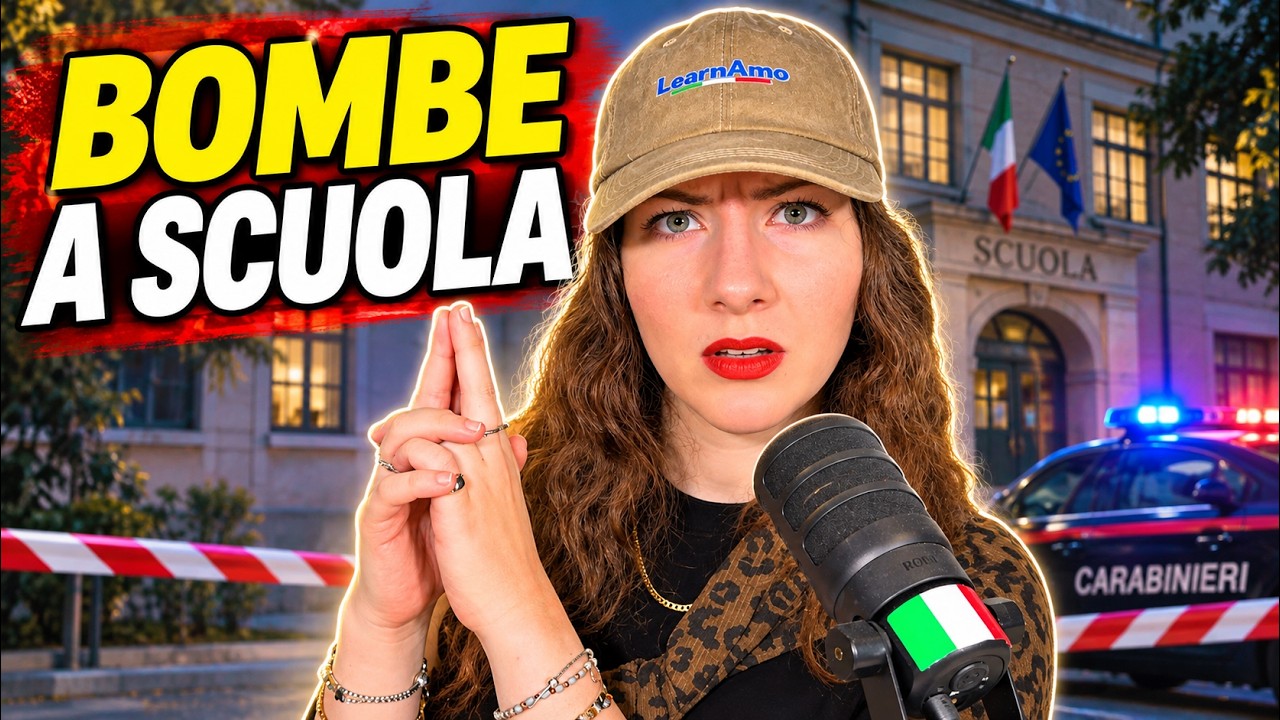
Schools and Beyond: What’s Happening in Italy?
The bomb threats at schools are, in the language of Italian journalists, a notizia in evoluzione [evolving news story]: a vicenda that changes day after day, with new emails, new investigations and new government decisions. Understanding it also means learning the Italian news vocabulary that has always accompanied this kind of coverage — a lexicon that Italian textbooks hardly ever cover.
The Chronicle of Events: the Two Waves of November 2026
Wednesday, November 11, 2026, around 10 in the morning, hundreds of Italian schools received the same email: a message announcing the presence of an ordigno [explosive device] in the building. By mid-morning the institutes involved were about 300, but the number grew quickly: in the end, according to the Minister of Education and Merit Giuseppe Valditara, the message reached more than six thousand state institutes — practically all public schools in the country, from north to south.
Not all schools were evacuated: many simply received the message. The next day, Thursday, November 12, a second email with a different text but the same signature reached nearly 3,800 schools. This time, however, evacuations were far less numerous, thanks to the new rules decided by the government in the hours following the first wave.
The Precedents: October and Early November
November 11 was not the first episode. The “previous chapters” are two:
- October 19: about 50 Italian schools received emails signed by a sedicente “Corpo delle guardie della rivoluzione islamica” [self-styled Corps of the Guardians of the Islamic Revolution]. The same day the same threat also reached hundreds of schools in Northern Ireland, Scotland, Hungary and Serbia.
- November 2: same signature, but this time the email reached 271 institutes and also threatened a Ryanair flight.
A lexical note: sedicente is a very elegant adjective from Italian journalism and means “self-styled, who claims to be”. The writer claims to belong to a certain group, but there’s no proof it’s true. In all cases recorded to date, moreover, the result is always the same: no bomb found. All false alarms.
Who Is Involved in the Vicenda
The characters in this chronicle are many, and each corresponds to a precise Italian word, useful for understanding any school or emergency news.
| Figure | Who they are |
|---|---|
| Studenti e studentesse | From primary school children to high school students |
| Docenti | The teachers |
| Personale ATA | Administrative, Technical and Auxiliary staff (once called “bidelli”) |
| Dirigente scolastico (preside) | Who runs the school and decides the evacuation |
| Forze dell’ordine | Police and carabinieri, with the artificieri |
| Unità cinofile | The explosive-detection dogs |
| Prefetto | The representative of the government in each province |
At the top of the political response is the government: Prime Minister Giorgia Meloni called an emergency meeting at Palazzo Chigi, seat of the government in the Italian political system, with the ministers of Interior and Defence and the heads of the intelligence services.
How the Email Arrives: an Easy Target to Hit
The mechanism is almost embarrassingly simple. Someone writes a single email and sends it simultaneously to thousands of school addresses. The message declares that a device has been hidden in the building, in a plastic bag, and can be remotely detonated. The real question is: how can one write to six thousand schools in a single morning?
The Codice Meccanografico and Open Data
The answer is: the addresses were public. In Italy every state school has a codice meccanografico [school identification code], a kind of alphanumeric ID card, and the institute’s email address is built precisely with that code, in the format [email protected]. The Ministry of Education also publishes on its open data portal (open data, downloadable by anyone) the list of all state schools, with name, address, email and website. According to newspaper reconstructions, whoever sent the emails most likely started from there.
Two Revealing Clues
There are two clues, as in a mystery novel, that confirm the hypothesis:
- The email did not reach the scuole paritarie, i.e. state-recognised private schools, which on the Ministry portal are listed in a separate file.
- The email did not reach schools in Trentino-Alto Adige and Valle d’Aosta, autonomous regions that manage their own institutes with different email addresses and don’t share those data with the Ministry.
The Sender: a Hacked University Account in Taiwan
The sender of the emails was an account of the Da-Yeh University, a private university in Taiwan. According to initial investigations, the account belonged to a former student and had been violated (in informal slang, hacked) by hackers as early as the beginning of the year. The choice is particularly clever: anti-spam filters usually don’t block university emails, considered trustworthy. And for a mail service, six thousand recipients are very few, comparable to those of a small newsletter.
Finding the real culprit, however, is extremely difficult: the Polizia postale, i.e. the Italian police department dealing with cybercrime, must request access data from the university, from Microsoft, which manages that mail service, and from the Taiwanese authorities. The additional problem is that Italy and Taiwan have no official diplomatic relations. A real investigative maze.
From the Email to the Evacuation: What Happens at School, Step by Step
The procedure activated on November 11 in hundreds of schools follows a now-consolidated script. Let’s see it in sequence:
- The secretariat reads the email and immediately informs the preside.
- The preside calls law enforcement and orders the evacuation: the alarm sounds and everyone leaves in line, calmly, following the emergency plan.
- Students and staff gather at the punto di raccolta [assembly point]: the courtyard, a nearby park, sometimes another institute’s gym.
- The artificieri arrive and carry out the bonifica [sweep]: they check every classroom, every cupboard, every bathroom.
- The check has esito negativo [negative outcome] (meaning: nothing is found) and the school is declared safe.
- Everyone returns. Or, if it’s late, everyone goes home.
The key vocabulary to pin down in this section is central for understanding any Italian emergency news:
| Word | Meaning |
|---|---|
| Ordigno | Explosive device (formal, news-type term) |
| Evacuazione | Action of getting everyone out of a building |
| Bonifica | Complete check to eliminate a danger |
| Artificieri | Explosives experts of the police forces |
| Esito negativo | Nothing has been found (a piece of good news) |
| Mittente / Destinatario | Who sends / who receives a message |
| Violare (or hackerare) un account | To illegally take control of an account |
Two Grammar Notes Hidden in the News
This news story contains two interesting grammar points, often overlooked by Italian textbooks but fundamental for a natural use of the language.
“Allarmi Bomba” and the Invariable Plural
In the singular, we say un allarme bomba, but in the plural the correct form is due allarmi bomba, not “allarmi bombe”. The reason? Here bomba works almost like an adjective: it specifies the type of alarm. The first noun changes in the plural, the second remains unchanged. The same phenomenon is found in:
- parola chiave → parole chiave
- uomo ragno → uomini ragno
- parola d’ordine → parole d’ordine
It’s one of the best-known cases of the large family of Italian invariable nouns.
The “Fare + Infinitive” Construction
In the news you often read far scattare l’allarme, far uscire gli studenti, far atterrare un aereo [to trigger the alarm, to make the students leave, to make a plane land]. It’s the fare + infinitive (causative) construction, used when someone causes an action performed by others. The typical example, in this vicenda, is: “il preside ha fatto uscire gli studenti”, which means “the students left because the preside decided it”. The subject of fare (the preside) doesn’t perform the action but causes it.
Not Only Schools: the European Vicenda of Planes, TV and Supermarkets
Schools are only the latest chapter in a wider story that in the first weeks of November has touched half of Europe. The common thread is always the same: threat emails sent from hacked accounts.
The Planes: Diversions and Military Escorts
Between November 2 and 6, dozens of European flights received false bomb alarms. A plane from London to Sofia was diverted to Budapest. On November 5 a flight from Dublin to Rome was made to land at a French military base, escorted by two fighter jets; another, from Helsinki to Rome, arrived at Fiumicino flanked by Italian Air Force jets. The next day a flight from Prague to Rome was diverted to Venice. No explosives found, in any case. Some of these emails were signed by another acronym, the “combattenti dello Stato Maschile” [fighters of the Male State], a real Russian extremist and misogynist movement that has, however, denied any link with the attacks.
Two useful lexical notes. The verb dirottare has two meanings in the news: it can simply mean “to change route” (as in this case) or “to take control of a plane by force”, as in the case of hijackers. And watch out for the noun caccia: il caccia, masculine, is a military combat aircraft and in the plural stays unchanged (i caccia); la caccia, feminine, is instead the activity of hunting. A different article, two completely different worlds.
The TV Stations: Dublin, London and Sofia
On November 6 the threats also reached the media. In Dublin, the headquarters of Irish public television RTÉ was evacuated and had to broadcast recorded programmes. Similar emails reached Sky, in the United Kingdom, and the Bulgarian TV Nova. It’s precisely in those days that the signature of Mikhail Andropov appears for the first time, claiming responsibility for the alarms on the flights. No one, however, has been able to verify the authenticity of the claim.
The Attacks on Supermarkets
In the same days, an apparently unrelated episode: the hacker attacks on the refrigeration systems of more than a hundred European supermarkets. Foreign Minister Antonio Tajani recalled that those attacks were claimed by pro-Russian hackers, but specified that for the bomb threats, at the moment, there’s no proof of who was responsible. The accounts used for the threats to the flights had in fact been stolen from the Ministries of Education of Egypt and Saudi Arabia and from a health facility in Bogotá, Colombia: an international mosaic hardly attributable to a single mastermind.
Black Friday at LearnAmo
Discounts and gifts until November 30.
Who Is Mikhail Andropov? A Name Crafted with Art
The emails of November 11 and 12 were signed by a certain Mikhail Andropov, who presents himself as leader of the "Vilayat di Misoginistan". According to investigators, he's not a real person and the group doesn't exist: it's an invented identity, a pseudonym built with suspicious precision. Let's analyse the name from a linguistic point of view, because it's a small masterpiece of symbolic manipulation.
| Element | Origin and Reference |
|---|---|
| Andropov | Recalls Yuri Andropov, head of the KGB and leader of the USSR. "Russian" sound |
| Vilayat | Arabic word meaning "province, governorate". Evokes jihadist groups |
| Misoginistan | Invented word: misogynist + suffix -stan (like Afghanistan, Pakistan) |
The result is a strange, almost ridiculous mix, typical of internet trolls or disinformation campaigns. Misoginistan, in particular, is a neologism, that is, a new word invented ad hoc, almost a mockery. The same name had already appeared in the previous days in the emails sent to European TV stations, claiming the false alarms on the flights. The emails of October 19 and November 2, on the other hand, were signed with the acronym of the sedicente "Corpo delle guardie della rivoluzione islamica". A puzzle of contradictory signatures that further complicates the investigation.
Why Are They Doing It? Hybrid Warfare or Mythomaniacs?
No one yet knows for certain: the investigations are ongoing. But there are two main hypotheses circulating in Italian investigative and political circles.
The Hybrid Warfare Hypothesis
Minister Valditara has explicitly spoken of the risk of hybrid warfare against the country, while maintaining prudence: he said he doesn't know whether there's an organised strategy behind it or whether it's just mythomaniacs. Hybrid warfare is a conflict without tanks, waged with cyberattacks, fake news and alarms, with the aim of creating chaos, fear and distrust in institutions. In hybrid warfare, you don't need a real bomb: an email is enough to stop thousands of schools.
The Mythomaniacs and Emulators Hypothesis
Defence Minister Guido Crosetto also recalled that today anyone can send such an email, and that at times like these people who just want to create confusion or feel important often jump in. Two key terms:
- Mitomane [mythomaniac]: a person who invents or exaggerates things to attract attention.
- Emulatore [emulator]: those who copy what others have done, often to imitate their notoriety.
The State's Reaction and the New Protocol
Prime Minister Giorgia Meloni summarised the government's position with a sentence destined to be remembered: "Non permetteremo a una mail anonima di decidere il calendario scolastico dei nostri figli." [We won't allow an anonymous email to decide our children's school calendar.] The day after the first wave, in fact, schools were regularly open.
The real operational novelty, however, is another: the government decided to stop automatic evacuations. The new protocol, discussed by the Comitato interministeriale per la sicurezza della Repubblica (CISR), establishes that if a school receives only a mass email and there are no other concrete elements of danger, the building is not evacuated. To decide any evacuation, when there's proof of real risk, is the prefetto, i.e. the government's representative in each province.
The protocol has produced immediate results: on November 12, when the second wave of emails arrived, the government immediately instructed prefetti and presidi to continue lessons normally, and according to Palazzo Chigi evacuations fell drastically. Safety remains the priority, but lessons can't stop every time someone presses the Send key.
The Procurato Allarme Offence and Criminal Consequences
In the Italian penal code there's a specific offence for those who do what happened on November 11: the procurato allarme [false alarm offence], provided for by article 658 of the Penal Code. It's committed by those who announce a non-existent danger, creating alarm among the authorities or among those who provide a public service. The penalty is arrest up to six months or an ammenda [fine] from 10 to 516 euros.
In this specific case, however, the procure (the offices of the investigating magistrates) also hypothesise more serious crimes: the Rome prosecutor's office is investigating through the Antiterrorism department for aggravated threats, while Milan's also proceeds for public intimidation. Added to this is the civil profile: those responsible may be called to pay damages, for example the costs of mobilised law enforcement and interrupted services. A bill, in euros and years of imprisonment, potentially very steep. For more on the vocabulary of crime and law, there's a dedicated guide.
Linguistic Curiosities: "Gridare al Lupo" and the "Good Bombs"
This chronicle offers, finally, the opportunity to explore some Italian expressions that increasingly appear in everyday and journalistic language.
"Gridare al Lupo" and Aesop's Fable
In Aesop's famous fable, the little shepherd shouts "al lupo, al lupo!" [wolf, wolf!] as a joke. When the wolf really arrives, no one believes him any more. In Italian, the expression gridare al lupo is used precisely to indicate those who raise false alarms and, in the long run, risk not being believed even when the danger is real. It's one of the many Italian expressions that come from fairy tales, and it explains well why the Italian State no longer wants automatic evacuations: too many false alarms risk making us lower our guard against the real ones.
"Psicosi" in Newspaper Headlines
In Italian headlines you often read the expression "psicosi bomba" or "psicosi allarme". In these journalistic contexts, psicosi doesn't have the medical meaning: it indicates a collective and exaggerated fear that spreads rapidly through the media and everyday conversations.
The "Good Bombs" of Italian
Fortunately, in Italian, the word bomba also has positive or neutral uses, often idiomatic. They are worth knowing, because they appear constantly in everyday conversation:
| Expression | Meaning |
|---|---|
| È una bomba! | It's fantastic, outstanding (e.g. "Questa pizza è una bomba!") |
| Una notizia bomba | A sensational, stunning piece of news |
| A prova di bomba | Extremely resistant (e.g. "Ho un alibi a prova di bomba") |
| Tornare a bomba | To return to the main topic after a digression |
| Un bombolone / una bomba alla crema | A filled, often cream-filled, fried doughnut |
The bombolone, in particular, is a classic Italian altered noun: it derives from bomba with the augmentative suffix -one, which in Italian makes things larger and in the case of pastries evokes a greedy abundance.
Summary Table: the Vocabulary of Security
Here's a summary of the Italian vocabulary of security and judicial news encountered in this article, ready to enter the active vocabulary of anyone who follows Italian news.
| Word | Meaning |
|---|---|
| Ordigno | Explosive device (formal term) |
| Evacuazione | Getting everyone out of a building in an emergency |
| Bonifica | Complete check to eliminate a danger |
| Artificieri | Explosives experts of the police forces |
| Unità cinofile | Explosive-detection dogs |
| Personale ATA | Administrative, Technical and Auxiliary staff (formerly "bidelli") |
| Dirigente scolastico / preside | Who runs the school |
| Prefetto | Government representative in each province |
| Codice meccanografico | ID code of each Italian school |
| Procurato allarme | Offence of announcing a non-existent danger (art. 658 CP) |
| Rivendicare | To publicly claim responsibility for something |
| Sedicente | Self-styled (without proof) |
| Mitomane / Emulatore | Those who invent for attention / Those who copy others |
| Guerra ibrida | Conflict with cyberattacks and disinformation |
Frequently Asked Questions
How Many Italian Schools Were Involved in the Bomb Threats?
According to Minister of Education Giuseppe Valditara, the email of November 11, 2026 reached more than six thousand state institutes — practically all public schools in Italy. The next day, November 12, a second email with the same signature reached about 3,800 schools. Not all were evacuated: many only received the message, and thanks to the new government protocol, evacuations during the second wave were far fewer.
Who Really Is Mikhail Andropov?
According to investigators, Mikhail Andropov doesn't exist: it's an invented pseudonym, built by mixing symbolic elements of different origins. Andropov recalls the Soviet KGB chief; Vilayat is an Arabic word that evokes the language of jihadist groups; Misoginistan is a neologism built with misogynist + the suffix -stan. All this is typical of disinformation campaigns and online trolls, and the same name appeared in the emails sent to European TV stations in the preceding days.
What Is the "Procurato Allarme" in Italy?
The procurato allarme is an offence provided for by article 658 of the Italian Penal Code: it's committed by those who announce a non-existent danger, creating alarm among the authorities or among those who provide a public service. The penalty is arrest up to six months or a fine of 10 to 516 euros. In the most serious cases, such as that of the bomb threats to schools, prosecutors also hypothesise more serious crimes such as aggravated threats and public intimidation.
Why Do You Say "Allarmi Bomba" and Not "Allarmi Bombe"?
Because in "allarme bomba" the word bomba works almost as an adjective: it specifies the type of alarm. In the plural only the first noun changes: allarmi bomba. The same phenomenon occurs with parole chiave (not "parole chiavi"), uomini ragno (not "uomini ragni") and parole d'ordine. It's one of the best-known cases of the plural of Italian compound nouns.
What Is "Hybrid Warfare"?
Hybrid warfare is a type of modern conflict that doesn't use traditional means (armies, tanks, invasions), but aims to destabilise a country through cyberattacks, disinformation, false alarms and economic pressure. The objective is to create chaos, fear and distrust in institutions, without openly fighting. The bomb threats to schools, if they were really part of a coordinated operation, would fall exactly into this category.
Want the lesson PDF with exercises and solutions?
Join the LearnAmo AcademyLoading quiz...
Podcast: Play in new window | Download ()
Iscriviti: Apple Podcasts | Spotify | Android | iHeartRadio | Podcast Index | TuneIn | Deezer | RSS | Altri...