


When you study Italian, you learn a language rich in history. But there is a lesser-known chapter: the 1920s and 1930s, when Benito Mussolini and the fascist regime decided to intervene directly in the Italian language — modifying it, purifying it, and using it as a tool of power. Language is never neutral: whoever controls words, controls thought. Fascism understood this perfectly.
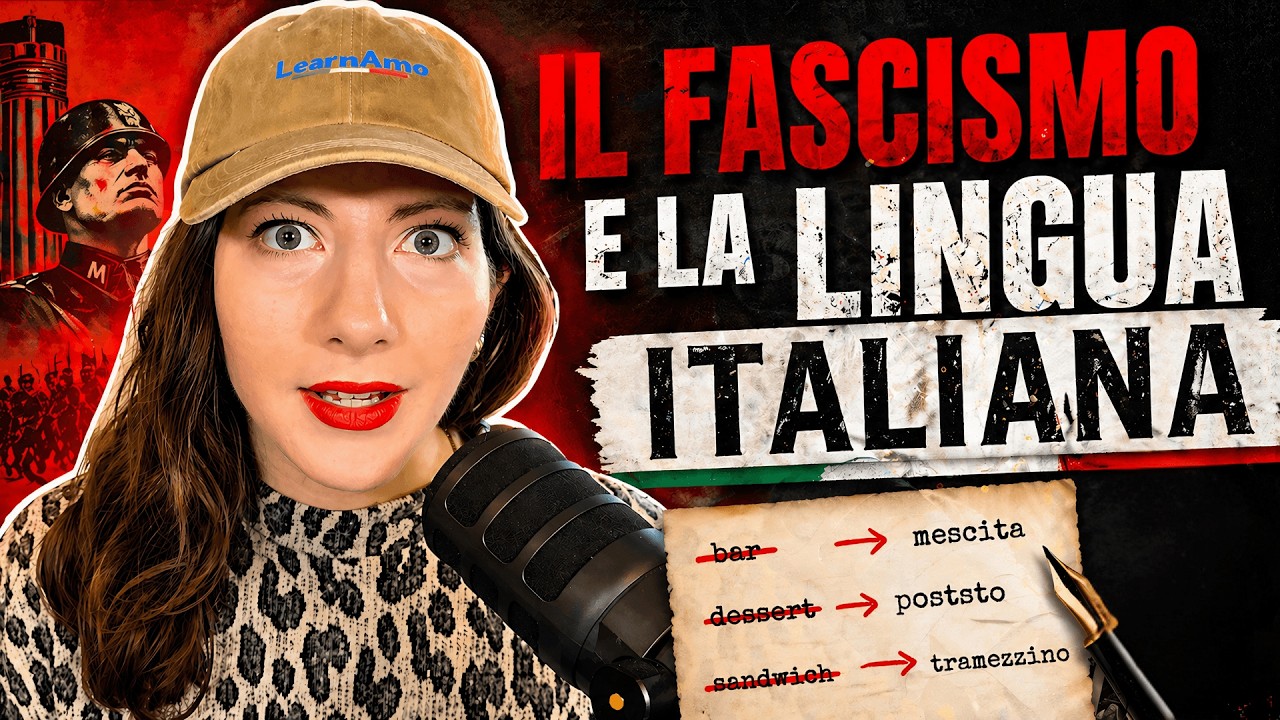
The «Battle» for Linguistic Purity
In the 1930s, the regime launched a full-scale campaign against foreign words, known as bonifica linguistica (linguistic reclamation). The goal was to eliminate forestierismi — words of foreign origin — and replace them with Italian terms. In 1940, a law banned the use of foreign words in public spaces, shop signs, and newspapers.
For example, the word bar had to become mescita, and restaurant was to be replaced by ristoro. As fascist rhetoric of the time proclaimed: “Language is the soul of the nation. Whoever does not speak Italian is not Italian.”
Banned Words and Their Fascist Replacements
Here are some of the substitutions imposed by the regime, showing the original foreign words and the new mandatory Italian terms:
| Italian word (imposed) | Meaning / Notes |
|---|---|
| calcio | football (already Italian, but officially enforced) — replaces: football |
| autista | driver / chauffeur — replaces: chauffeur |
| portiere | goalkeeper / doorman — replaces: goal-keeper |
| mescita / caffè | bar / café — replaces: bar, café |
| ristoro | restaurant — replaces: restaurant |
| pellicola | film / movie — replaces: film |
| palcoscenico | stage — replaces: stage |
| gol | goal (later accepted as is) |
As you can see, some of these words — like calcio and portiere — have survived in modern Italian to this day, while others, such as ristoro in place of restaurant, have fallen out of use. If you want to explore the topic of foreign words and anglicisms in Italian, check out our dedicated article.
«Voi» vs «Lei»: A Grammatical Battle
In 1938, the regime declared that Lei was a «servile» pronoun of Spanish origin, unworthy of a proud and virile Italian. In its place, it imposed Voi as the formal form of address, considered more «Roman» and «fascist». This was a genuine grammar reform driven by political ideology: the choice of pronoun became an act of obedience — or resistance — to the regime.
Today, Lei has fully returned as the standard formal pronoun in Italian. Voi, however, still survives in parts of Southern Italy — Campania, Calabria, Sicily — as a historical and cultural legacy of that period.
Why Did the Regime Prefer Voi?
Voi was presented as an authentically Italian pronoun, rooted in Roman and Renaissance tradition. Fascism argued that Lei had been introduced by the Spanish during their domination of the peninsula, and therefore represented a form of foreign cultural subjugation. In reality, linguists and historians show that Lei already had a long, independent Italian tradition — but propaganda had no need for historical accuracy. It needed symbols.
Dialects: Enemies of the Nation?
Before the unification of Italy in 1861, every region had its own language: Venetian, Neapolitan, Sicilian, Piedmontese… Many Italians, even in the 1920s, spoke their local dialect as their first language and treated standard Italian as something to be learned.
Fascism viewed dialects as an obstacle to national unity. The goal was to build a united, powerful Italy with a single language. Dialects were discouraged in schools and public life. The regime wanted a standard, clear, uniform Italian — an instrument of ideological cohesion as much as communication.
Yet the regime never succeeded in eliminating dialects: they were too deeply rooted in everyday life. In fact, many fascist officials continued to speak their regional dialect in private. Want to learn more about Italian dialects and their history? We have a full article on the topic.
Stop reading Italian.
Start speaking it.
Online lessons in groups of 4, organised by level and goals, with qualified teachers. Pick the day and time that suit you from the available slots.
Max 4 students:
there’s a seat for you
The Language of Propaganda
Beyond banning foreign words, fascism created its own specific lexicon: a vocabulary loaded with rhetoric, grandeur, and references to the Roman Empire. Language had to convey strength, glory, and obedience. Every word was carefully chosen to evoke feelings of power and national belonging.
Key Words of the Fascist Vocabulary
| Italian word | Meaning / Notes |
|---|---|
| Duce | from Latin dux = leader, commander. Mussolini’s official title |
| Camerata | fascist comrade. From Latin camera = room |
| Squadrismo | organised violence carried out by fascist «squads» |
| Patria | the nation, used obsessively in a sacred sense |
| Balilla | fascist youth organisation (children aged 8–14) |
| Fascio | Roman symbol (the lictor’s bundle) adopted by the regime |
Mussolini’s Speeches: Rhetoric in the Service of Power
Mussolini’s speeches were carefully crafted to strike emotionally. They adopted an oratorical style drawn from classical Latin rhetoric, but adapted to modern media: radio and the great public squares. Short sentences, hammering rhythm, obsessive repetition — a technique designed not to make people think, but to make them feel.
Fascist language was built to generate collective emotions: enthusiasm, fear, pride, hatred. If you’re interested in how journalistic and political Italian works, you can find more resources on our website.
What Has Survived to This Day?
Most of the changes imposed by the regime disappeared along with it. Modern Italian has reintegrated foreign borrowings and adopted thousands of anglicisms throughout the twentieth century — exactly the opposite of what fascism had tried to achieve. Words like film, bar, and sport are now fully accepted in contemporary Italian.
Some traces remain in the language today:
→ Calcio and portiere (in the football sense) are words born or consolidated in that period and have stayed.
→ The Voi of courtesy survives in the dialect of some southern regions.
→ Many words from the fascist vocabulary have entered the historical lexicon and school textbooks.
Above all, what remains is an awareness: language can be used as a political tool. Studying these events helps us read language with more critical eyes — and to understand why certain linguistic choices are never purely «grammatical». If you want to explore the history of the Italian language further, read our article on the origins and history of Italian.
Frequently Asked Questions (FAQ)
Did fascism actually manage to change the Italian language?
Partly yes. Some lexical replacements imposed by the regime — such as calcio for football — survived into modern Italian. However, most fascist linguistic reforms ultimately failed: speakers returned to the original terms once the regime fell, and post-war Italian freely resumed absorbing foreign words.
Is «Lei» really of Spanish origin?
The claim of a Spanish origin for Lei was a propagandistic oversimplification. Language historians show that Lei already had deep roots in the Italian Renaissance tradition, independently of any Iberian influence. The regime’s assertion was an ideological pretext, not a linguistic truth. To learn more about formal pronouns in Italian, read our dedicated article.
What does «bonifica linguistica» mean?
Bonifica linguistica was the fascist regime’s official campaign to «purify» the Italian language by eliminating forestierismi — words of foreign origin. The term deliberately echoes bonifica agraria (land reclamation — draining swamps) to evoke the idea of «cleaning up» the language from elements considered «polluting». It was, in essence, nationalism applied to vocabulary.
Why were dialects never eliminated despite the regime’s pressure?
Italian dialects were too deeply rooted in the daily life of local communities to be eliminated by decrees. Schools and radio spread standard Italian, but at home, at the market, and among friends, people continued to speak their dialect. Even fascist leaders often used their regional dialect in private. This shows how powerfully language is tied to social and personal identity — something that escapes purely political control. Curious about how Italian evolved over the centuries? Don’t miss our full article on the subject.
If you want to find out more about the history of Italy and when Italian was born, don’t forget to take a look at the dedicated article.
Want the lesson PDF with exercises and solutions?
Join the LearnAmo AcademyLoading quiz…
Podcast: Play in new window | Download (Duration: 25:29 — 23.3MB)
Iscriviti: Apple Podcasts | Spotify | Android | iHeartRadio | Podcast Index | TuneIn | Deezer | RSS | Altri...