


Have you ever wondered how the Italian language was born? The history of Italian is a fascinating journey spanning about 3000 years, starting from a small community of shepherds in Lazio and arriving at the language studied and loved all over the world. Understanding where Italian comes from will help you better grasp its grammar, vocabulary, and discover why Italian is the way it is.
How Was Italian Born? The History of the Italian Language
The Origins: Before Rome
A Mosaic of Languages on the Peninsula (Before 753 BC)
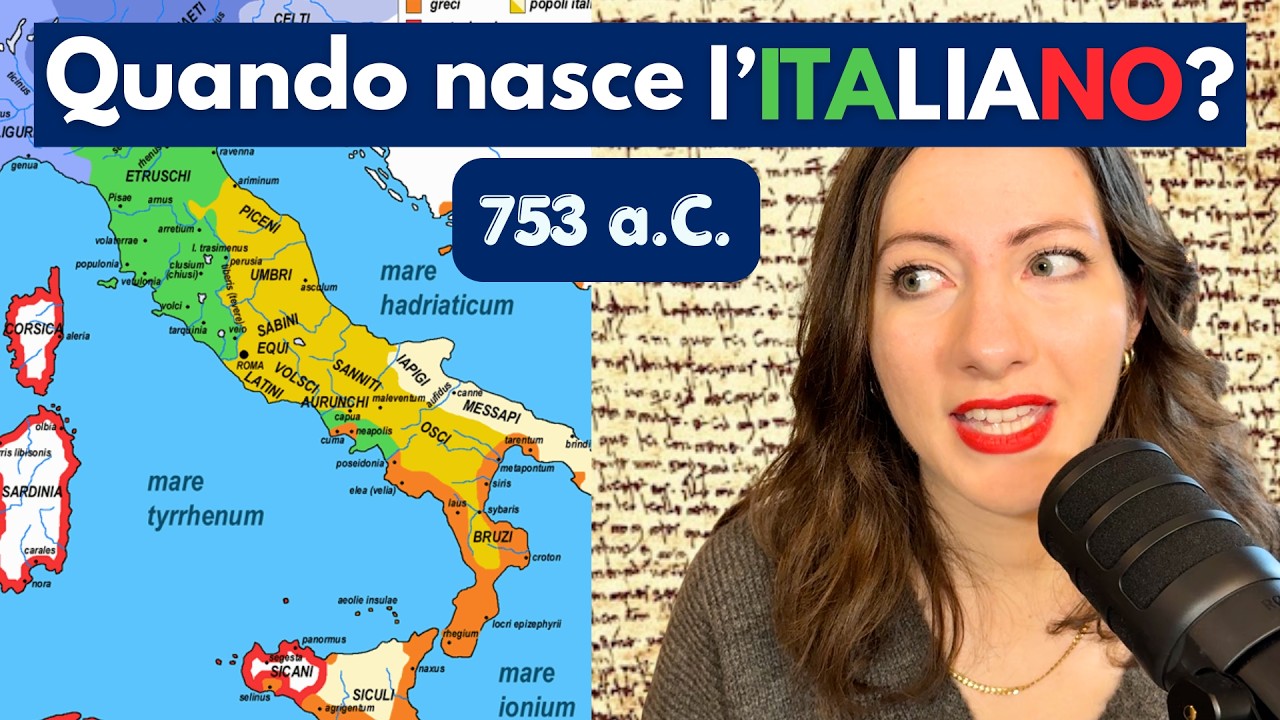
Imagine Italy about 3000 years ago, around 1000 BC. There was no “Italy” as we know it today. The peninsula was a mosaic of different peoples, each with its own language and culture.
In the north, there were the Celts (or Gauls), who spoke Celtic languages — yes, the same languages related to today’s Irish and Welsh. In the center, there were the Etruscans, a mysterious and fascinating people. Their language has not yet been fully deciphered: we can read their letters, but we don’t always understand the meaning of the words.
In the south and in Sicily, there were the Greeks, who had founded colonies so important that the area was called Magna Grecia [Magna Graecia], meaning “Great Greece.” Cities like Naples (Neapolis, “new city” in Greek), Syracuse, and Taranto were Greek cities.
And then, in the center of the peninsula, in the Lazio area, there was a small community of shepherds and farmers: the Latins. They spoke an Indo-European language that we now call Latin.
| Popolo [People] | Zona geografica [Geographic Area] | Lingua parlata [Language Spoken] |
|---|---|---|
| Celti (Galli) [Celts (Gauls)] | Nord Italia [Northern Italy] | Lingue celtiche [Celtic languages] |
| Etruschi [Etruscans] | Centro Italia (Toscana, Umbria, Lazio) [Central Italy (Tuscany, Umbria, Lazio)] | Etrusco (non completamente decifrato) [Etruscan (not fully deciphered)] |
| Greci [Greeks] | Sud Italia e Sicilia (Magna Grecia) [Southern Italy and Sicily (Magna Graecia)] | Greco antico [Ancient Greek] |
| Latini [Latins] | Lazio | Latino (lingua indoeuropea) [Latin (Indo-European language)] |
Fun fact: The word “Italia” probably comes from the word Italói, a term used by the Greeks to refer to the populations of the southern peninsula. It may derive from the word víteliú, which meant “land of calves”. So “Italy” could mean “land of calves.”
Rome and Latin (753 BC – 476 AD)
The Birth and Expansion of Rome
According to legend, Rome was founded in 753 BC by Romulus and Remus, twin brothers nursed by a she-wolf. In reality, the founding was a gradual process, but what is certain is that Rome, from a small village, slowly became an enormous power, conquering first the rest of Italy and then the entire Mediterranean: Spain, France (which the Romans called “Gallia”), part of Great Britain, North Africa, Greece, the Middle East… And with the Roman conquests, Latin spread as well.
Two Versions of Latin: Classical and Vulgar
There were, in practice, two “versions” of Latin, and understanding the difference between them is essential to grasp the birth of Italian.
Classical Latin (or literary Latin) was the one used by writers, poets, and philosophers like Cicero, Virgil, and Ovid. It was an elegant, complex language with very precise grammatical rules. It was the language of books, official speeches, and documents.
Vulgar Latin (from the Latin vulgus = “people”) was instead the Latin spoken by ordinary people, soldiers, and merchants. It was simpler, more direct, and constantly changing depending on the place and time period. The word “vulgar” in this context does not mean “rude” or “ill-mannered” as in modern English, but simply “of the people.”
And it is precisely from Vulgar Latin, not Classical Latin, that all the Romance languages would be born: Italian, Spanish, French, Portuguese, Romanian, Catalan, and many others.
Concrete Examples: from Vulgar Latin to the Romance Languages
| Significato [Meaning] | Latino classico [Classical Latin] | Latino volgare [Vulgar Latin] | Italiano [Italian] | Spagnolo [Spanish] | Francese [French] |
|---|---|---|---|---|---|
| Cavallo [Horse] | equus | caballus | cavallo | caballo | cheval |
| Mangiare [To eat] | edere | manducare | mangiare | manjar (antico) [old] | manger |
As you can see, the Italian, Spanish, and French words derive from the Vulgar form, not from the Classical one. Classical Latin has nonetheless left traces in educated Italian: from equus come words like “equestre” [equestrian] and “equitazione” [horse riding].
The Fall of the Roman Empire and Linguistic Fragmentation (476 AD – 9th Century)
The Collapse of Linguistic Unity
In 476 AD, the Western Roman Empire fell. The invasions of Germanic peoples — Goths, Lombards, Franks, Vandals — completely changed the situation. Without Rome’s political unity, without the efficient Roman roads, without centralized administration, the Vulgar Latin spoken in different regions began to evolve in different directions. Imagine a great river splitting into many smaller rivers: that is exactly what happened to the language.
In France, Vulgar Latin gradually became Old French. In Spain, it became Old Castilian. In Italy, it became not “Italian,” but many different vernaculars: the Tuscan vernacular, the Sicilian vernacular, the Venetian vernacular, the Neapolitan vernacular, and so on.
The Influence of Germanic Peoples on the Language
The Germanic peoples who settled in Italy left extremely important traces in the language. The Lombards, for example (who dominated much of Italy from 568 AD), gave us words we still use today.
| Parola italiana [Italian Word] | Origine longobarda [Lombard Origin] | Significato originale [Original Meaning] |
|---|---|---|
| guancia [cheek] | wankja | guancia [cheek] |
| schiena [back] | skina | stinco, osso [shin, bone] |
| stinco [shin] | skinka | gamba [leg] |
| stampa [press/print] | stampfjan | pestare [to pound] |
| panca [bench] | banka | panca [bench] |
| guerra [war] | werra (Germanic) | mischia, confusione [brawl, confusion] |
The word “guerra” [war], which we use daily in Italian, does not come from Latin! In Classical Latin, “war” was bellum (from which comes the adjective “bellico” [warlike]). The Italian word “guerra” comes instead from the Germanic werra, and likely arrived in Italian through the Franks or the Lombards. From the same Germanic root comes the English word war.
Fun fact: During this period, ordinary people no longer knew Classical Latin, but the Church continued to use it. This created curious situations: people would go to mass and could barely understand anything the priest was saying! Even the word “Italy” as a geographic entity survived during this period, even though politically the peninsula was divided into a thousand pieces. Lombardy, for example, takes its name directly from the Lombards.
The First Documents in the Italian Vernacular (9th – 12th Century)
The Placito Capuano (960 AD)
The most famous document among the first texts in the vernacular is the so-called Placito Capuano (or Placito di Capua), from 960 AD. It is a legal document written in Capua, near Naples. It is a testimony in a trial concerning lands disputed between a monastery and a landowner. The key sentence, spoken by the witnesses, is:
“Sao ko kelle terre, per kelle fini que ki contene, trenta anni le possette parte Sancti Benedicti.”
Which means: “I know that those lands, within those borders described here, have been possessed for thirty years by the party (monastery) of Saint Benedict.”
Look at this sentence: sao (so [I know]), kelle (quelle [those]), terre (terre [lands]), possette (possedette/possedé [possessed]). It is not Latin, it is not yet modern Italian, but we are getting closer. It is like seeing a blurry photograph that slowly comes into focus.
The Indovinello Veronese (Late 8th – Early 9th Century)
Actually, there is a document even older than the Placito Capuano. It is the famous Indovinello Veronese [Veronese Riddle], written between the late 8th and early 9th century, found in the Biblioteca Capitolare di Verona:
“Se pareba boves, alba pratalia araba, albo versorio teneba, negro semen seminaba.”
It is a riddle that means: “He pushed forward the oxen, plowed white fields, held a white plow, sowed black seed.” The answer? Fingers writing!
The “oxen” are the fingers, the “white fields” are the sheet of paper, the “white plow” is the quill pen, and the “black seed” is the ink. This text is a mix of Latin and vernacular and shows us exactly the moment of transition between the two languages.
The Sicilian School and the First Poets (13th Century)
The Court of Frederick II and the Birth of Vernacular Poetry
In the 13th century, at the court of Emperor Frederick II of Swabia, in Palermo, something revolutionary happened: a group of poets and intellectuals began to write poetry in the vernacular instead of in Latin or Provençal (which was the language of poetry par excellence at the time).
These poets formed the so-called Sicilian School (or Scuola poetica siciliana). Among the most important was Jacopo da Lentini, who is considered the inventor of the sonnet — yes, that poetic form of 14 lines that Shakespeare would later use as well. An Italian invention, born in Sicily!
The Spread of the Tuscan Vernacular
When the Sicilian poems spread to the rest of Italy, they were copied by Tuscan scribes who “translated” them into their own vernacular. This means that the Tuscan vernacular began to absorb and rework the Sicilian literary tradition. It was a first step toward the centrality of Tuscan.
Meanwhile, in other parts of Italy, other literary traditions flourished: in Bologna, the poet Guido Guinizzelli founded the so-called Dolce Stil Novo [Sweet New Style], a poetic movement that spoke about love in a new and refined way. But the Tuscan vernacular began to emerge as the most prestigious among the Italian vernaculars.
Dante, Petrarch, and Boccaccio: the “Three Fathers” of Italian (14th Century)
And here we are at the most important moment in the entire history of the Italian language. Three men, all Tuscan, all brilliant, changed everything forever.
Dante Alighieri (1265–1321)
Dante is the father of the Italian language. Without Dante, Italian as we know it probably would not exist. His most famous work is the Divine Comedy (which he simply called Commedia [Comedy]; the adjective “Divina” [Divine] was added later by Boccaccio in his Trattatello in laude di Dante).
It is a poem of about 14,233 lines in which Dante travels through Hell, Purgatory, and Paradise. And the revolutionary thing? It was written in the Tuscan vernacular, not in Latin!
Dante also wrote a treatise called De Vulgari Eloquentia (“On Eloquence in the Vernacular”) in which he analyzed all the Italian vernaculars and argued that it was possible to create an Italian literary language starting from the vernacular. In practice, Dante said: “Latin is the language of the past. The future belongs to the vernacular!“
Fun fact: In the Divine Comedy, Dante used about 12,000 different words. A great many of these words are still used today exactly as he used them in the 1300s! Words like bolgia [pit/chasm], contrapasso [retribution], even the expression “il bel paese” [the beautiful country] to refer to Italy comes from Dante. Every time an Italian says “il Bel Paese,” they are quoting Dante without knowing it!
Francesco Petrarch (1304–1374)
Petrarch is famous above all for the Canzoniere [Songbook], a collection of 366 poems dedicated to a woman named Laura. Petrarch actually wrote most of his works in Latin, which he considered the superior language! He even called his poems in the vernacular nugae, meaning “trifles, little things”! Yet, paradoxically, he worked for almost 40 years perfecting the Canzoniere, polishing every single word. The result? A pure, elegant, musical vernacular — so refined that it almost seemed like Latin in its perfection.
If Dante is the courageous father who said “let’s use the vernacular!”, Petrarch is the perfectionist who said “the vernacular is fine, but it must be flawless.” And it was precisely his style that would become, centuries later, Bembo’s model for the Italian poetic language.
Giovanni Boccaccio (1313–1375)
Boccaccio wrote the Decameron, a collection of 100 short stories told by ten young people who flee the plague in Florence in 1348. The Decameron is extremely important because it demonstrated that the Tuscan vernacular also worked for narrative prose, not just for poetry. Boccaccio used a lively, entertaining, sometimes irreverent language, full of realistic dialogue.
In summary: Dante demonstrated that the vernacular could be as great as Latin. Petrarch made it elegant. Boccaccio made it versatile. Together, these three created the model on which Italian would be based.
| Autore [Author] | Opera principale [Main Work] | Contributo alla lingua [Contribution to the Language] | Genere [Genre] |
|---|---|---|---|
| Dante Alighieri (1265–1321) | Divina Commedia [Divine Comedy] | Dimostra la grandezza del volgare [Demonstrated the greatness of the vernacular] | Poesia epica [Epic poetry] |
| Francesco Petrarca [Petrarch] (1304–1374) | Canzoniere [Songbook] | Rende il volgare elegante e raffinato [Made the vernacular elegant and refined] | Poesia lirica [Lyric poetry] |
| Giovanni Boccaccio (1313–1375) | Decameron | Dimostra la versatilità del volgare nella prosa [Demonstrated the versatility of the vernacular in prose] | Prosa narrativa [Narrative prose] |
Stop reading Italian.
Start speaking it.
Online lessons in groups of 4, organised by level and goals, with qualified teachers. Pick the day and time that suit you from the available slots.
Max 4 students:
there’s a seat for you
The “Language Question” (15th – 16th Century)
Which Vernacular for Italy?
After Dante, Petrarch, and Boccaccio, everyone agreed: the vernacular could be a great literary language. But which vernacular? Because in Italy there was not ONE vernacular, but many different ones. A Venetian and a Neapolitan could not understand each other! This is how what scholars call the “Questione della lingua” [Language Question] was born — the debate over which should be the common language of Italians.
The Three Main Positions
| Sostenitore [Advocate] | Proposta [Proposal] | Modello linguistico [Linguistic Model] |
|---|---|---|
| Pietro Bembo (veneziano) [Venetian] | Toscano letterario del Trecento [14th-century literary Tuscan] | La lingua di Petrarca e Boccaccio come modello perfetto [The language of Petrarch and Boccaccio as the perfect model] |
| Niccolò Machiavelli (fiorentino) [Florentine] | Fiorentino contemporaneo [Contemporary Florentine] | La lingua parlata a Firenze nel presente [The language spoken in Florence at the time] |
| Baldassare Castiglione | Lingua cortigiana [Courtly language] | Una lingua mista basata sull’uso delle corti italiane [A mixed language based on the usage of Italian courts] |
Who won? Bembo. His proposal became dominant, and 14th-century literary Tuscan became the model for written Italian. In 1525, Bembo published the “Prose della volgar lingua” [Writings on the Vernacular Language], which became a sort of “manual” for the Italian language.
The Vocabolario degli Accademici della Crusca
In 1612, the Vocabolario degli Accademici della Crusca [Vocabulary of the Academicians of the Crusca] was published — the first great dictionary of the Italian language and the second dictionary of a modern European language (preceded by only one year by the Spanish dictionary of Covarrubias, in 1611!). The Accademia della Crusca [Crusca Academy], founded in Florence in 1583, still exists today and remains the point of reference for the Italian language.
Fun fact: The name “Crusca” refers to wheat bran: the idea was to “separate the flour from the bran”, that is, the good words from the bad ones. The Vocabolario della Crusca became a model for all subsequent major European dictionaries, from the French one (1694) to Samuel Johnson’s English one (1755)!
Italian in the 17th and 18th Centuries
A Literary Language, Not a Popular One
During the 17th and 18th centuries, literary Italian became established as the language of culture, music, and opera. But there was an enormous problem: almost no one actually spoke it in daily life! Italian was the language of books, poets, and scholars. In everyday life, people continued to speak their own regional dialects. A Lombard farmer spoke Lombard, a Sicilian fisherman spoke Sicilian, a Roman woman spoke Romanesco. “Official” Italian was like a foreign language for the majority of the population!
Foreign Influences on Italian
During this period, Italian was influenced by other European languages, in particular:
- Spanish, during the Spanish domination of southern Italy (16th–17th centuries), brought words like regalo [gift], guerriglia [guerrilla], puntiglio [point of honor].
- French, especially in the 18th century, when French culture dominated Europe, introduced words like toilette, menu, abat-jour [lampshade]. Many Italian intellectuals of the 18th century even wrote in French!
Italian: the International Language of Music
Italian was the international language of music, and it largely still is today. The great composer Mozart wrote his operas in Italian, not in German: “Le nozze di Figaro” [The Marriage of Figaro], “Don Giovanni,” “Così fan tutte” [Thus Do They All]… were all in Italian.
Think of all the Italian musical terms used around the world: piano, forte, allegro, adagio, soprano, crescendo… When a Japanese, Brazilian, or Canadian musician reads a score, they read Italian words.
| Lingua di influenza [Influencing Language] | Periodo [Period] | Parole entrate in italiano [Words Adopted into Italian] |
|---|---|---|
| Spagnolo [Spanish] | XVI–XVII secolo [16th–17th century] | regalo [gift], guerriglia [guerrilla], puntiglio [point of honor] |
| Francese [French] | XVIII secolo [18th century] | toilette, menu, abat-jour [lampshade] |
| Inglese [English] | XX–XXI secolo [20th–21st century] | computer, weekend, smartphone, streaming |
The Unification of Italy and the Birth of Modern Italian (19th Century)
“Italy Is Made, Now We Must Make Italians”
In 1861, Italy was finally unified and became a single state. But there was a gigantic problem. The famous phrase attributed to the writer Massimo D’Azeglio says: “Fatta l’Italia, bisogna fare gli italiani.” [Italy is made, now we must make Italians.] And he was right.
At the time of the Unification of Italy, according to the estimate of scholar Tullio De Mauro, only about 2.5% of the population spoke Italian. Other scholars, like Arrigo Castellani, raise the figure to about 10%. In any case, the vast majority of Italians spoke exclusively their own dialect. The first King of Italy, Victor Emmanuel II, habitually spoke Piedmontese and French, and his Italian was not that great!
The Three Factors of Linguistic Unification
- Schools: with compulsory public education (Legge Casati [Casati Law] of 1859, then Legge Coppino [Coppino Law] of 1877), children began to learn Italian at school. Teachers taught standard Italian, based on the Tuscan model.
- The army: mandatory military service mixed young men from all over Italy, forcing them to communicate in a common language.
- Bureaucracy: official documents, laws, and public administration were all in Italian.
The Role of Alessandro Manzoni
An extremely important role was also played by Alessandro Manzoni, the author of I Promessi Sposi [The Betrothed]. He, a Milanese, decided to rewrite his novel using contemporary Florentine (not the 14th-century variety) as a model.
His goal was to create a living, spoken Italian that was understandable to everyone. I Promessi Sposi became the most widely read book in Italian schools and contributed enormously to the spread of Italian.
Fun fact: Manzoni literally went to Florence to “sciacquare i panni in Arno” [rinse his clothes in the Arno], as he himself said — that is, to immerse his language in living Florentine. Rewriting an entire novel to change the language… now that is love for language!
The 20th Century: the True Spread of Italian
If in 1861 only a small percentage of Italians spoke Italian, what changed in the 20th century? Mainly three revolutionary inventions.
Radio (1920s–1930s)
With the birth of radio in the 1920s, for the first time Italians heard the same language in their homes, from north to south. Radio broadcast in standard Italian and reached even those who could not read or write.
Cinema (1930s–1950s)
Italian cinema and the dubbing of foreign films contributed enormously to the spread of Italian. The Fascist regime (1922–1943) imposed mandatory dubbing of foreign films, banning other languages. This had an important side effect: Italians became accustomed to hearing standard Italian at the cinema.
Television (from 1954)
But the true revolution was television. On January 3, 1954, RAI (Radiotelevisione Italiana) began regular broadcasts. One program in particular was fundamental: “Non è mai troppo tardi” [It’s Never Too Late], hosted by teacher Alberto Manzi from 1960 to 1968. It was an educational program that taught illiterate adults to read and write. It is estimated that thanks to this program, nearly one and a half million Italians obtained their elementary school certificate!
Television did what centuries of literature and schooling had not been able to fully achieve: it brought Italian into every home, every day, in a natural and enjoyable way.
Fun fact: The famous television presenter Mike Bongiorno (American by birth) with his quiz show “Lascia o raddoppia?” [Double or Nothing?] is considered one of the great “linguistic unifiers” of Italy. Millions of Italians watched his program and became accustomed to hearing and using standard Italian. Television did more for the Italian language than many grammarians put together!
| Mezzo di comunicazione [Medium] | Periodo [Period] | Effetto sulla lingua [Effect on the Language] |
|---|---|---|
| Radio | Anni ’20-’30 [1920s–1930s] | Prima diffusione orale dell’italiano standard in tutte le case [First oral spread of standard Italian in all homes] |
| Cinema | Anni ’30-’50 [1930s–1950s] | Doppiaggio obbligatorio abituò all’italiano standard [Mandatory dubbing accustomed people to standard Italian] |
| Televisione [Television] | Dal 1954 [From 1954] | Vera unificazione linguistica; programmi educativi per adulti [True linguistic unification; educational programs for adults] |
Italian Today (21st Century)
The Spread and Numbers of Italian in the World
Today, Italian is spoken by about 85 million people worldwide (as a native language and as a second language). It is an official language in Italy, Switzerland (in the Canton of Ticino), San Marino, and Vatican City. It is also spoken in some areas of Slovenia and Croatia (Istria).
Ongoing Evolution: Anglicisms and Dialects
Modern Italian continues to evolve. Today, the main influences come from English: computer, weekend, meeting, smartphone, social, web, streaming… Many purists complain about this invasion of anglicisms, but in reality Italian has always absorbed words from other languages. As we have seen, it did so with Germanic, Spanish, and French… it is part of the natural life of a language.
Dialects have not disappeared, but their use has decreased dramatically. Today, the vast majority of Italians speak Italian, although many, especially older generations and in southern regions, also speak the local dialect. In some regions, such as Veneto, Friuli, Sardinia, and South Tyrol, there are also true regional languages that are recognized and protected.
Fun fact: Italian is considered one of the most studied languages in the world, often in the top 5. And not only for practical reasons, but also for love of Italian culture, music, food, art, and cinema.
Timeline of the Italian Language: from its Origins to Today
| Periodo [Period] | Evento chiave [Key Event] | Effetto sulla lingua [Effect on the Language] |
|---|---|---|
| Before 753 BC | Mosaico di lingue nella penisola [Mosaic of languages on the peninsula] | Celti, Etruschi, Greci, Latini coesistono con lingue diverse [Celts, Etruscans, Greeks, Latins coexisted with different languages] |
| 753 BC – 476 AD | Roma e l’espansione del latino [Rome and the expansion of Latin] | Il latino volgare si diffonde in tutto l’Impero [Vulgar Latin spread throughout the Empire] |
| 476 AD – 9th century | Caduta dell’Impero Romano [Fall of the Roman Empire] | Il latino volgare si frammenta nei vari volgari [Vulgar Latin fragmented into various vernaculars] |
| 9th – 12th century | Primi documenti in volgare [First documents in the vernacular] | Indovinello Veronese, Placito Capuano |
| 13th century | Scuola Siciliana e Dolce Stil Novo [Sicilian School and Dolce Stil Novo] | Nasce la poesia in volgare; il toscano emerge come prestigioso [Vernacular poetry was born; Tuscan emerged as prestigious] |
| 14th century | Dante, Petrarca, Boccaccio [Dante, Petrarch, Boccaccio] | Il volgare toscano diventa modello letterario [The Tuscan vernacular became the literary model] |
| 15th – 16th century | Questione della lingua [Language Question] | Bembo stabilisce il toscano trecentesco come standard [Bembo established 14th-century Tuscan as the standard] |
| 1612 | Vocabolario della Crusca | Primo grande dizionario della lingua italiana [First great dictionary of the Italian language] |
| 17th – 18th century | Influenze spagnole e francesi [Spanish and French influences] | L’italiano resta lingua letteraria; i dialetti dominano [Italian remained a literary language; dialects dominated] |
| 1861 | Unità d’Italia [Unification of Italy] | Solo il 2,5%-10% parla italiano; scuola, esercito e burocrazia diffondono la lingua [Only 2.5%–10% spoke Italian; schools, the army, and bureaucracy spread the language] |
| 20th century | Radio, cinema, televisione [Radio, cinema, television] | Vera unificazione linguistica della popolazione [True linguistic unification of the population] |
| 21st century | Globalizzazione e anglicismi [Globalization and anglicisms] | 85 milioni di parlanti; l’italiano tra le lingue più studiate al mondo [85 million speakers; Italian among the most studied languages in the world] |
Frequently Asked Questions
Does Italian Derive from Classical Latin or Vulgar Latin?
Italian derives from Vulgar Latin, that is, the language spoken daily by the people, soldiers, and Roman merchants. Classical Latin, the one used by Cicero and Virgil, was the language of literature and official documents, but it was not spoken in everyday life. A clear example: the word “cavallo” [horse] does not derive from Classical Latin equus, but from Vulgar Latin caballus.
Why Is Italian Based on Tuscan and Not on Another Dialect?
Tuscan established itself as the basis of Italian thanks to the enormous literary prestige of the works of Dante, Petrarch, and Boccaccio in the 14th century. These three Tuscan authors created masterpieces of such greatness that their vernacular became the linguistic model for all of Italy. In the 16th century, Pietro Bembo made this choice official by proposing 14th-century literary Tuscan as the standard in his Prose della volgar lingua (1525).
What Is the First Text Written in Italian (Vernacular)?
The oldest text is the Indovinello Veronese [Veronese Riddle] (late 8th – early 9th century), although it is a mix of Latin and vernacular and not all scholars consider it fully “vernacular.” The first official document in the vernacular is the Placito Capuano from 960 AD, a judicial act containing the famous phrase: “Sao ko kelle terre…”
How Many Italians Spoke Italian at the Time of the Unification of Italy?
At the time of the Unification of Italy in 1861, according to scholars’ estimates, only between 2.5% and 10% of the population spoke Italian. The vast majority spoke exclusively their own dialect. The spread of Italian to the entire population occurred thanks to compulsory public education, military service, and, in the 20th century, radio, cinema, and especially television.
Who Invented the Sonnet?
The sonnet was invented by Jacopo da Lentini, a poet of the Sicilian School, at the court of Frederick II of Swabia in the 13th century. This poetic form of 14 lines is an Italian invention born in Sicily, which subsequently spread throughout Europe and was also adopted by great poets like Shakespeare.
Why Are International Musical Terms in Italian?
Italy was the cradle of opera and classical music between the 17th and 18th centuries. Italian became the international language of music thanks to the spread of Italian operas throughout Europe. Composers of every nationality, including Mozart, wrote their operas in Italian. For this reason, terms like piano, forte, allegro, adagio, soprano, crescendo are universally used in all languages of the world.
What Is the Accademia della Crusca?
The Accademia della Crusca [Crusca Academy] is a linguistic institution founded in Florence in 1583. In 1612, it published the Vocabolario degli Accademici della Crusca [Vocabulary of the Academicians of the Crusca], the first great dictionary of the Italian language. The name “Crusca” refers to wheat bran: the idea was “to separate the flour from the bran,” that is, to distinguish good words from bad ones. The Academy still exists today and is the main point of reference for the Italian language.
Are Italian Dialects Disappearing?
Italian dialects have not disappeared, but their use has decreased dramatically over the course of the 20th and 21st centuries. Today, the vast majority of Italians speak Italian as their main language, although many, especially older generations and in southern regions, still speak the local dialect. In some regions, such as Veneto, Friuli, Sardinia, and South Tyrol, there are also true regional languages recognized and protected by law.
A journey from Latin roots to the words of today: continue reading with the article on modern words recently added to the Italian language.
Buy our new book “Il Principe Marco e le parole del mondo” and learn Italian step by step through an engaging story, practical exercises, and thorough grammar review, from beginner to advanced level.
Want the lesson PDF with exercises and solutions?
Join the LearnAmo AcademyLoading quiz…
Podcast: Play in new window | Download (Duration: 30:40 — 28.1MB)
Iscriviti: Apple Podcasts | Spotify | Android | iHeartRadio | Podcast Index | TuneIn | Deezer | RSS | Altri...