


Have you ever wondered why in Italian we say “vado A Roma“ [I go to Rome] but “vengo DA Milano“ [I come from Milan]? Or why sometimes we use “sul tavolo“ [on the table] and other times “sopra il tavolo“ [above the table]? Prepositions are one of the most important and complex aspects of the Italian language. In this complete guide, you’ll see how to use them correctly.
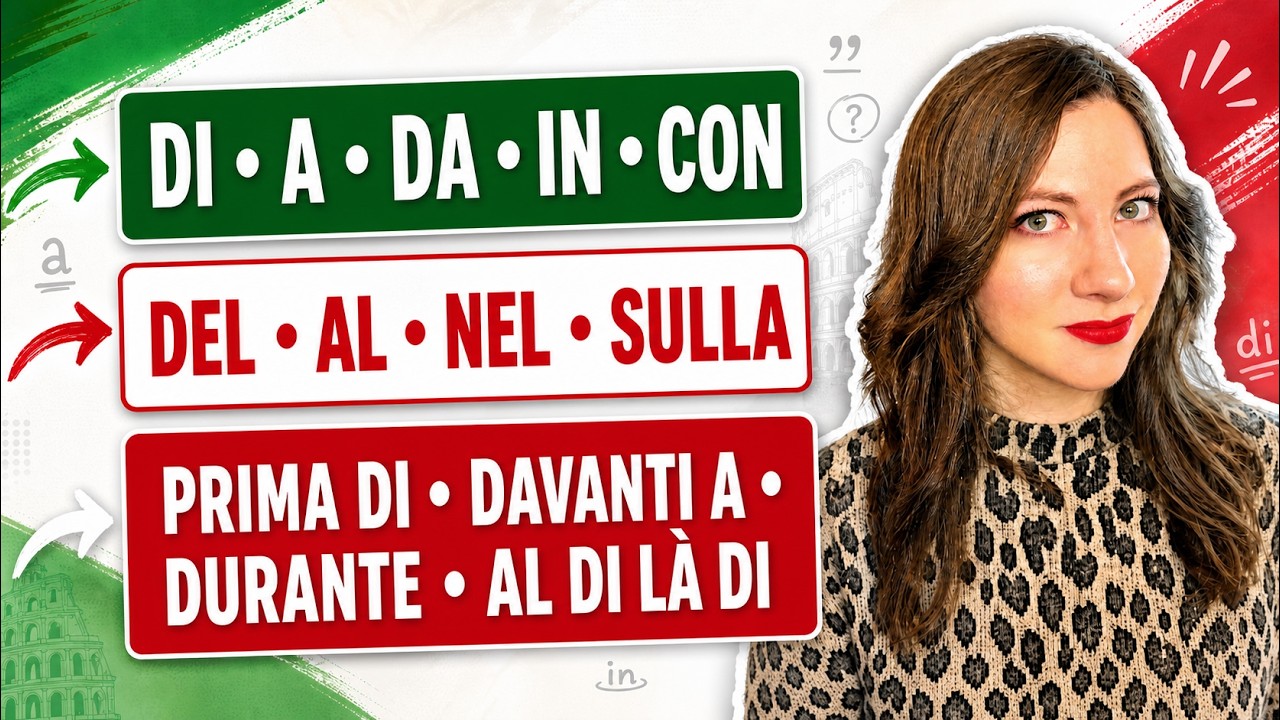
ITALIAN PREPOSITIONS: Simple, Articulated, Improper
What Are Prepositions?
Prepositions are small words that create a connection between the elements of a sentence. They are like “grammatical bridges” that unite words and give meaning to the relationships between them. Without prepositions, communication would be incomplete and unclear.
Example: “Il libro di Marco è sul tavolo della cucina.” [Marco’s book is on the kitchen table.]
Without the prepositions “di”, “sul” and “della”, we wouldn’t understand who owns the book, where it is and in which room. Prepositions are therefore essential for effective communication.
Simple Prepositions
In Italian there are 9 simple prepositions: DI, A, DA, IN, CON, SU, PER, TRA, FRA.
Each preposition has multiple uses and functions. Let’s look together at the main meanings and uses of each one.
1. The Preposition DI
The preposition DI is the most versatile of all. Let’s see its main uses:
Possession and Belonging
When something belongs to someone:
Examples:
- Il telefono di Luca [Luca’s phone] (= the phone belongs to Luca)
- La borsa di mia madre [my mother’s bag]
Specification
When we specify something:
Examples:
- Un bicchiere di vino [a glass of wine]
- Una tazza di caffè [a cup of coffee]
- Il professore di matematica [the mathematics teacher]
Topic
When we talk about something:
Examples:
- Parliamo di politica [We talk about politics]
- Discutere di sport [To discuss sports]
Material
To indicate what something is made of:
Examples:
- Un tavolo di legno [a wooden table]
- Una collana d’oro [a gold necklace]
Origin and Provenance
Examples:
- Sono di Napoli [I’m from Naples] (= I come from Naples)
- Maria è di origine spagnola [Maria is of Spanish origin]
Comparison
Examples:
- Marco è più alto di Luigi [Marco is taller than Luigi]
- Questo film è meno interessante di quello [This film is less interesting than that one]
Time
In some temporal expressions:
Examples:
- Di mattina studio sempre [In the morning I always study]
- Di notte fa freddo [At night it’s cold]
- D’estate vado al mare [In summer I go to the seaside]
Quality
Examples:
- Prodotti di alta qualità [high quality products]
- Un uomo di grande cultura [a man of great culture]
Limitation
Examples:
- Campione italiano di nuoto [Italian swimming champion]
- Debole di stomaco [weak stomach]
Lack
Examples:
- Privo di esperienza [lacking experience]
- Senza di te non posso vivere [Without you I cannot live]
Quantity
Examples:
- Pieno di errori [full of errors]
- Ricco di vitamine [rich in vitamins]
2. The Preposition A
A is a very important preposition that mainly indicates movement and time.
Motion Towards a Place
Indicates where we’re going (or where we’d like to go):
Examples:
- Vado a Roma [I’m going to Rome]
- Andiamo a casa [We’re going home]
- Andremo a teatro [We’ll go to the theater]
Location with Cities
Examples:
- Abito a Milano [I live in Milan]
- Sono a Firenze [I’m in Florence]
Specific Time and Hour
Examples:
- Parto a gennaio [I’m leaving in January]
- Arrivo a mezzogiorno [I arrive at noon]
Age
Examples:
- A vent’anni ho iniziato l’università [At twenty I started university]
- Si è sposato a trent’anni [He got married at thirty]
Indirect Object
Answers the question: “to whom? to what?”
Examples:
- Do il libro a Maria [I give the book to Maria]
- Scrivo a mio padre [I write to my father]
- Telefono a Luca [I call Luca]
Manner and Way
Indicates “how?”
Examples:
- Una camicia a righe [a striped shirt]
- Un vestito a fiori [a floral dress]
- Scarpe a punta [pointed shoes]
With Names of Small Islands
Examples:
- Vado a Capri [I’m going to Capri]
- Sono a Lampedusa [I’m in Lampedusa]
Verbs Followed by A + Infinitive
Examples:
- Imparo a guidare [I’m learning to drive]
- Riesco a capire [I manage to understand]
- Mi abituo a svegliarmi presto [I’m getting used to waking up early]
- Comincio a studiare [I start studying]
- Continuo a lavorare [I continue working]
- Inizio a cucinare [I begin cooking]
Transformation to AD
Important note: The preposition A becomes AD before the vowel A (mandatory) and optionally before other vowels:
Examples:
- Vado AD Ancona [I’m going to Ancona] (before A, mandatory)
- Vado AD Empoli / a Empoli [I’m going to Empoli] (before other vowels, optional)
3. The Preposition DA
DA is the preposition of movement and origin!
Motion From a Place
Indicates where we come from:
Examples:
- Vengo da Roma [I come from Rome]
- Arrivo da scuola [I’m arriving from school]
Location with People
With people, DA indicates that we are at their home:
Examples:
- Sono da Maria [I’m at Maria’s place] (= I’m at Maria’s home)
- Stasera ceniamo da sua nonna [Tonight we’re having dinner at her grandmother’s]
Continuous Time
Indicates since when and the action is still continuing:
Examples:
- Studio italiano da tre anni [I’ve been studying Italian for three years]
- Lavoro al ristorante da quest’estate [I’ve been working at the restaurant since this summer]
Agent Complement
With passive verbs, indicates who does the action:
Examples:
- Il libro è stato scritto da Dante [The book was written by Dante]
- La pizza è stata mangiata da Luigi [The pizza was eaten by Luigi]
Purpose and Function
Indicates what something is for:
Examples:
- Una macchina da caffè [a coffee machine]
- Occhiali da sole [sunglasses]
- Scarpe da ginnastica [gym shoes]
Separation and Distance
Examples:
- Lontano da casa [far from home]
- Diverso da te [different from you]
Value and Price
Examples:
- Un biglietto da 10 euro [a 10 euro ticket]
- Una banconota da 50 euro [a 50 euro note]
With Indeterminate Constructions
Pattern: qualcosa/qualcuno/niente + DA + infinitive
Examples:
- Hai qualcosa da dire? [Do you have something to say?]
- Cerco qualcuno da invitare [I’m looking for someone to invite]
- Non ho niente da fare [I have nothing to do]
4. The Preposition IN
IN mainly indicates where we are or where we’re going. It’s the preposition of position and location.
Location
Examples:
- Sono in Italia [I’m in Italy]
- Lavoro in ufficio [I work in an office]
- Studio in biblioteca [I study in the library]
Motion Towards a Place
With continents, countries, regions:
Examples:
- Vado in Francia [I’m going to France]
- Andiamo in Asia [We’re going to Asia]
- Vado in Toscana [I’m going to Tuscany]
Time
With months, years, seasons, epochs:
Examples:
- Sono nato in estate [I was born in summer]
- In primavera i fiori sbocciano [In spring flowers bloom]
- In passato le cose erano diverse [In the past things were different]
Means of Transport
Examples:
- Viaggio in treno [I travel by train]
- Vado in autobus [I go by bus]
- Andiamo in aereo [We’re going by plane]
ATTENTION! with cars we say both “Vado in macchina” and “Vado con la macchina”! Both are correct!
Manner
Examples:
- In silenzio [in silence]
- In fretta [in a hurry]
- In pace [in peace]
With Street Names
Examples:
- Abito in via Roma [I live on Rome Street]
- Il negozio è in corso Vittorio Emanuele [The shop is on Vittorio Emanuele Avenue]
With Shop Names Ending in -IA
Examples:
- Vado in libreria [I’m going to the bookshop]
- Sono in pasticceria [I’m at the pastry shop]
- Devo andare in lavanderia [I have to go to the laundry]
Important Exceptions
But attention! There are some IMPORTANT EXCEPTIONS to memorize:
Examples:
- Vado in vacanza [I’m going on vacation]
- Vado in montagna [I’m going to the mountains]
- Vado in campagna [I’m going to the countryside]
- Sono in centro [I’m downtown]
- Lavoro in ufficio [I work in an office]
- Vado in palestra [I’m going to the gym]
- È in ospedale [He/she is in the hospital]
5. The Preposition CON
CON is the preposition that mainly indicates company and instrument.
Company
Indicates who we’re with:
Examples:
- Vado al cinema con Maria [I’m going to the cinema with Maria]
- Studio con i miei amici [I study with my friends]
- Vivo con mia sorella [I live with my sister]
Means and Instrument
Indicates what we use:
Examples:
- Scrivo con la penna [I write with a pen]
- Taglio con le forbici [I cut with scissors]
- Pago con la carta di credito [I pay with a credit card]
Manner and Way
Examples:
- Parla con gentilezza [He/she speaks with kindness]
- Tratta tutti con rispetto [He/she treats everyone with respect]
- Lavora con passione [He/she works with passion]
Quality and Characteristics
Examples:
- La ragazza con i capelli lunghi [the girl with long hair]
- L’uomo con la barba [the man with a beard]
Time and Period
Examples:
- Con l’estate arrivano le vacanze [With summer come the holidays]
- Con il passare del tempo tutto cambia [With the passing of time everything changes]
Limitations and Field of Interest
Examples:
- Come va con lo studio? [How’s it going with your studies?]
- Sono indietro con i compiti [I’m behind with my homework]
6. The Preposition SU
SU mainly indicates position above something. It’s the preposition that expresses spatial superiority.
Position
Location:
Examples:
- Il libro è su quel tavolo [The book is on that table]
- Il gatto è seduto su quella sedia [The cat is sitting on that chair]
Topic
Indicates what we talk about or write about:
Examples:
- Guarda un film su Attila [He/she watches a film about Attila]
- Ha letto un libro su Leonardo da Vinci [He/she read a book about Leonardo da Vinci]
Distribution
Means approximately, more or less:
Examples:
- Una macchina su otto è elettrica [One car out of eight is electric]
- Nella libreria ci sono solo cinque libri su dodici [In the bookcase there are only five books out of twelve]
Idiomatic Expressions
Examples:
- Su misura [tailor-made] (= made especially for you)
- Su due piedi [on the spot] (= immediately, without thinking)
7. The Preposition PER
PER is the preposition that indicates cause, purpose and means. It expresses the reason or the means through which the action is performed.
Cause and Reason
Indicates why something happens:
Examples:
- Piango per la gioia [I cry for joy]
- È famoso per la sua gentilezza [He’s famous for his kindness]
- Trema per il freddo [He/she trembles from the cold]
Purpose and Goal
Indicates for what purpose we do something:
Examples:
- Studio per imparare [I study to learn]
- Lavoro per vivere [I work to live]
- Domani veniamo da te per guardare la serie [Tomorrow we’re coming to your place to watch the series]
Motion Through a Place
Indicates through where we pass:
Examples:
- Passo per il centro [I pass through the center]
- Il treno passa per Bologna [The train passes through Bologna]
Time and Duration
Indicates how long something lasts:
Examples:
- Resto qui per due settimane [I’m staying here for two weeks]
- Studio per un’ora al giorno [I study for an hour a day]
Means and Instrument
Examples:
- Ti chiamo per telefono [I’ll call you by phone]
- Spedisco per posta la lettera [I send the letter by mail]
- Ti invio quel file per email [I’ll send you that file by email]
Distributive
Examples:
- Uno per uno [one by one]
- Due per volta [two at a time]
Substitution
Examples:
- Che sbadato, ho preso Marco per Luca! [How careless, I mistook Marco for Luca!]
- L’ho scambiato per suo fratello [I mistook him for his brother]
Fault and Punishment
Examples:
- Arrestato per rapina [arrested for robbery]
- Multato per eccesso di velocità [fined for speeding]
With “Stare Per”
Indicates imminent action:
Examples:
- Sto per uscire [I’m about to leave]
- Il concerto sta per iniziare [The concert is about to begin]
Manner
Examples:
- L’ho fatto per sbaglio [I did it by mistake]
- L’ho incontrato per fortuna [I met him by chance]
8. The Prepositions TRA and FRA
TRA and FRA are two identical prepositions. They’re used in exactly the same way and the only difference is phonetic.
Generally we use TRA before words that begin with “fra” (to avoid repetition of the sound: “tra fratelli“ [among brothers] instead of “fra fratelli“) and FRA before words that begin with “tra” (“fra tram“ [among trams] instead of “tra tram“). But it’s not a rigid rule!
Position
In the middle of two things or people:
Examples:
- Il bar è tra la banca e la farmacia [The bar is between the bank and the pharmacy]
- Siedo fra Maria e Luca [I sit between Maria and Luca]
Relationship
Examples:
- Tra amici si dice tutto [Among friends we say everything]
- Il segreto resta fra noi [The secret stays between us]
Future Time
Indicates how much time is left:
Examples:
- Arrivo tra dieci minuti [I’ll arrive in ten minutes]
- L’esame è fra una settimana [The exam is in one week]
Choice
Examples:
- Devi scegliere tra questi due [You must choose between these two]
- Fra tutti, preferisco questo [Among all, I prefer this one]
Motion Through
Examples:
- Cammino tra gli alberi [I walk among the trees]
- Passare fra le macchine [To pass between the cars]
Distance
Examples:
- Tra 5 chilometri c’è il paese [In 5 kilometers there’s the town]
- Fra pochi metri arriviamo [In a few meters we’ll arrive]
Partitive
Indicates in which group an element is found:
Examples:
- Il più alto tra i miei amici [The tallest among my friends]
- La migliore fra le studentesse [The best among the students]
Approximation and Estimation
Examples:
- Costa tra i 100 e i 150 euro [It costs between 100 and 150 euros]
- Ci vogliono fra le 2 e le 3 ore [It takes between 2 and 3 hours]
Fixed Expressions
Tra l’altro [by the way] (= moreover, furthermore): “Devo studiare, tra l’altro domani ho l’esame” [I have to study, by the way I have an exam tomorrow]
Articulated Prepositions
And now let’s move on to articulated prepositions! What are they? They are prepositions that are formed by the union between a simple preposition and a definite article. It’s like a grammatical marriage: two words that unite to become one!
But attention! Not all simple prepositions form articulated prepositions. Only 5 do: DI, A, DA, IN, SU. These five have decided to collaborate with articles.
CON, PER, TRA, FRA instead never unite with articles! (Although in ancient Italian “col” = con il existed, but today it’s considered a bit antiquated and is only used in poetry or to seem intellectual).
Complete Table of Articulated Prepositions
Here’s the complete table of articulated prepositions:
| Preposition | il | lo | l’ | la | i | gli | le |
|---|---|---|---|---|---|---|---|
| DI | del | dello | dell’ | della | dei | degli | delle |
| A | al | allo | all’ | alla | ai | agli | alle |
| DA | dal | dallo | dall’ | dalla | dai | dagli | dalle |
| IN | nel | nello | nell’ | nella | nei | negli | nelle |
| SU | sul | sullo | sull’ | sulla | sui | sugli | sulle |
Practical Examples
Here are some practical examples:
- Vado al cinema [I’m going to the cinema] (a + il = al)
- Il libro dello studente [the student’s book] (di + lo = dello)
- Arrivo dalla stazione [I’m arriving from the station] (da + la = dalla)
- Sono nei guai! [I’m in trouble!] (in + i = nei)
- Sugli alberi ci sono gli uccelli [On the trees there are birds] (su + gli = sugli)
- Parlo delle mie vacanze [I talk about my vacation] (di + le = delle)
A Trick to Remember Them
A little trick to remember them: think of the article you would normally use, then add the preposition in front of it and unite them.
Examples:
- il cinema [the cinema] → a + il cinema → al cinema
- lo studente [the student] → di + lo studente → dello studente
- la stazione [the station] → da + la stazione → dalla stazione
The Partitive Article
Before moving on to improper prepositions, let’s talk about a special use of the preposition DI: the partitive article!
When the preposition DI unites with the definite article, it can function as a partitive article. But what does this mean? It serves to indicate a part of a whole or an indeterminate quantity of something.
In the Singular
In the singular, the partitive article means “some”, “a little” or “any” and is used:
With Unspecified Quantities
Examples:
- Vuoi del caffè? [Do you want some coffee?] (= a little coffee)
- C’è della pasta in dispensa? [Is there any pasta in the pantry?]
- Ho comprato del pane fresco [I bought some fresh bread]
With Abstract Nouns
Examples:
- Luca ha del coraggio! [Luca has courage!] (= he has courage)
- Quella ragazza ha dello stile! [That girl has style!] (= she has style)
- Ci vuole della pazienza con i bambini [It takes patience with children] (= patience is needed)
In the Plural
In the plural, the partitive article means “some” and is used:
With the Meaning of “Some”
Examples:
- Ho comprato dei libri [I bought some books]
- Marco ha visto delle amiche [Marco saw some friends]
- Ci sono degli errori nel testo [There are some errors in the text]
With Subject or Direct Object
Examples:
- Dei ragazzi stanno giocando in giardino [Some boys are playing in the garden]
- Ho incontrato delle turiste americane [I met some American tourists]
- Degli studenti hanno fatto domande [Some students asked questions]
With Indirect Complement (Optional)
In this case, you can choose whether to use it or not, or replace it with “alcuni/alcune” [some]:
Examples:
- Ho cenato con dei compagni di classe [I had dinner with some classmates]
- Ho cenato con compagni di classe [I had dinner with classmates]
- Ho cenato con alcuni compagni di classe [I had dinner with some classmates]
All three forms are correct!
Improper Prepositions
Let’s now move on to an important category: improper prepositions.
Improper prepositions are special words that have a double function: they can be adverbs, adjectives or past participles, but in certain contexts they take on the characteristics of prepositions.
Here are the main ones (they are numerous):
List of Improper Prepositions
- DAVANTI (A) = in front of
- Examples:
- La fermata è davanti alla scuola [The bus stop is in front of the school]
- Aspettami davanti al bar [Wait for me in front of the bar]
- DIETRO (A) = behind
- Examples:
- Il giardino è dietro alla casa [The garden is behind the house]
- Si è nascosto dietro all’albero [He hid behind the tree]
- SOPRA = above, on top
- Examples:
- Il gatto è sopra l’armadio [The cat is on top of the wardrobe]
- Abito sopra una pizzeria [I live above a pizzeria]
- SOTTO = under, below
- Examples:
- Il cane dorme sotto il letto [The dog sleeps under the bed]
- Abito sotto i miei genitori [I live below my parents]
- DENTRO = inside
- Examples:
- Il telefono è dentro la borsa [The phone is inside the bag]
- Sono dentro casa [I’m inside the house]
- FUORI (DI) = outside
- Examples:
- Ti aspetto fuori dal negozio [I’ll wait for you outside the shop]
- È fuori città [He/she is out of town]
- VICINO (A) = near, close to
- Examples:
- Abito vicino alla stazione [I live near the station]
- Il bar è vicino a casa [The bar is close to home]
- LONTANO (DA) = far from
- Examples:
- L’ufficio è lontano da casa [The office is far from home]
- Abito lontano dal centro [I live far from the center]
- DOPO = after
- Examples:
- dopo la lezione andiamo al bar [after the lesson we go to the bar]
- Ci vediamo dopo cena [See you after dinner]
- PRIMA (DI) = before
- Examples:
- prima di mangiare, lavati le mani [before eating, wash your hands]
- Arriva sempre prima di me [He/she always arrives before me]
- LUNGO = along
- Examples:
- Cammino lungo il fiume [I walk along the river]
- Ci sono negozi lungo la strada [There are shops along the street]
- VERSO = towards / approximately
- Examples:
- Vado verso il centro [I’m going towards the center]
- Arrivo verso le cinque [I’ll arrive around five]
- CONTRO = against
- Examples:
- Lotto contro le ingiustizie [I fight against injustice]
- La macchina è andata a sbattere contro il muro [The car crashed against the wall]
- DURANTE = during
- Examples:
- durante la lezione, non parlare! [during the lesson, don’t talk!]
- durante l’estate fa caldo [during summer it’s hot]
- MEDIANTE / TRAMITE = by means of (formal)
- Examples:
- Ho trovato lavoro tramite un amico [I found a job through a friend]
- Comunichiamo mediante email [We communicate by email]
- SECONDO = according to
- Examples:
- secondo me, hai ragione [in my opinion, you’re right]
- secondo la legge, non si può [according to the law, it’s not allowed]
- INVECE DI = instead of
- Examples:
- invece di studiare, guarda la TV [instead of studying, he/she watches TV]
- Prendi il treno invece dell’aereo [Take the train instead of the plane]
- CIRCA = approximately
- Examples:
- Arrivo circa alle tre [I’ll arrive at around three]
- Costa circa 50 euro [It costs about 50 euros]
Important Note
To avoid confusion: some of these improper prepositions can stand alone (like “sopra“, “sotto“, “dopo“), while others are a bit shy and always need a friend preposition with them (like “davanti a“, “vicino a“, “prima di“, “invece di“).
Prepositional Phrases
Last category: prepositional phrases (also called prepositive phrases).
Prepositional phrases are groups of two or three words that function together as a single preposition, creating more specific and precise meanings compared to simple prepositions.
These phrases are particularly frequent in formal and written language, where they confer greater precision and clarity to discourse.
List of Main Prepositional Phrases
- A CAUSA DI = because of
- Examples:
- Non sono uscito a causa del maltempo [I didn’t go out because of the bad weather]
- a causa di un incidente, sono arrivato in ritardo [because of an accident, I arrived late]
- A PROPOSITO DI = regarding, about
- Examples:
- a proposito di vacanze, dove vai quest’estate? [speaking of vacation, where are you going this summer?]
- a proposito del tuo progetto, come procede? [regarding your project, how’s it going?]
- AL DI LÀ DI = beyond
- Examples:
- al di là del fiume c’è un bosco [beyond the river there’s a forest]
- al di là delle apparenze, è una persona gentile [beyond appearances, he/she is a kind person]
- AL DI SOTTO DI = below, under
- Examples:
- La temperatura è al di sotto di zero [The temperature is below zero]
- I risultati sono al di sotto delle aspettative [The results are below expectations]
- AL DI SOPRA DI = above
- Examples:
- Vola al di sopra delle nuvole [He/she flies above the clouds]
- È al di sopra di ogni sospetto [He/she is above all suspicion]
- ALL’INTERNO DI = inside (formal)
- Examples:
- all’interno del palazzo c’è un cortile [inside the building there’s a courtyard]
- all’interno della scatola troverai tutto [inside the box you’ll find everything]
- ALL’ESTERNO DI = outside (formal)
- Examples:
- Il parcheggio è all’esterno dell’edificio [The parking is outside the building]
- all’esterno della città c’è più verde [outside the city there’s more green space]
- GRAZIE A = thanks to
- Examples:
- grazie a te, ho superato l’esame [thanks to you, I passed the exam]
- grazie al tuo aiuto, ce l’ho fatta [thanks to your help, I made it]
- A DIFFERENZA DI = unlike
- Examples:
- a differenza di mio fratello, io amo cucinare [unlike my brother, I love cooking]
- a differenza degli altri, lei è arrivata puntuale [unlike the others, she arrived on time]
- IN BASE A / SULLA BASE DI = based on
- Examples:
- in base alle tue capacità, ti assegneremo un ruolo [based on your abilities, we’ll assign you a role]
- Decidiamo sulla base dei risultati [We decide based on the results]
- IN CONFRONTO A / A CONFRONTO DI = compared to
- Examples:
- in confronto a lui, sono molto più paziente [compared to him, I’m much more patient]
- Questa casa è piccola in confronto alla tua [This house is small compared to yours]
- IN MEZZO A = in the middle of
- Examples:
- La fontana è in mezzo alla piazza [The fountain is in the middle of the square]
- Mi trovo in mezzo a due fuochi [I’m caught between two fires]
- IN QUANTO A = as for
- Examples:
- in quanto a esperienza, sono il più qualificato [as for experience, I’m the most qualified]
- in quanto a cucina, sono un disastro! [as for cooking, I’m a disaster!]
- NEI CONFRONTI DI / RIGUARDO A / RISPETTO A = towards, regarding
- Examples:
- È sempre stato gentile nei confronti di tutti [He’s always been kind towards everyone]
- riguardo al tuo problema, cosa posso fare? [regarding your problem, what can I do?]
- rispetto a ieri, oggi fa più freddo [compared to yesterday, today it’s colder]
- PER CAUSA DI = because of
- Examples:
- per causa tua, ho perso il treno! [because of you, I missed the train!]
- per causa del traffico, sono in ritardo [because of traffic, I’m late]
- PER CONTO DI = on behalf of
- Examples:
- Lavoro per conto di un’azienda internazionale [I work on behalf of an international company]
- Parlo per conto del mio cliente [I speak on behalf of my client]
- PER MEZZO DI = by means of
- Examples:
- Comunichiamo per mezzo di email [We communicate by means of email]
- Ho risolto il problema per mezzo del tuo consiglio [I solved the problem by means of your advice]
- INSIEME A/CON = together with
- Examples:
- Vado in vacanza insieme a mia moglie [I’m going on vacation together with my wife]
- Studio insieme ai miei compagni [I study together with my classmates]
- DI FRONTE A = in front of, facing
- Examples:
- La banca è di fronte alla stazione [The bank is facing the station]
- di fronte a questa situazione, non so cosa fare [faced with this situation, I don’t know what to do]
- IN DIREZIONE DI = in the direction of
- Examples:
- Il treno viaggia in direzione di Roma [The train is traveling in the direction of Rome]
- Cammina in direzione del centro [Walk in the direction of the center]
- IN COMPAGNIA DI = in the company of (formal)
- Examples:
- Sono sempre in compagnia di amici [I’m always in the company of friends]
- Preferisco viaggiare in compagnia di qualcuno [I prefer traveling in someone’s company]
- IN SEGUITO A = following, as a result of (formal)
- Examples:
- in seguito alla riunione, abbiamo deciso di cambiare strategia [following the meeting, we decided to change strategy]
- in seguito a quell’evento, tutto è cambiato [following that event, everything changed]
- PER VIA DI = because of (colloquial)
- Examples:
- La strada è chiusa per via dei lavori [The road is closed because of the construction]
- Non posso venire per via dell’influenza [I can’t come because of the flu]
- A FAVORE DI = in favor of
- Examples:
- Sono a favore della tua proposta [I’m in favor of your proposal]
- Voto a favore di questa legge [I vote in favor of this law]
- CONTRARIO A = against, opposed to
- Examples:
- Sono contrario a questa idea [I’m against this idea]
- È contrario alla violenza [He/she is opposed to violence]
Prepositional phrases are numerous, but it’s not necessary to learn them all immediately. With time and practice, through reading and listening, they will become increasingly familiar and their use will feel natural.
We’ve reached the end of this complete guide on Italian prepositions. The key to mastering them is constant practice. The more you read, listen and speak Italian, the more natural their use will become.
Prepositions are the “grammatical bridges” that give meaning to our sentences. Without them, communication would be impossible. Although they may seem complicated at first, with time and practice they will become an integral part of your Italian.
Do Italian prepositions feel clearer now? Put your knowledge to the test with the article dedicated to the prepositions test.
Do pronominal verbs trip you up and fill you with doubts? Turn confusion into confidence with our exclusive course:“Da «Non ce la faccio più» a «Ora me la cavo»: i verbi pronominali in 30 giorni.” With fun, bite-size lessons and targeted practice, you’ll learn to use them naturally in just one month.
Loading quiz…
Podcast: Play in new window | Download (Duration: 43:39 — 40.0MB)
Iscriviti: Apple Podcasts | Spotify | Android | iHeartRadio | Podcast Index | TuneIn | Deezer | RSS | Altri...