


“Ieri mi sono mangiato una pizza gigante e poi mi sono bevuto una birra ghiacciata!” [Yesterday I ate a giant pizza and then I drank an ice-cold beer!] Does this sound like a strange sentence to you? Actually, when an Italian says “mi sono bevuto un caffè” [I drank a coffee] instead of “ho bevuto un caffè” [I drank a coffee], they’re not making a mistake: they’re using a structure called the affective pronominal use of transitive verbs.
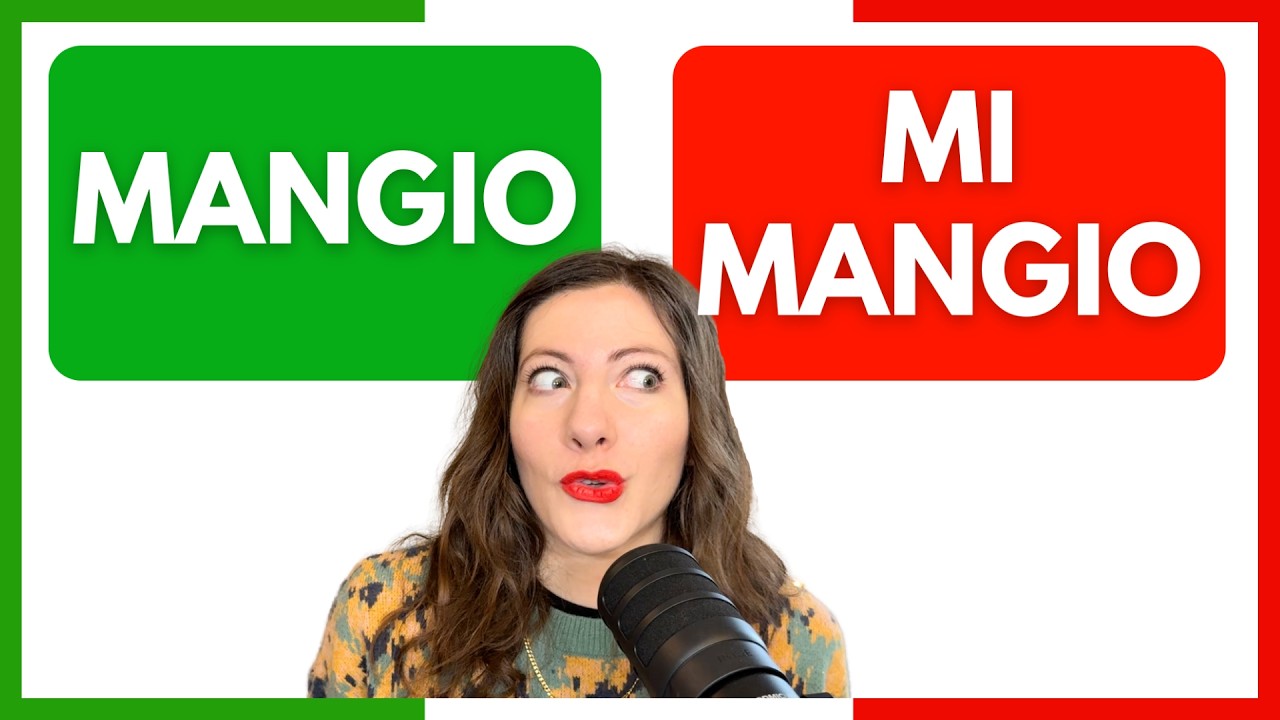
“Mi Sono Mangiato una Pizza”: How to Use PRONOUNS with Transitive Verbs
What Is a Transitive Verb? The Fundamental Basics
Before delving into the main topic, it’s essential to do a quick review. A transitive verb is a verb that can have a direct object. But what is a direct object? It’s an element of the sentence that completes the meaning of the verb, answering the question “what?” or “whom?”, and connects to the verb without a preposition.
Here are some concrete examples:
- “Marco mangia una mela.” [Marco eats an apple.] → Eats what? An apple. (direct object)
- “Lucia legge un libro.” [Lucia reads a book.] → Reads what? A book. (direct object)
- “Ho incontrato Maria.” [I met Maria.] → Met whom? Maria. (direct object)
The direct object, also called complemento oggetto in Italian, is fundamental for understanding today’s topic. There’s a rule that every Italian student learns very early: when a transitive verb has a direct object, in compound tenses the auxiliary AVERE (to have) is used.
So normally you say: Ho mangiato una pizza. Ho bevuto un caffè. Ho guardato un film. Ho letto un articolo. [I ate a pizza. I drank a coffee. I watched a movie. I read an article.] Everything perfectly regular. But then something unexpected happens.
The Mystery of “Superfluous” Pronouns: Pleonastic Pronouns
In real life, you hear Italians say sentences like these:
- “Mi sono mangiata una pizza incredibile!” [I ate an incredible pizza!]
- “Ti sei bevuto tutto il vino?” [Did you drink all the wine?]
- “Ieri sera ci siamo guardati un film bellissimo.” [Last night we watched a beautiful movie.]
- “Marco si è letto tutto il giornale a colazione.” [Marco read the entire newspaper at breakfast.]
But wait! There’s a direct object… and the auxiliary is essere (to be)? And those pronouns (mi, ti, ci, si)… what are they for?
These pronouns are called pleonastic pronouns. The word “pleonastic” comes from the Greek pleonasmós, which means “excess, overabundance”. In grammar, a pleonastic element is something that, from a strictly logical point of view, seems superfluous, unnecessary. But be careful: “apparently superfluous” doesn’t mean “useless”! In Italian, these pronouns have a very important communicative function.
What Are These Pronouns For? The Communicative Functions
When you add a personal pronoun to a transitive verb, you’re communicating something more compared to the “neutral” sentence. You’re adding various shades of meaning:
- Emotional involvement – The subject isn’t just a simple “executor” of the action, but is emotionally engaged.
- Intense participation – The action is perceived as more personal, more lived.
- Affective value – It can be positive (pleasure, satisfaction, enjoyment) or negative (annoyance, disapproval, regret).
- Informal register – This construction is typical of spoken, colloquial, everyday language.
In technical terms, we can say that the subject of the sentence becomes both the agent of the action (the one who performs the action) and the beneficiary or recipient of the action itself. It’s as if the subject were doing something for their own benefit (or detriment).
Comparison Between Neutral and Affective Sentences
| Neutral Sentence (Informative) | Sentence with Pronoun (Affective) |
|---|---|
| Ho mangiato una torta. [I ate a cake.] | Mi sono mangiato una torta! [I ate a cake!] |
| Abbiamo fatto una passeggiata. [We took a walk.] | Ci siamo fatti una bella passeggiata! [We took a nice walk!] |
| Ha bevuto tre birre. [He drank three beers.] | Si è bevuto tre birre! [He drank three beers!] |
| Ho letto un libro interessante. [I read an interesting book.] | Mi sono letto un libro interessante! [I read an interesting book!] |
| Hanno guardato un film. [They watched a movie.] | Si sono guardati un film! [They watched a movie!] |
In the first column, the sentences are grammatically correct but cold, detached, simply informative. They communicate a fact, period. In the second column, however, there’s emotion! There’s the pleasure of eating that cake, the satisfaction of that walk, the amazement (or disapproval) about those three beers. The speaker wants to communicate not only what happened, but also how they experienced it.
Positive or Negative? It Depends on the Context
Attention: the emotional involvement expressed by this construction is not always positive. It can indicate either a pleasant or an unpleasant experience.
Positive Sense (Pleasure, Satisfaction, Enjoyment)
- Example: “Mi sono gustato un tiramisù fantastico!” [I savored a fantastic tiramisù!] → I really appreciated it.
- Example: “Ci siamo fatti una vacanza meravigliosa!” [We had a wonderful vacation!] → A great experience, we benefited from it.
- Example: “Mi sono letto un romanzo bellissimo in tre giorni.” [I read a beautiful novel in three days.] → It was a pleasure to read it.
Negative Sense (Annoyance, Disapproval, Negative Consequences)
- Example: “Mi sono dovuto sorbire due ore di riunione inutile!” [I had to endure two hours of useless meeting!] → A real torture.
- Example: “Si è bevuto tutti i suoi risparmi al casinò.” [He drank away all his savings at the casino.] → He wasted them, a disaster.
- Example: “Si è fumato venti sigarette in un giorno.” [He smoked twenty cigarettes in one day.] → Disapproval for the excess.
The context of the conversation and the tone of voice will always help you understand whether the emotion expressed is positive or negative.
The Most Common Verbs with Affective Pronominal Use
This affective pronominal construction is mainly used with certain specific categories of verbs.
Verbs Related to Food and Drinks
These are the most frequent. Eating, drinking and similar actions directly involve our body and our pleasure, so it’s natural to express emotional involvement:
- mangiarsi [to eat] → Example: “Mi sono mangiato un piatto di spaghetti gigante.” [I ate a giant plate of spaghetti.]
- bersi [to drink] → Example: “Ti sei bevuta tutta la bottiglia da sola?” [Did you drink the whole bottle by yourself?]
- gustarsi [to savor] → Example: “Ci siamo gustati un aperitivo al tramonto.” [We savored an aperitif at sunset.]
- prendersi [to have/take] → Example: “Mi sono preso un dolcetto dopo pranzo.” [I had a little dessert after lunch.]
Verbs Related to the Senses and Entertainment
Activities related to sensory pleasure and entertainment are also suitable for this construction:
- guardarsi [to watch] → Example: “Mi sono guardato tre episodi di fila della mia serie preferita.” [I watched three episodes in a row of my favorite series.]
- vedersi [to see/watch] → Example: “Vi siete visti quel documentario di cui parlano tutti?” [Have you seen that documentary everyone’s talking about?]
- leggersi [to read] → Example: “Si è letto il libro in una sola notte, non riusciva a smettere.” [He read the book in one night, he couldn’t stop.]
- ascoltarsi [to listen to] → Example: “Mi sono ascoltato tutto l’album nuovo mentre cucinavo.” [I listened to the whole new album while cooking.]
The Verb FARE: The King of This Category
The verb fare (to do/make) is incredibly versatile in Italian and is used very frequently with this pronominal construction:
- farsi una passeggiata [to take a walk] → Example: “Ci siamo fatti una bella passeggiata lungo il fiume.” [We took a nice walk along the river.]
- farsi una doccia/un bagno [to take a shower/bath] → Example: “Mi sono fatto una doccia lunghissima e rilassante.” [I took a very long and relaxing shower.]
- farsi due/quattro risate [to have a good laugh] → Example: “Vi siete fatti due risate con quella commedia?” [Did you have a good laugh with that comedy?]
- farsi un viaggio [to take a trip] → Example: “Si sono fatti un viaggio incredibile in Sudamerica.” [They took an incredible trip to South America.]
- farsi un pisolino [to take a nap] → Example: “Mi sono fatto un pisolino pomeridiano rigenerante.” [I took a rejuvenating afternoon nap.]
- farsi un’idea [to form an idea] → Example: “Mi sono fatto un’idea abbastanza chiara della situazione.” [I formed a fairly clear idea of the situation.]
The Fundamental Grammar Rules
When you use this construction, there are some important grammar rules to keep in mind.
Rule 1: Auxiliary ESSERE (not AVERE)
Even if the verb is transitive and has a direct object, when you add the pleonastic pronoun the auxiliary becomes ESSERE (to be):
- Example: “Ho mangiato una pizza.” [I ate a pizza.] → “Mi sono mangiato una pizza.” [I ate a pizza.]
- Example: “Abbiamo guardato un film.” [We watched a movie.] → “Ci siamo guardati un film.” [We watched a movie.]
Rule 2: Past Participle Agreement with the Subject
With the auxiliary essere, the past participle agrees in gender and number with the subject:
| Subject | Example |
|---|---|
| Io (man) [I (man)] | Mi sono mangiato una pizza. [I ate a pizza.] |
| Io (woman) [I (woman)] | Mi sono mangiata una pizza. [I ate a pizza.] |
| Tu (man) [You (man)] | Ti sei bevuto un caffè. [You drank a coffee.] |
| Tu (woman) [You (woman)] | Ti sei bevuta un caffè. [You drank a coffee.] |
| Lui [He] | Si è guardato un film. [He watched a movie.] |
| Lei [She] | Si è guardata un film. [She watched a movie.] |
| Noi (men/mixed) [We (men/mixed)] | Ci siamo fatti una passeggiata. [We took a walk.] |
| Noi (women) [We (women)] | Ci siamo fatte una passeggiata. [We took a walk.] |
| Voi (men/mixed) [You (men/mixed)] | Vi siete letti quel libro? [Did you read that book?] |
| Voi (women) [You (women)] | Vi siete lette quel libro? [Did you read that book?] |
| Loro (men/mixed) [They (men/mixed)] | Si sono comprati una casa nuova. [They bought a new house.] |
| Loro (women) [They (women)] | Si sono comprate una casa nuova. [They bought a new house.] |
Rule 3: The Pronouns to Use
The pronouns used are reflexive pronouns:
| Person | Pronoun |
|---|---|
| Io [I] | mi |
| Tu [You] | ti |
| Lui/Lei [He/She] | si |
| Noi [We] | ci |
| Voi [You (plural)] | vi |
| Loro [They] | si |
Stop reading Italian.
Start speaking it.
Online lessons in groups of 4, organised by level and goals, with qualified teachers. Pick the day and time that suit you from the available slots.
Max 4 students:
there’s a seat for you
The Relationship with Reflexive Verbs
At this point, you might be wondering: “Are these reflexive verbs?”
True reflexive verbs (or “direct reflexives”) are verbs where the subject and the object coincide. The subject performs an action on themselves:
- Example: “Mi lavo.” [I wash myself.] = I wash myself.
- Example: “Ti vesti.” [You dress yourself.] = You dress yourself.
- Example: “Si pettina.” [She combs her hair.] = She combs herself.
In these cases, the pronoun (mi, ti, si…) represents the direct object, which is the same person as the subject.
But in the construction we’re studying today, things are different: “Mi sono mangiato una pizza.” [I ate a pizza.] Here the subject is “io” (I), but the direct object is “una pizza” (a pizza), not “myself”. So it’s not a true reflexive.
This construction is called various names by linguists:
- Apparent reflexive or indirect reflexive
- Intensive or affective pronominal use
Whatever the technical name, the important thing to remember is this: the pronoun doesn’t indicate that the action falls on the subject, but that the subject is emotionally involved in the action or derives benefit/detriment from it.
It’s as if the pronoun meant “for my own benefit”, “for me”, “for my pleasure”:
- Example: “Mi sono mangiato una pizza” [I ate a pizza] ≈ “Ho mangiato una pizza (per il mio piacere/godimento)” [I ate a pizza (for my pleasure/enjoyment)]
- Example: “Ci siamo fatti una passeggiata” [We took a walk] ≈ “Abbiamo fatto una passeggiata (per il nostro piacere)” [We took a walk (for our pleasure)]
When the Pronoun Is Mandatory (Not Optional)
So far we’ve seen cases where the pronoun is optional: you can add it to express emotional involvement, or you can omit it for a more neutral sentence. However, there are situations in Italian where the pronoun is mandatory. You can’t omit it without the sentence sounding strange or unnatural.
Case A: When the Object Is a Body Part of the Subject
When the direct object indicates a body part belonging to the subject, in Italian you must use the pronoun + definite article (and NOT the possessive adjective as in other languages):
- “Mi sono lavato le mani.” [I washed my hands.]
- “Ho lavato le mie mani.“ [I washed my hands.] (sounds very strange, unnatural)
- “Si è rotta una gamba.” [She broke her leg.]
- “Ha rotto la sua gamba.“ [She broke her leg.] (incorrect)
- “Ti sei tagliato i capelli?” [Did you cut your hair?]
- “Hai tagliato i tuoi capelli?“ [Did you cut your hair?] (unnatural)
Other examples:
- Example: “Mi sono bruciato la mano con il forno.” [I burned my hand with the oven.]
- Example: “Si è morso la lingua mentre mangiava.” [He bit his tongue while eating.]
- Example: “Ci siamo bagnati i piedi camminando sulla riva.” [We got our feet wet walking on the shore.]
This is an important difference between Italian and other European languages like English, German, or French, where the possessive adjective is normally used (“I washed my hands”, “J’ai lavé mes mains”).
Case B: When the Object Is Clothing or an Accessory of the Subject
The same principle applies when the object is a piece of clothing or an accessory that belongs to the subject:
- “Mi sono messo il cappotto.” [I put on my coat.]
- “Ho messo il mio cappotto.“ [I put on my coat.] (possible but less natural)
- “Si è tolta le scarpe.” [She took off her shoes.]
- “Ti sei allacciato la cintura?” [Did you fasten your seatbelt?]
- “Vi siete messi gli occhiali da sole?” [Did you put on your sunglasses?]
In these cases, the pronoun clearly indicates that the clothing belongs to the subject and the action is performed on oneself.
Summary Chart of Affective Pronominal Use
| Characteristic | Description |
|---|---|
| Name | Affective/intensive pronominal use |
| Function | To express the subject’s emotional involvement |
| Auxiliary | ESSERE (always, even with transitive verbs) |
| Participle agreement | With the SUBJECT (not with the object) |
| Register | Informal, colloquial, everyday |
| Most common verbs | mangiare, bere, guardare, leggere, fare, comprare |
| Mandatory cases | Body parts, clothing, accessories |
| Emotional value | Can be positive OR negative (depends on context) |
Frequently Asked Questions
Is It Correct to Say “Mi Sono Mangiato” or Is It a Grammar Mistake?
No, it’s not a mistake. It’s a perfectly correct construction of the Italian language, called “affective pronominal use” or “intensive use”. It’s very common in everyday spoken language and serves to express emotional involvement in the action.
Can I Use This Construction in Formal Contexts?
This construction mainly belongs to the informal and colloquial register. In formal contexts (official documents, professional communications, academic texts), it’s preferable to use the standard form without the pleonastic pronoun: “Ho letto il documento” [I read the document] instead of “Mi sono letto il documento” [I read the document].
Why Does the Auxiliary Change from AVERE to ESSERE?
When you add the reflexive pronoun, the verb takes on the characteristics of pronominal verbs, which in Italian always require the auxiliary essere (to be) in compound tenses. It’s a fixed rule that admits no exceptions in this construction.
With Which Verbs Can I Use This Construction?
It’s mainly used with verbs that express actions related to personal pleasure: mangiare (to eat), bere (to drink), guardare (to watch), leggere (to read), ascoltare (to listen). However, it can be extended to many other transitive verbs when you want to emphasize the subject’s emotional involvement: comprarsi (to buy oneself), regalarsi (to give oneself), concedersi (to treat oneself), godersi (to enjoy), etc.
What’s the Difference Between “Mi Sono Lavato le Mani” and “Ho Lavato le Mani”?
In Italian, when the action concerns a part of your own body, the form with the reflexive pronoun is mandatory and standard: “Mi sono lavato le mani” [I washed my hands]. The form “Ho lavato le mani” [I washed the hands] could be interpreted as if you were washing someone else’s hands, or it would simply sound unnatural.
Do Foreigners Need to Learn to Use This Construction?
Yes. To speak natural and authentic Italian, it’s essential to know and be able to use this construction. It’s one of the features that distinguishes an advanced speaker from someone who speaks correct but “artificial” Italian. Furthermore, in mandatory cases (body parts, clothing), it’s indispensable to avoid making mistakes.
If you enjoyed this topic, also explore the ethical dative, another affective use of pronouns, in the dedicated article.
Do pronominal verbs trip you up and fill you with doubts? Turn confusion into confidence with our exclusive course: “Da «Non ce la faccio più» a «Ora me la cavo»: i verbi pronominali in 30 giorni.” With fun, bite-size lessons and targeted practice, you’ll learn to use them naturally in just one month.
Want the lesson PDF with exercises and solutions?
Join the LearnAmo AcademyLoading quiz…
Podcast: Play in new window | Download (Duration: 25:48 — 23.6MB)
Iscriviti: Apple Podcasts | Spotify | Android | iHeartRadio | Podcast Index | TuneIn | Deezer | RSS | Altri...