


Adjectives are fundamental in Italian, but also the most skilled speakers can often make mistakes. In this article, we will analyze the most common mistakes made by Italian learners (and not only by them!). Let’s see how to avoid them and improve your use of adjectives.
What is an Adjective?
An adjective is a variable part of speech, that gets tied to a name to determine or specify properties or characteristics. Common examples include:
- Un cane nero (A black dog)
- Una casa grande (A big house)
- Una battuta divertente (A funny joke)
Many think adjectives are easy to learn, especially because they are introduced at beginner levels. However, there are a lot of mistakes that can be made, also by Italians! Here, we will see some of the most common mistakes.
1. Adjectives in -CIA and -GIA in the Plural form
Did you ever ask yourself If it is correct to write maglie grigie or maglie grige? You are not the only one! This is one of frequent mistakes. The grammatical rule is simple:
- If the letter before -cia/-gia is a vocal (fradicia, grigia), the “i” will be maintained when plural (fradicie, grigie)
- If the letter before -cia/-gia is a consonant (liscia, saggia), the “i” will be removed when plural (lisce, sagge)
Remember: do not guess it! Follow this rule to avoid any mistakes.
2. Agreement errors
Noun-Adjective agreement is essential. But it can also create confusion. Some common mistakes include:
- La casa granda (correct: la casa grande)
- Il libro tristo (correct: il libro triste)
- Le ragazze intelligente (correct: le ragazze intelligenti)
Other mistakes are:
- Adjectives like “incinta”: when plural, it is “incinte” (not “incinta”)
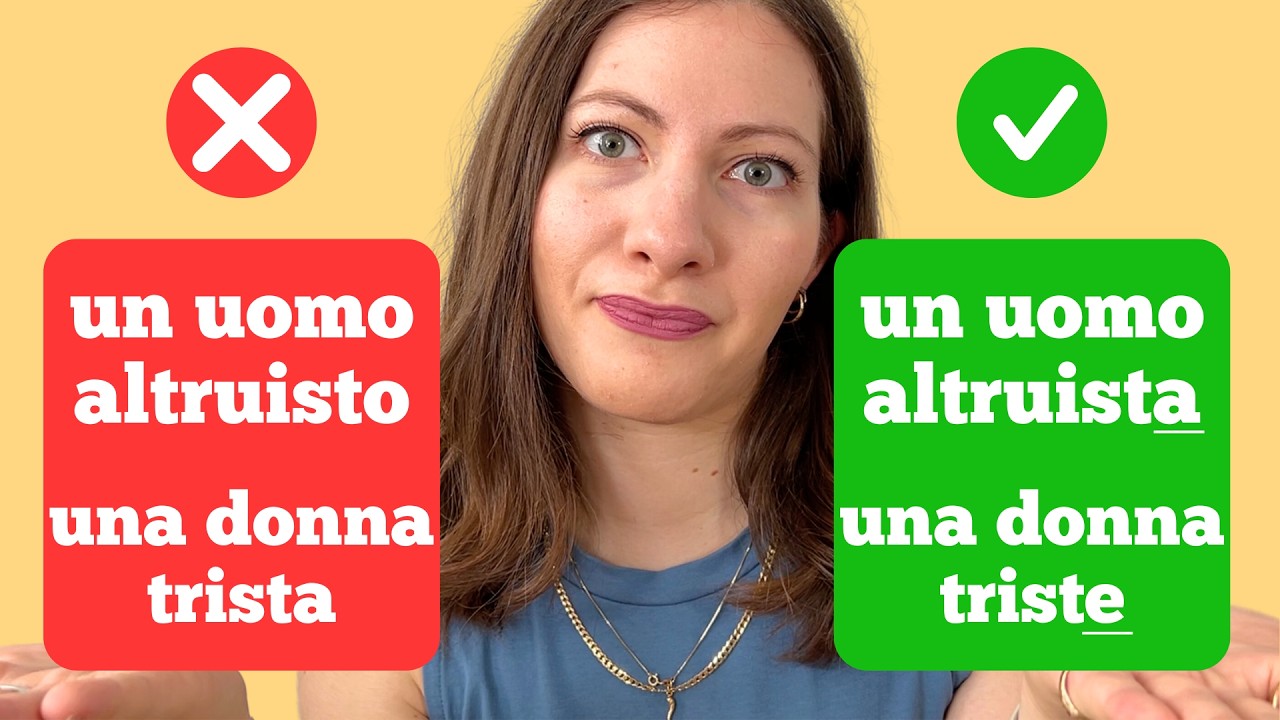
- Adjectives in -ista: they stay the same when singular but change when plural. For example:
- Singular: una donna altruista, un uomo altruista (a generous woman, a generous man)
- Plural: due donne altruiste, due uomini altruisti (two generous women, two generous men)
When the adjective is referring to many names – with a different gender – follow those rules:
- If they are people, use the masculine plural: La mamma e il papà sono simpatici. (Mum and Dad are funny)
- If they are things, the masculine plural is usually used, but if the last name is a feminine plural, you can use the feminine agreement: Un armadio e due sedie neri / Un armadio e due sedie nere. (a black wardrobe and two black chairs)
3. Adjectives with Collective Names
Collective names like “folla”, “famiglia” or “squadra” always need a singular adjective. For example:
- Una folla furiosa (an enraged crowd)
- Una famiglia felice (a happy family)
4. Spelling Mistakes
Some adjectives can create some doubts about spelling. Here are some rules to remember:
With or without i?
- Ingegnoso (not ingegnioso) (clever)
- Cosciente (not coscente) (conscious)
- Scemo (not sciemo) (fool, stupid)
- Cieco (blind person) MA ceco (Czech Republic citizen)
With a c or a q?
- Innocuo (not innoquo) (harmless)
- Proficuo (not profiquo) (profitable, lucrative)
Remember: adjectives derived from “acqua” use cq (ex: acquatico, acquoso).
Stop reading Italian.
Start speaking it.
Online lessons in groups of 4, organised by level and goals, with qualified teachers. Pick the day and time that suit you from the available slots.
Max 4 students:
there’s a seat for you
5. The Position of the Adjective
The position of the adjective can change the meaning of the sentence. Here are some examples of this:
- Un alto dirigente (a high-level manager) VS un dirigente alto (high of stature)
- Un vecchio amico (a friend you have known for a long time) VS un amico vecchio (older/elder friend)
Italian can be quite flexible on the position of the adjective, but it is important to remember those cases!
6. Troppo pochi or troppi pochi?
This distinction can be often confusing. Here is the rule:
- Troppo pochi: adverb
- Troppi: adjective
The correct sentence is: I miei libri sono troppo pochi. (My books are not enough)
Or: I miei libri sono troppi.
7. False Friends: Be Careful of the Meaning!
Some adjectives can appear to be tied to a particular word, but their meaning is completely different:
- Cinofilo: refers to dogs, not to the cinema.
- Fragrante: refers to a perfume, not to strawberries.
- Accattivante: means attractive, not evil.
8. Don’t say “più migliore”!
“Migliore” is already a comparative, so don’t add “più”. This is the correct scale of comparison:
- Buono -> Migliore -> Ottimo (Good -> Better -> Excellent)
- Cattivo -> Peggiore -> Pessimo (Bad -> Worse -> Terrible)
- Grande -> Maggiore -> Massimo (Big -> Great -> Greatest)
Do you want to take Italian lessons with our qualified native teachers? Purchase your Italiano Intensivo package!
Adjectives in Italian may seem easy, but they can also be a bit tricky. If you follow those rules, you can avoid common mistakes and improve your knowledge and use of Italian. But wait, because it does not end here. If you want to know more, we suggest studying our complete guide to comparatives and superlatives. Good luck with your studies!
Want the lesson PDF with exercises and solutions?
Join the LearnAmo AcademyCaricamento quiz in corso…
Podcast: Play in new window | Download (Duration: 15:27 — 21.2MB)
Iscriviti: Apple Podcasts | Spotify | Android | iHeartRadio | Podcast Index | TuneIn | Deezer | RSS | Altri...