


In Italian, there are many words that look similar, sometimes almost identical, but have very different meanings. Using the wrong one can create embarrassing, funny, or simply confusing situations. In this article, you’ll discover 10 groups of words that are constantly confused: by the end, you’ll know exactly which word to use in every situation!
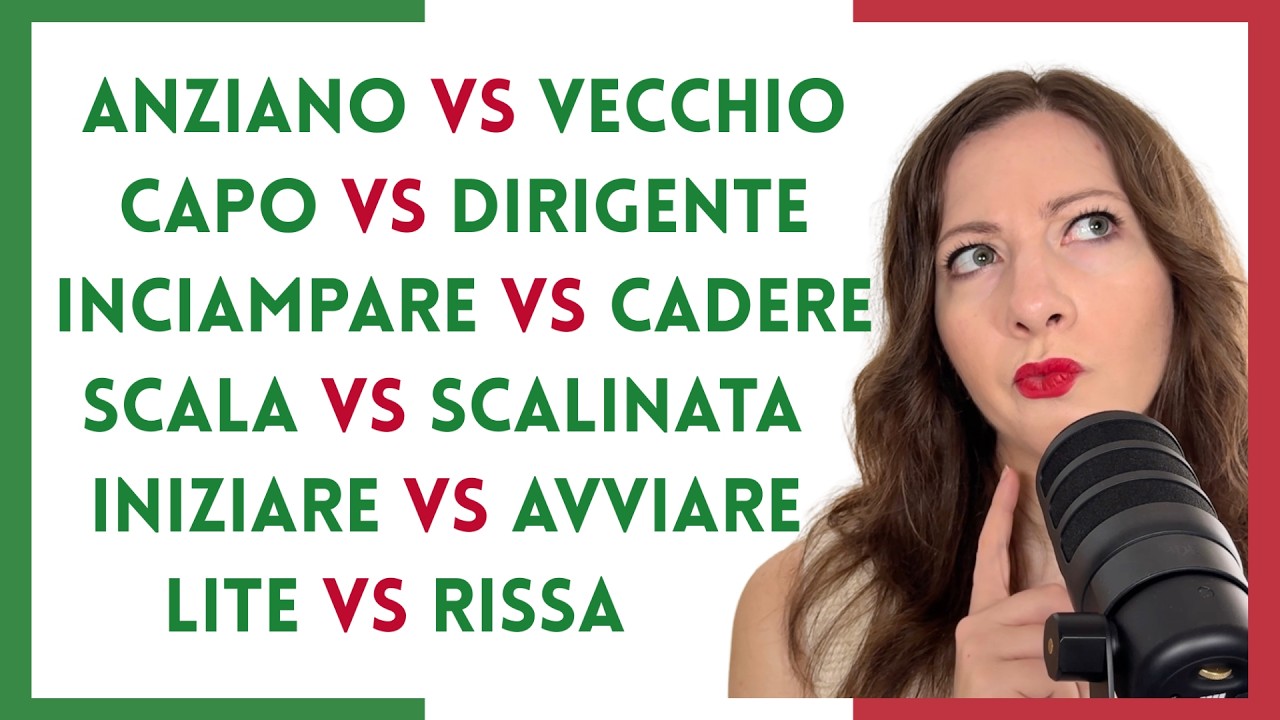
10 Groups of Italian Words that Look the Same But Aren’t
Words Related to Relationships and Roles
Group #1: Litigio vs Rissa vs Discussione vs Lite [Quarrel vs Brawl vs Discussion vs Argument]
Let’s start with four words that all relate to situations of disagreement. But be careful, because the level of intensity is very different!
Complete Definitions
- DISCUSSIONE [discussion] = an exchange of opinions between two or more people who have different points of view. It can be calm and civil, or a bit heated, but it always remains on a verbal and rational level. It’s what you do when you talk about politics with friends, when you decide where to go for dinner, when a professor and a student debate a topic. It doesn’t necessarily imply anger or conflict – it can also be constructive and interesting.
- LITE [quarrel/argument] = a verbal conflict more intense than a discussione, characterized by anger, emotional tension and often raised voices. People get angry, say unpleasant things, maybe raise their voices. It’s what happens when couples “hanno una lite” [have a quarrel], when two neighbors argue over a parking spot, when mom finds out you didn’t do your homework. It remains verbal, but there is strong emotional involvement.
- LITIGIO [quarrel/dispute] = it is essentially a synonym of lite, perhaps slightly more formal or more often used to indicate a prolonged or repeated quarrel. “Hanno avuto un litigio” [They had a dispute] and “hanno avuto una lite” [They had a quarrel] mean practically the same thing. In some regions one is preferred, in others the other. This is also purely verbal.
- RISSA [brawl] = a physical fight between two or more people. Here we go from words to action: punches, shoves, kicks. It’s what can happen outside nightclubs or during sports events when tension escalates. A rissa is violent and physical, often illegal, and requires law enforcement intervention.
The Intensity Scale
| Word | Type | Intensity | Example |
|---|---|---|---|
| Discussione [discussion] | Verbal, rational | Low | “Abbiamo avuto una discussione interessante sulla politica italiana.” [We had an interesting discussion about Italian politics.] |
| Lite / Litigio [quarrel / dispute] | Verbal, emotional | Medium | “I miei genitori hanno avuto una lite ieri sera. Mia madre non gli parla ancora.” [My parents had a quarrel last night. My mother still isn’t speaking to him.] |
| Rissa [brawl] | Physical, violent | High | “È scoppiata una rissa fuori dal bar. Sono dovuti intervenire i carabinieri.” [A brawl broke out outside the bar. The police had to intervene.] |
Examples
- “Abbiamo avuto una discussione interessante sulla politica italiana.” [We had an interesting discussion about Italian politics.] = A civil exchange of opinions, nobody got angry.
- “I miei genitori hanno avuto una lite ieri sera. Mia madre non gli parla ancora.” [My parents had a quarrel last night. My mother still isn’t speaking to him.] = They got angry, raised their voices, there’s tension at home.
- “Il litigio tra i due fratelli dura da anni.” [The dispute between the two brothers has been going on for years.] = A verbal conflict prolonged over time, they no longer speak to each other.
- “È scoppiata una rissa fuori dal bar. Sono dovuti intervenire i carabinieri.” [A brawl broke out outside the bar. The police had to intervene.] = Physical fight, law enforcement intervention.
Why Is It Important to Distinguish Them?
Because if you say “ho avuto una rissa con mia moglie” [I had a brawl with my wife], you’re saying you physically fought each other. That’s very different from “ho avuto una lite con mia moglie” [I had a quarrel with my wife]. And if you say “abbiamo avuto una discussione“ [we had a discussion] when in reality you screamed at each other for an hour, you’re downplaying the situation quite a bit. Words matter.
Group #2: Antico vs Vecchio vs Anziano [Ancient vs Old vs Elderly]
Three words that all indicate something that has many years, but that are used in very different contexts. Confusing them can be offensive.
Complete Definitions
- ANTICO [ancient] = something that belongs to a distant historical era, that has historical, cultural, or artistic value precisely because of its age. It’s used for objects, buildings, civilizations, traditions that date back centuries. It has a positive and prestigious connotation: antiquity gives value. Roma antica [Ancient Rome], mobili antichi [antique furniture], tradizioni antiche [ancient traditions], civiltà antiche [ancient civilizations]. Never for people!
- VECCHIO [old] = something or someone that has many years of age, that is used, worn by time, or that is no longer new/recent. It can refer to objects, ideas, habits, and also to people – but be careful, used for people it can sound disrespectful or simply indicate “not young.” It often has a neutral or negative connotation: vecchie scarpe [old shoes], vecchie abitudini [old habits], vecchia macchina [old car].
- ANZIANO [elderly] = a person who is of advanced age, typically over 65-70 years old. It is the respectful and neutral term for indicating people of advanced age. It is never used for objects! Only for human beings. It’s the word you use when speaking respectfully about the elderly: “gli anziani del paese” [the elderly of the town], “una signora anziana” [an elderly lady], “assistenza agli anziani” [elderly care].
Quick Reference
| Word | Used for | Connotation | Example |
|---|---|---|---|
| Antico [ancient] | Objects, buildings, civilizations | Positive, prestigious | “Questo vaso è antico, risale all’epoca romana.” [This vase is ancient, it dates back to the Roman era.] |
| Vecchio [old] | Objects and people (informal) | Neutral or negative | “Queste scarpe sono vecchie, devo comprarne di nuove.” [These shoes are old, I need to buy new ones.] |
| Anziano [elderly] | People only | Respectful | “Mio nonno è anziano, ha 85 anni.” [My grandfather is elderly, he’s 85 years old.] |
Common Mistakes
- “Mio nonno è antico.” [My grandfather is ancient.] – Your grandfather isn’t an archaeological artifact. → “Mio nonno è anziano.” [My grandfather is elderly.]
- “Questa chiesa è anziana.” [This church is elderly.] – Churches don’t reach retirement age. → “Questa chiesa è antica.” [This church is ancient.] (if it’s centuries old); “Questa chiesa è vecchia.” [This church is old.] (if it’s simply not new)
- “Ho comprato un mobile anziano.” [I bought an elderly piece of furniture.] – Furniture doesn’t age like people. → “Ho comprato un mobile antico.” [I bought an antique piece of furniture.] (if it has historical value); “Ho comprato un mobile vecchio.” [I bought an old piece of furniture.] (if it’s simply used)
Why Is It Important to Distinguish Them?
Because calling a person “vecchia” [old] can be offensive, while “anziana” [elderly] is respectful. And calling an object “anziano” doesn’t make sense! Likewise, a piece of furniture from the 1700s is “antico” [antique] and has value; a piece of furniture from the ’80s bought at Ikea is simply “vecchio” [old]. The difference is also economic: antique items cost much more.
Group #3: Rispettoso vs Rispettato vs Rispettabile [Respectful vs Respected vs Respectable]
Three adjectives that all derive from the verb “rispettare” [to respect], but that describe completely different situations. Be careful not to confuse them.
Complete Definitions
- RISPETTOSO [respectful] = someone who shows respect toward others, who behaves with politeness, courtesy, and consideration. It describes a person’s behavior toward others. A respectful child listens to their parents; a respectful student doesn’t interrupt the teacher; a respectful guest behaves well at someone else’s home.
- RISPETTATO [respected] = someone who receives respect from others, who is esteemed, considered, admired. It describes how others see a person. It’s the result of actions, skills, reputation. A respected doctor is esteemed by colleagues; a respected professor is admired by students; a respected leader is followed with conviction.
- RISPETTABILE [respectable] = someone or something that deserves respect, that is worthy of consideration, that has a good reputation in society. It can also mean “acceptable, decent” when talking about quantities or results. Una famiglia rispettabile [a respectable family] is a family of good standing; una cifra rispettabile [a respectable sum] is a considerable amount; un lavoro rispettabile [a respectable job] is a dignified job.
Quick Reference
| Word | Meaning | Direction | Example |
|---|---|---|---|
| Rispettoso [respectful] | I give respect to others | Active → | “Marco è molto rispettoso con gli anziani: cede sempre il posto sull’autobus.” [Marco is very respectful toward the elderly: he always gives up his seat on the bus.] |
| Rispettato [respected] | I receive respect from others | ← Passive | “Il professor Rossi è molto rispettato nel suo campo: tutti citano i suoi studi.” [Professor Rossi is very respected in his field: everyone cites his studies.] |
| Rispettabile [respectable] | I deserve respect | Intrinsic quality | “Viene da una famiglia rispettabile: suo padre è giudice e sua madre è medico.” [He comes from a respectable family: his father is a judge and his mother is a doctor.] |
Common Mistakes
- “Luigi è molto rispettato verso i suoi professori.” [Luigi is very respected toward his professors.] → “Luigi è molto rispettoso verso i suoi professori.” [Luigi is very respectful toward his professors.] (Luigi GIVES respect, he doesn’t RECEIVE it)
- “Voglio essere una persona rispettosa nella mia professione.” [I want to be a respectful person in my profession.] → “Voglio essere una persona rispettata nella mia professione.” [I want to be a respected person in my profession.] (You want to receive respect, not just give it)
Why Is It Important to Distinguish Them?
Because the meaning changes completely! Saying “è una persona rispettata“ [he/she is a respected person] is a compliment about reputation. Saying “è una persona rispettosa“ [he/she is a respectful person] is a compliment about behavior. And saying “è una persona rispettabile“ [he/she is a respectable person] means they are upstanding, with a good social position. Three different concepts, three different adjectives.
Group #4: Capo vs Direttore vs Responsabile vs Dirigente [Boss vs Director vs Manager vs Executive]
Now let’s talk about Italian corporate hierarchy. These four words all indicate people with authority, but at different levels and in different contexts.
Complete Definitions
- CAPO [boss] = a generic and informal term for someone who has authority over you, who gives you orders, who is above you in the hierarchy. It can be used in any context: work, sports, informal groups. “Il mio capo” [my boss] is simply the person you report to, whatever their official title may be. It’s also the term used in criminal contexts – the “capo” of the mafia, for example.
- RESPONSABILE [manager/person in charge] = someone who has the responsibility for a specific area, a project, a department. They are not necessarily at the top of the company, but they have authority and responsibility for a given area. Il responsabile delle vendite [the sales manager], il responsabile della comunicazione [the communications manager], il responsabile del personale [the HR manager]. It indicates a specific function rather than an absolute hierarchical level.
- DIRETTORE [director] = someone who directs, who leads an organization, a department, an institution. It’s a more formal and specific title, often used for defined roles: direttore generale [general director/CEO], direttore artistico [artistic director], direttore di banca [bank director], direttore d’orchestra [orchestra conductor], direttore di un giornale [newspaper editor-in-chief]. It implies a role of important and recognized leadership.
- DIRIGENTE [executive/senior manager] = someone who belongs to the highest professional category in a company, who is part of management. In Italy, “dirigente” is also a specific contractual category with certain rights and responsibilities. Executives make strategic decisions, have special contracts, and higher salaries. Not all bosses are dirigenti!
Typical Corporate Hierarchy
| Level | Role | Example |
|---|---|---|
| 1️⃣ | Dipendente [employee] | “Il mio capo mi ha chiesto di finire il progetto entro venerdì.” [My boss asked me to finish the project by Friday.] |
| 2️⃣ | Responsabile (di area) [area manager] | “Devo parlare con il responsabile delle risorse umane.” [I need to talk to the HR manager.] |
| 3️⃣ | Direttore (di dipartimento) [department director] | “Il direttore della banca ha approvato il mio mutuo.” [The bank director approved my mortgage.] |
| 4️⃣ | Dirigente (top management) [executive] | “Mio zio è dirigente in una grande azienda farmaceutica.” [My uncle is an executive in a large pharmaceutical company.] |
Important Note
In informal contexts, “capo” [boss] can replace all the other terms. If you’re talking with a friend, you can say “il mio capo” [my boss] even if technically they are a direttore or a dirigente. But in formal contexts, it’s important to use the correct title – executives care a lot about this.
Why Is It Important to Distinguish Them?
Because in Italy corporate hierarchy is important and people care about their titles! Calling a dirigente [executive] a “responsabile” [manager] could offend them. And if you say “sono dirigente” [I’m an executive] when you’re actually in charge of a small department, you’re greatly exaggerating your role. Every title carries its own weight.
Words that Describe Physical Actions and Places
Group #5: Cascare vs Cadere vs Inciampare [To Fall (informal) vs To Fall vs To Trip]
Three verbs that all relate to losing balance, but in different ways. When you fall, the word you use tells exactly how it happened.
Complete Definitions
- CADERE [to fall] = to lose balance and end up on the ground or lower down. It’s the generic and neutral verb to describe this movement. It doesn’t specify the cause: you can cadere because you slipped, because someone pushed you, because you lost your balance, because the floor was wet. Cadere describes only the result: you were standing, now you’re on the ground.
- CASCARE [to fall – informal] = practically a synonym of cadere, but more informal and colloquial. It’s used more often in spoken language than in writing. It also has very common figurative uses: “cascare dal sonno” [to be dead tired, literally: to fall from sleep], “cascare dalle nuvole” [to be very surprised, literally: to fall from the clouds], “cascarci” [to fall for it, to be fooled]. In some regions of Italy, it’s used more than “cadere” in everyday language.
- INCIAMPARE [to trip/stumble] = to hit something with your feet while walking, losing your balance. It’s the cause of many falls: you trip on a step, a stone, a cable, a rug. Inciampare doesn’t necessarily mean falling! You can trip and recover, or trip and fall. It’s the action of the foot hitting an obstacle.
The Typical Sequence
| Phase | Action | Description |
|---|---|---|
| 1️⃣ Cause | Inciampare [to trip] | The foot hits an obstacle |
| 2️⃣ Result (possible) | Cadere / Cascare [to fall] | You end up on the ground |
Examples
- “Sono caduto dalle scale e mi sono fatto male.” [I fell down the stairs and hurt myself.] = Result: I was on the stairs, now I’m on the ground. Generic.
- “Attento a non cascare! Il pavimento è bagnato.” [Be careful not to fall! The floor is wet.] = Informal, same meaning as “cadere.”
- “Sono inciampato nel tappeto, ma per fortuna non sono caduto.” [I tripped on the rug, but luckily I didn’t fall.] = My foot hit the rug, but I kept my balance.
- “È inciampata in un gradino ed è caduta.” [She tripped on a step and fell.] = First the trip (cause), then the fall (consequence).
Figurative Uses
- “Casco dal sonno, vado a letto.” [I’m dead tired, I’m going to bed.] – I’m extremely sleepy.
- “Quando l’ha saputo, è cascato dalle nuvole.” [When he found out, he was completely shocked.] – He was extremely surprised.
- “Non cascarci! È una truffa!” [Don’t fall for it! It’s a scam!] – Don’t be fooled.
- “La sua teoria cade di fronte ai fatti.” [His theory falls apart in the face of facts.] – It doesn’t hold up, it collapses.
Why Is It Important to Distinguish Them?
Because “inciampare” [to trip] describes a specific cause, while “cadere/cascare” [to fall] describes a result. If the doctor asks you “come è successo?” [how did it happen?], saying “sono caduto” [I fell] doesn’t explain anything. Saying “sono inciampato in un cavo” [I tripped on a cable] explains exactly what happened. And in figurative uses, the meanings are completely different: “cascare dalle nuvole” [to fall from the clouds] has nothing to do with physical falls!
Group #6: Sparire vs Scomparire [To Vanish vs To Disappear]
Two verbs that both mean “to no longer be visible, to no longer be there”, but with different nuances. The difference is subtle, but it’s worth knowing.
Complete Definitions
- SPARIRE [to vanish/disappear – informal] = to no longer be visible, to go away, often in a sudden or mysterious way. It’s the more common and colloquial verb. It’s used for people, objects, animals that can no longer be found or that have gone away. It often has a connotation of speed or mystery: “è sparito nel nulla” [he vanished into thin air], “i soldi sono spariti” [the money has disappeared], “il gatto è sparito” [the cat has vanished].
- SCOMPARIRE [to disappear – formal] = to cease being visible or present, often with a more formal or definitive nuance. It’s widely used to indicate someone’s death in an elegant and respectful way: “è scomparso il grande attore…” [the great actor has passed away…] (instead of “è morto” [he died]). It’s also used for things that gradually cease to exist: “specie scomparse” [extinct species], “tradizioni scomparse” [lost traditions].
The Nuances
| Word | Register | Characteristic | Example |
|---|---|---|---|
| Sparire [to vanish] | Informal, everyday | Can be temporary | “Le mie chiavi sono sparite! Le avevo messe qui!” [My keys have vanished! I had put them here!] |
| Scomparire [to disappear] | Formal, elegant | Often definitive, used for death | “È scomparso ieri all’età di 90 anni.” [He passed away yesterday at the age of 90.] |
Examples
- “Le mie chiavi sono sparite! Le avevo messe qui!” [My keys have vanished! I had put them here!] = I can’t find them anymore.
- “Il mago ha fatto sparire il coniglio.” [The magician made the rabbit vanish.] = A magic trick, the rabbit is no longer visible.
- “Appena ho detto ‘conto, per favore’, Mario è sparito.” [As soon as I said “check, please,” Mario vanished.] = He left quickly to avoid paying!
- “È scomparso ieri all’età di 90 anni.” [He passed away yesterday at the age of 90.] = A respectful and elegant way to say he died.
- “Questa specie è scomparsa 10.000 anni fa.” [This species disappeared 10,000 years ago.] = It no longer exists, it went extinct.
- “La nebbia è scomparsa e il sole è uscito.” [The fog disappeared and the sun came out.] = It went away, it’s no longer there.
Fun Fact
In many contexts, the two verbs are interchangeable!
You can say both “il sole è sparito dietro le nuvole” and “il sole è scomparso dietro le nuvole” [the sun disappeared behind the clouds]. The main difference is that “scomparire” is more formal and preferred in serious contexts or when talking about death. “Sparire” is more everyday and often implies speed or surprise.
Why Is It Important to Know the Difference?
Because if you say “mio nonno è sparito“ [my grandfather vanished] it sounds like he went away or you can’t find him. If you say “mio nonno è scomparso“ [my grandfather has passed away] it can mean he died. Context always helps, but choosing the right word avoids ambiguity in delicate situations.
Stop reading Italian.
Start speaking it.
Online lessons in groups of 4, organised by level and goals, with qualified teachers. Pick the day and time that suit you from the available slots.
Max 4 students:
there’s a seat for you
Group #7: Pozzanghera vs Stagno vs Lago [Puddle vs Pond vs Lake]
Three words that all indicate still water, but of very different sizes! Confusing them can create rather strange situations.
Complete Definitions
- POZZANGHERA [puddle] = a small amount of stagnant water that forms temporarily on the ground, usually after rain. It’s that thing you step in when you’re not watching where you walk, the one children love to jump through, the one cars splash on you when driving by. Small, temporary, annoying.
- STAGNO [pond] = a body of still freshwater, larger than a puddle but smaller than a lake. It’s a permanent natural environment, with aquatic plants, frogs, insects, water lilies. It’s what you see in the countryside, in parks, in wetlands. It has its own ecosystem, with animals that live there year-round.
- LAGO [lake] = a large body of freshwater collected in a depression in the ground, much larger than a pond. Lakes are big enough to have beaches, harbors, boats, large fish. In Italy, we have Lago di Garda, Lago di Como, Lago Maggiore… you can swim, go boating, go on vacation there!
Size Scale
| Word | Size | Duration | Example |
|---|---|---|---|
| Pozzanghera [puddle] | Small | Temporary | “Ho messo il piede in una pozzanghera e ora ho la scarpa bagnata.” [I stepped in a puddle and now my shoe is wet.] |
| Stagno [pond] | Medium | Permanent | “Nello stagno del parco ci sono le paperelle e le ninfee.” [In the park’s pond there are ducklings and water lilies.] |
| Lago [lake] | Large | Permanent | “Quest’estate andiamo in vacanza sul Lago di Como.” [This summer we’re going on vacation to Lake Como.] |
Typical Mistakes
- “C’è un lago sul marciapiede.” [There’s a lake on the sidewalk.] → “C’è una pozzanghera sul marciapiede.” [There’s a puddle on the sidewalk.] (Unless you live in a very peculiar place.)
- “Nuotiamo nella pozzanghera!” [Let’s swim in the puddle!] → “Nuotiamo nel lago.” [Let’s swim in the lake.] (You certainly can’t swim in puddles.)
Why Is It Important to Distinguish Them?
Because size matters! If you invite someone for a walk “intorno al lago” [around the lake] and then take them to see a pond, they’ll be disappointed. And if you say you swam in a puddle, people will think that’s a bit strange. Each word evokes a different mental image.
Group #8: Scala vs Scalinata [Stairs vs Monumental Staircase]
Two words that both relate to steps, but in different architectural contexts. One is inside the house, the other is a monument.
Complete Definitions
- SCALA [stairs/staircase] = a structure with steps that allows you to go from one floor to another, from one level to another. It’s the generic and common term for any series of steps: the stairs in your house, the staircase in your apartment building, a spiral staircase, a ladder. It can be indoor or outdoor, large or small, made of wood, marble, concrete, metal…
- SCALINATA [monumental staircase/grand steps] = a monumental, wide staircase, often outdoor, typically associated with important buildings like churches, palaces, public monuments. It has a connotation of grandeur and architectural importance. Think of the scalinata di Piazza di Spagna [the Spanish Steps] in Rome, the grand staircase of a cathedral, the monumental steps of a historic palace. It’s not just functional like a normal staircase – it’s also beautiful to look at!
The Difference
| Word | Characteristic | Context | Example |
|---|---|---|---|
| Scala [stairs] | Functional, everyday | Home, apartment building, work | “Abito al terzo piano senza ascensore: devo fare le scale ogni giorno.” [I live on the third floor with no elevator: I have to take the stairs every day.] |
| Scalinata [monumental staircase] | Monumental, impressive | Churches, squares, monuments | “Ci siamo seduti sulla scalinata di Piazza di Spagna a mangiare il gelato.” [We sat on the Spanish Steps eating gelato.] |
Typical Mistakes
- “Devo salire la scalinata del mio condominio.” [I have to climb the monumental staircase of my apartment building.] → “Devo salire le scale del mio condominio.” [I have to climb the stairs of my apartment building.] (Unless you live in a historic palace.)
- “Abbiamo visitato la scala di Piazza di Spagna.” [We visited the stairs of Piazza di Spagna.] → “Abbiamo visitato la scalinata di Piazza di Spagna.” [We visited the Spanish Steps.] (It’s too beautiful and famous to be a simple staircase.)
Why Is It Important to Distinguish Them?
Because “scala” [stairs] is everyday, functional; “scalinata” [monumental staircase] evokes grandeur, beauty, importance. If you say your house has a scalinata, people will expect something impressive! And if you call a famous monument’s grand staircase a simple “scala,” you sound a bit dismissive.
Group #9: Padre vs Padrino vs Patrigno [Father vs Godfather vs Stepfather]
Three words that all relate to important male figures in someone’s life, but with completely different roles! Confusing them can create rather significant misunderstandings.
Complete Definitions
- PADRE [father] = the man who biologically fathered you or who legally adopted you. He is the male parental figure, the one you call “papà” [dad], the one who appears on your birth certificate. It’s the basic term, the one we all know and use since childhood.
- PADRINO [godfather] = the man who was chosen to assist you at your baptism (or confirmation) and who theoretically has the task of guiding you spiritually in life. It’s a traditionally important figure in Catholic cultures. The godfather is often a family friend, an uncle, someone the parents respect and to whom they entrust a symbolic role. Oh, and yes: “Il Padrino” [The Godfather] is also the title of the famous mafia movie – the “padrino” in the mafia is the boss, the leader, the reference figure.
- PATRIGNO [stepfather] = the mother’s new husband, when he is not the biological father. If your parents divorce and your mother remarries, the new husband is your patrigno. He didn’t father you, but he’s part of your family through the marriage to your mother. It’s the male equivalent of “matrigna” [stepmother] (the father’s new wife).
Quick Reference
| Word | Role | Relationship | Example |
|---|---|---|---|
| Padre [father] | Fathered or adopted you | Parent | “Mio padre mi ha insegnato ad andare in bicicletta.” [My father taught me to ride a bicycle.] |
| Padrino [godfather] | Religious/symbolic role | Baptism/Confirmation | “Il mio padrino mi ha regalato un orologio per la cresima.” [My godfather gave me a watch for my confirmation.] |
| Patrigno [stepfather] | Mother’s husband | Not the biological father | “Il mio patrigno è simpatico: lui e mia madre sono sposati da cinque anni.” [My stepfather is nice: he and my mother have been married for five years.] |
Watch Out for the Article!
This is an important peculiarity of Italian: with close family nouns (padre, madre, fratello, sorella, nonno, nonna, zio, zia) in the singular, the article is not used before the possessive. But with padrino, patrigno, madrina, matrigna, cugino, cognato, suocero… the article is required!
- Example: “Mio padre lavora in banca.” [My father works in a bank.] (without article)
- Example: “Il mio padrino mi ha regalato un orologio.” [My godfather gave me a watch.] (with article)
- Example: “Il mio patrigno è una brava persona.” [My stepfather is a good person.] (with article)
Typical Italian Situation
When a baby is born, the parents choose a padrino e una madrina [godfather and godmother] for the baptism. They are often siblings of the parents (so the child’s uncle and aunt), or very close friends. The godfather has no biological connection to the child, but has a symbolic and emotional bond.
Why Is It Very Important to Distinguish Them?
Because family relationships are delicate! If you say “il mio patrigno” [my stepfather] when you mean “il mio padrino” [my godfather], you’re saying your parents divorced and your mother remarried! And if you say “mio padre” [my father] when you mean “il mio padrino” [my godfather], you’re confusing two completely different roles. In Italy, family relationships are important and the words you use reveal a lot about your story.
Words Related to Actions and Processes
Group #10: Iniziare vs Cominciare vs Avviare vs Far Partire [To Begin vs To Start vs To Start Up vs To Get Going]
The last group! Four ways to say that something “starts”, but with different nuances and uses. Let’s look at them together.
Complete Definitions
- INIZIARE [to begin/start] = to give beginning to something, to go from the absence of activity to activity. It’s a generic and very common verb, used in practically all contexts. You can iniziare a book, a course, a job, a relationship, a trip, a diet… everything! It can be transitive (iniziare qualcosa [to start something]) or intransitive (qualcosa inizia [something starts]).
- COMINCIARE [to begin/start] = practically a perfect synonym of iniziare! In Italian, they are interchangeable in most cases. Some people prefer one, others prefer the other. “Cominciare” is perhaps slightly more colloquial, “iniziare” slightly more formal, but the difference is minimal. You can use whichever you prefer.
- AVVIARE [to start up/launch] = to set in motion, to make something work, to kick off something that will continue to operate. It’s often used for machines, engines, computer programs, business activities. It has a nuance of “putting something mechanical or systematic into operation”: avviare il computer [to start up the computer], avviare un’impresa [to launch a business], avviare un processo [to start a process], avviare le pratiche [to initiate the paperwork]. It implies that something will continue operating after the startup.
- FAR PARTIRE [to get something going/start up] = to cause the beginning of the movement or operation of something. It’s more concrete and physical, often used for vehicles, machines, devices. It’s also used figuratively to indicate the beginning of something thanks to a specific action: “far partire un progetto” [to get a project going], “far partire una canzone” [to play a song], “far partire il motore” [to start the engine].
The Nuances
| Verb | Main use | Register | Example |
|---|---|---|---|
| Iniziare / Cominciare [to begin/start] | Generic, for everything | Universal | “Il film inizia alle 20:00.” / “Il film comincia alle 20:00.” [The movie starts at 8:00 PM.] |
| Avviare [to start up/launch] | Machines, activities, processes | More technical | “Devo avviare il computer prima di poter lavorare.” [I need to start up the computer before I can work.] |
| Far partire [to get going] | Vehicles, music, videos | Concrete, physical | “Non riesco a far partire la macchina: forse la batteria è scarica.” [I can’t get the car to start: maybe the battery is dead.] |
Examples
- “Il film inizia alle 20:00.” / “Il film comincia alle 20:00.” [The movie starts at 8:00 PM.] = Identical! Choose whichever you prefer.
- “Ho iniziato a studiare italiano tre anni fa.” / “Ho cominciato a studiare italiano tre anni fa.” [I started studying Italian three years ago.] = Interchangeable, no difference.
- “Devo avviare il computer prima di poter lavorare.” [I need to start up the computer before I can work.] = To put into operation, to turn on a system.
- “Mio zio ha avviato un’attività di ristorazione.” [My uncle launched a restaurant business.] = He started a business that will continue to operate.
- “Non riesco a far partire la macchina: forse la batteria è scarica.” [I can’t get the car to start: maybe the battery is dead.] = To get it working, to set it in motion.
- “Puoi far partire la musica, per favore?” [Can you play the music, please?] = To press play, to activate.
A Useful Trick
For machines, computers, business activities → prefer “avviare”.
For vehicles, music, videos → prefer “far partire”.
For everything else → freely use “iniziare” or “cominciare”!
Why Is It Important to Know the Differences?
Because even though “iniziare” and “cominciare” are interchangeable, “avviare” and “far partire” have more specific uses. If you say “ho iniziato il computer” [I began the computer], it sounds a bit odd – better to say “ho avviato il computer” [I started up the computer]. And if you say “ho avviato un libro” [I launched a book], that’s incorrect – you inizia/comincia [begin] a book. Every verb has its ideal context.
Frequently Asked Questions
Are “Lite” and “Litigio” Really the Same Thing?
Yes, they are essentially synonyms. “Litigio” is perhaps slightly more formal and can indicate a more prolonged conflict, but in everyday practice you can use them interchangeably. Both indicate a verbal conflict with emotional involvement, without physical violence.
Can I Use “Vecchio” for a Person Without Being Offensive?
It depends on the context. In general, it’s better to use “anziano” [elderly] for people of advanced age, because it’s the respectful term. “Vecchio” [old] can sound indelicate, especially if you don’t know the person well. However, among friends or in very informal contexts, “vecchio” can also be used with affection: “il mio vecchio amico Marco” [my old friend Marco]. Tone and relationship make all the difference.
When Should I Use “Scomparire” Instead of “Sparire”?
Use “scomparire” in formal contexts, when talking about death in a respectful way (“è scomparso il grande artista…” [the great artist has passed away…]), or when something ceases to exist definitively (“specie scomparse” [extinct species]). Use “sparire” for everyday, informal situations or when something or someone goes away suddenly (“le chiavi sono sparite!” [the keys have vanished!], “Mario è sparito quando è arrivato il conto” [Mario vanished when the bill arrived]).
Why Is the Article Not Used with “Padre” But Required with “Padrino”?
It’s a specific Italian grammar rule for close family nouns. With terms like padre [father], madre [mother], fratello [brother], sorella [sister], nonno [grandfather], nonna [grandmother], zio [uncle], zia [aunt] in the singular, the article is not used before the possessive: “mio padre” [my father], “mia madre” [my mother]. With less direct family terms like padrino [godfather], patrigno [stepfather], madrina [godmother], matrigna [stepmother], cugino [cousin], cognato [brother-in-law], suocero [father-in-law], the article is required: “il mio padrino” [my godfather], “il mio patrigno” [my stepfather]. Note: in the plural, the article is always required: “i miei fratelli” [my brothers], “le mie sorelle” [my sisters].
Are “Iniziare” and “Cominciare” Always Interchangeable?
In the vast majority of cases, yes! You can say “il film inizia” or “il film comincia” [the movie starts] with no difference at all. The only nuance is that “cominciare” is slightly more colloquial and “iniziare” slightly more formal, but it’s such a subtle difference that most Italians don’t even notice it. The advice is: use whichever you prefer and focus instead on the difference with “avviare” and “far partire”, which have more specific uses.
If you want to learn more, check out other confusing word pairs in the dedicated article.
Do you want to take Italian lessons with our qualified native teachers? Purchase your Italiano Intensivo package!
Want the lesson PDF with exercises and solutions?
Join the LearnAmo AcademyLoading quiz…
Podcast: Play in new window | Download (Duration: 30:53 — 28.3MB)
Iscriviti: Apple Podcasts | Spotify | Android | iHeartRadio | Podcast Index | TuneIn | Deezer | RSS | Altri...